
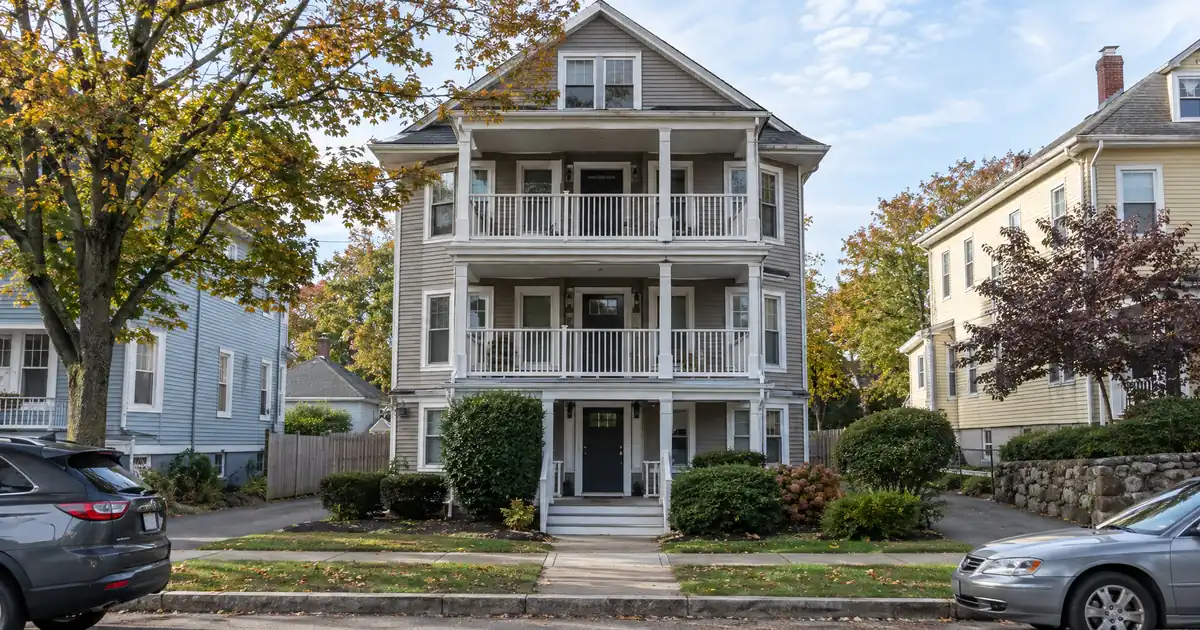
A cash-out in Brockton starts with a ceiling and a rent check. The ceiling is 75 percent of appraised value. The rent check divides the property’s rent used for lender review by its full monthly obligation, which includes principal, interest, taxes, insurance, and any HOA dues. With the citywide median closed price at $525,000 across 377 sales, most Brockton properties land near or below the 1.00 benchmark at maximum leverage. Investors usually end up trading some leverage for coverage.
Lendmire (NMLS# 2371349) works with investors buying or refinancing in Brockton, Massachusetts, helping place DSCR financing across 41 markets, including Washington, D.C. This piece covers the equity-extraction side of the market: what the numbers do at 75 percent, where in the city they hold up, and what the proceeds can fund next.
DSCR Cash-Out Calculator
Run the cash-out numbers in Brockton, MA
Rate source: Freddie Mac 30-yr average via FRED® — Federal Reserve Bank of St. Louis · effective Sep 24, 2026
Prefilled with starting assumptions — enter your property’s value, balance, taxes, and insurance for a more accurate picture.
Program parameters update from Lendmire’s centralized guideline source. Taxes and insurance are editable estimates.
As of Sep 24, 2026 · General Freddie Mac market benchmark, not a Lendmire loan offer. Property value, balance, taxes, and insurance are editable estimates. Maximum loan-to-value varies by lender, program, property type, and seasoning. Not a Loan Estimate, approval, or commitment to lend. Program availability and eligibility are subject to lender guidelines, credit approval, property review, and underwriting.
At a Glance: A Brockton cash-out refinance is underwritten primarily on the property’s rental income measured against its full monthly obligation, then sized to a value-based leverage ceiling after the title-recording seasoning period. Equity here depends on basis and rent support, not on price growth.
- Zillow puts average values near $516,482, up 2.0 percent over the past year.
- Cash-out LTV tops out at 75 percent, with seasoning of about 6 months from title recording.
- Two-bedroom rent sources span $1,945 to $2,194 depending on method.
- Clifton Heights has the lowest multifamily entry band of the neighborhoods profiled below.
- Reserves of about 6 months of PITIA are the typical expectation.
How the 75 Percent Ceiling Plays Out on Brockton Rents
At maximum leverage, Brockton’s rent-to-price ratios rarely clear 1.00 once taxes and insurance are included. That doesn’t kill the strategy. It tells you where to adjust: leverage, rent evidence, or structure.
Here is the mechanism step by step. The lender orders an appraisal and a rent schedule, caps the new loan at 75 percent of value, and then tests the rent against the full monthly carry. Everything below is a modeled assumption, not a sourced result. Each ratio uses full PITIA, with taxes and insurance at Massachusetts-average loadings, and I’ve rounded the figures down.
Run the numbers on a single-family home valued at $525,000 and rented at a modeled $2,600. At 75 percent LTV, the coverage lands around 0.80 including taxes and insurance. That is well short of the 1.00 benchmark that most standard DSCR programs are built around.
Now a two-family at the $789K citywide multifamily median listing price, with two 2BR units at RentCafe’s $2,194 average, so roughly $4,388 a month. That works out to about 0.56 percent rent-to-price. At 75 percent LTV, coverage sits near 0.85 to 0.90. Drop to 60 percent LTV and it moves to roughly 1.0 to 1.05.
Sub-1.00 results aren’t a dead end, but they are a different conversation. Some lenders review sub-1.00 programs, interest-only structures, or lower-leverage requests with stronger compensating factors such as higher reserves or credit. Eligibility depends on lender guidelines, credit profile, reserves, property review, and state overlays. A 1.00 baseline is common because rent covers the payment at that level. It is not a promise of approval.
The two-family’s edge over the single-family isn’t yield. It’s unit count and vacancy tolerance. A vacant unit in a duplex leaves half the rent standing. A vacant single-family leaves none.
Flat Values Mean Equity Comes From Basis
Brockton is cash-flow-led, not appreciation-led. A cash-out here mostly depends on what you paid, what you put in, and how the appraiser sees the street. Market growth contributes little.
The price trail is modest. Zillow shows the average value up 2.0 percent over the past year. Redfin’s 02301 data shows a $525K median, up 4.0 percent, but days on market stretched to 41 from 24 a year earlier. The citywide picture in Redfin’s housing market data was flatter: a late-year median of $503K, up just 0.9 percent, with sales falling to 49 from 58.
The comp spread matters more than the median. Resideline shows the middle half of closings running from $445,000 to $660,000. That is a wide band. Two investors with similar buildings can get appraisals that differ materially depending on the street and the comps the appraiser pulls.
The practical read for an equity-extraction plan: assume values hold roughly flat, plan around the original purchase basis plus documented improvements, and don’t count on market appreciation to expand your LTV capacity. A thin sales pool, with transaction counts falling in both Redfin datasets, makes comp selection the swing factor in the appraisal.
That is the “tension” in this market. Rents are decent relative to basis, but coverage can be thin once taxes and insurance are included. There’s also little appreciation to harvest. Seasoning, about 6 months from title recording, is a calendar step. It does not create equity on its own. Value-add work is the lever that does. The refi options page on cash-out refinance for investment property covers the general mechanics.
Which Rent Number Do You Trust?
Brockton rent sources disagree by enough to change the answer on a duplex. Underwrite to the low end, or to the appraiser’s rent schedule, not to the highest aggregator.
For two-bedrooms, RentCafe’s Yardi Matrix figure is $2,194. Apartments.com puts it at $1,945 in a mid-2025 snapshot. The gap is about $250 a month per unit, roughly $6,000 a year across a duplex. On a duplex that is the difference between a coverage number near 1.05 and one in the low-to-mid 0.9s at 60 percent LTV.
Note the method differences. RentCafe covers only buildings with 50 or more units, so it skews toward newer product. A triple-decker built decades ago may not rent like a 200-unit complex. That argues for caution on the high figure.
Other datapoints: Redfin’s rental page lists an average rent of $1,975, and a May MLS-based snapshot showed 46 active rentals with a $2,692 median asking rent and about 41 days to lease. That last number is a vacancy flag. Six weeks to lease means a vacancy allowance belongs in your own model, and asking rents above roughly $2,700 may sit longer.
On unit mix, Point2Homes data shows 2-bedrooms are the largest share of Brockton rentals at 38 percent, and the biggest rent band, $1,501 to $2,000, covers 49 percent of units. Two-bedroom-per-floor duplexes and triple-deckers match the deepest tenant pool. Units with 5 or more bedrooms are about 1 percent of rentals, so a bi-level large-format unit has thin comps and harder rent support.
Where the Cash-Out Math Is Strongest
Clifton Heights is the best fit for coverage-driven refinancing. Campello is the redevelopment story. Montello is thin and pricey for multifamily. The downtown station core is a long-term demand play with little neighborhood-level price data.
Clifton Heights. Redfin lists a $2,200 median rent here, the only neighborhood-level rent figure the research turned up. Multifamily listings on Homes.com ran $638K to $1.299M in a mid-2025 snapshot across 8 listings. That entry band is far below Montello’s, which gives the rent more purchase-price basis to work against. For an investor who already owns here, lower basis is what makes a 75 percent loan size land closer to coverage. The sample is small and dated, so treat it as direction, not a quote.
Montello. Homes.com reports an average sale price of $486,766 over the last 12 months, with homes selling after about 23 days on the market. Multi-family is common here, including triple-deckers and updated duplexes, per a community-authored neighborhood site. But the multifamily listing band on only 2 listings was $1.249M to $2.099M. With prices that high, rent-to-price likely runs thinner than in Clifton Heights, so a Montello owner may need lower leverage to reach 1.00.
Campello. Redevelopment is moving here. MassHousing reports a $50M financing close for a seven-story, 144-unit first phase of the Campello Apartments redevelopment, on a Main Street campus 0.3 miles from the Campello station. A separate 94-unit transit-oriented development sits adjacent to the station. Reliable neighborhood-level price and rent data wasn’t found, so I’d describe this as an area where investment is building rather than put numbers on it. Existing owners may see appraiser comps shift as new product delivers. That cuts both ways: it can lift value, or add competing supply to rent comps.
Downtown and the commuter rail core. The city’s downtown planning page says the MBTA station provides access to downtown Boston in under 35 minutes and that WB Mason’s world headquarters sits downtown. Tenant demand is commuter-driven. Price data is the gap, so a downtown owner needs a thorough appraisal and rent schedule before sizing proceeds.
Demand Anchors Behind the Rents
Brockton’s tenant base is supported by healthcare, a community college, and rail access to Boston. Census Bureau QuickFacts puts the population at 105,785 on 21.3 square miles, with a median age of 36.8. RentCafe reports 43 percent of households rent (15,312), and Data USA puts the homeownership rate at 57.4 percent.
On the employment side, Signature Healthcare’s Brockton Hospital, founded in 1896, is described as the city’s largest non-governmental employer. The Brockton VA Medical Center and Boston Medical Center – South add to the hospital cluster. No current ranked employer list or verified headcounts were found, so this is a qualitative read of demand stability, not a number.
Massasoit Community College reported 5,684 credit students in the fall, up 18 percent from the prior year, with more than 8,000 enrolling for credit annually. Those students and the hospital workforce are a steady two-bedroom renter pool. For a lender reviewing a cash-out file, long-lease tenants in a dependable job base carry more weight than a hot-market narrative.
Working DSCR brokers see a recurring pattern in older, small-multifamily commuter markets like this one: the rent-to-price ratio looks workable on a listing page, but the file lands below 1.00 once the full monthly obligation is built in at maximum leverage. The files that move forward usually involve a lower requested LTV, a rent schedule conservative enough to survive the appraiser, and reserves documented before the application goes in. Investors who pick the leverage level first and test the rent second tend to rework the request.
What Happens to the Proceeds?
The proceeds only help if the property still covers itself after you pull cash out. Every dollar extracted raises the monthly obligation and lowers the coverage number. That is why the seasoning and reserves requirements matter as much as the 75 percent cap.
The program parameters for lender review typically run like this, subject to lender guidelines and borrower profile:
- Seasoning of about 6 months of ownership from title recording.
- A 1.00 DSCR benchmark on rent used for program review versus PITIA.
- Credit tiers starting at a 620 floor, with better terms commonly tied to 660, 680, and 700.
- Reserves of about 6 months of PITIA, rising to about 9 months above $1,500,000.
- Loan sizes up to $3,000,000 on standard programs, with smaller balances routed through select lenders.
Available equity is not a guaranteed cash figure. It depends on rent used for eligibility review, PITIA, reserves, and the 75 percent ceiling. Properties held in an LLC are subject to lender program eligibility. The mechanics of the ratio itself are covered in Lendmire’s DSCR qualification guidance, and for a comparison with income-based loans, see the guide “Where DSCR and Conventional Diverge”.
The honest question is what the next deal looks like. In a market where values are flat, proceeds work best when they fund a deal that earns more than the extracted equity costs. A sub-1.00 refinance that starves the original property to fund a new one is a stretch. The stronger play might be a smaller extraction on a well-covered building rather than a maximum pull on a thin one. Investors who want to see how this fits a broader plan can compare their refinancing options for investor properties. Investors should verify current local rental rules, taxes, and insurance with qualified local professionals.
DSCR vs. conventional financing
There are two common ways to finance an investment property in Brockton, MA, and they qualify you differently — here’s how investors weigh them.
Why investors choose it
- Qualifies on the property’s rental income — no personal tax returns, W-2s, or pay stubs needed to document income.
- No personal debt-to-income ceiling to clear, so existing mortgages and obligations don’t cap your borrowing the same way.
- Can be closed in an LLC, keeping the property inside a business entity.
- Built for scaling — not held to the limit on number of financed properties that conventional financing applies.
- Underwriting centers on the deal: generally qualifies when the rent covers the payment, a 1.00x coverage ratio being a common baseline (confirmed in underwriting).
- Designed specifically for investment property, including long-term and, where the program allows, short-term rentals.
Where it’s strong
- Often the lowest ongoing financing cost for a buyer who fully qualifies on personal income — a fit for a first property or a cost-first purchase.
Trade-offs for investors
- Requires full personal income documentation and must fit within a debt-to-income limit — salary, existing debts, and other mortgages all count.
- Typically held in your personal name rather than a business entity.
- Caps how many financed properties you can carry, which can become a ceiling as a portfolio grows.
- Evaluates you as a borrower as much as the property, which usually means more paperwork.
How investors usually choose: a first or single property often optimizes for the lowest financing cost; portfolio builders often optimize for leverage, vesting in an LLC, and scaling past conventional caps. The right answer depends on your goals, the property, and current guidelines — both paths run through select lenders in Lendmire’s wholesale network, with eligibility and terms confirmed in underwriting.
To discuss a specific Brockton property, connect with Lendmire or call 828-256-2183. The hub page for Massachusetts DSCR investor loans covers the state-level picture.
Frequently Asked Questions
How do you qualify for a DSCR cash-out refinance in Brockton?
Qualification centers on the property’s rent used for the lender’s review measured against its full monthly obligation, with a 1.00 benchmark common across standard programs. You also need about 6 months of ownership from title recording, a credit score at or above a 620 floor, and about 6 months of PITIA in reserves. Brockton’s rent sources vary widely, so the appraiser’s rent schedule often decides the outcome. All terms are subject to lender guidelines.
What are the requirements for an investment property cash-out loan in Brockton, Massachusetts?
Typical guidance includes a 75 percent LTV ceiling on cash-out, loan amounts up to $3,000,000 on standard programs, and reserves of about 6 months of PITIA (about 9 months above $1,500,000). Manufactured homes, log homes, and barndominiums fall outside these programs. Triple-deckers and two- to four-unit buildings are the most common fit locally. Final eligibility depends on property review and credit approval. Terms vary by lender guidelines, property type, leverage, credit profile, and full file review.
Can a Brockton duplex reach 1.00 coverage on a cash-out?
Often not at 75 percent leverage. In a modeled case at the $789K citywide multifamily median listing price with two 2BR units at RentCafe’s $2,194 average, coverage including taxes and insurance runs roughly 0.85 to 0.90 at 75 percent LTV. It reaches about 1.0 to 1.05 at 60 percent. Using Apartments.com’s lower $1,945 two-bedroom figure drops that into the low-to-mid 0.9s. Options such as sub-1.00 programs or lower leverage may be reviewed, subject to lender guidelines.
Does Brockton’s slow appreciation limit how much equity I can pull out?
Yes. Zillow shows values up only 2.0 percent over the past year, and Redfin’s citywide median was up less than 1 percent in its late-year read. Equity depends mostly on your original basis, any improvements, and appraisal comps. Resideline’s closed-sale spread of $445,000 to $660,000 means appraisal results vary block by block.
What DSCR terms may lenders review for investors in Massachusetts?
Lendmire is a non-QM DSCR mortgage broker (NMLS# 2371349) that arranges investor loans with lenders. Lenders typically review the property’s debt service coverage ratio, which compares the property’s rental income with its housing obligations, along with factors such as loan-to-value, the borrower’s credit profile, and reserves. A key program feature is that review centers on the property’s rental income rather than the borrower’s traditional personal-income documentation. Terms depend on the lender, borrower, and property.
About Lendmire
As a DSCR and non-QM mortgage broker, Lendmire (NMLS# 2371349) connects investors with wholesale lending channels across 41 markets, including Washington, D.C. Financing review centers on the property’s rental income rather than the borrower’s traditional personal-income documentation, which suits self-employed operators and portfolios beyond four financed properties. The firm was recognized by Scotsman Guide as a 2026 Top Workplace and named a 2025 Scotsman Guide Top Mortgage Workplace, details of which appear in the 2026 industry recognition release.
Get Started
Ready to find the right loan for you?
In about 30 seconds you can review financing options available for your investment property. No commitment required.
Informational only. Not a Loan Estimate, approval, or commitment to lend. Program availability and eligibility are subject to lender guidelines, credit approval, property review, and underwriting.
References
1. Resideline – Brockton housing market
2. Zillow — Home Values Brockton MA
4. $789K citywide multifamily median listing price
6. Redfin – Brockton housing market
7. $1,945
8. Redfin — Brockton Rental Market
10. Point2Homes data
11. Homes.com
12. Homes.com — Brockton MA Montello Neighborhood
13. MassHousing – Campello Apartments
14. MassHousing – Brockton South TOD
15. City of Brockton – Transforming Downtown
16. Census Reporter – Brockton city
18. Massasoit Community College
19. recognized by Scotsman Guide as a 2026 Top Workplace
20. a 2025 Scotsman Guide Top Mortgage Workplace
21. EIN Presswire — Lendmire Recognized as a 2026 Top Workplace by Scotsman Guide
This article is part of Lendmire’s investment property cash-out refinance program — full qualification details, guidelines, and scenarios live on the program page.
Related reading: Luxury Rental DSCR Loans In New Jersey · Jersey Shore Vacation Rental Loans: DSCR Financing In Ocean City, Cape May And Long Beach Island · DSCR Cash-out Refinance In New Jersey: Pulling Equity From A Rental
Guides: Investment Property Cash-Out Refinance in Brockton, MA · Investment Property Cash-Out Refinance in Massachusetts
Brandon Miller
Founder & CEO, Mortgage Loan Originator, Lendmire LLC
- Mortgage Loan Originator · NMLS# 1129696 · Verify on NMLS Consumer Access
- North Carolina Real Estate Broker · License# 343312 · Verify on NCREC
- North Carolina Insurance Producer · License# 19053198 · Property, Casualty, Life, Health · Verify on NAIC SBS
- Lendmire LLC · Firm NMLS# 2371349 · Verify firm licensure
Compliance and disclosures. Lendmire (NMLS# 2371349) is a licensed mortgage broker and is not a direct lender, depository institution, financial advisor, or tax professional. Content in this article is general market analysis and educational information — not financial, legal, or tax advice for any specific situation. Lendmire does not guarantee loan approval; every transaction is subject to underwriting by the funding lender. Mortgage pricing and loan program guidelines are subject to change at any time without notice and vary by borrower characteristics, property type, and state regulations. Lendmire complies with Equal Housing Opportunity. Licensure verification: NMLS Consumer Access.