
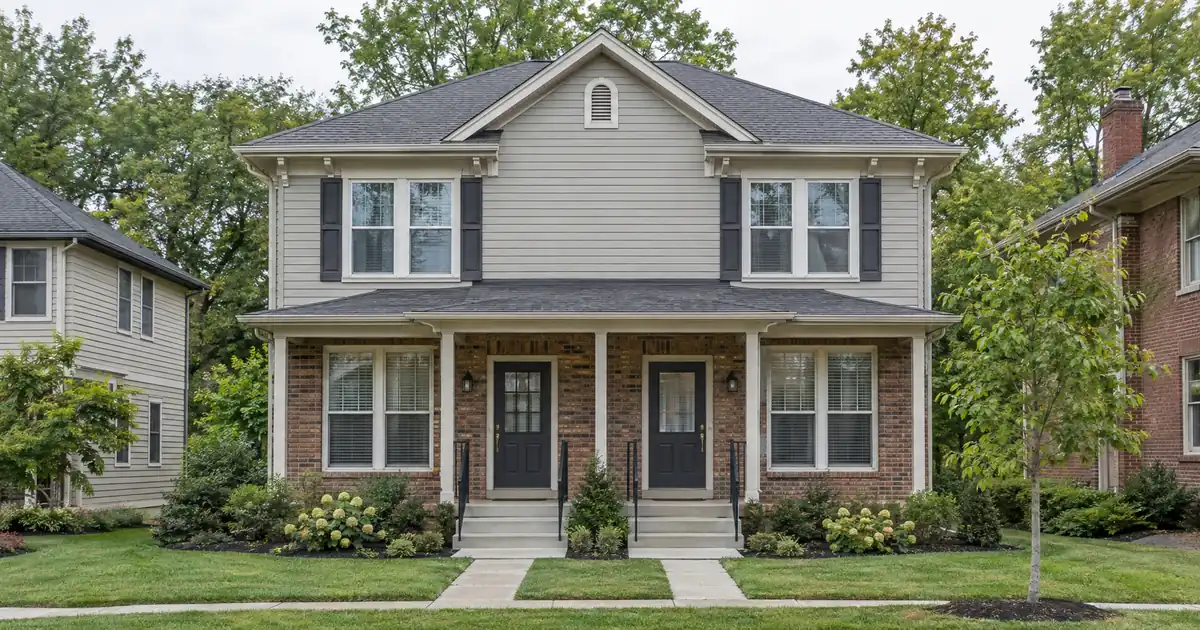
An out-of-state investor scrolling Carmel listings sees a $550K median sale price per Redfin and a corridor the City of Carmel says holds more than 100 corporate headquarters. The pairing looks like a sure thing. For anyone planning a DSCR cash out refinance on a Carmel rental already owned, the real question is how far the rent can carry a loan against that value.
DSCR Cash-Out Calculator
Run the cash-out numbers in Carmel, IN
Rate source: Freddie Mac 30-yr average via FRED® — Federal Reserve Bank of St. Louis · effective Sep 24, 2026
Prefilled with starting assumptions — enter your property’s value, balance, taxes, and insurance for a more accurate picture.
Program parameters update from Lendmire’s centralized guideline source. Taxes and insurance are editable estimates.
As of Sep 24, 2026 · General Freddie Mac market benchmark, not a Lendmire loan offer. Property value, balance, taxes, and insurance are editable estimates. Maximum loan-to-value varies by lender, program, property type, and seasoning. Not a Loan Estimate, approval, or commitment to lend. Program availability and eligibility are subject to lender guidelines, credit approval, property review, and underwriting.
Key Takeaways:
A cash-out refinance on a Carmel, Indiana rental is underwritten primarily on the property’s rental income measured against its full monthly obligation, so the deal works from title-recording seasoning to appraisal to a lender-reviewed coverage ratio, with proceeds capped by a 75 percent loan-to-value ceiling and reserves.
- Single-family at the Redfin median pencils below 1.00 coverage at the 75 percent ceiling.
- Condos average near $392K, the lower-basis option.
- Duplex and small-apartment stock is only 3.48 percent of housing, so multi-unit comps run thin.
- Redfin days on market stretched from 8 to 18, so underwrite to the trend, not the peak.
- Seasoning runs about six months from title recording; reserves about six months of PITIA.
Carmel, Indiana rental property investors can tap DSCR programs that Lendmire arranges, available across 41 markets, including Washington, D.C. Lendmire (NMLS# 2371349) is a DSCR-focused mortgage broker, so lenders in its network, not Lendmire, review eligibility and approve. This report asks what an owner can pull out of a high-priced suburb, and what to watch over the next six to 24 months.
Carmel Market Snapshot
A quick read on the Carmel investor landscape — figures come from the cited sources below. Confirm current property-level numbers before underwriting.
| Metric | Detail |
|---|---|
| Recent appreciation | Appreciation below 70% of indiana cities (NeighborhoodScout Carmel) |
| University enrollment | ~5,300 students (Carmel Clay Schools, Carmel) |
| Population | +8.79% hamilton county population 2020–24 (The Kirkland Company) |
| Employment | 700+ staff (Carmel Clay Schools, Carmel) |
Why Carmel Prices Everything Against Rent
Carmel is an appreciation-led, high-basis market, and coverage is the constraint, not equity. Redfin’s three-month median sits near $550K, while Zumper’s median for all rental types is $2,205. That is roughly 0.4 percent monthly rent-to-price, about 4.8 percent gross annually (Lendmire Research’s own arithmetic from two datasets, not a published ratio).
Price momentum is real. Redfin shows the median up 4.7 percent year over year, with price per square foot at $206, up 12.6 percent. Zillow’s home value index reads higher, at $580,014, up 4.6 percent, which reflects a different methodology. This report uses the Redfin figure throughout.
Rent data is messier than price data. RentCafe puts apartment rents at $1,455 for a one-bedroom, $1,784 for a two-bedroom and $2,155 for a three-bedroom, up 2.98 percent. Zumper shows rents up 9 percent. Zillow’s rental page labels the market “cool” with rent down $375. All three are listing-based snapshots, not appraisal-grade comps, and they point in different directions. Anyone quoting a single “Carmel rent” is guessing (and the sources won’t settle it for them).
The Employment Base Behind the Rents
Carmel’s tenant pool is professional, and that is what supports long-term occupancy even when coverage is tight. The City of Carmel says the Meridian Street Corridor has the second-largest concentration of office workers in Indiana. It names Delta Faucet, Allegion, CNO, MISO Energy, Telamon and NextGear among local headquarters. No verified headcounts for those employers surfaced.
Per Data USA, the largest resident sectors are health care and social assistance at 8,868 people, professional, scientific and technical services at 8,259, and manufacturing at 6,182. Residents may work outside the city. Census Bureau QuickFacts shows about 103,858 residents.
Health systems add steady demand. Ascension St. Vincent Carmel runs a full-service hospital with 24/7 emergency care, and Ascension’s Heart Center is described as Indiana’s largest cardiac surgery program. IU Health North is an 189-bed hospital in Carmel, per PracticeMatch. No college campus in Carmel surfaced, so there is no student-rental angle. Demand here is employer-driven.
Where the Coverage Math Gets Closest
The closest coverage in Carmel comes from lower-basis attached product and the downtown core, not from large single-family homes. NeighborhoodScout shows 69.94 percent of units are single-family detached and 20.77 percent are large apartment complexes. Attached row houses make up 5.58 percent. Duplexes, converted homes and small apartment buildings make up only 3.48 percent.
Carmel City Center and the Arts & Design District. Redfin’s neighborhood page shows a $496K median sale price, up 1.4 percent year over year, with homes selling in about 33 days. That sits below the citywide median but with flatter appreciation. Rent.com puts average one-bedroom rent at $1,602 in City Center and $1,879 in the Arts & Design District. These are apartment averages. The tenant base is young professionals and office workers along the Monon Trail and Meridian corridor.
Home Place and The Retreat condominiums. Rent.com lists one-bedroom averages of $1,767 in Home Place and $1,568 at The Retreat. Condos average about $392K citywide, against a single-family median near $550K. For a cash-out, that lower basis helps. The sub-neighborhood comps are thin.
Old Meridian and Woodland Springs. Old Meridian is the lowest-rent area on Rent.com’s list at $1,105 for a one-bedroom, sitting at the heart of the office concentration. Woodland Springs averages $1,256. Both suggest workforce-level rents near employers, though no verified 2-3 bedroom rents or prices were found at neighborhood level.
Village of West Clay. One-bedroom rent averages $1,399, and the area is luxury subdivisions and large estates. High basis, thin rental depth. Skip it for coverage.
Rent.com’s one-bedroom figures run well apart from RentCafe’s citywide $1,455, a reminder that the aggregators don’t agree.
Run the Numbers: Two Modeled Cash-Out Files
Both scenarios below use modeled assumptions, not cited market facts. Coverage is rent divided by full PITIA, including taxes and insurance.
Single-family near the median. Consider an owner whose house appraises near $550K, with modeled rent between $2,205 (the Zumper median) and $2,499 (the RentHop three-bedroom listing average, a small sample). At the 75 percent ceiling, coverage lands around 0.65 to 0.75, well under the standard 1.00 benchmark. Pulling the loan-to-value to roughly 50 percent moves the same rent to about 0.90 to 1.00. That is the tradeoff: less leverage, smaller proceeds.
Condo near $392K. Run the numbers on a condo at that price with modeled rent of $1,800 to $2,000, close to RentCafe’s two-bedroom average. At 75 percent loan-to-value, coverage runs about 0.75 to 0.85. At 60 percent, it moves to roughly 0.90 to 1.00.
Neither file clears 1.00 at full leverage. Many programs are built around a 1.00 benchmark because rent covers the obligation at that level. Some lenders review sub-1.00 scenarios, but those usually mean lower leverage, different pricing or more reserves, and eligibility depends on lender guidelines, credit and property review. Options a lender may review include a sub-1.00 program, an interest-only structure or a lower-leverage cash-out. Lendmire’s DSCR walkthrough explains how the ratio is built.
Standard parameters help frame it. Cash-out is typically capped at 75 percent loan-to-value, with about six months of seasoning from title recording and credit tiers starting at a 620 floor. Reserves typically run about six months of PITIA, and standard programs go up to $3,000,000. Holding title in an LLC works on many files, subject to lender program eligibility, but a recent title transfer can affect the seasoning clock, so sequence it early. Equity available is never a guaranteed figure. Program details change, so confirm current guidelines before planning around them.
Skip the Peak-Value Appraisal Trap
Lendmire’s deal desk tends to see the same friction in high-basis suburbs like this one: an owner anchors on the strongest recent sale, the appraisal reflects a cooling trend, and the proceeds shrink. The cleaner files start with conservative rent, in-place leases where possible and a fresh insurance quote before submission. The owners who plan around the lower-leverage case usually get fewer surprises. Pulling equity with a DSCR cash-out works best when the owner treats the value as a range.
Redfin shows 312 homes sold in a recent month versus 305 a year earlier, which is deep enough to support comps. But days on market rose from 8 to 18, and monthly city readings swing widely, so use the three-month trend rather than a single spike. For owners comparing cash-out with other routes, it is worth weighing DSCR loans against conventional financing, and a rate-and-term refinance is the main alternative.
What Changes Over the Next 6 to 24 Months
Four indicators decide whether Carmel’s cash-out math improves or tightens. The first is days on market. If the 18-day reading keeps stretching, appraisals soften and the 75 percent ceiling bites on a lower value.
The second is rent direction. Zumper, RentCafe and Zillow disagree on whether Carmel rents are rising or falling, so the number to watch is renewal rents on actual leases. The third is vacancy. The Kirkland Company’s metro report says vacancy has risen above historical norms from new supply, though absorption stayed positive. That covers the Indianapolis metro, not Carmel specifically.
The fourth is demand. The same report says Hamilton County’s population grew 8.79 percent from 2020 to 2024, which supports long-term occupancy. NeighborhoodScout separately ranks Carmel’s latest annual appreciation below 70 percent of Indiana cities, so the price surge is no guarantee.
Here’s the catch: if appreciation cools while rents stay flat, cash-out capacity shrinks from both sides. Owners who season now and refinance at a documented value avoid betting on that outcome. Investors can talk through the numbers or reach Lendmire at 828-256-2183. Investors reviewing Indiana-wide options can start with Lendmire’s Indiana DSCR loan programs.
Frequently Asked Questions
How do you qualify for a DSCR cash-out refinance in Carmel, Indiana?
Qualification centers on the rent-to-PITIA ratio, typically measured against a 1.00 benchmark, plus credit, reserves and seasoning. Typical guidance includes a 620 credit floor, about six months of ownership from title recording and about six months of PITIA in reserves. Final eligibility depends on lender guidelines, credit approval and property review.
DSCR vs. conventional financing
There are two common ways to finance an investment property in Carmel, IN, and they qualify you differently — here’s how investors weigh them.
Why investors choose it
- Qualifies on the property’s rental income — no personal tax returns, W-2s, or pay stubs needed to document income.
- No personal debt-to-income ceiling to clear, so existing mortgages and obligations don’t cap your borrowing the same way.
- Can be closed in an LLC, keeping the property inside a business entity.
- Built for scaling — not held to the limit on number of financed properties that conventional financing applies.
- Underwriting centers on the deal: generally qualifies when the rent covers the payment, a 1.00x coverage ratio being a common baseline (confirmed in underwriting).
- Designed specifically for investment property, including long-term and, where the program allows, short-term rentals.
Where it’s strong
- Often the lowest ongoing financing cost for a buyer who fully qualifies on personal income — a fit for a first property or a cost-first purchase.
Trade-offs for investors
- Requires full personal income documentation and must fit within a debt-to-income limit — salary, existing debts, and other mortgages all count.
- Typically held in your personal name rather than a business entity.
- Caps how many financed properties you can carry, which can become a ceiling as a portfolio grows.
- Evaluates you as a borrower as much as the property, which usually means more paperwork.
How investors usually choose: a first or single property often optimizes for the lowest financing cost; portfolio builders often optimize for leverage, vesting in an LLC, and scaling past conventional caps. The right answer depends on your goals, the property, and current guidelines — both paths run through select lenders in Lendmire’s wholesale network, with eligibility and terms confirmed in underwriting.
What are the requirements for an investment property loan in Carmel, Indiana?
Expect a loan-to-value ceiling of 75 percent on a cash-out, with amounts up to $3,000,000 on standard programs. Manufactured homes, log homes and barndominiums fall outside these programs. Documentation leans on the lease and property income, though specifics vary by program.
Will a single-family rental at Carmel’s median price reach 1.00 coverage?
Usually not at the 75 percent ceiling. Modeled rents of $2,205 to $2,499 against a roughly $550K value produce coverage around 0.65 to 0.75 including taxes and insurance. A lower-leverage cash-out or a sub-1.00 program may be reviewed instead.
Does Carmel have enough duplex stock to support a small-multifamily cash-out?
Only 3.48 percent of Carmel’s housing is duplex or small-apartment stock, so comps are sparse and an appraiser may lean on out-of-area sales. Townhomes and attached homes are the more available lower-basis product. No sourced duplex price band surfaced, so get actual listings and comps before assuming multi-unit clears coverage.
How do DSCR lenders review rental income instead of traditional tax-return income in Indiana?
Lendmire arranges DSCR investor loans, and lenders in its network review eligibility on the property’s lease income against its full monthly obligation. A key program feature is a cash-out ceiling of 75 percent loan-to-value, subject to lender guidelines.
Where the Asymmetry Is
The asymmetric opportunity in Carmel is attached, lower-basis product near the Meridian office corridor, particularly condos and townhomes priced well under the single-family median. The rent still trails price, but the gap is narrower there than in the large-home market. If Carmel’s employer base keeps absorbing new supply, those units can carry a lower-leverage cash-out with better coverage than the $550K house next door.
For current guidelines and terms, see Lendmire’s DSCR loan programs page.
About Lendmire
A DSCR-focused mortgage broker, Lendmire (NMLS# 2371349) places investor financing across 41 markets, 40 states plus Washington, D.C. Lenders generally review DSCR eligibility on property cash flow instead of traditional personal-income documentation, subject to lender guidelines. Scotsman Guide named Lendmire a 2026 Scotsman Guide Top Mortgage Workplace and a top-ranked workplace in 2025.
Get Started
Ready to find the right loan for you?
In about 30 seconds you can review financing options available for your investment property. No commitment required.
Informational only. Not a Loan Estimate, approval, or commitment to lend. Program availability and eligibility are subject to lender guidelines, credit approval, property review, and underwriting.
References
1. Redfin, Carmel housing market
2. City of Carmel Business Resources
4. Carmel Clay Schools, Carmel
5. The Kirkland Company, Indianapolis multifamily report
8. Zumper, Carmel rent research
10. Data USA, Carmel
12. Ascension St. Vincent Carmel
14. PracticeMatch
15. Redfin, Carmel City Center
16. Rent.com
17. a 2026 Scotsman Guide Top Mortgage Workplace
18. Scotsman Guide — Top Workplaces 2025
This article is part of Lendmire’s investment property cash-out refinance program — full qualification details, guidelines, and scenarios live on the program page.
Related reading: Luxury Rental DSCR Loans In New Jersey · Jersey Shore Vacation Rental Loans: DSCR Financing In Ocean City, Cape May And Long Beach Island · DSCR Cash-out Refinance In New Jersey: Pulling Equity From A Rental
Guides: Investment Property Cash-Out Refinance in Carmel, IN · Investment Property Cash-Out Refinance in Indiana
Brandon Miller
Founder & CEO, Mortgage Loan Originator, Lendmire LLC
- Mortgage Loan Originator · NMLS# 1129696 · Verify on NMLS Consumer Access
- North Carolina Real Estate Broker · License# 343312 · Verify on NCREC
- North Carolina Insurance Producer · License# 19053198 · Property, Casualty, Life, Health · Verify on NAIC SBS
- Lendmire LLC · Firm NMLS# 2371349 · Verify firm licensure
Legal disclosures. Lendmire (NMLS# 2371349) is a state-licensed mortgage brokerage that arranges financing through wholesale lender relationships. Lendmire is not a direct lender, depository institution, or registered financial advisor. The discussion above is general informational content about real estate financing — it is not financial, legal, or tax advice, and readers should consult licensed professionals for guidance on their individual circumstances. Loan inquiries are subject to lender underwriting; this article does not represent a commitment to lend. Loan terms, rates, and qualification standards vary by borrower, property, and state, and are subject to change at any time. Equal Housing Opportunity. NMLS Consumer Access: nmlsconsumeraccess.org.