
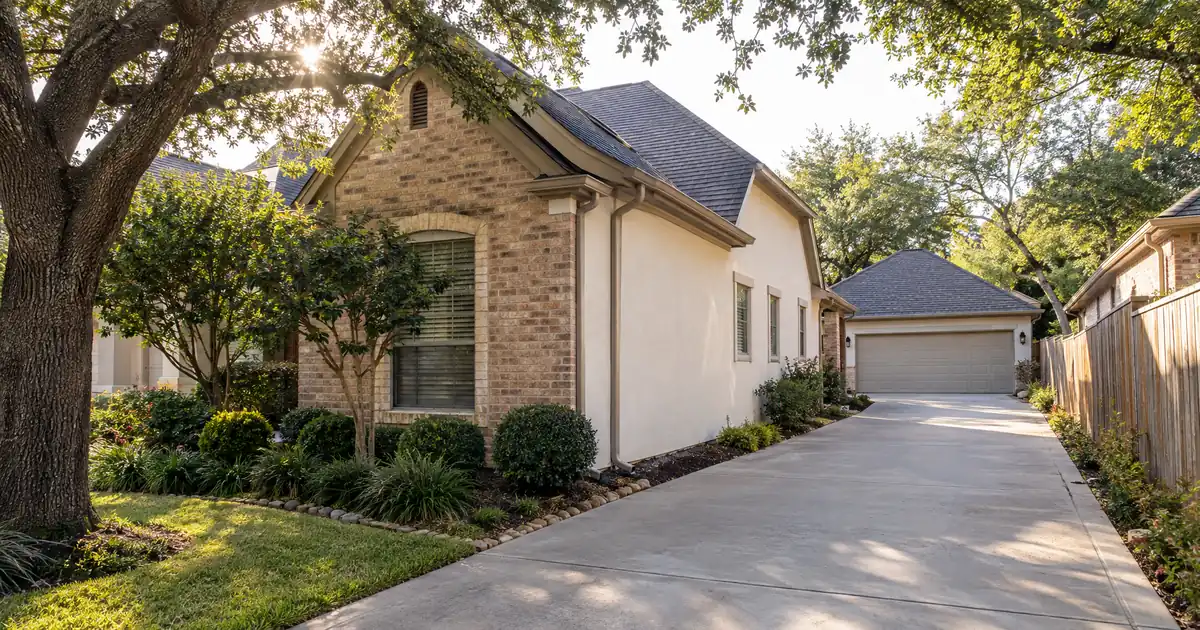
If you own a rental in Carrollton that would appraise near the $420K median sale price, here’s what most brokers skip: the cash-out amount isn’t set by what you paid or by what you hope the neighborhood does next. It’s set by what the property appraises for, the leverage ceiling, and whether the rent covers the full monthly obligation. In a city where prices have drifted lower, that third variable does most of the work.
DSCR Cash-Out Calculator
Run the cash-out numbers in Carrollton, TX
Rate source: Freddie Mac 30-yr average via FRED® — Federal Reserve Bank of St. Louis · effective Sep 24, 2026
Prefilled with starting assumptions — enter your property’s value, balance, taxes, and insurance for a more accurate picture.
Program parameters update from Lendmire’s centralized guideline source. Taxes and insurance are editable estimates.
As of Sep 24, 2026 · General Freddie Mac market benchmark, not a Lendmire loan offer. Property value, balance, taxes, and insurance are editable estimates. Maximum loan-to-value varies by lender, program, property type, and seasoning. Not a Loan Estimate, approval, or commitment to lend. Program availability and eligibility are subject to lender guidelines, credit approval, property review, and underwriting.
The Quick Read:
A DSCR cash-out refinance in Carrollton, Texas is underwritten primarily on the property’s rental income measured against its full monthly obligation, with proceeds capped by a maximum loan-to-value ratio and an appraisal rather than by the owner’s personal income. Eligibility, leverage, and reserves are set by the lender and vary by borrower and property.
- Median sale price sits near $420K, down 2.6% year over year, per Redfin.
- ZIP 75007 three-bedroom rent-to-price runs near 0.63% versus roughly 0.50% in 75010, per Prop:Metrics.
- Cash-out typically tops out at 75% LTV after about six months of ownership.
- Single-house coverage at full cash-out leverage models below 1.00 including taxes and insurance.
- Duplexes through fourplexes are only 6.67% of housing units, per NeighborhoodScout.
Carrollton Market Snapshot
A quick read on the Carrollton investor landscape — figures come from the cited sources below. Confirm current property-level numbers before underwriting.
| Metric | Detail |
|---|---|
| Home prices | $420K median (Redfin, Carrollton housing) |
| Typical rents | $2,200 avg (Prop:Metrics ZIP 75007) |
ZIP 75007 Is Where the Coverage Holds
ZIP 75007 is the stronger cash-out candidate in Carrollton. A three-bedroom there rents at a level that sits comfortably against the area’s median price, giving it a noticeably higher rent-to-price ratio than ZIP 75010, where prices run meaningfully higher for almost identical rent. The side-by-side comparison below shows how the two ZIP codes line up.
| Factor | ZIP 75007 | ZIP 75010 |
|---|---|---|
| Median home price | Meaningfully lower than 75010 | Meaningfully higher than 75007 |
| 3-bedroom rent | ~$2,480 | ~$2,590 |
| 2-bedroom rent | ~$1,850 | ~$1,870 |
| 3BR rent-to-price | ~0.63% | ~0.50% |
| Modeled coverage, 75% LTV | low 0.9s | around 0.7 |
Rent figures come from Prop:Metrics’ 75007 page and its 75010 page, which attribute them to RentCast. The price snapshots are from different months, so treat the ratios as directional and pull current comps before sizing a file. The coverage row is modeled analysis, not sourced data: rent divided by full PITIA (principal, interest, taxes, and insurance) using Texas-average tax and insurance loads.
Rents differ by about $110 a month between the two ZIPs while values differ by roughly a third. The owner in 75010 may hold more absolute equity, but equity is only half the equation. At the same LTV, that higher basis carries a heavier monthly obligation against nearly the same rent. A 75010 owner can often pull more dollars out in theory, yet the coverage ratio is what the lender tests first.
Which ZIP “wins” depends on the goal. An investor maximizing cash proceeds could argue for 75010. An investor who wants a file that clears the coverage test without a lender exception should lean toward 75007.
What Appreciation Won’t Do for You Here
Carrollton is not an appreciation-led cash-out market right now, and the refinance thesis should be built on rent coverage instead. Redfin shows the three-month median at $420K, down 2.6% from a year earlier, with homes averaging 33 days on market and $218 per square foot. Zillow’s home value index lands lower at $409,845, down 3.2%. The gap reflects different methodologies, not a conflict. Both point the same direction.
For an extraction strategy, that has a specific consequence. An owner who bought near the top of the cycle may find the appraisal flat to below the purchase basis, which caps proceeds regardless of how much principal has been paid down. The cleaner candidates are owners with a low original basis, long ownership, or meaningful principal reduction.
Appraisal defensibility is better than the price trend suggests. A brokerage summary built on NTREIS data, from the Dunnican Team, points to a relatively balanced supply picture and homes selling close to asking price. That suggests comps are deep and recent. Treat that as secondary sourcing, though. The same summary describes an older housing stock, so condition matters. Deferred maintenance on an older Carrollton house can cost value at appraisal and draw lender scrutiny before the number ever reaches the coverage test.
How the Cash-Out Math Actually Runs
The mechanics come in four steps: season the property, cap the leverage, test the coverage, and check reserves. Each step can shrink the proceeds, and the order matters.
Step one: seasoning. Most programs look for about six months of ownership, measured from title recording, before a cash-out refinance. An investor who closed on a Carrollton rental a few months ago is not yet eligible, however strong the rent looks.
Step two: the leverage ceiling. Cash-out refinances on investment property are capped at 75% LTV. That differs from the higher purchase-side limit, and the two should never be confused. The 75% applies to the appraised value, so a flat appraisal means a flat ceiling. Every figure here varies by lender and program — guidelines, property type, leverage, and credit profile all apply.
Step three: coverage. DSCR is monthly rent divided by the full monthly obligation. How the qualification works is covered in detail elsewhere, but the short version is that most standard programs are built around a 1.00 benchmark because rent covers the payment at that level. Some lenders will look below 1.00, but that usually requires lower leverage, different pricing, or stronger compensating factors. Eligibility turns on lender guidelines, credit profile, reserves, and property review.
Step four: reserves and credit. Reserves of about six months of PITIA are typical, rising to about nine months on balances above $1,500,000. Credit tiers generally step through 620, 660, 680, and 700, with 620 as the floor. Standard programs go up to $3,000,000, and smaller balances route through select lenders in the network. Program details are subject to change and to lender overlays.
Run the numbers on a modeled Carrollton house. Assume a 75007 property valued at $392K renting for $2,480. Those inputs are illustrative assumptions drawn from the table above, not a specific listing:
- At 75% LTV, modeled coverage including taxes and insurance lands in the low 0.9s.
- At 70% LTV, it sits just under 1.00.
- At 65% LTV, it moves slightly above 1.00.
- Final terms depend on lender guidelines, property type, leverage, and the borrower’s complete credit picture.
This is the part brokers tend to gloss over. On a single three-bedroom house, the maximum cash-out and the cleanest coverage pull in opposite directions. Pulling the full 75% leaves the file under the baseline. Dropping leverage by ten points moves coverage over the line but trims proceeds.
When a scenario lands below 1.00, a few structures may be reviewed: a sub-1.00 program with reduced leverage and added conditions, an interest-only structure that lowers the monthly obligation, or a smaller cash-out request. Whether any of them applies depends on the lender, credit approval, and property review. Equity available is never a fixed cash figure. It’s the product of rent used for lender review, the full obligation, reserves, and the 75% ceiling working together.
Lendmire’s team sees this pattern often in markets with soft prices and mid-range rents. The common friction point is an owner who sizes the request off the 75% ceiling and then discovers coverage is the binding constraint. The cleaner files tend to start from the coverage number and work backward to a leverage level, rather than starting from a desired cash figure. Owners who want to see where their own file lands can review my scenario before committing to a number.
Small Multifamily: Better Coverage, Thinner Comps
Duplexes, triplexes, and fourplexes carry far better coverage per dollar of value, but Carrollton has very little of them. Per NeighborhoodScout, about 6.67% of housing units are duplexes, converted homes, or small apartment buildings. Another 29.37% sit in large complexes and 58.95% are single-family detached.
The rent arithmetic favors multi-unit. Two-bedroom rents run about $1,850 to $1,870 across the two main ZIPs, so four of them gross roughly $7,400 to $7,500 a month. That is about three times a single three-bedroom’s rent. Run the logic forward: a fourplex only needs to trade for less than roughly three times a comparable single-family house to beat its coverage. No fourplex-specific price data surfaced in the research, so that breakeven is a framework, not a quote.
Thin supply is the catch, and it cuts two ways. Few small multifamily buildings means few appraisal comps, which raises the risk of a valuation that arrives conservative, and the 75% ceiling applies to that number. At the same time, the owner who holds one has little local small-building competition. Most of the renter competition is large-complex apartments, which brings the next section into focus.
North Carrollton and the Concession Problem
Competition from new apartments is concentrated in specific pockets, and it’s the main risk to rent assumptions here. Underwrite north Carrollton rents conservatively.
The Trinity Mills Station area is the clearest example. The city describes the EVIVA project as roughly 430 multifamily units and live-work spaces on a transit-oriented site served by DART’s Green Line and the DCTA A-train. That is institutional-grade product competing for the same tenants as small-scale landlords nearby.
More is coming. Northmarq reports that Allen/McKinney, Frisco, and The Colony/Far North Carrollton together account for about one-third of expected DFW deliveries. Multi-Housing News reports a 370-unit NRP community near I-35E and the George Bush Turnpike, scheduled to finish by the end of the year. The Dallas Fed cautions that Texas markets face lingering headwinds from elevated supply and continued discounting.
The numbers show up in rents. RentCafe puts average rent at $1,569, down 3.25% from $1,622 a year earlier, though its data covers buildings with 50 or more units. Discounting at that scale pulls on older small properties nearby.
Here’s why it matters for a refinance. Where a lender uses market rent rather than the in-place lease, a concession-driven drop in comparable rents flows straight into the coverage number. An owner near the new deliveries should model rents a notch below current leases. The older stock in 75007, farther from the new product, has less exposure.
Why Do Tenants Keep Showing Up in a Flat-Price Market?
Because Carrollton’s demand rests on employment, not a campus or a single employer. Data Commons puts the population at 134,562, and the U.S. Census Bureau is the official cross-check. The city sits across Dallas, Denton, and Collin counties. Carrollton’s economic development office describes an economy anchored by advanced manufacturing, professional and technical services, logistics and distribution, healthcare, and corporate headquarters operations.
No verified employer headcounts surfaced. The city’s top-employers table is sourced to direct company contact, but the figures didn’t load in research, so this analysis stays qualitative. Named anchors include Baylor Scott & White Health, which operates the hospital in town, and Carrollton-Farmers Branch ISD. The Valwood industrial area and the I-35E corridor supply logistics and manufacturing jobs, which tend to support steady workforce housing demand. No college campus or enrollment figure was found in Carrollton itself, so this is an employer-driven market.
Household income adds context. ACS data via Every City in the USA shows a median household income of $101,396, against a national median of $77,719. About 42% of households rent, leaving a large owner-occupied base and a rental pool that is meaningful but not dominant.
DSCR vs. conventional financing
There are two common ways to finance an investment property in Carrollton, TX, and they qualify you differently — here’s how investors weigh them.
Why investors choose it
- Qualifies on the property’s rental income — no personal tax returns, W-2s, or pay stubs needed to document income.
- No personal debt-to-income ceiling to clear, so existing mortgages and obligations don’t cap your borrowing the same way.
- Can be closed in an LLC, keeping the property inside a business entity.
- Built for scaling — not held to the limit on number of financed properties that conventional financing applies.
- Underwriting centers on the deal: generally qualifies when the rent covers the payment, a 1.00x coverage ratio being a common baseline (confirmed in underwriting).
- Designed specifically for investment property, including long-term and, where the program allows, short-term rentals.
Where it’s strong
- Often the lowest ongoing financing cost for a buyer who fully qualifies on personal income — a fit for a first property or a cost-first purchase.
Trade-offs for investors
- Requires full personal income documentation and must fit within a debt-to-income limit — salary, existing debts, and other mortgages all count.
- Typically held in your personal name rather than a business entity.
- Caps how many financed properties you can carry, which can become a ceiling as a portfolio grows.
- Evaluates you as a borrower as much as the property, which usually means more paperwork.
How investors usually choose: a first or single property often optimizes for the lowest financing cost; portfolio builders often optimize for leverage, vesting in an LLC, and scaling past conventional caps. The right answer depends on your goals, the property, and current guidelines — both paths run through select lenders in Lendmire’s wholesale network, with eligibility and terms confirmed in underwriting.
None of this produces rent spikes. It produces steadiness, and for a cash-out refinance on a long hold, steadiness is the point.
Recycling the Proceeds
Equity extraction only matters if the capital goes somewhere. The logic is straightforward: use proceeds as the down payment on the next acquisition, where the purchase-side coverage math is tested on its own merits. Carrollton’s own numbers suggest a split strategy. Hold the 75007 house at moderate leverage for stability, and point the proceeds toward product with stronger rent-to-price ratios, potentially small multifamily if comps can be found.
Owners comparing structures can read about refinance options for investors and Lendmire’s DSCR cash-out refinance. For a one-line comparison of income documentation, see conventional vs DSCR on investor loans. Statewide context lives on the Texas DSCR financing page. LLC-held rentals are common among investors with several doors, subject to program terms. Anyone weighing a specific property can call 828-256-2183.
Before sizing any file, verify current local rental rules, property taxes, and insurance costs with qualified local professionals.
Frequently Asked Questions
How do you qualify for a DSCR loan in Carrollton, Texas?
Qualification centers on the property’s rent relative to its full monthly obligation, plus credit, reserves, and leverage. On most files the lender looks for a coverage ratio around 1.00 or better, a credit score of at least 620, and about six months of PITIA in reserves. A Carrollton single-family rental renting near the ZIP medians will often need reduced leverage to reach that baseline. Final eligibility depends on lender guidelines and property review.
What are the requirements for a cash-out refinance on an investment property in Carrollton, Texas?
Typical requirements include about six months of ownership measured from title recording, a maximum 75% LTV on the appraised value, and a minimum 1.00 coverage ratio. Reserves of about six months of PITIA are standard, and loan size runs up to $3,000,000 on standard programs. Appraisals in Carrollton may land near asking given the 97.7% close-to-list ratio, but older homes can face condition adjustments. All terms are subject to lender overlays. These specifics are subject to lender guidelines and a full review of property, leverage, and credit.
How much equity can an owner pull from a Carrollton rental when prices have softened?
Less than the headline LTV suggests. The 75% ceiling applies to the new appraisal, and with the median sale price down 2.6% year over year, owners with a recent high-price purchase may see little room. Owners with older, lower-basis holdings fare better. Coverage can also constrain proceeds: a single house at the full ceiling may model below 1.00, which pushes the request toward lower leverage.
Which Carrollton ZIP code gives the better coverage ratio?
ZIP 75007 does, by a clear margin. Its three-bedroom rent-to-price ratio runs near 0.63% against roughly 0.50% in 75010, because 75010 prices sit about $130K higher for nearly the same rent. Those figures mix data months, so recheck current rent and sale comps before sizing a loan.
Carrollton Against the Northern Suburbs
The math favors Carrollton’s older 75007 stock over the heavily supplied northern suburbs. Allen/McKinney and Frisco carry the biggest share of the delivery pipeline, and concessions there will weigh on rents longer. Carrollton’s price softness and nearby pockets of new supply are real, but an owner who underwrites at moderate leverage and holds the older, rent-supported product has the cleaner coverage story right now.
For current guidelines and terms, see Lendmire’s DSCR loan programs page.
About Lendmire
Lendmire (NMLS# 2371349) is a DSCR and non-QM mortgage brokerage with investor loan programs across 41 markets, Washington, D.C. included. Lenders commonly review DSCR eligibility around the property’s rental income rather than personal income documentation, subject to lender guidelines, and the brokerage helps arrange financing for LLC-owned portfolios beyond conventional financed-property limits. Lendmire has been recognized as a 2025 Scotsman Guide Top Mortgage Workplace and a 2026 Scotsman Guide Top Mortgage Workplace.
Get Started
Ready to find the right loan for you?
In about 30 seconds you can review financing options available for your investment property. No commitment required.
Informational only. Not a Loan Estimate, approval, or commitment to lend. Program availability and eligibility are subject to lender guidelines, credit approval, property review, and underwriting.
References
1. Redfin, Carrollton housing market
3. NeighborhoodScout, Carrollton real estate
5. Zillow Home Values, Carrollton
6. City of Carrollton, EVIVA news release
7. Northmarq, DFW multifamily insights
8. Multi-Housing News, NRP Group
9. Dallas Fed, Southwest Economy
10. RentCafe, Carrollton average rent
13. City of Carrollton Economic Development, Key Industries
14. Baylor Scott & White Health
15. Every City in the USA, Carrollton
16. a 2025 Scotsman Guide Top Mortgage Workplace
17. a 2026 Scotsman Guide Top Mortgage Workplace
This article is part of Lendmire’s investment property cash-out refinance program — full qualification details, guidelines, and scenarios live on the program page.
Related reading: Cash Out Refinance on Investment Property in Carrollton TX · DSCR Cash Out Refinance in Carrollton, Georgia: The 2026 DSCR Financing Guide to the UWG Corridor · DSCR Cash Out Refinance in Conroe, Texas: How the Rent Math Clears at 75% LTV Here
Guides: Investment Property Cash-Out Refinance in Carrollton, TX · Investment Property Cash-Out Refinance in Texas
Brandon Miller
Founder & CEO, Mortgage Loan Originator, Lendmire LLC
- Mortgage Loan Originator · NMLS# 1129696 · Verify on NMLS Consumer Access
- North Carolina Real Estate Broker · License# 343312 · Verify on NCREC
- North Carolina Insurance Producer · License# 19053198 · Property, Casualty, Life, Health · Verify on NAIC SBS
- Lendmire LLC · Firm NMLS# 2371349 · Verify firm licensure
Disclosures. The information presented in this article is general market commentary, not financial, legal, or tax advice. Lendmire is a mortgage brokerage (NMLS# 2371349) — not a direct lender or depository institution — and loan placement is subject to lender underwriting. Nothing in this content represents a commitment to lend. Loan terms, pricing, and program availability vary based on borrower qualifications, property characteristics, and state of subject property, and are subject to change at any time. Lendmire complies with Equal Housing Opportunity requirements. Consumer access: nmlsconsumeraccess.org.