
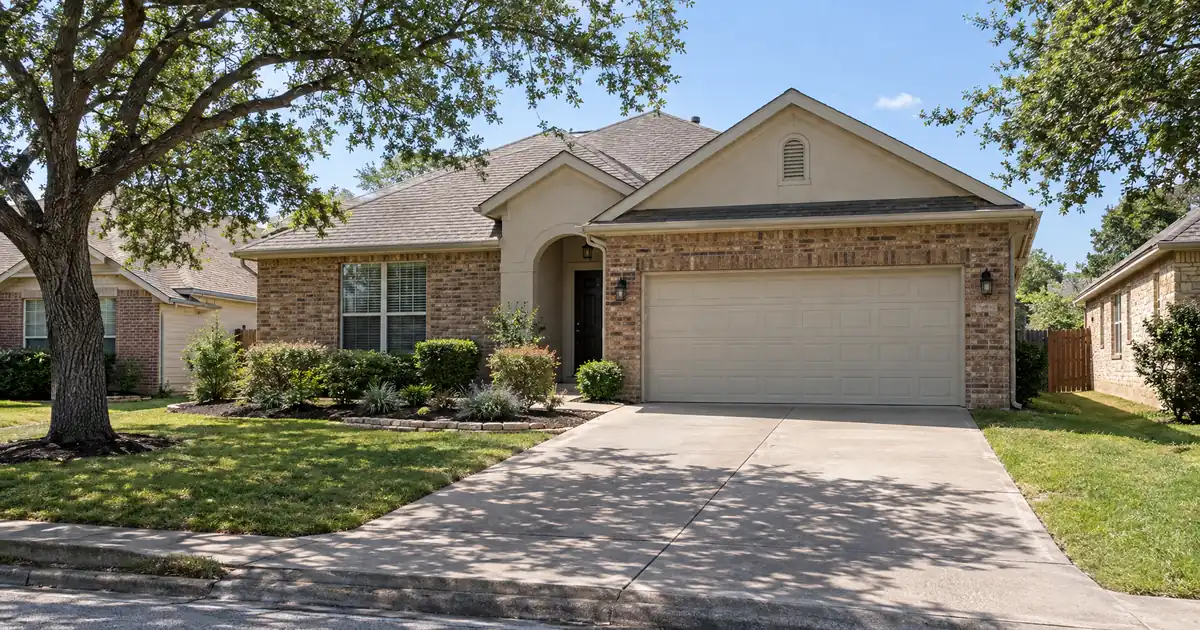
Picture an investor holding a three-bedroom in Block House Creek, bought near $360,000 and rented without drama. The plan is a DSCR cash-out refinance in Cedar Park to pull equity and fund the next property. The appraisal lands, the lender sets rent against the full monthly obligation, and the investor learns the two things that matter here: how much equity is really there, and whether the rent can carry the bigger loan. Neither answer is automatic in this market.
At a Glance: A DSCR cash-out refinance in Cedar Park, Texas starts with an appraisal and rent schedule, then moves to lender review of the property’s rental income against its full monthly obligation, a 75 percent LTV ceiling, about six months of title seasoning, and reserves before any proceeds are released.
DSCR Cash-Out Calculator
Run the cash-out numbers in Cedar Park, TX
Rate source: Freddie Mac 30-yr average via FRED® — Federal Reserve Bank of St. Louis · effective Sep 24, 2026
Prefilled with starting assumptions — enter your property’s value, balance, taxes, and insurance for a more accurate picture.
Program parameters update from Lendmire’s centralized guideline source. Taxes and insurance are editable estimates.
As of Sep 24, 2026 · General Freddie Mac market benchmark, not a Lendmire loan offer. Property value, balance, taxes, and insurance are editable estimates. Maximum loan-to-value varies by lender, program, property type, and seasoning. Not a Loan Estimate, approval, or commitment to lend. Program availability and eligibility are subject to lender guidelines, credit approval, property review, and underwriting.
- Typical home value is $461,620, down 3.6 percent year over year, per Zillow.
- Apartment vacancy reached 14.1 percent, per CoStar data in The Real Deal.
- Full-PITIA coverage at 75 percent leverage often lands below 1.00x on single-family rents.
- Cash-out is capped at 75 percent LTV after about six months of ownership.
Lendmire (NMLS# 2371349) works with investors buying or refinancing in Cedar Park, Texas, helping place DSCR financing across 41 markets, including Washington, D.C. The brokerage’s Texas DSCR platform covers the state-level program picture. This piece stays on the equity side: what Cedar Park properties can realistically release, and what the file looks like when they do.
Cedar Park Isn’t an Appreciation Story Right Now
Cash-out proceeds in Cedar Park depend on today’s appraisal, not hoped-for gains. Zillow shows a typical value of $461,620, down 3.6 percent over the past year, with about 49 days to pending. Homegrity, citing Zillow data, shows values down 10.6 percent over five years.
Other yardsticks run higher. Data USA reports a Census-based median property value of $513,600, a different method that captures the owner-occupied stock as a whole. Redfin’s housing data showed a $450,000 median sale price, down 11.8 percent year over year, with homes selling in about 62 days and roughly 3 percent below list. That Redfin snapshot is dated, so treat it as direction, not a current print.
The takeaway is blunt. An investor who bought near the peak may have little to pull. An investor who bought years earlier, or picked up older stock at a discount, has a real shot at meaningful proceeds. Appraisers lean on recent comps, and the recent comps are soft. Model a conservative value, then decide whether the cash-out still makes sense.
Run the Coverage Math Before You Apply
Coverage is where Cedar Park gets tough. A DSCR ratio is monthly rent divided by the full monthly obligation: principal, interest, taxes, insurance and any HOA dues. Most standard programs use 1.00x as the baseline, though some lenders review lower ratios with compensating factors, subject to lender guidelines. For a refresher, see Lendmire’s DSCR walkthrough.
The rent inputs disagree depending on property type. Rentometer lists three-bedroom rents at $2,098 and four-plus-bedroom rents at $2,746 (listing-based, mid-August data). RentCafe reports an apartment average of $1,415, down 5.15 percent, and $1,946 for three-bedroom apartments. That covers only buildings with 50-plus units, so it understates single-family rents. Zillow’s index, via Homegrity, shows $1,727, up 2 percent. Use the appraiser’s rent schedule, not any single index.
Now run the numbers on a modeled case. These are assumptions, not sourced market data: a house valued at $360,000, rent of $2,098, a 30-year amortizing loan, and taxes and insurance at typical Texas levels.
- At 75 percent LTV: coverage lands around 0.85x including taxes and insurance.
- At 60 percent LTV: coverage lands around 1.0x.
Lower leverage fixes the ratio but shrinks proceeds. That is the Cedar Park tradeoff in one line.
DSCR files in markets like this one typically look a certain way. Appraised value comes in a notch below the owner’s expectation, and rents are solid but not strong enough to carry maximum leverage. The files that hold together usually pick a leverage tier after seeing the rent schedule, not before. They also carry a documented insurance quote and reserves staged in advance.
When a file lands below 1.00x on long-term rent, the paths a lender may review include a sub-1.00 program, an interest-only structure, or a lower-leverage cash-out. Any of them depends on credit, reserves, property review and lender guidelines. Pricing and leverage usually tighten as coverage drops.
Where the Numbers Hold Up (and Where They Don’t)
The lower-priced, older stock pencils best. Block House Creek is the clearest example in the research. Homes.com lists a single-family median of $360,000 there against a citywide $527,500. Redfin’s older rent page also shows Block House Creek at the lowest median rent among nine listed neighborhoods. Price drops faster than rent as you move down-market, so coverage clears more easily. Those two datapoints come from different sources and dates, so read them as directional, not as a computed yield.
Older stock near Bell Boulevard, including Buttercup Creek, trades at a discount to newer product north of Whitestone and in Avery Ranch, according to local broker commentary. That cuts both ways. A lower basis helps coverage, but thinner equity cushions and appraisal variance need a closer look.
Skip Twin Creeks for cash flow. Homes.com puts its single-family median at $850,000, and rent doesn’t scale with price. The cash-out proceeds look attractive on paper, but coverage at 75 percent leverage gets worse, not better. Same story for premium pockets like Ranch at Brushy Creek and Avery Ranch: strong rents, stronger prices, thin coverage.
One caution deserves its own line. Apartment vacancy hit 14.1 percent, per The Real Deal citing CoStar, the first decline since 2021. A 194-unit Bell District project is still in the pipeline. Concessions at the apartment level pressure single-family landlords too, so underwrite a real vacancy allowance. Per RentCafe, only 33 percent of households rent, and 28 percent of rentals are single-family against 44 percent in small complexes. You compete with a deep, familiar product.
The Tenant Base Is Why You Hold
Cedar Park’s rental case rests on employment, not appreciation. The City of Cedar Park reports a population near 83,159 and a median age of 34.74. The Cedar Park EDC says local businesses employ over 40,000 people, with the Dell and Apple campuses 10 minutes away. Data USA shows Professional, Scientific and Technical Services as the largest industry at 6,866 workers, ahead of Retail Trade at 4,846 and Health Care at 4,166. Average commute time is 25.5 minutes.
Austin Community College’s Cypress Creek campus adds a student and staff base in town. The EDC puts enrollment there above 4,500. Aerospace suppliers, additive manufacturing and a medical center anchored by Cedar Park Regional round out the picture. This is a stable, job-driven tenant pool, which supports holding the asset through a soft pricing stretch.
Seasoning, Proceeds and the Next Deal
The mechanics are simple. Cash-out on an investment property is capped at 75 percent LTV, with about six months of ownership measured from title recording. Reserves typically run about six months of PITIA, and credit tiers generally start from a 620 floor. Standard programs reach loan amounts up to $3,000,000, with smaller balances routed through select lenders. LLC-titled properties can work, subject to lender program eligibility.
Equity available is not a guaranteed figure. It depends on rent used for lender review, the full monthly obligation, reserves and that 75 percent ceiling. Lendmire’s cash-out refinance walkthrough covers the sequence in more detail, and the refinancing options page covers rate-and-term alternatives. DSCR loans differ from conventional financing, which underwrites on personal income.
Proceeds become capital for the next acquisition. In Cedar Park that often means recycling equity from a seasoned rental into lower-basis stock where coverage clears with more cushion. Before committing, verify current local rental rules, taxes and insurance with qualified local professionals. Questions about a specific file can go to Lendmire at 828-256-2183.
The Real Choice
Take the cash-out now and accept a lower leverage tier, say around 60 percent LTV, so coverage clears near 1.0x. You get smaller proceeds but a cleaner file and a loan the rent actually carries. Or hold and wait for rents to firm or values to recover, keeping your existing loan but leaving equity idle while softer pricing and apartment supply play out. Both are defensible. Neither is free.
Frequently Asked Questions
How do you qualify for a DSCR cash-out refinance in Cedar Park, Texas?
Qualification centers on the property’s rent compared with its full monthly obligation, with 1.00x as the common benchmark. Lenders also review credit (tiers generally start from a 620 floor), reserves of about six months PITIA, and an appraisal. Exact eligibility depends on lender guidelines and the specific property.
DSCR vs. conventional financing
There are two common ways to finance an investment property in Cedar Park, TX, and they qualify you differently — here’s how investors weigh them.
Why investors choose it
- Qualifies on the property’s rental income — no personal tax returns, W-2s, or pay stubs needed to document income.
- No personal debt-to-income ceiling to clear, so existing mortgages and obligations don’t cap your borrowing the same way.
- Can be closed in an LLC, keeping the property inside a business entity.
- Built for scaling — not held to the limit on number of financed properties that conventional financing applies.
- Underwriting centers on the deal: generally qualifies when the rent covers the payment, a 1.00x coverage ratio being a common baseline (confirmed in underwriting).
- Designed specifically for investment property, including long-term and, where the program allows, short-term rentals.
Where it’s strong
- Often the lowest ongoing financing cost for a buyer who fully qualifies on personal income — a fit for a first property or a cost-first purchase.
Trade-offs for investors
- Requires full personal income documentation and must fit within a debt-to-income limit — salary, existing debts, and other mortgages all count.
- Typically held in your personal name rather than a business entity.
- Caps how many financed properties you can carry, which can become a ceiling as a portfolio grows.
- Evaluates you as a borrower as much as the property, which usually means more paperwork.
How investors usually choose: a first or single property often optimizes for the lowest financing cost; portfolio builders often optimize for leverage, vesting in an LLC, and scaling past conventional caps. The right answer depends on your goals, the property, and current guidelines — both paths run through select lenders in Lendmire’s wholesale network, with eligibility and terms confirmed in underwriting.
What are the requirements for an investment property loan in Cedar Park, Texas?
For cash-out, expect about six months of ownership from title recording, a maximum 75 percent LTV, reserves of about six months, and a rent schedule from the appraiser. Manufactured homes, log homes and barndominiums fall outside these programs. Requirements vary by borrower, property and lender.
Is Cedar Park a good place to pull equity when prices are falling?
It depends on when you bought. Zillow shows values down 3.6 percent over the past year and 10.6 percent over five, so recent buyers may have little equity. Longer-held or discounted older stock is where proceeds can still be meaningful. Model a conservative appraisal first.
Which rent figure should I trust for Cedar Park coverage?
For single-family DSCR, lean on the appraiser’s rent schedule and three- or four-bedroom listing data. RentCafe’s apartment average of $1,415 covers only larger buildings and runs lower than house rents. Zillow’s index of $1,727 blends property types. No single index replaces a property-level rent check.
Can Lendmire help arrange DSCR financing for investment properties in Cedar Park?
Yes. Lendmire is a DSCR-focused mortgage broker with investor programs. Cash-out refinances are reviewed primarily on property rent, subject to lender guidelines.
For current guidelines and terms, see Lendmire’s DSCR loan programs page.
About Lendmire
Lendmire, NMLS# 2371349, is a DSCR and non-QM mortgage brokerage with investor loan programs in 41 markets, including Washington, D.C. Lenders commonly review DSCR eligibility around property-level rent rather than personal income documentation, subject to lender guidelines. The brokerage helps arrange financing for LLC-owned portfolios beyond conventional financed-property limits. Lendmire was recognized by Scotsman Guide as a 2026 Top Workplace and was a 2025 Scotsman Guide Top Workplace.
Get Started
Ready to find the right loan for you?
In about 30 seconds you can review financing options available for your investment property. No commitment required.
Informational only. Not a Loan Estimate, approval, or commitment to lend. Program availability and eligibility are subject to lender guidelines, credit approval, property review, and underwriting.
References
1. Zillow – Cedar Park Home Values
2. The Real Deal – Cedar Park apartments
3. Homegrity
6. Rentometer
7. RentCafe
8. Homes.com
9. RentCafe
10. City of Cedar Park – Residents
11. Cedar Park EDC – Key Industries
12. Austin Community College – Campuses
13. recognized by Scotsman Guide as a 2026 Top Workplace
14. a 2025 Scotsman Guide Top Workplace
This article is part of Lendmire’s investment property cash-out refinance program — full qualification details, guidelines, and scenarios live on the program page.
Related reading: Cash Out Refinance on Investment Property in Cedar Park TX · DSCR Cash Out Refinance in Mesquite, Texas: Pulling Equity From Workforce Rentals · DSCR Cash Out Refinance in Richardson, Texas: The 2026 DSCR Financing Guide to Telecom Corridor
Guides: Investment Property Cash-Out Refinance in Cedar Park, TX · Investment Property Cash-Out Refinance in Texas
Brandon Miller
Founder & CEO, Mortgage Loan Originator, Lendmire LLC
- Mortgage Loan Originator · NMLS# 1129696 · Verify on NMLS Consumer Access
- North Carolina Real Estate Broker · License# 343312 · Verify on NCREC
- North Carolina Insurance Producer · License# 19053198 · Property, Casualty, Life, Health · Verify on NAIC SBS
- Lendmire LLC · Firm NMLS# 2371349 · Verify firm licensure
Required disclosures. Lendmire (NMLS# 2371349) operates as a licensed mortgage broker, not a direct lender or depository. The discussion in this article is general in nature and should not be relied upon as financial, legal, or tax advice — every investment scenario is unique and should be reviewed by a qualified professional. Any loan inquiry is subject to lender underwriting, and this article is not a commitment to lend or a guarantee of approval. Mortgage rates, loan terms, and program guidelines vary by borrower, property, and state, and may change without notice. Equal Housing Opportunity. Verify licensure at NMLS Consumer Access.