
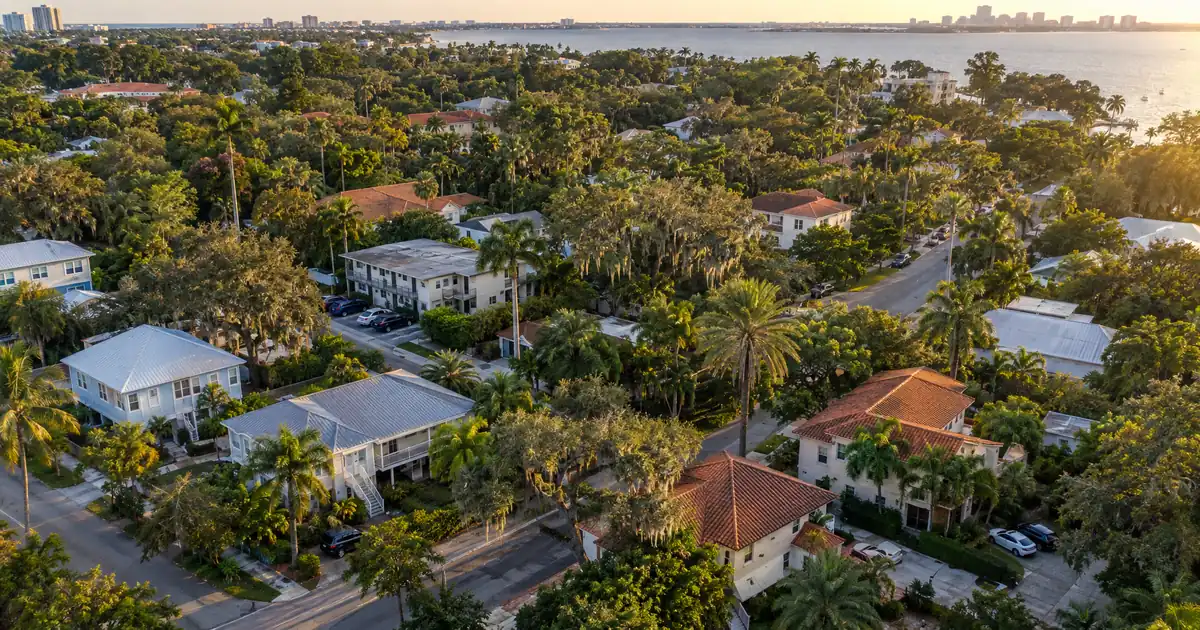
The coverage number on a Coconut Grove cash-out is set by two inputs that barely talk to each other: what an appraiser says the property is worth, and what a tenant will actually pay. At a 75 percent loan-to-value ceiling, the first sets the loan size and the second has to carry it, taxes and insurance included. Per Realtor.com figures summarized by Team Citron Miami, sub-neighborhood medians run from $649,500 in Sailboat Bay to $1,948,500 in Grove Center. That is a threefold spread inside one ZIP code, and it decides which Grove properties can turn appreciation into usable capital and which can’t.
DSCR Cash-Out Calculator
Run the cash-out numbers in Coconut Grove, FL
Rate source: Freddie Mac 30-yr average via FRED® — Federal Reserve Bank of St. Louis · effective Sep 24, 2026
Prefilled with starting assumptions — enter your property’s value, balance, taxes, and insurance for a more accurate picture.
Program parameters update from Lendmire’s centralized guideline source. Taxes and insurance are editable estimates.
As of Sep 24, 2026 · General Freddie Mac market benchmark, not a Lendmire loan offer. Property value, balance, taxes, and insurance are editable estimates. Maximum loan-to-value varies by lender, program, property type, and seasoning. Not a Loan Estimate, approval, or commitment to lend. Program availability and eligibility are subject to lender guidelines, credit approval, property review, and underwriting.
The Quick Read:
A cash-out refinance on a Coconut Grove, Florida rental is underwritten primarily on the property’s rental income measured against its full monthly obligation. The loan-to-value ceiling, applied to appraised value, decides how much equity comes out. That makes the rent-to-value gap between Grove submarkets the variable that matters most.
- Entry-price pockets like Sailboat Bay sit near $649,500, per Realtor.com via Team Citron.
- Near-$2 million Grove Center pricing pushes coverage far below 1.00 on rent alone.
- Cash-out typically requires about six months of ownership, measured from title recording.
- Miami metro multifamily vacancy sat at 6.6 percent, per Miami REALTORS.
- Older condo stock carries 10.9 months of supply, which can soften appraisals.
Coconut Grove Market Snapshot
A quick read on the Coconut Grove investor landscape — figures come from the cited sources below. Confirm current property-level numbers before underwriting.
| Metric | Detail |
|---|---|
| Home prices | $2.85M median (3 months) (Redfin: Coconut Grove Housing) |
| Typical rents | $2,660 asking rent (May 2026) (Miami REALTORS: South Florida) |
| Recent appreciation | +50.5% median (David Siddons Group Q1 2026) |
| University enrollment | 20,104 students (University of Miami) |
| Population | 22,053 population (Niche: Coconut Grove) |
| Employment | 18,003 staff (University of Miami) |
West Grove: Small Units on High Ground
West Grove is the strongest small-multifamily thesis in the neighborhood, and it is the only Grove submarket where stacking unit-level rents plausibly offsets land prices. It is the oldest continuously inhabited neighborhood in Miami-Dade County. It also sits on the Miami Rock Ridge, which WLRN reports averages nine feet above sea level, about three feet above Miami’s average. That elevation is drawing developers.
The pipeline is large. Coconut Grove Spotlight reports two high-rises with 795 apartments planned along Douglas Road. WLRN also describes a 345-unit Gallery in the Grove project that includes 62 workforce units. Large cube homes are replacing the historic small bungalows. For an existing owner of a duplex, triplex, or fourplex here, that redevelopment pressure is the appreciation story. New supply across the street is the competing rent story.
One gap needs stating plainly: the research found no sourced sale-price or rent figures for West Grove. Anyone modeling a refinance there is working from their own rent roll and an appraiser’s comps, not from a published benchmark. Some parcels also carry subsidized or income-restricted programs, so check deed and funding restrictions before assuming market-rate rents.
There is a wrinkle in the small-multifamily thesis. A Marcus & Millichap managing director, quoted in South Florida Agent Magazine, said investor interest is picking up in North Beach and, more selectively, Little Havana. Unit-level cash flow may be getting chased outside the Grove. That cuts both ways. It could mean the Grove is priced past what small-unit rents support, or that West Grove is under-discovered. Reasonable analysts could land on either side.
Where the Coverage Math Splits (and Why There’s No Single Grove Number)
Coverage in the Grove depends almost entirely on which price band a property sits in. The citywide-style medians mislead in both directions. Niche lists a median home value of $1,204,249 and a median rent of $1,991. NeighborhoodScout shows a median price of $1,073,323 and an average rent of $2,984. The sources disagree because they sample different stock. A luxury broker, Luxe Miami Realty, puts a quality two-bedroom at $3,500 to $6,500 a month. That is a promotional claim without lease data behind it, so underwrite toward the low end unless signed leases say otherwise.
Run the numbers on a cash-out at the 75 percent ceiling. The rents below are modeled assumptions, not sourced market rents. The coverage figures are rent divided by full PITIA, meaning principal, interest, taxes, and insurance, at an assumed high-6s financing cost, and rounded down:
| Submarket (median) | Modeled rent | Modeled coverage |
|---|---|---|
| Sailboat Bay ($649,500) | $4,000 | about 0.95 |
| Bird Grove East ($725,000) | $4,000 | about 0.85 |
| Grove Center ($1,948,500) | $6,500 | about 0.50 |
Sailboat Bay and Bird Grove East are the only bands that sit near ordinary DSCR loan sizes. Even there, coverage lands near or below the 1.00 benchmark unless rents reach the upper half of the broker band. Grove Center lands at roughly half of 1.00 even with a luxury rent. Skip the idea that a trophy property will cover itself.
A 1.00 benchmark is common because rent covers the payment at that level. Some lenders review lower-ratio scenarios, but those usually bring stronger compensating factors, lower leverage, different pricing, or more cash in the deal. For a sub-1.00 Grove property, the structures a lender might review include a sub-1.00 program, an interest-only structure, or a lower LTV than the 75 percent cap. Eligibility depends on lender guidelines, credit approval, reserves, and property review. None of it is assured.
Appreciation Is the Engine
The Grove is an appreciation-led market, and a cash-out here works best on a property bought before the run-up. Redfin shows a median sale price of $2.85 million over the last three months, up 68.4 percent year over year. That figure is skewed by luxury closings and isn’t a typical price. Price per square foot is the better gauge: Redfin shows $1.06K per square foot, up 23.0 percent.
The gap between those two growth rates matters to an appraiser. A Jorge Guanche market report using MLS data shows Grove single-family closings rising from 46 to 58 in the first quarter, with the median sold price up 37.9 percent to $3.0 million. Price per square foot rose only 17.6 percent, to $1,087. Much of the headline jump is mix shift toward big-ticket sales. An appraiser comparing like-for-like square footage won’t necessarily credit the owner with a median-sized gain.
The David Siddons Group analysis adds the segment split. Its read of MLS data says the inland trophy ceiling rose 79.2 percent in three years while the median moved 50.5 percent. Waterfront and trophy inland properties sit at or near peak pricing. Mid-market and older condo stock carries 10.9 months of supply, so buyers have options and sellers can’t push prices. That is an agent’s analysis, not an official index, but the pattern is coherent.
The practical read is that equity extraction splits by segment. Trophy single-family appraisals have headroom, but those properties rarely cover their debt on rent. Older condos can cover better, but appraisals may come in flat, which caps the proceeds.
This one is a genuine toss-up for owners of older condos: refinance now on a soft appraisal, or hold until the segment’s supply clears. Cash-out only works when the 75 percent ceiling produces a meaningful figure against the existing balance. Equity available depends on rent used for lender review, PITIA, reserves, and that ceiling. It is never a guaranteed cash amount. Seasoning matters too. Programs typically look for about six months of ownership from title recording before a cash-out, so a recent purchase can’t be refinanced early on a projected value.
What’s the Catch on Vacancy and Supply?
The catch is metro-level supply, and no Grove-specific vacancy figure exists to offset it. Miami’s multifamily vacancy stood at 6.6 percent in March, the lowest among the largest South Region metros, per Miami REALTORS citing Apartment List and Zillow data. Occupancy is rising in higher rent tiers and declining in Class B and C rentals. Marcus & Millichap separately reports Class C vacancy near 3 percent. Those two sources conflict on the lower tiers, and the honest move is to hold both in mind rather than pick one.
Miami Finance Review puts vacancy at 4.6 percent with a county pipeline of 19,131 units. Sources define vacancy differently, so call it mid-single digits depending on the source. The supply tension shows up in the Miami REALTORS rental report: 11,489 completions over twelve months against 8,476 absorbed.
Rents are moving, but not toward the Grove. Miami-Dade asking rents rose 1.5 percent to $2,660, per Miami REALTORS. Submarket gains were led by Miami-Overtown at 12.8 percent, Miami Beach at 9.7 percent, and Coral Gables at 9.1 percent. Coconut Grove wasn’t among the leaders. A refinance model that assumes Grove rents will climb like Overtown’s is borrowing someone else’s growth.
Employment cuts unevenly. Metro nonfarm employment rose only 0.2 percent year over year in June, with financial activities down 2.5 percent and education and health services up 2.5 percent. That favors the Grove’s anchors over tenants commuting to Brickell finance jobs.
Anchors That Hold Tenants
The Grove’s demand base leans on health care and education, which tend to stay steadier than finance. HCA Florida Mercy Hospital is a 488-bed acute care hospital on South Miami Avenue, inside the neighborhood. Headcount sources conflict: Coconut Grove Spotlight cites 1,450 employees, while Wikipedia says more than 2,000 full-time staff. Roughly 1,500 to more than 2,000 is the defensible range. Ransom Everglades School, also in the Grove, had 1,147 students and 242 faculty in its most recent reported year, per Wikipedia.
The University of Miami sits next door in Coral Gables. Its Fast Facts, as reproduced on Wikipedia, show 20,104 students in the latest fall term, plus 3,695 faculty. UHealth and the Miller School of Medicine add to that footprint. Baptist Health South Florida and Jackson Health employ tens of thousands regionally, and Brickell’s finance and tech cluster is roughly 10 to 15 minutes away. Only Mercy and Ransom Everglades are physically inside the Grove.
Tenure complicates the picture. RentCafe puts Miami’s renter-occupied share at 69 percent, but Niche says most Grove residents own their homes. That points to a thinner rental stock inside the Grove than in the city overall. For a refinance, thin stock means fewer rental comps and more weight on the owner’s own lease documentation.
Experience signal: on DSCR cash-out files from high-value, owner-heavy neighborhoods like this one, the common friction point is the gap between the appraiser’s value and the lender’s rent figure. Files that arrive with signed leases, a clean rent roll, and a current insurance quote tend to be cleaner to review than files leaning on a market-rent estimate. Lendmire’s deal desk sees the insurance line move coverage more than almost anything else in coastal Florida markets. Pulling a fresh quote before submission avoids surprises.
Village Core and the Metrorail Corridor
The Village Center, CocoWalk, and Grand Avenue area is the walkable heart of the neighborhood, with Metrorail’s Coconut Grove station nearby. Tenants skew toward young professionals, University of Miami-affiliated renters, and health care workers. Redfin’s Northeast Coconut Grove page shows a $2.3 million median sale price, up 28.8 percent, with homes taking 100 days to sell versus 64 a year earlier. The slower pace suggests buyers are pushing back at those prices, which is a caution for any owner counting on a rising appraisal.
RentCafe’s $1,639 average for the area reflects only 50-plus-unit buildings, per Yardi data, so it says little about small-property rents. Don’t use it as a comp for a duplex.
The Douglas Road corridor, served by the Douglas Road Metrorail station, is transit-oriented workforce and mid-market territory. No price data was found for it. The two planned high-rises there will reshape the rental competition, so owners in the immediate blocks should watch lease-up timing.
Bayfront Condos: Do the Math Twice
The waterfront towers around Dinner Key, including the Grove at Grand Bay and Park Grove, are luxury condo territory. Rent-to-value ratios are thin at those prices, and the Siddons analysis puts waterfront at or near peak pricing. Appraisal headroom exists, but coverage on rent alone is unlikely to clear 1.00. An owner here is refinancing for equity, and the loan has to stand on structure, not on cash flow.
Silver Bluff and the residential Grove to the south and southwest are tree-lined, near Mercy, Ransom Everglades, and Vizcaya. No reliable sub-neighborhood price source turned up for them, so treat them as appraisal-dependent rather than benchmarkable.
How the Proceeds Become the Next Deal
Several program parameters shape the Grove case, all subject to lender guidelines:
- The cash-out LTV ceiling is 75 percent. Purchase loans run higher, but cash-out does not.
- Reserves typically run about six months of PITIA, rising to about nine months above $1,500,000. Grove Center pricing crosses that line easily.
- Standard programs go up to $3,000,000, which matters because some Grove trophy properties exceed it.
- Credit tiers start at a 620 floor, with better terms generally available at 660, 680, and 700.
Loans to LLC-titled properties are available subject to lender program eligibility. Florida-specific options live on the page for DSCR loan options for Florida investors. Investors who want to see the numbers can get a rental-income loan quote or call 828-256-2183.
The One Step Before You Apply
Pull signed leases for the actual units, and compare them against the price-per-square-foot comps an appraiser is likely to use. Everything in the Grove hinges on that pairing. Rent below the broker band and value anchored to per-square-foot sales, rather than the headline median, is where most Grove models either hold or break. Check local rental rules, property taxes, and insurance with qualified local professionals, because those move coverage as much as rent does. In a neighborhood where the median sale price can swing by tens of percentage points on a handful of closings, the only number that holds still is the one printed on a signed lease.
DSCR vs. conventional financing
Two common ways to finance an investment property in Coconut Grove, FL. They qualify you differently — here’s how investors weigh them.
Why investors choose it
- Qualifies on the property’s rental income — no personal tax returns, W-2s, or pay stubs needed to document income.
- No personal debt-to-income ceiling to clear, so existing mortgages and obligations don’t cap your borrowing the same way.
- Can be closed in an LLC, keeping the property inside a business entity.
- Built for scaling — not held to the limit on number of financed properties that conventional financing applies.
- Underwriting centers on the deal: generally qualifies when the rent covers the payment, a 1.00x coverage ratio being a common baseline (confirmed in underwriting).
- Designed specifically for investment property, including long-term and, where the program allows, short-term rentals.
Where it’s strong
- Often the lowest ongoing financing cost for a buyer who fully qualifies on personal income — a fit for a first property or a cost-first purchase.
Trade-offs for investors
- Requires full personal income documentation and must fit within a debt-to-income limit — salary, existing debts, and other mortgages all count.
- Typically held in your personal name rather than a business entity.
- Caps how many financed properties you can carry, which can become a ceiling as a portfolio grows.
- Evaluates you as a borrower as much as the property, which usually means more paperwork.
How investors usually choose: a first or single property often optimizes for the lowest financing cost; portfolio builders often optimize for leverage, vesting in an LLC, and scaling past conventional caps. The right answer depends on your goals, the property, and current guidelines — both paths run through select lenders in Lendmire’s wholesale network, with eligibility and terms confirmed in underwriting.
Frequently Asked Questions
How do you qualify for a DSCR cash-out refinance in Coconut Grove?
Qualification centers on the property’s rent against its full PITIA, with 1.00 as the common benchmark and a minimum credit score around 620. Seasoning is typically about six months from title recording, and reserves run around six months of PITIA. Because Grove values are high relative to rents, many properties land below 1.00 at the 75 percent cap. Eligibility depends on lender guidelines, credit, and property review.
What are the requirements for an investment property loan in Coconut Grove, Florida?
Expect a credit tier between 620 and 700, reserves of roughly six months of PITIA, and a loan size within program limits, up to $3,000,000 on standard programs. Manufactured homes, log homes, and barndominiums fall outside these programs. Specifics vary by lender and loan scenario, so treat these as guidance rather than commitments.
What property types work best for DSCR cash-out in Coconut Grove?
Small multifamily in West Grove and mid-priced condos or townhomes carry the most workable rent-to-value math. Lendmire arranges DSCR investor loans with cash-out capped at 75 percent LTV. Trophy single-family and bayfront condos rarely cover debt on rent alone.
Does a high Grove median price help my appraisal?
Only partly. Headline medians are skewed by luxury closings, and price per square foot rose far less than the median. Appraisers compare similar properties, so a modest home will not automatically receive credit for trophy-sale growth. Older condos, with 10.9 months of supply, may appraise flat.
Can I cash out right after buying a Grove property?
Not usually. Programs typically require about six months of ownership, measured from title recording, before a cash-out refinance. Purchase price and documented improvements then inform the appraisal. Equity is never guaranteed, and it depends on the appraisal, rent, reserves, and the 75 percent ceiling.
About Lendmire
Lendmire is a non-QM mortgage brokerage (NMLS# 2371349) arranging DSCR investor loans in 41 markets, including Washington, D.C. Eligibility is generally reviewed around property-level rental income rather than personal income, subject to lender and program guidelines. That suits self-employed investors and LLC-owned portfolios. The firm was recognized as a 2025 Scotsman Guide Top Workplace and a 2026 Scotsman Guide Top Mortgage Workplace.
A deeper walk-through of investment-property equity extraction lives in cash-out refinance on an investment property.
Get Started
Ready to find the right loan for you?
In about 30 seconds you can review financing options available for your investment property. No commitment required.
Informational only. Not a Loan Estimate, approval, or commitment to lend. Program availability and eligibility are subject to lender guidelines, credit approval, property review, and underwriting.
References
3. Redfin: Coconut Grove Housing Market
4. Miami REALTORS: South Florida Rents
5. David Siddons Group analysis
6. Wikipedia
7. Niche
9. Coconut Grove Spotlight: A Small Housing Project
10. South Florida Agent Magazine
13. Jorge Guanche market report
14. Marcus & Millichap: Miami-Dade Multifamily Report
15. Miami Finance Review: Miami Multifamily Market
16. Miami REALTORS rental report
18. Wikipedia
19. RentCafe
20. Redfin: Northeast Coconut Grove Housing Market
21. a 2025 Scotsman Guide Top Workplace
22. a 2026 Scotsman Guide Top Mortgage Workplace
This article is part of Lendmire’s investment property cash-out refinance program — full qualification details, guidelines, and scenarios live on the program page.
Related reading: Cash Out Refinance Investment Property in Coconut Grove, Florida: Can Your Grove Rent Cover the New Loan? · DSCR Cash Out Refinance in North Miami, Florida: What It Takes to Qualify on $2,400 Rent · Cash Out Refinance Investment Property in South Miami, Florida: A 2026 DSCR Guide to Sunset Drive
Guides: Investment Property Cash-Out Refinance in Florida
Brandon Miller
Founder & CEO, Mortgage Loan Originator, Lendmire LLC
- Mortgage Loan Originator · NMLS# 1129696 · Verify on NMLS Consumer Access
- North Carolina Real Estate Broker · License# 343312 · Verify on NCREC
- North Carolina Insurance Producer · License# 19053198 · Property, Casualty, Life, Health · Verify on NAIC SBS
- Lendmire LLC · Firm NMLS# 2371349 · Verify firm licensure
Compliance and disclosures. Lendmire (NMLS# 2371349) is a licensed mortgage broker and is not a direct lender, depository institution, financial advisor, or tax professional. Content in this article is general market analysis and educational information — not financial, legal, or tax advice for any specific situation. Lendmire does not guarantee loan approval; every transaction is subject to underwriting by the funding lender. Mortgage pricing and loan program guidelines are subject to change at any time without notice and vary by borrower characteristics, property type, and state regulations. Lendmire complies with Equal Housing Opportunity. Licensure verification: NMLS Consumer Access.