
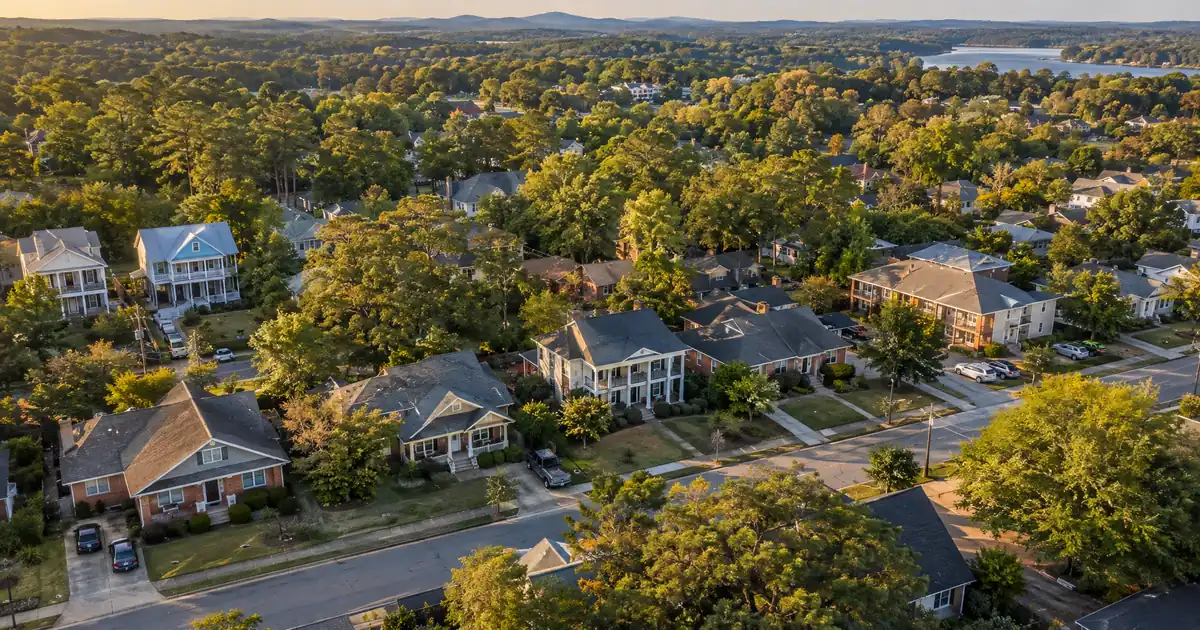
Cumming’s median sale price sits at $559,000, up 5.4 percent year over year, but price per square foot is down 6.2 percent and homes are taking 107 days to sell versus 58 a year earlier, per Redfin. Higher headline price with softer underlying signals changes how equity should be counted on a cash-out file. The appraisal, not the purchase contract, sets the loan ceiling.
At a Glance: A DSCR cash-out refinance in Cumming, Georgia is underwritten primarily on the property’s rental income measured against its full monthly obligation, principal, interest, taxes, insurance, and any HOA dues, with proceeds limited by appraised value, seasoning, and reserves rather than personal income documents.
DSCR Cash-Out Calculator
Run the cash-out numbers in Cumming, GA
Rate source: Freddie Mac 30-yr average via FRED® — Federal Reserve Bank of St. Louis · effective Sep 24, 2026
Prefilled with starting assumptions — enter your property’s value, balance, taxes, and insurance for a more accurate picture.
Program parameters update from Lendmire’s centralized guideline source. Taxes and insurance are editable estimates.
As of Sep 24, 2026 · General Freddie Mac market benchmark, not a Lendmire loan offer. Property value, balance, taxes, and insurance are editable estimates. Maximum loan-to-value varies by lender, program, property type, and seasoning. Not a Loan Estimate, approval, or commitment to lend. Program availability and eligibility are subject to lender guidelines, credit approval, property review, and underwriting.
- Cash-out LTV tops out at 75 percent, measured against the appraisal, not the contract price.
- Seasoning is about 6 months of ownership, measured from title recording.
- Houses average $2,946 and townhomes $2,436 in rent, per Apartments.com data reported by Stovall.
- At median-price values and high leverage, coverage tends to land under 1.00x.
Cumming is a market where the cash-out decision is mostly about how much to pull, not whether equity exists. Rents are steady. Prices are high. The gap between them decides the file.
Cumming Market Snapshot
A quick read on the Cumming investor landscape — figures come from the cited sources below. Confirm current property-level numbers before underwriting.
| Metric | Detail |
|---|---|
| Home prices | $650K listing price (Stovall Properties Group blog) |
| Typical rents | $2,162 median (Stovall Properties Group blog) |
| University enrollment | About 1,000 students (UNG, Cumming expansion) |
| Employment | 3,600+ employees (Northside Hospital Forsyth) |
| Vacancy | 6.4% (Matthews Atlanta Multifamily Q1) |
Two Cummings, One Appraisal Problem
The incorporated city of Cumming had 7,318 residents in the census count, up from 5,430 a decade earlier, but roughly 100,000 people live in unincorporated areas with a Cumming mailing address, according to Wikipedia’s Cumming entry. Forsyth County itself counted 251,283 in the census and carries an estimate near 282,805. The Atlanta Regional Commission reports 43 percent county growth between the last two census counts.
That matters on a file. Most investable inventory sits in unincorporated South Forsyth under Cumming mailing addresses (30040, 30041, 30028). Appraisers have to pull comps from the actual submarket, not the city limits. A reviewer who sees a “Cumming” address and a comp set from a different pocket will push back. Get the property’s true location and the comp radius straight before the order goes in.
Investors should also verify current local rental rules, taxes, and insurance with qualified local professionals. Beyond that, the files here turn on valuation and coverage.
The Equity Math (Why 75 Percent of Appraised Value Is a Ceiling, Not a Target)
The 75 percent LTV cap is a hard ceiling on cash-out, and Cumming files rarely reach it. The binding constraint is usually coverage: rent against full PITIA, where the standard benchmark is 1.00x and lenders review exceptions case by case.
Run the numbers on a house valued near the citywide $559,000 median. Model it with rent at $2,946, the Apartments.com house average Stovall reports. Assume a 30-year amortization with taxes and insurance included. At 75 percent LTV, coverage lands in the low 0.8x range including taxes and insurance. That is a modeled result, not a quote. Drop leverage to about 50 percent and the same rent produces roughly 1.15x to 1.2x. A townhome at the $2,436 average rent, on a comparable value, sits lower at the same leverage.
Sub-1.00 coverage does not end the conversation. A lender may review a sub-1.00 program, an interest-only structure, or a lower-LTV request that brings the ratio up. All of it is subject to lender guidelines, credit review, reserves, and property review. Expect pricing and leverage to shift as coverage drops.
Some program basics that matter here, stated as typical guidance:
- Credit tiers generally start at a 620 floor and step up through 660, 680, and 700, with better tiers opening more leverage.
- Reserves are typically around 6 months of PITIA, rising to about 9 months on balances above $1,500,000.
- Standard programs go up to $3,000,000. Smaller balances route through select lenders in the network.
- Manufactured homes, log homes, and barndominiums fall outside these programs.
Lendmire’s cash-out qualification details page lays out the program structure, and the broader investor refinance options cover rate-and-term paths for files that do not need proceeds.
Seasoning and the Builder-Incentive Trap
Seasoning is the simplest requirement and the one files get wrong. The clock is about 6 months from title recording, documented by the settlement statement. A closing date on the contract does not count. A file that assumes seasoning away gets kicked back.
The less obvious problem is what the purchase price represents. Local brokerage commentary from North Georgia Group says builder incentives like closing-cost contributions and rate buydowns are becoming common, and that prices are stabilizing rather than crashing. Stovall, citing a Realtor.com snapshot, shows Forsyth County homes closing about 2.04 percent below asking. An incentive-heavy contract can sit above true market value. When the cash-out appraisal lands on comps that exclude the incentive, the equity is smaller than the purchase-price plan assumed.
Picture an investor who bought a new-construction townhome near the median price with incentives baked in. Six months later the appraisal comes in 5 percent under contract. The 75 percent ceiling now applies to a lower number, and coverage, which was already tight, tightens again. Plan for the appraisal, not the contract.
Where the Cash-Out Files Pencil
Coverage is strongest where rents are highest relative to what the product costs, and in Cumming that is narrower than the map suggests. No neighborhood-level median price or rent source exists beyond one listing range, so the profiles below lean on tenant demand and product fit.
Vickery and the Halcyon Corridor
Vickery Lake is the one submarket with a sourced rent range. ApartmentHomeLiving lists single-family, condo, and townhome rentals from $1,800 to $6,699, averaging $3,188. That is a listing range, not a median, and the top end is not a pricing comp. Still, it shows where higher-rent product exists. The Halcyon and GA-400 corridor markets rental townhomes to commuters headed toward North Fulton, and that townhome product is the most likely fit for a cash-out that can carry moderate leverage.
Downtown and the Hospital Belt
Northside Hospital Forsyth has 389 beds, more than 3,600 employees, and about 800 physicians, and is described as the county’s largest private-sector employer. The UNG Cumming campus reported about 1,000 students at its last expansion opening, with a $15.5 million build-out sized for 2,200. Current enrollment is unverified, so the safe read is roughly 1,000 to 1,400 with room to grow. Healthcare and service workers plus students make a steady renter base around Highway 9. Long-term tenant demand is the point here, not rent growth.
Lake Lanier and North Forsyth (Watch the Comps)
Homes.com showed 29 houses for rent in the Lake Lanier neighborhood of Cumming. Lake-access properties are priced in a league of their own, but no numeric figure exists. A thin rental comp set plus premium values is a hard pairing for a coverage file. North Forsyth (Matt, Coal Mountain, Chestatee) is lower-density with newer builds, and there is no rent or price source at all. Both need property-specific rent evidence, not area averages.
Rent Comp Risk by Property Type
Rent comps get thin on large homes. Point2Homes, compiled from Yardi Matrix data covering buildings of 50 or more units, shows 2-bedroom units are 41 percent of rentals and 4-bedroom units only 3 percent. That data skews to apartments, so use it directionally. The takeaway holds: a rent estimate built on 4-bedroom comps carries more appraisal-side risk than one built on 2-to-3-bedroom townhomes.
RentCafe puts the large-complex apartment average at $1,764, down 1.85 percent year over year, with three-bedrooms at $2,201. Fifty-two percent of city households rent. No data turned up on duplex, triplex, or fourplex inventory or ADUs, so nobody should assume small multifamily is abundant here. If an investor holds one, the rent schedule and leases need to carry the file.
What to Track Over the Next Six to Twenty-Four Months
Three indicators will move a Cumming cash-out more than any rent bump:
1. Days on market and price per square foot. If 107 days stretches or price per square foot keeps falling while the median rises, expect appraisers to lean conservative.
2. Metro apartment supply. Matthews, using CoStar data, reports metro Atlanta vacancy of 6.4 percent, 0.4 percent rent growth, and 17.1K units under construction, with new supply concentrated in higher-growth suburban nodes. That is metro-level, not Cumming-specific. Stovall separately cites local apartment rents down 3.4 percent. Keep rent-growth assumptions near zero.
3. Value signals outside the median. Stovall cites Zillow’s Forsyth County index at negative 2.3 percent over one year, while Zillow’s Cumming value index shows $561,749, up 0.3 percent. Flat to soft is the pattern. An equity plan that needs appreciation to work is a risk.
Here’s the honest toss-up: an investor holding a long-owned house with low basis can pull real equity at 75 percent LTV but may fail coverage, while a recent buyer with thin equity may pass coverage but have nothing to pull. Neither is wrong. They are different files.
DSCR vs. conventional financing
Two common ways to finance an investment property in Cumming, GA. They qualify you differently — here’s how investors weigh them.
Why investors choose it
- Qualifies on the property’s rental income — no personal tax returns, W-2s, or pay stubs needed to document income.
- No personal debt-to-income ceiling to clear, so existing mortgages and obligations don’t cap your borrowing the same way.
- Can be closed in an LLC, keeping the property inside a business entity.
- Built for scaling — not held to the limit on number of financed properties that conventional financing applies.
- Underwriting centers on the deal: generally qualifies when the rent covers the payment, a 1.00x coverage ratio being a common baseline (confirmed in underwriting).
- Designed specifically for investment property, including long-term and, where the program allows, short-term rentals.
Where it’s strong
- Often the lowest ongoing financing cost for a buyer who fully qualifies on personal income — a fit for a first property or a cost-first purchase.
Trade-offs for investors
- Requires full personal income documentation and must fit within a debt-to-income limit — salary, existing debts, and other mortgages all count.
- Typically held in your personal name rather than a business entity.
- Caps how many financed properties you can carry, which can become a ceiling as a portfolio grows.
- Evaluates you as a borrower as much as the property, which usually means more paperwork.
How investors usually choose: a first or single property often optimizes for the lowest financing cost; portfolio builders often optimize for leverage, vesting in an LLC, and scaling past conventional caps. The right answer depends on your goals, the property, and current guidelines — both paths run through select lenders in Lendmire’s wholesale network, with eligibility and terms confirmed in underwriting.
What a Cumming File Usually Looks Like
DSCR files in markets like this one typically look like a high-value property with rent that supports moderate leverage but not the maximum. The strongest files arrive with a signed lease or rent schedule, a clean entity package if the property is titled in an LLC (subject to lender program eligibility), and reserves documented by statement before the lender asks. The weak ones lean on a single listing comp for rent and assume the 75 percent ceiling is available. Appraisal reconsideration, with recent in-submarket sales and condition adjustments, is routine, not a last resort. Ask for it early if the value comes back thin.
For the reasoning on why rental income is the qualifying basis, see the guide “What Is a DSCR Loan” and the guide “Where DSCR and Conventional Diverge”. Georgia investors can also review the Georgia DSCR investor loans hub.
The proceeds themselves are not a guaranteed figure. They depend on rent used for lender review, PITIA, reserves, and the 75 percent ceiling working together. To test a specific property, see what the numbers look like or call Lendmire at 828-256-2183.
Frequently Asked Questions
How do you qualify for a DSCR cash-out refinance in Cumming, Georgia?
Qualification centers on the property’s rent covering its full PITIA, typically at or above a 1.00x benchmark, plus a credit score at or above a 620 floor, about 6 months of seasoning from title recording, and roughly 6 months of reserves. Cash-out LTV is capped at 75 percent of appraised value. Final eligibility depends on lender guidelines, credit, and property review.
What are the requirements for an investment property loan in Cumming, Georgia?
Expect a rental-income basis for qualifying, an appraisal, reserves documentation, and entity documents if the property is in an LLC. Loan amounts go up to $3,000,000 on standard programs. Manufactured homes, log homes, and barndominiums are not eligible. Specific terms vary by lender and borrower.
Does a Cumming mailing address matter for the appraisal?
Yes. The incorporated city is small, while about 100,000 people live in unincorporated areas using Cumming addresses. Appraisers need comps from the property’s actual submarket, so confirm the location and comp radius before the appraisal is ordered.
Why do Cumming cash-out files often come in below the maximum leverage?
Price is high against rent. On a typical Cumming house, rent often falls short of covering the full monthly housing obligation once taxes and insurance are included, so modeled coverage can land below 1.00x at higher leverage. Lower leverage, a sub-1.00 program, or an interest-only structure may be reviewed, subject to lender guidelines.
Before You Order the Appraisal
Equity in Cumming is real but it is priced in a market that is flat to soft under the headline median. The file that works starts with a conservative value, documented rent, and a leverage number the coverage ratio can carry. If your appraisal came in 5 percent light tomorrow, would your rent still cover the loan you are planning to pull?
For current guidelines and terms, see Lendmire’s DSCR loan programs page.
About Lendmire
Lendmire (NMLS# 2371349) is a DSCR-focused mortgage broker that helps arrange investor financing across 41 markets, including Washington, D.C., through wholesale and investor-lending channels. DSCR eligibility is generally reviewed by the lender on the property’s rental income rather than personal income documentation, subject to lender guidelines, which works for self-employed investors, LLC operators, and portfolios above four financed properties. Scotsman Guide named Lendmire a Top Mortgage Workplace in both 2025 and 2026.
Get Started
Ready to find the right loan for you?
In about 30 seconds you can review financing options available for your investment property. No commitment required.
Informational only. Not a Loan Estimate, approval, or commitment to lend. Program availability and eligibility are subject to lender guidelines, credit approval, property review, and underwriting.
References
1. Redfin, Cumming housing market
2. Stovall Properties Group, rental investing in Cumming and Forsyth County
3. UNG Cumming campus expansion
5. Matthews, Atlanta multifamily
7. Atlanta Regional Commission, Forsyth County
11. 2025
12. 2026
This article is part of Lendmire’s investment property cash-out refinance program — full qualification details, guidelines, and scenarios live on the program page.
Related reading: Luxury Rental DSCR Loans In New Jersey · Jersey Shore Vacation Rental Loans: DSCR Financing In Ocean City, Cape May And Long Beach Island · DSCR Cash-out Refinance In New Jersey: Pulling Equity From A Rental
Guides: Investment Property Cash-Out Refinance in Georgia
Brandon Miller
Founder & CEO, Mortgage Loan Originator, Lendmire LLC
- Mortgage Loan Originator · NMLS# 1129696 · Verify on NMLS Consumer Access
- North Carolina Real Estate Broker · License# 343312 · Verify on NCREC
- North Carolina Insurance Producer · License# 19053198 · Property, Casualty, Life, Health · Verify on NAIC SBS
- Lendmire LLC · Firm NMLS# 2371349 · Verify firm licensure
Disclosure information. Lendmire is a state-licensed mortgage brokerage under NMLS# 2371349. Lendmire is not a depository institution, direct lender, or financial advisor — all loans referenced are placed through wholesale lender partners and are subject to each lender's underwriting standards. This article is provided for general informational purposes and is not a commitment to lend, nor does it constitute financial, legal, or tax advice. Loan programs, terms, rates, and qualification standards change without notice and depend on borrower profile, property type, and the state in which the subject property is located. Equal Housing Opportunity provider. NMLS Consumer Access: nmlsconsumeraccess.org.