
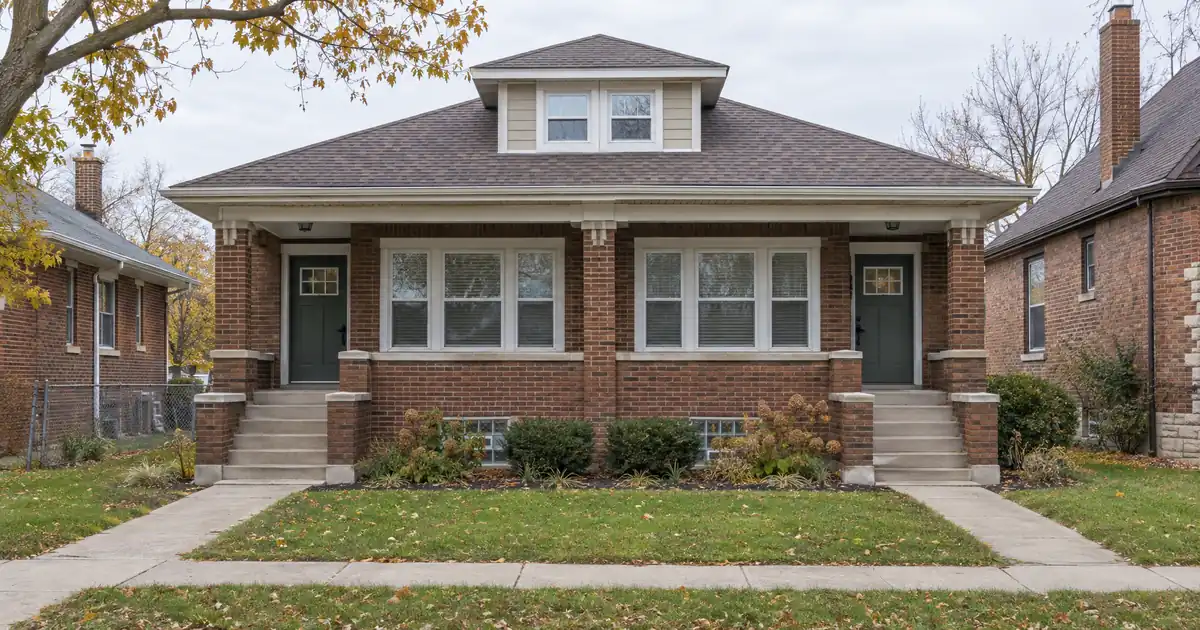
Zillow’s home value index puts Danville’s typical home worth at $71,990, up 11.5% over the past year — one of the sharper 12-month moves the Zillow Home Value Index tracks for a market this size. That number alone tells an investor holding a Danville rental something important: equity may have built faster than the sale price suggests, and a cash-out refinance is worth running the math on before assuming the property is still worth what it was purchased for.
The Quick Read: A Danville, Illinois cash-out refinance is underwritten primarily on the property’s rent measured against its full monthly obligation, not on income documents, and the file clears seasoning and appraisal review before any equity is released.
DSCR Cash-Out Calculator
Run the cash-out numbers in Danville, IL
Rate source: Freddie Mac 30-yr average via FRED® — Federal Reserve Bank of St. Louis · effective Sep 17, 2026
Prefilled with starting assumptions — enter your property’s value, balance, taxes, and insurance for a more accurate picture.
Program parameters update from Lendmire’s centralized guideline source. Taxes and insurance are editable estimates.
As of Sep 17, 2026 · General Freddie Mac market benchmark, not a Lendmire loan offer. Property value, balance, taxes, and insurance are editable estimates. Maximum loan-to-value varies by lender, program, property type, and seasoning. Not a Loan Estimate, approval, or commitment to lend. Program availability and eligibility are subject to lender guidelines, credit approval, property review, and underwriting.
- Danville’s typical home value sits near $71,990, up 11.5% year-over-year per Zillow.
- Redfin’s raw median sale price for November 2025 was $122,000, down 2.4% year-over-year — a divergent signal worth understanding before ordering an appraisal.
- Illinois carries a lender geographic overlay capping cash-out LTV near 70%, below the network’s general 75% ceiling.
- Seasoning is roughly 6 months of ownership from the recorded title date before cash-out proceeds are available.
- A 7-unit multifamily near downtown recently traded around $180,000 against $3,300/month gross rent — a stacking ratio single-family Danville rentals rarely match. Final terms depend on lender guidelines, property type, leverage, and the borrower’s complete credit picture.
Danville Market Snapshot
A quick read on the Danville investor landscape — figures come from the cited sources below. Confirm current property-level numbers before underwriting.
| Metric | Detail |
|---|---|
| Home prices | $122,000 median sale price (Redfin) |
| Typical rents | $822 avg (Apartments.com) |
| Recent appreciation | +11.5% yoy (Zillow Home Value Index) |
| University enrollment | 5,247 total students (Danville Area Community College) |
| Population | 28,595 population (Census Reporter) |
| Employment | 1,001-5,000 employees (LinkedIn) |
Why the Comp Data Disagrees With Itself
Danville’s real estate data doesn’t line up cleanly across sources, and that matters more for a cash-out refinance than for a purchase. Zillow’s smoothed index says values are up 11.5% over the past year. Redfin’s raw closed-sale data for November 2025 says the median sale price fell 2.4% year-over-year to $122,000, with homes moving in 27 days on just 14 total sales that month, per Redfin’s Danville housing market page.
Both can be true at once. Danville sells so few homes in a given month — 14 to 21 transactions — that a handful of higher-value sales can swing the median in either direction without reflecting a real market shift. For an investor pulling equity, this thin volume means the appraisal itself becomes the friction point, not the underwriting math. An appraiser working a cash-out file here has a small, volatile comp pool to draw from. The practical fix: push for a broader comp radius rather than assuming the most recent three sales represent the block, and expect the appraisal reconsideration process to be a normal step rather than a red flag if the first value comes in short.
NeighborhoodScout’s research adds a third data point worth weighing: it ranks Danville’s recent annual appreciation rate higher than 90% of other cities and towns in Illinois. Combined with a sub-$125,000 basis, an investor who bought and stabilized a rental here has better-than-average odds of showing refinanceable equity inside a normal seasoning window — though the low price base means percentage swings look bigger than they’d look in a $400,000 metro.
The Illinois Overlay: 70%, Not 75%
Danville cash-out files run into an Illinois-specific ceiling before they run into anything city-specific. Lendmire’s wholesale network generally caps DSCR cash-out refinances at 75% loan-to-value, but Illinois carries a lender geographic overlay that pulls that ceiling down to roughly 70%. That’s the number to model against, not the general program cap.
Seasoning is the second gate. Cash-out proceeds typically require about 6 months of ownership measured from the recorded title date. An investor who bought a Rabbittown duplex eight months ago and stabilized the rent roll has cleared that window; one whose purchase is still recent hasn’t — the file simply isn’t eligible yet regardless of how much value has appreciated, since actual timing varies by file and lender.
The qualifying-rent side of the math runs on a modeled basis, not a promise. Full PITIA — principal, interest, taxes, insurance, and any HOA dues — gets divided into the monthly rent to produce the coverage ratio, and Illinois property tax and insurance assumptions get built into that PITIA figure rather than ignored. A DSCR floor of 1.00 is the typical benchmark most standard programs are built around, since rent covering the full payment at that level is the baseline lenders look for; some files with lower ratios get reviewed with different structuring or pricing, subject to lender guidelines, credit approval, and reserves. Reserve requirements generally run near 6 months of PITIA, moving to roughly 9 months above the $1.5 million loan-amount range — not a typical Danville file size, but worth knowing for anyone stacking multiple properties into one refinance.
None of this is a guarantee of proceeds or approval. What it does is give an investor a real framework to model before ordering an appraisal: price, the 70% overlay, and the resulting coverage ratio — not a promised dollar figure.
Rabbittown and the Single-Family Equity Case
Rabbittown’s older, small-footprint 2-bedroom, 1-bath housing stock is the workforce single-family core of Danville’s rental market, and it’s a market where rent-to-price math works better than most Illinois metros. Against a citywide typical value near $71,990, 2-bedroom house rents average $725 per RentCafe’s Danville data, while Rentometer pegs comparable 2-bedroom units closer to the $900s.
Run a modeled scenario: an investor bought a Rabbittown duplex-style single-family conversion at $75,000 roughly ten months ago, past the 6-month seasoning gate. Danville’s appreciation trend, as reflected in local market data, puts a fresh appraised value in the neighborhood of $95,000-$105,000 depending on which comp set the appraiser leans on — itself a reminder of the volatility discussed above. At a 70% Illinois cash-out ceiling against that appraised range, and modeling rent used for lender review near $900/month against a full PITIA figure that folds in Illinois property tax and insurance at their typical local levels, the coverage ratio lands in the 1.05x-1.15x range — inside standard program territory but not with a lot of cushion.
That’s the honest read on Rabbittown: the basis is low enough that leverage math works, but the rent ceiling is real too. Apartments.com’s market-wide data puts Danville’s overall average rent at $822/month, 51% below the national average — this is a cash-flow market built on a low cost base, not a market where rents are climbing fast enough to carry aggressive refinance assumptions.
The Downtown/Ellsworth Park Corridor and Multi-Unit Stacking
The strongest DSCR cash-out math in Danville isn’t on single-family stock at all — it’s on the small multifamily buildings clustered near the downtown historic district, Ellsworth Park, and the Lake Vermilion corridor. Danville’s older building stock includes a meaningful share of duplex and small-plex conversions: NeighborhoodScout’s housing-type data puts small multifamily (duplexes and buildings converted to apartments) at 5.90% of the city’s housing stock, a share that’s genuinely sourceable rather than a rarity, against 73.15% single-family detached and 17.96% large apartment complexes.
A recent listing illustrates the ceiling on this play. A 7-unit multifamily property near downtown — six 1-bed/1-bath units plus a studio, fully occupied — was listed around $180,000 generating $3,300/month in gross rent including sewer, sanitary, and trash, per Coldwell Banker’s MLS listing and confirmed pricing on Redfin’s ZIP 61832 listings. That’s roughly 1.8% of the listed price in monthly gross rent — a ratio that lets a stabilized 5+ unit acquisition clear a 1.20x-1.25x coverage ratio even before optimizing rents, a number single-family Danville rentals rarely touch on their own.
For a cash-out refinance specifically, this matters because the seasoning and appraisal mechanics work the same way on a multi-unit as on a single-family — 6 months of ownership, an appraisal, a 70% Illinois LTV ceiling — but the income base going into the DSCR calculation is stacked across multiple leases instead of resting on one. That gives the file more room above the 1.00 floor even after taxes and insurance get folded into PITIA. Investors holding one of these buildings for a year or more, with occupancy stabilized and rent rolls documented cleanly, are the ones most likely to see this play out as modeled.
Working DSCR brokers see a recurring pattern in small multifamily-heavy micro-markets like this one: the file usually clears on income stacking even when individual unit rents look unremarkable on paper, but the rent roll and lease documentation have to be clean and current — a rent roll with expired leases or undocumented month-to-month tenants slows the file down more than the coverage math itself ever does.
The VA Anchor and the East Main Street Corridor
The VA Illiana Health Care System is the single most distinctive demand driver in Danville, and it’s worth understanding for what it is and isn’t. The campus opened in 1898 as the Danville Branch of the National Home for Disabled Volunteer Soldiers, per the National Park Service’s historic district listing — making it one of the oldest continuously operating veterans’ medical campuses in the country. Its LinkedIn company profile places current staffing at 1,001-5,000 employees, a four-figure federal employment base that’s rare for a city this size.
That’s a genuine long-term tenant anchor for rentals near East Main Street — VA staff, contractors, and veteran-connected households provide a renter pool that isn’t tied to the manufacturing or retail cycles that dominate the rest of Danville’s employment base (per Data USA, manufacturing and health care/social assistance are the two largest employment sectors for Danville residents). But it’s not an unlimited-growth story. A February 2025 report noted the facility dismissed a small number of probationary staff amid broader national VA staffing pressure — a reminder to size any single-employer rental thesis conservatively rather than assuming the anchor only grows.
The VA corridor also lost a different kind of demand recently: Blue Cross Blue Shield of Illinois is closing its East Main Street/Lynch Road call center, shifting employees to fully remote work, per the News-Gazette’s coverage. That facility once employed more than 400 people and was one of Danville’s few private white-collar commuter employers. Investors targeting East Danville rentals for that specific tenant pool should discount future in-office demand from BCBS and lean instead on VA staff, DACC employees and students, and manufacturing/logistics workers as the base case.
Highland Park, DACC, and the Steady-Not-Spectacular Rental Pool
Highland Park and the corridor near Danville Area Community College don’t produce headline appreciation numbers, but they produce a dependable tenant base. DACC’s own student profile page reports 5,247 total students and 3,385 credit students for the most recent fiscal year — a figure that differs meaningfully from third-party aggregator counts, which is worth knowing if an investor is cross-checking enrollment claims across sites. Either way, DACC provides a mix of student, staff, and workforce renters that keeps this corridor’s single-family and small apartment stock leased at a steady clip, per general market commentary on the area’s mixed housing at reasonable prices.
Rent levels here track the citywide averages reported by Apartment Finder — $820 for a 1-bedroom, $1,071 for a 2-bedroom — landing in the middle of Danville’s range and giving cash-out investors a fairly reliable rent assumption to model against, with less of the volatility that shows up in the sale-price data.
What a Modeled Cash-Out File Looks Like Start to Finish
Picture an investor holding a small multifamily property in the Ellsworth Park corridor, purchased 14 months ago — well past the 6-month seasoning gate. The building has stabilized with full occupancy and documented leases.
1. Order a fresh appraisal. Given Danville’s thin sales volume, expect the appraiser to widen the comp search — and be ready for an appraisal reconsideration request if the first pass comes in light against recent duplex/small-plex sales.
2. Confirm the Illinois overlay applies at 70% LTV, not the network’s general 75% cash-out ceiling — this changes the proceeds math meaningfully on a property this size. These specifics are subject to lender guidelines and a full review of property, leverage, and credit.
3. Assemble rent-roll documentation. Current leases, not verbal agreements, for every unit — this is the single most common friction point on multi-unit DSCR files in a market this size.
4. Model rent used for lender review against full PITIA, including Illinois property tax and insurance assumptions, to land on the coverage ratio the lender will actually underwrite to.
5. Verify reserves. Roughly 6 months of PITIA is the standard target; an investor holding multiple financed properties should check the cumulative reserve requirement before assuming one property’s equity covers it alone. Terms vary by lender guidelines, property type, leverage, credit profile, and full file review.
Entity-titled owners (LLC-held properties) go through the same steps with entity documents added to the file — operating agreement, EIN verification, and authorized-signer documentation — subject to program eligibility requirements that vary by lender. None of this guarantees a specific proceeds figure; eligibility review depends on the appraisal, the rent roll, credit, reserves, and program review.
DSCR vs. conventional financing
Two common ways to finance an investment property in Danville, IL. They qualify you differently — here’s how investors weigh them.
Why investors choose it
- Qualifies on the property’s rental income — no personal tax returns, W-2s, or pay stubs needed to document income.
- No personal debt-to-income ceiling to clear, so existing mortgages and obligations don’t cap your borrowing the same way.
- Can be closed in an LLC, keeping the property inside a business entity.
- Built for scaling — not held to the limit on number of financed properties that conventional financing applies.
- Underwriting centers on the deal: generally qualifies when the rent covers the payment, a 1.00x coverage ratio being a common baseline (confirmed in underwriting).
- Designed specifically for investment property, including long-term and, where the program allows, short-term rentals.
Where it’s strong
- Often the lowest ongoing financing cost for a buyer who fully qualifies on personal income — a fit for a first property or a cost-first purchase.
Trade-offs for investors
- Requires full personal income documentation and must fit within a debt-to-income limit — salary, existing debts, and other mortgages all count.
- Typically held in your personal name rather than a business entity.
- Caps how many financed properties you can carry, which can become a ceiling as a portfolio grows.
- Evaluates you as a borrower as much as the property, which usually means more paperwork.
How investors usually choose: a first or single property often optimizes for the lowest financing cost; portfolio builders often optimize for leverage, vesting in an LLC, and scaling past conventional caps. The right answer depends on your goals, the property, and current guidelines — both paths run through select lenders in Lendmire’s wholesale network, with eligibility and terms confirmed in underwriting.
Frequently Asked Questions
How do you qualify for a DSCR cash-out refinance in Danville, Illinois?
Qualification runs primarily on the property’s rental income measured against its full monthly payment (including taxes and insurance), rather than on the borrower’s personal income documents. A minimum coverage ratio near 1.00x is the typical benchmark most standard programs are built around, though the exact threshold, LTV, and pricing depend on credit tier, reserves, and lender guidelines. Illinois carries a 70% cash-out LTV overlay rather than the network’s general 75% ceiling, which is the number to model against here. Exact terms depend on the lender’s guidelines, property type, leverage, and a full review of the borrower’s file.
What are the requirements for an investment property cash-out refinance in Danville, Illinois?
Standard requirements include roughly 6 months of seasoning from the title recording date, credit typically in the 620-700+ range depending on the pricing tier, and reserves near 6 months of PITIA. A current appraisal and, for multi-unit properties, documented leases for every unit are also part of the file — given Danville’s thin monthly sales volume, expect the appraisal comp search to matter more here than in a higher-volume market.
Why do Zillow and Redfin show different home value trends for Danville?
Zillow’s ZHVI is a smoothed index across the broader home-value mix, currently showing an 11.5% year-over-year gain, while Redfin’s median sale price reflects actual closed transactions and showed a 2.4% year-over-year decline as of November 2025 on just 14 sales. The gap comes from Danville’s low transaction volume — a handful of unusual sales can swing a monthly median without reflecting a real shift, which is exactly why appraisal comp selection matters more on a cash-out file here.
Does the VA Illiana Health Care System actually support rental demand near East Main Street?
It’s a genuine anchor — the campus carries 1,001-5,000 employees per its LinkedIn profile and has operated continuously since 1898, giving the corridor a stable renter base tied to federal employment. That said, national VA staffing pressure led to some probationary dismissals reported in early 2025, so an investor should size any single-employer rental thesis around this anchor conservatively rather than assume unlimited growth.
Can a self-employed investor buying in Danville be reviewed for DSCR financing?
Yes, a self-employed investor buying in Danville can be reviewed for DSCR financing, since the file leans on the rent roll and appraisal rather than personal income documentation, subject to lender program guidelines.
Is a 7-unit multifamily building in Danville actually easier to refinance than a single-family rental?
The math often favors it. A recently listed 7-unit property near downtown traded around $180,000 against $3,300/month in gross rent — a stacking ratio that can push coverage into the 1.20x-1.25x range once stabilized, well above what a single-family Danville rental typically produces on its own. The tradeoff is documentation: every unit’s lease needs to be current and verifiable, and that paperwork load is the main friction point on multi-unit files.
Danville’s biggest blind spot for a DSCR-financed cash-out isn’t the rent level or the price — it’s the comp volatility itself. With roughly 14 to 21 home sales a month feeding two data platforms that already disagree by double-digit percentage points, an investor who assumes either Zillow’s appreciation trend or Redfin’s decline is a stable signal is underwriting against noise. The safer approach treats every appraisal as its own event, orders it with a wide comp radius in mind, and builds the refinance case on documented rent — not on whichever index happens to be trending favorably that month.
For broader investor-financing rules and property-type coverage across the state, see Illinois DSCR loans.
Investors weighing their equity options can start with cash-out refinance on an investment property.
For current guidelines and terms, see Lendmire’s DSCR loan programs page.
About Lendmire
Lendmire is a DSCR-focused mortgage brokerage, NMLS# 2371349, placing investor loans across 41 markets, including Washington, D.C. DSCR eligibility is generally reviewed by the lender on a property’s rental income rather than personal income documentation, which fits LLC-held rentals, self-employed investors, and portfolios scaling past conventional financed-property limits. Scotsman Guide named Lendmire a Top Mortgage Workplace in both 2025 and 2026.
Get Started
Ready to find the right loan for you?
In about 30 seconds you can review financing options available for your investment property. No commitment required.
Informational only. Not a Loan Estimate, approval, or commitment to lend. Program availability and eligibility are subject to lender guidelines, credit approval, property review, and underwriting.
References
1. Zillow Home Value Index – Danville, IL
2. Redfin – Danville, IL Housing Market
4. Danville Area Community College
6. LinkedIn
7. RentCafe – 2-Bedroom Houses for Rent in Danville, IL
8. Redfin’s ZIP 61832 listings
9. National Park Service – Danville Branch Historic District
10. Data USA
11. News-Gazette – Blue Cross Blue Shield to Close Danville Building
12. 2025
13. 2026
This article is part of Lendmire’s investment property cash-out refinance program — full qualification details, guidelines, and scenarios live on the program page.
Related reading: Cash Out Refinance Investment Property in Danville, Illinois: Equity From a Sub-$125K Basis · DSCR Investment Property Loans in Galena, IL: The 2026 DSCR Financing Guide to Main Street · Cash Out Refinance Investment Property in Palatine, Illinois: Two-Flat Equity, Redeployed
Guides: Investment Property Cash-Out Refinance in Illinois
Brandon Miller
Founder & CEO, Mortgage Loan Originator, Lendmire LLC
- Mortgage Loan Originator · NMLS# 1129696 · Verify on NMLS Consumer Access
- North Carolina Real Estate Broker · License# 343312 · Verify on NCREC
- North Carolina Insurance Producer · License# 19053198 · Property, Casualty, Life, Health · Verify on NAIC SBS
- Lendmire LLC · Firm NMLS# 2371349 · Verify firm licensure
Compliance and disclosures. Lendmire (NMLS# 2371349) is a licensed mortgage broker and is not a direct lender, depository institution, financial advisor, or tax professional. Content in this article is general market analysis and educational information — not financial, legal, or tax advice for any specific situation. Lendmire does not guarantee loan approval; every transaction is subject to underwriting by the funding lender. Mortgage pricing and loan program guidelines are subject to change at any time without notice and vary by borrower characteristics, property type, and state regulations. Lendmire complies with Equal Housing Opportunity. Licensure verification: NMLS Consumer Access.