
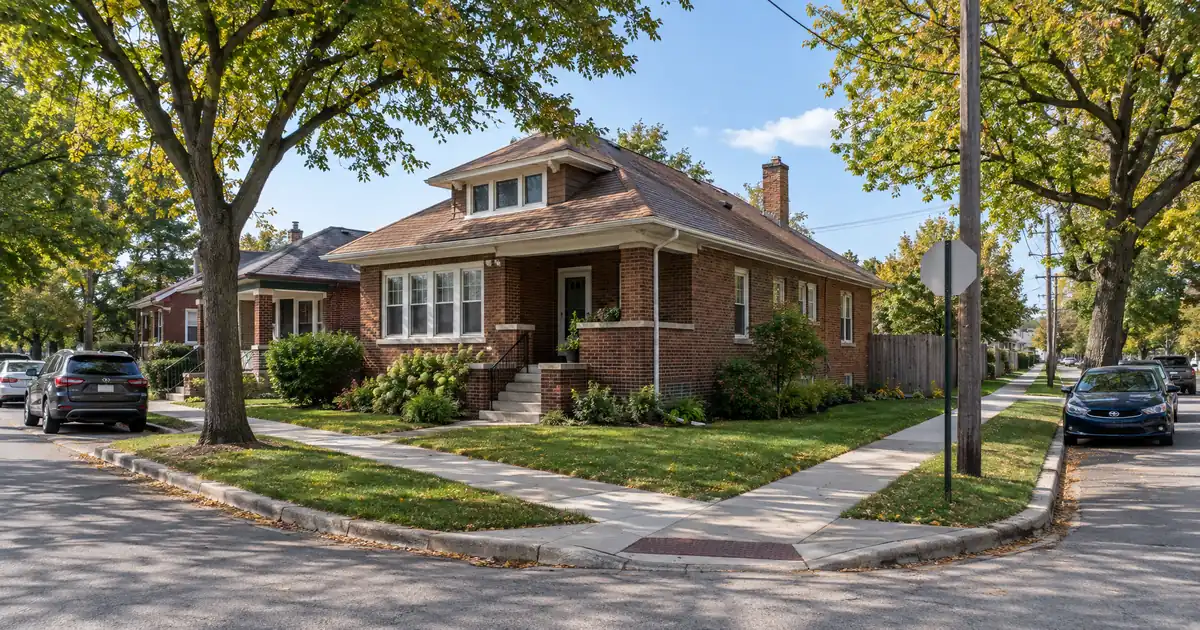
A detached house in Des Plaines renting at the median gross rent of $1,650 against a median home value of $347,287 puts rent at roughly 0.48 percent of value, per City-Data’s Census-derived profile. Run that through a 75 percent cash-out ceiling with taxes and insurance in the obligation, and coverage lands in the high-0.6s. That is the mechanical reality of a DSCR cash-out refinance here. Single-family hold stock mostly doesn’t clear 1.00, and the two-to-four-unit buildings do the heavy lifting.
DSCR Cash-Out Calculator
Run the cash-out numbers in Des Plaines, IL
Rate source: Freddie Mac 30-yr average via FRED® — Federal Reserve Bank of St. Louis · effective Sep 24, 2026
Prefilled with starting assumptions — enter your property’s value, balance, taxes, and insurance for a more accurate picture.
Program parameters update from Lendmire’s centralized guideline source. Taxes and insurance are editable estimates.
As of Sep 24, 2026 · General Freddie Mac market benchmark, not a Lendmire loan offer. Property value, balance, taxes, and insurance are editable estimates. Maximum loan-to-value varies by lender, program, property type, and seasoning. Not a Loan Estimate, approval, or commitment to lend. Program availability and eligibility are subject to lender guidelines, credit approval, property review, and underwriting.
The Quick Read:
A DSCR cash-out refinance on a Des Plaines, Illinois investment property is underwritten primarily on the property’s rental income measured against its full monthly obligation, with the loan sized to a 75 percent LTV ceiling, about six months of seasoning from title recording, and reserves, all subject to lender guidelines and property review.
- Detached single-family rent sits near 0.48 percent of value, per City-Data, which is well under 1.00 coverage at the cash-out cap.
- Two-unit buildings trade at roughly 60 percent of a detached home’s mean price, so they carry the coverage math.
- Multifamily listings are thin: Homes.com showed only two, so expect appraisers to reach for comps.
- Appreciation is modest, so the refinance case here rests on rents, not price acceleration.
Des Plaines Market Snapshot
A quick read on the Des Plaines investor landscape — figures come from the cited sources below. Confirm current property-level numbers before underwriting.
| Metric | Detail |
|---|---|
| Home prices | $390K median sale price (Redfin) |
| Typical rents | $1,665 avg rent (1br) (Apartments.com) |
| University enrollment | 7,433 students (spring 2022) (Oakton College) |
| Population | 60,675 population (Des Plaines Community Profile) |
| Employment | ~45,000 employees (Ascension/Prime Healthcare) |
Why Des Plaines Pays Back Rent-Driven Owners
Des Plaines suits owners who bought for rent and are now pulling capital out. Demand is driven by jobs and commuting. Appreciation is not the story. The city had 60,675 residents at the last decennial count, per the City of Des Plaines community profile, and it sits inside a Chicago metro of more than 9.3 million people. It also sits just north of O’Hare, with two Metra stops on the Union Pacific Northwest line downtown.
The daytime population is the number that matters. City-Data puts the commuting-driven daytime swing at +9,139, or +15.4 percent, and only 7,493 residents (24.4 percent) both live and work in the city. Des Plaines imports workers. Those workers need housing nearby, and most of them aren’t buying.
Resident employment spreads across a few sectors. Data USA shows Health Care and Social Assistance at 4,949 residents, Manufacturing at 4,053, and Retail Trade at 3,608. That is a mix of hospital shifts, light-industrial floors, and retail hours. Aviation-adjacent logistics adds to it. It’s a workforce-rental base, not a luxury one.
Tenure tells you who the buyer pool is. RentCafe reports that 79 percent of households are owner-occupied and 21 percent rent, which is 4,655 renter households. A majority-homeowner city has a smaller renter pool and fewer large apartment buildings, and that shapes which assets are worth refinancing.
The Equity Math: What the 75 Percent Ceiling Actually Does
Cash-out proceeds are the gap between 75 percent of the appraised value and the existing payoff, minus costs and reserves. Cash-out LTV tops out at 75 percent, not the 80 percent that applies to purchases. Seasoning is about six months from title recording. Reserves run about six months of PITIA. Those are typical program guidelines, not promises, and they vary by lender, borrower, and property.
Picture an owner holding a duplex with an existing payoff well below half of today’s appraised value. The 75 percent ceiling leaves a meaningful slice of equity available before closing costs and the reserve requirement. That slice is what funds the next purchase’s down payment. Most purchase programs ask for a down payment in the range of one-fifth to one-quarter of the price, so one refinanced duplex can seed one acquisition. The equity-extraction mechanics get the full treatment elsewhere. The point here is the Des Plaines-specific limit: the available slice depends on coverage as much as on value. Exact terms depend on the lender’s guidelines, property type, leverage, and a full review of the borrower’s file.
Coverage is the binding constraint. Here is the arithmetic, labeled as modeled assumptions. Rent used for lender review is divided by full PITIA, which means principal, interest, taxes, and insurance on a standard 30-year structure at the 75 percent ceiling. Roughly 0.7 percent of value in monthly rent gets a property to 1.00. Standard DSCR programs are commonly built around a 1.00 baseline because the rent covers the obligation at that level. Some lenders will review below that, with lower leverage and stronger credit, and exact eligibility depends on guidelines and property review.
Now run the two property types:
- Detached single-family: at the Census-derived 0.48 percent rent-to-value, coverage sits around 0.65 to 0.70 including taxes and insurance. That is a sub-1.00 file.
- A duplex: assume a modeled $400,000 appraised value and two units near the RentCafe citywide average of $1,904 each. Rent runs about 0.95 percent of value, and coverage lands near 1.3x including taxes and insurance. That is a different file.
Those are modeled inputs, not market facts. The ratio gap between them is what matters, and it is why the two-to-four-unit stock matters so much.
Sub-1.00 on a Single-Family: What a Broker Reviews
A single-family rental below 1.00 coverage is not dead, but the file gets harder. Lenders may review sub-1.00 scenarios, but they usually ask for reduced leverage, stronger credit, more reserves, or different pricing. An interest-only structure can change the obligation, and a documented rent increase can move the numerator. Whether any of those fit depends on lender guidelines, credit approval, and property review.
There is also an appreciation side to the single-family story, and it is not flattering. City-Data shows median house value rising from $174,800 in 2000 to $347,287 in the latest data. That is a long climb, and the owner who bought early already holds it. NeighborhoodScout ranks the latest annual appreciation lower than 70 percent of Illinois cities. Zillow shows the average home value at $326,044, up 4.2 percent over the year. Zillow’s figure is an average rather than a median, which is why it sits below the $390,000 median sale price Redfin reports (up 3.3 percent year over year). Those are growth rates that support equity, not equity that jumps.
So the thesis is straightforward. Buy rent-heavy, refinance on rent-backed value, and don’t bet on a price spike to force proceeds.
Where the Duplex Sweet Spot Lives
The structural sweet spot is the two-unit building. City-Data’s mean 2024 prices put 2-unit structures at $225,678, against $376,132 for detached houses and $375,458 for 3-to-4-unit buildings. A duplex runs about 60 percent of a detached home’s price and produces two rent streams. The 3-to-4-unit jump, by contrast, costs roughly what a detached house does. The per-door price advantage is real at two units and mostly gone at four.
That kind of stock is scarce. The city’s own community profile lists 14,102 detached single-family homes (58.4 percent), 266 two-unit buildings (1.1 percent), 592 three-or-four-unit buildings (2.5 percent), and 769 buildings with five to nine units (3.2 percent). Add the small-multifamily categories and the total is only a few percent of the stock. Scarcity cuts both ways. Owners of these buildings hold a rare product with strong coverage. They also face a thin appraisal market, which is the cautionary note here.
Working DSCR brokers see a recurring pattern in suburban markets dominated by owner-occupied single-family housing. Small multifamily trades infrequently, so the appraiser’s comparable set is old, out-of-area, or mismatched on unit count. The file that goes best has current leases, a clean rent schedule, entity documents (for properties held in an LLC, subject to lender program eligibility), title, and property details ready for lender review before the order goes in. That prep cuts the back-and-forth when a valuation comes in lighter than the owner expected.
On the supply side, Homes.com listed just two multifamily properties, priced from $899,900 to $1,200,000, with an average of 24 days on the market. That is almost no active comp set. The same page describes a well-maintained, fully occupied 6-unit building generating about $120,000 in annual income with an estimated $84,000 NOI and tenant tenures of 10 to 25 years. Treat that as a listing description, not an audited result. It still shows what stacked income looks like when tenants stay, and long tenure is what makes small multifamily underwrite cleanly. It is not what you refinance for coverage on an ordinary duplex.
Submarkets: Where the Equity Is Worth Pulling
Downtown Des Plaines
Downtown has the Metra stops, the walkable core, and the most liquid comps in the city. Redfin’s downtown neighborhood data shows prices rising modestly year over year. The city’s downtown page confirms the Union Pacific Northwest station in the heart of downtown. The tenant base is commuters, with direct rail into Chicago.
Rent here is on the higher end for Des Plaines, according to Apartments.com, which ranks Downtown among the most expensive neighborhoods and also among those with the most apartments available. That means more competition for tenants. For a cash-out, downtown’s advantage is appraisal depth. More sales make for better comps, which makes this the easier submarket to get a value that holds up.
Central Road Acres and the Arlington Heights Corridor (Scalable but Uneven)
Apartments.com lists Central Road Acres, Heritage Pointe Condominiums, and the Des Plaines/Arlington Heights Corridor among the most affordable rental neighborhoods. Central Road Acres and the corridor also appear among the most expensive and among those with the most apartments available. That spread inside a single submarket means unit-level underwriting matters more than neighborhood-level averages. A broker looking at a file here wants the actual lease rent, not the neighborhood story.
For an owner already holding in this pocket, the workforce single-family product is the most scalable. It is also the product with the weakest coverage at the cash-out cap. Treat it as the equity you hold and refinance conservatively, not the file you stretch.
Oakton Corridor (Steady, Not Spectacular)
Oakton College has a 147-acre campus in Des Plaines and, per Wikipedia, reported 7,433 students in spring 2022. It is a commuter college, so it creates modest, steady rental demand from students, adjunct faculty, and staff rather than dorm-adjacent pressure. The research puts one-bedroom units near the college around $1,655 and two-bedrooms around $2,000.
The Lee, Oakton, and Norma micro-pockets near the Oakton Street commercial corridor tend to be lower-cost and multi-unit-friendly. Skip them if you want a clean comp set. Look at them if you hold an older small multifamily asset and want a rent-driven refinance.
The O’Hare and Golden Corridor Side
This area benefits from O’Hare-adjacent logistics, cargo, and airline-support employment, which drives shift-worker rental demand. Expect hourly-wage tenants and steady demand. The cash-out case here depends on how current leases compare to the rent schedule, and the research doesn’t support specific price or rent figures for it. Treat it qualitatively and underwrite from the actual leases.
The Oakton Metra Station: A Catalyst, Not a Guarantee
The city is advancing plans for a Metra station at Oakton Street on the North Central line. The Lakota Group’s feasibility work found that only 2.5 percent of workers in the area use public transportation, and 75 percent commute alone by car. That is an underserved, car-dependent corridor.
The investor angle is the “buy-before-the-catalyst” case: property near a future station could see a transit-driven rental bump ahead of the market pricing it in. This one is a genuine toss-up. A planned station is not a built station, and plans stall. An owner who already holds property there has a free option on it. A buyer paying up for it is making a bet. For cash-out purposes, a lender values the property on current rents and current comps, not on a station that doesn’t exist yet.
What the Rent Data Says (and Where Sources Disagree)
Rental figures vary by source, which tells you to underwrite the actual lease and not the platform average. RentCafe reports a citywide average of $1,904. Apartments.com puts studios near $1,500, one-bedrooms at $1,665, and two-bedrooms around $2,023, with rents up just 0.9 percent over the past year. Zillow Rental Manager puts the average two-bedroom at $2,082 and the three-bedroom at $3,200.
The flat rent growth matters. At 0.9 percent, rents are not outrunning the cost of carrying the property, so coverage doesn’t improve on its own. An owner who refinances expecting rents to catch up with a higher obligation is counting on growth the data doesn’t show. No single authoritative vacancy figure turned up in the research. Treat vacancy qualitatively and verify current local rental rules, taxes, and insurance with qualified local professionals before underwriting.
The Hospital and Employer Backstop
Demand holds partly because of institutional anchors. Holy Family Medical Center is a 178-bed long-term acute care hospital, per an Illinois Health Facilities and Services Review Board filing. It is owned through Prime Healthcare, which operates 44 hospitals with roughly 45,000 employees and affiliated physicians. It is a specialty facility, not a full general hospital, so it draws complex-care staff rather than a large patient-visitor population.
DSCR vs. conventional financing
There are two common ways to finance an investment property in Des Plaines, IL, and they qualify you differently — here’s how investors weigh them.
Why investors choose it
- Qualifies on the property’s rental income — no personal tax returns, W-2s, or pay stubs needed to document income.
- No personal debt-to-income ceiling to clear, so existing mortgages and obligations don’t cap your borrowing the same way.
- Can be closed in an LLC, keeping the property inside a business entity.
- Built for scaling — not held to the limit on number of financed properties that conventional financing applies.
- Underwriting centers on the deal: generally qualifies when the rent covers the payment, a 1.00x coverage ratio being a common baseline (confirmed in underwriting).
- Designed specifically for investment property, including long-term and, where the program allows, short-term rentals.
Where it’s strong
- Often the lowest ongoing financing cost for a buyer who fully qualifies on personal income — a fit for a first property or a cost-first purchase.
Trade-offs for investors
- Requires full personal income documentation and must fit within a debt-to-income limit — salary, existing debts, and other mortgages all count.
- Typically held in your personal name rather than a business entity.
- Caps how many financed properties you can carry, which can become a ceiling as a portfolio grows.
- Evaluates you as a borrower as much as the property, which usually means more paperwork.
How investors usually choose: a first or single property often optimizes for the lowest financing cost; portfolio builders often optimize for leverage, vesting in an LLC, and scaling past conventional caps. The right answer depends on your goals, the property, and current guidelines — both paths run through select lenders in Lendmire’s wholesale network, with eligibility and terms confirmed in underwriting.
Other named employers include the City of Des Plaines, Oakton College, and Alliant Credit Union, which is headquartered in town. The zip-codes.com business census counts 3,020 establishments employing about 65,193 people. It is a third-party aggregator, so treat it as directional.
Which Equity Is Worth Pulling?
- Duplex with solid rents and a current rent schedule: pull it. Coverage clears 1.00 with room, and the proceeds fund a next deal.
- Small multifamily with long-tenured tenants: pull it, with a conservative appraisal expectation. Comp scarcity is the risk, not coverage.
- Detached single-family near 0.48 percent rent-to-value: hold it, or take less. Coverage sits well under 1.00 at the cap, and a sub-1.00 file means reduced leverage and a harder review.
- Anything bought in the last six months: wait. Seasoning runs about six months from title recording.
A pulled quote shows where an actual file lands. Lendmire arranges these through wholesale investor lenders, and the guide “What Is a DSCR Loan” is the place to start if the ratio is unfamiliar. For a view across the state, there are DSCR loan options for Illinois investors. If the existing loan is conventional, the guide “Where DSCR and Conventional Diverge” explains why coverage, not personal income, drives this structure. The refinance side covers rate-and-term options for owners who don’t need cash out. The team can be reached at 828-256-2183.
Frequently Asked Questions
How much cash can a Des Plaines investor pull out?
It depends on the appraised value, the existing payoff, and rent used for lender review. The ceiling is 75 percent LTV on cash-out, and about six months of PITIA reserves is typical. Equity available is not a guaranteed figure. A duplex with strong rents leaves more room than a single-family at 0.48 percent rent-to-value.
Do Des Plaines single-family rentals qualify for a cash-out?
Most struggle at the 75 percent ceiling. Rent near 0.48 percent of value puts coverage in the high-0.6s with taxes and insurance included. Select lenders may review sub-1.00 scenarios with lower leverage, stronger credit, or an interest-only structure, but that is a harder file, and approval is not assumed.
Will an appraiser find comps for a Des Plaines duplex or fourplex?
Often not inside city limits. With only two multifamily listings on the market at last count, expect appraisers to reach outside Des Plaines for comparables. That can compress an as-is valuation, so pull a current rent schedule and recent leases before ordering.
Is it worth buying near the planned Oakton Metra station?
Treat it as an option, not a plan. The feasibility study shows a car-dependent corridor where only 2.5 percent of workers use transit. A station would add demand if it gets built. A lender values on current rents and comps, so don’t borrow against a station that doesn’t exist yet.
Can I refinance right after buying a Des Plaines rental?
Not on a standard program, because most lenders require a seasoning period before they will size a cash-out refinance to your new value instead of your purchase price. Once that period passes, the loan is sized to the 75 percent ceiling on the value the appraisal supports. Renovation value that isn’t yet documented in comps can leave proceeds lighter than expected.
The Real Choice
Des Plaines owners usually end up choosing between two paths. One is to refinance the duplex or small multifamily now at the 75 percent ceiling, take the proceeds, and carry a higher obligation on a coverage ratio that clears 1.00 but leaves less cushion. The other is to keep the building at lower leverage, preserve the cushion against flat rent growth, and use a smaller slice of equity, or none, on the next deal. The first path moves faster toward the next acquisition, and the second stays more resilient if rents stall at 0.9 percent growth and the Oakton station never gets built.
For current guidelines and terms, see Lendmire’s DSCR loan programs page.
About Lendmire
Lendmire (NMLS# 2371349), a non-QM mortgage broker serving investors in 41 markets including Washington, D.C., helps structure DSCR scenarios commonly evaluated around a property’s rental income rather than personal income paperwork, subject to lender guidelines. A 2026 Scotsman Guide Top Mortgage Workplace and a top-ranked workplace in 2025, Lendmire places loans through wholesale investor lenders and is not a direct lender.
Get Started
Ready to find the right loan for you?
In about 30 seconds you can review financing options available for your investment property. No commitment required.
Informational only. Not a Loan Estimate, approval, or commitment to lend. Program availability and eligibility are subject to lender guidelines, credit approval, property review, and underwriting.
References
1. City-Data
2. Homes.com
3. Redfin
5. Wikipedia
6. City of Des Plaines Community Profile
9. RentCafe
11. Zillow
12. Redfin’s downtown neighborhood data
13. Oakton College
14. The Lakota Group: Des Plaines Oakton Metra Station
16. 2026 Scotsman Guide Top Mortgage Workplace
17. Scotsman Guide — Top Workplaces 2025
This article is part of Lendmire’s investment property cash-out refinance program — full qualification details, guidelines, and scenarios live on the program page.
Related reading: Luxury Rental DSCR Loans In New Jersey · Jersey Shore Vacation Rental Loans: DSCR Financing In Ocean City, Cape May And Long Beach Island · DSCR Cash-out Refinance In New Jersey: Pulling Equity From A Rental
Guides: Investment Property Cash-Out Refinance in Des Plaines, IL · Investment Property Cash-Out Refinance in Illinois
Brandon Miller
Founder & CEO, Mortgage Loan Originator, Lendmire LLC
- Mortgage Loan Originator · NMLS# 1129696 · Verify on NMLS Consumer Access
- North Carolina Real Estate Broker · License# 343312 · Verify on NCREC
- North Carolina Insurance Producer · License# 19053198 · Property, Casualty, Life, Health · Verify on NAIC SBS
- Lendmire LLC · Firm NMLS# 2371349 · Verify firm licensure
Compliance and disclosures. Lendmire (NMLS# 2371349) is a licensed mortgage broker and is not a direct lender, depository institution, financial advisor, or tax professional. Content in this article is general market analysis and educational information — not financial, legal, or tax advice for any specific situation. Lendmire does not guarantee loan approval; every transaction is subject to underwriting by the funding lender. Mortgage pricing and loan program guidelines are subject to change at any time without notice and vary by borrower characteristics, property type, and state regulations. Lendmire complies with Equal Housing Opportunity. Licensure verification: NMLS Consumer Access.