
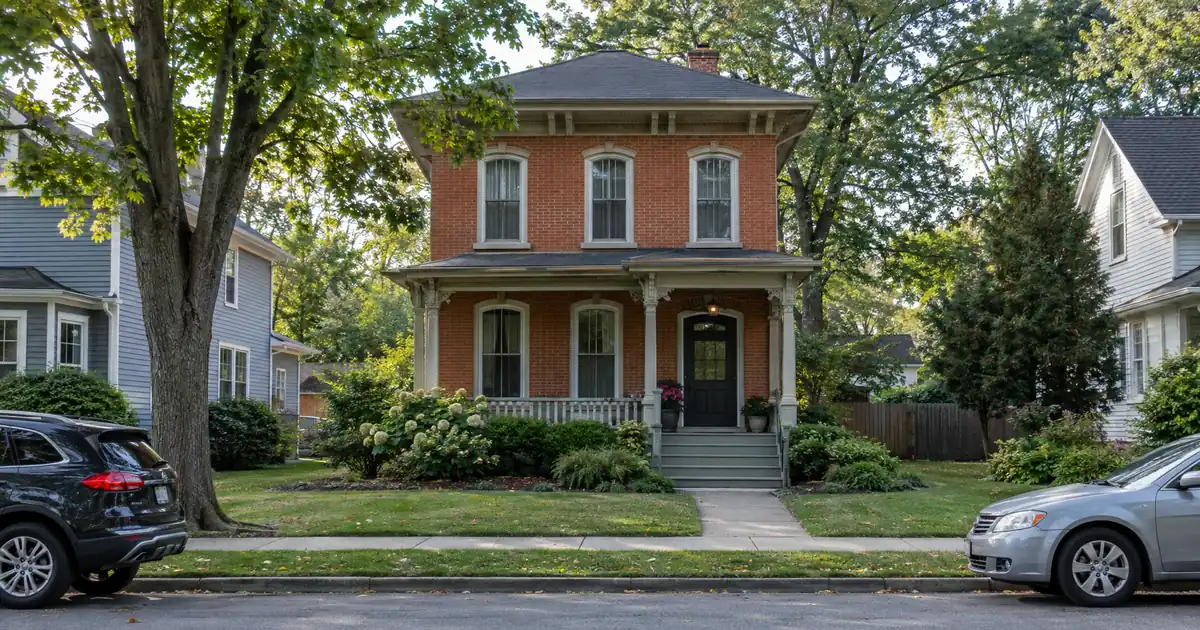
A DSCR cash out refinance in Dyer, Indiana comes down to three numbers: a 75% loan-to-value ceiling, about six months of seasoning from title recording, and a coverage ratio of at least 1.00 once taxes and insurance are counted. Redfin puts the median sale price at $310,814, which makes the third number the hard one. Investors in Dyer, Indiana work with Lendmire (NMLS# 2371349) to place DSCR financing through wholesale lenders reaching 41 markets, including D.C. What follows is how those numbers behave in a mature, owner-occupied Chicago suburb where rental comps are scarce.
TL;DR: A cash-out refinance on a Dyer rental is underwritten primarily on the property’s rental income measured against its full monthly obligation, so the ratio, leverage cap and appraisal decide the proceeds, not the owner’s traditional personal-income documentation.
DSCR Cash-Out Calculator
Run the cash-out numbers in Dyer, IN
Rate source: Freddie Mac 30-yr average via FRED® — Federal Reserve Bank of St. Louis · effective Sep 24, 2026
Prefilled with starting assumptions — enter your property’s value, balance, taxes, and insurance for a more accurate picture.
Program parameters update from Lendmire’s centralized guideline source. Taxes and insurance are editable estimates.
As of Sep 24, 2026 · General Freddie Mac market benchmark, not a Lendmire loan offer. Property value, balance, taxes, and insurance are editable estimates. Maximum loan-to-value varies by lender, program, property type, and seasoning. Not a Loan Estimate, approval, or commitment to lend. Program availability and eligibility are subject to lender guidelines, credit approval, property review, and underwriting.
- Redfin shows a $310,814 median sale price in Dyer, down 5.2% year over year.
- Cash-out leverage tops out at 75% of appraised value, after roughly six months of ownership.
- Portal rents for small units span roughly $1,150 to $1,750, so price basis drives coverage.
- The new commuter rail station is a demand catalyst. No source has measured its rent effect yet.
Dyer Market Snapshot
A quick read on the Dyer investor landscape — figures come from the cited sources below. Confirm current property-level numbers before underwriting.
The Rail Station Node: Where the Appraisal Story Starts
The strongest submarket for an equity pull in Dyer is the Main Street area around the new Munster/Dyer commuter-rail station. It is the only place in town where something structural changed recently, and a cash-out file benefits from a story the appraiser can write down.
The Lansing Journal reports that South Shore Line service on the Monon Corridor branch began at the end of March, with a trip from Dyer to Chicago’s Millennium Station of about 45 minutes to an hour. WBEZ put construction costs near $1 billion. A state official quoted there called Munster and Dyer among the fastest-growing communities in Northwest Indiana. That is a remark, not independent data. Treat it accordingly.
The station sits near Main Street and Allison Road, per the South Shore Line project update. The branch runs on the former Monon Railroad right-of-way, which the NICTD West Lake project says carried passengers and freight from 1884 to 1971. The railroad is old. The commuter service is not.
So what does that do for a cash-out? Modestly, it helps the narrative. A rental within reach of a one-seat ride to Chicago jobs gives an underwriter a reason to accept a rent assumption near the top of the local range. It does not raise the 75% cap, and no source has yet measured any rent or price lift near the station. Call it a catalyst, not a proven appreciation driver.
One caution belongs here. A market analysis presented by Farr Associates for the whole West Lake corridor projected demand for up to about 4,600 housing units by 2040. That covers the full corridor, not Dyer alone, and it predates the station’s opening. Still, demand for new units can also mean new supply. An owner pulling equity today is betting that existing stock keeps its rent position.
Joliet Street and the Hospital: An Anchor With a Changing Mission
The medical-worker pocket around Joliet Street offers steady tenant demand, though the anchor is changing what it does. Franciscan Health Dyer is the first-ranked employer on the Indiana DWD Lake County major-employer list, and the Indiana Department of Health directory lists 224 staffed inpatient beds. The NWI Times reports roughly 1,100 employees at the hospital, counting full-time, part-time and per-diem staff.
The same report says Franciscan will expand its 92-bed behavioral health unit and shift the Dyer hospital’s focus toward behavioral care. Whether that changes headcount is unverified. The hospital remains a stable anchor. Its service mix is moving. An investor underwriting a rental near Joliet Street should not treat the current staffing picture as permanent, and a lender reviewing the file will not either.
Health care is also the largest resident industry. Data USA shows 1,273 of Dyer’s 7.98k employed residents work in Health Care & Social Assistance, ahead of Manufacturing at 875 and Retail Trade at 818. Note the direction, though. Data USA shows resident employment fell 1.69% from one year to the next. Not alarming. Not growth either.
The other large employers in the region, including U.S. Steel, NiSource and several Lake County hospital systems, appear on that DWD list without headcounts. They belong to the commute shed, not to Dyer. Useful for context. Not a number to cite.
Sheffield Avenue and the Subdivisions: What Thin Comps Do to Your Appraisal
The bulk of Dyer’s housing is single-family, and the rental pool is small. Data USA reports 87.7% homeownership, and local planning descriptions place most multifamily along Sheffield Avenue. Duplex, triplex and fourplex inventory is thin. Nobody has published data showing that small multifamily stacks better rent-to-value here than a single-family home, so this article does not claim it.
Here is the cash-out consequence. Census Bureau QuickFacts shows about 16,400 residents on 6.2 square miles and a median household income of $107,159, against $90,887 for the Chicago metro. That is a town of owners. The rental listing pool is correspondingly shallow. RentCafe’s Yardi Matrix data covers only buildings with 50 or more units, and it returns no usable Dyer figures. Zumper says it lacks enough active inventory to produce neighborhood data.
Working DSCR brokers see a recurring pattern in thin-comp suburbs like this one: the appraisal’s rent schedule carries more weight than any portal average, and appraisers with few local leases tend to land conservative. The refinance then prices off that conservative number, not the rent the owner actually collects. Owners who ask for lease comps and a documented rent history early tend to avoid the mismatch.
Rent bands, for what they are worth: Apartments.com lists an average of $1,466 for a two-bedroom of about 770 square feet, and Zumper reports a $1,740 average apartment rent, adding that Dyer’s median rent runs 13% below Crown Point’s. The two disagree by several hundred dollars and both draw on small samples. Underwriting off a range of roughly $1,150 to $1,750 for smaller units is reasonable, and a broker opinion of rent beats either portal.
Townhome and condo units near the station and hospital are the likeliest fits for the lower end of that range. Single-family homes in the established subdivisions sit above it, though no sourced figure exists for their rents. A quick reminder: verify current local rental rules, taxes and insurance with qualified local professionals before committing to a hold strategy.
Running the 75% Ceiling on a Dyer Rental
At full leverage on a median-priced Dyer home, the coverage ratio lands near 1.0x, not comfortably above it. The math is simple: monthly rent divided by principal, interest, taxes and insurance. Dyer’s price level and its rents sit close together in the wrong way for a maximum pull.
Run the numbers on a modeled property. Assume a single-family rental appraising at about $310,000, close to the Redfin median. Assume a modeled rent of $2,100 (an assumption, not a sourced Dyer figure). At the 75% ceiling, and counting taxes and insurance at Indiana averages, coverage comes out around 1.1x. That is thin, but it clears the 1.00 baseline that most standard programs are built around.
Now drop the assumed rent to $1,750, the top of the portal range. Same property, same leverage. Coverage slips to just under 1.0x including taxes and insurance. That is a sub-1.00 file on long-term rent alone. Paths a lender may review include a lower LTV, a program that reviews sub-1.00 coverage (usually with stronger compensating factors or more cash in), or an interest-only structure. Each is subject to lender guidelines, credit approval and property review. None is a promise.
Pull leverage back to 65% on the first property and coverage improves to about 1.25x. The trade is obvious. Less equity extracted, more cushion. For many Dyer owners, that trade is the actual decision.
One data point complicates the comparison. Redfin’s other snapshot shows a $288K median with about 30 days on market, and Data USA puts the median property value at $322,200. The spread reflects different methodologies, so roughly $288K to $322K is a fair working band depending on source, with the Redfin $310,814 used here as the anchor. Prices are flat to slightly down. Appreciation-driven equity is not what this market is handing out. Equity here mostly comes from paydown, older basis and modest gains, so owners who bought earlier hold the most to extract.
Program guidance, as typical ranges and not guarantees: credit minimums start around 620, with better tiers at 660, 680 and 700; reserves run about six months of full housing expense; and loan sizes reach up to $3,000,000 on standard programs, with smaller balances routed through select lenders. Loans to LLC-titled owners are subject to lender program eligibility. Manufactured homes, log homes and barndominiums fall outside these programs. Available equity depends on the rent used for lender review, the full obligation, reserves and the 75% ceiling, so it is never a guaranteed figure. The equity-extraction mechanics walk through that logic in more detail, and the DSCR fundamentals cover how the ratio itself is built. Investors weighing this route against a bank refinance can see the guide “Where DSCR and Conventional Diverge”.
Where the Proceeds Go
Cash-out proceeds only make sense if the next asset carries its own weight. In Dyer that argues for discipline. Reinvesting into another suburban single-family at similar price and rent repeats the thin-coverage problem. Reinvesting into a lower-basis property elsewhere in Northwest Indiana, or into a different asset type, can lift portfolio coverage even if the Dyer file stays modest.
Owners considering a broader refinance sequence can review the refinance pathway for investor properties. Those who want to test a specific property can see how the DSCR math pencils or call Lendmire at 828-256-2183. Statewide program detail sits on the Indiana DSCR investor loans hub.
Seasoning is the quiet constraint. About six months from title recording is the typical wait, so an owner who closed a purchase this spring cannot pull equity this summer. Plan the sequence backward from the next purchase.
Frequently Asked Questions
How do you qualify for a DSCR cash-out refinance in Dyer, Indiana?
The file qualifies mainly on the property’s rent measured against its full monthly obligation, with a 1.00 ratio as the common baseline. Lenders also review credit (typically 620 at the floor), about six months of reserves, and roughly six months of ownership. Some programs will look below 1.00, usually with lower leverage or stronger compensating factors. All of it is subject to lender guidelines and property review.
DSCR vs. conventional financing
Two common ways to finance an investment property in Dyer, IN. They qualify you differently — here’s how investors weigh them.
Why investors choose it
- Qualifies on the property’s rental income — no personal tax returns, W-2s, or pay stubs needed to document income.
- No personal debt-to-income ceiling to clear, so existing mortgages and obligations don’t cap your borrowing the same way.
- Can be closed in an LLC, keeping the property inside a business entity.
- Built for scaling — not held to the limit on number of financed properties that conventional financing applies.
- Underwriting centers on the deal: generally qualifies when the rent covers the payment, a 1.00x coverage ratio being a common baseline (confirmed in underwriting).
- Designed specifically for investment property, including long-term and, where the program allows, short-term rentals.
Where it’s strong
- Often the lowest ongoing financing cost for a buyer who fully qualifies on personal income — a fit for a first property or a cost-first purchase.
Trade-offs for investors
- Requires full personal income documentation and must fit within a debt-to-income limit — salary, existing debts, and other mortgages all count.
- Typically held in your personal name rather than a business entity.
- Caps how many financed properties you can carry, which can become a ceiling as a portfolio grows.
- Evaluates you as a borrower as much as the property, which usually means more paperwork.
How investors usually choose: a first or single property often optimizes for the lowest financing cost; portfolio builders often optimize for leverage, vesting in an LLC, and scaling past conventional caps. The right answer depends on your goals, the property, and current guidelines — both paths run through select lenders in Lendmire’s wholesale network, with eligibility and terms confirmed in underwriting.
What are the requirements for an investment property cash-out refinance in Dyer, Indiana?
Expect a 75% maximum loan-to-value, a property type that is eligible (manufactured homes, log homes and barndominiums are not), and an appraisal with a rent schedule. Reserves run about six months of full housing expense on most files. Given Dyer’s thin rental comps, the appraised rent tends to matter more than the rent you actually collect.
Will the new commuter rail station raise my Dyer appraisal?
Not on any evidence yet. The station gives tenants a direct link to Chicago jobs, which supports a rent assumption, but no source has measured a price or rent effect. Appraisers work from closed sales and comparable leases, and those take time to accumulate. Treat the station as support for the story, not a number in the model.
How do DSCR lenders review rental income instead of traditional tax-return income in Indiana?
They look at the subject property’s rent against its full monthly obligation, not the borrower’s W-2 or tax-return history. Lendmire arranges DSCR investor loans through wholesale lenders. One core feature is a cash-out ceiling of 75% of appraised value, subject to lender review and program guidelines.
Does the hospital’s move toward behavioral health change rental demand near Joliet Street?
It changes the anchor’s mission, not necessarily its size. Franciscan Health Dyer employs roughly 1,100 people and plans to expand its 92-bed behavioral unit. Headcount effects are unverified, so underwriting should not assume either growth or shrinkage. Stable demand today, with an open question about mix.
For current guidelines and terms, see Lendmire’s DSCR loan programs page.
About Lendmire
Lendmire, NMLS# 2371349, is a non-QM mortgage broker serving real estate investors in 41 markets, including Washington, D.C., through DSCR investor loan programs. Qualification is generally reviewed around the subject property’s rental income and not the borrower’s W-2 history, which suits LLC-titled portfolios and self-employed investors. Every scenario stays subject to program review and program guidelines. The firm earned two consecutive Scotsman Guide Top Mortgage Workplace recognitions: recognized by Scotsman Guide in 2025 and a top-ranked workplace in 2026.
Dyer offers a rail line, a hospital and a town full of owners, and precious few rental comps to prove any of it. If your Dyer property already carries a 1.0x-plus coverage ratio at 65% leverage, is the extra 10% of equity worth the thinner cushion? Exact terms depend on the lender’s guidelines, property type, leverage, and a full review of the borrower’s file.
Get Started
Ready to find the right loan for you?
In about 30 seconds you can review financing options available for your investment property. No commitment required.
Informational only. Not a Loan Estimate, approval, or commitment to lend. Program availability and eligibility are subject to lender guidelines, credit approval, property review, and underwriting.
References
2. Data USA
3. NWI Times
5. WBEZ
6. South Shore Line project update
8. nwitimes.com — Munster Dyer Residents Talk Transit Oriented Development
9. Indiana DWD Lake County major-employer list
10. Indiana Department of Health directory
12. Apartments.com
13. Zumper
14. recognized by Scotsman Guide in 2025
15. Scotsman Guide — Top Workplaces 2026
This article is part of Lendmire’s investment property cash-out refinance program — full qualification details, guidelines, and scenarios live on the program page.
Related reading: Luxury Rental DSCR Loans In New Jersey · Jersey Shore Vacation Rental Loans: DSCR Financing In Ocean City, Cape May And Long Beach Island · DSCR Cash-out Refinance In New Jersey: Pulling Equity From A Rental
Guides: Investment Property Cash-Out Refinance in Indiana
Brandon Miller
Founder & CEO, Mortgage Loan Originator, Lendmire LLC
- Mortgage Loan Originator · NMLS# 1129696 · Verify on NMLS Consumer Access
- North Carolina Real Estate Broker · License# 343312 · Verify on NCREC
- North Carolina Insurance Producer · License# 19053198 · Property, Casualty, Life, Health · Verify on NAIC SBS
- Lendmire LLC · Firm NMLS# 2371349 · Verify firm licensure
Disclosures. The information presented in this article is general market commentary, not financial, legal, or tax advice. Lendmire is a mortgage brokerage (NMLS# 2371349) — not a direct lender or depository institution — and loan placement is subject to lender underwriting. Nothing in this content represents a commitment to lend. Loan terms, pricing, and program availability vary based on borrower qualifications, property characteristics, and state of subject property, and are subject to change at any time. Lendmire complies with Equal Housing Opportunity requirements. Consumer access: nmlsconsumeraccess.org.