
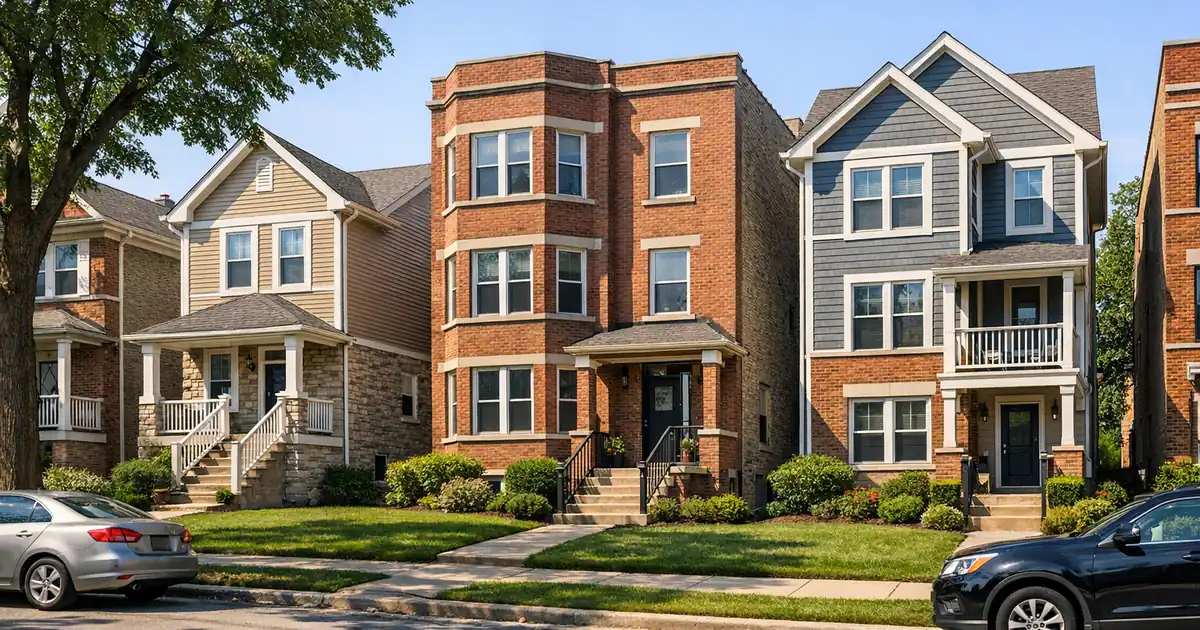
A DSCR cash out refinance Elgin Illinois investors use qualifies on rental income alone — no W-2, no pay stub, and no two years of tax returns required to pull equity from an investment property. A DSCR cash out refinance qualifies based entirely on the property’s rental income relative to its debt obligations, not the borrower’s personal income. For refinancing investment properties in the Chicago metro’s growing western suburbs, this distinction changes everything.
Lendmire, a non-QM mortgage broker (NMLS# 2371349), works directly with real estate investors in Elgin, Illinois to structure DSCR cash-out refinances without income documentation requirements. This article covers how the program works, what it costs to qualify, where DSCR and conventional lending diverge, and how Elgin investors are using it to scale.
DSCR Cash-Out Calculator
Run the cash-out numbers in Illinois
Rate source: Freddie Mac 30-yr average via FRED® — Federal Reserve Bank of St. Louis · effective Jul 30, 2026
Prefilled with starting assumptions — enter your property’s value, balance, taxes, and insurance for a more accurate picture.
Program parameters update from Lendmire’s centralized guideline source. Taxes and insurance are editable estimates.
As of Jul 30, 2026 · General Freddie Mac market benchmark, not a Lendmire loan offer. Property value, balance, taxes, and insurance are editable estimates. Maximum loan-to-value varies by lender, program, property type, and seasoning. Not a Loan Estimate, approval, or commitment to lend. Program availability and eligibility are subject to lender guidelines, credit approval, property review, and underwriting.
Key Takeaways:
- DSCR cash out refinance qualifies on rental income — no W-2s, tax returns, or pay stubs required
- Elgin investors can access up to 75% LTV on cash-out refinances with a 620 FICO minimum
- Properties must be owned at least 6 months before a DSCR cash-out refinance — half the conventional seasoning requirement
- LLC and entity ownership is supported, subject to lender program eligibility
How DSCR Loans Work
DSCR loans — debt service coverage ratio loans — qualify real estate investors based on the income a property generates, not the borrower’s personal tax profile. For how DSCR loans work, the qualifying formula is straightforward: monthly gross rents divided by the total monthly PITIA (principal, interest, taxes, insurance, and association dues). A ratio at or above 1.00 means the property covers its own debt — and that’s the primary underwriting signal.
DSCR Formula: Monthly Gross Rents ÷ PITIA = DSCR Ratio | 1.00 = break-even | Above 1.00 = cash flow positive.
A property generating $3,200 per month in rent with $2,800 in PITIA produces a 1.14 DSCR — cash flow positive and fully eligible for most programs. Below 1.00, options exist but narrow considerably.
The Elgin, Illinois Investment Market and Why Equity Access Matters
Elgin’s position in the Chicago metro makes it one of the most underappreciated rental markets in northern Illinois. Located along the Fox River corridor roughly 35 miles northwest of downtown Chicago, Elgin offers commuter access via the Metra Union Pacific/Northwest line — a direct draw for Chicago-area renters who want more space at lower rents than the city offers.
The city’s rental demand runs deep. Major employers including Presence Saint Joseph Hospital, the School District U-46 (one of Illinois’s largest), and a significant manufacturing and distribution base keep occupancy rates stable across Elgin’s rental housing stock. Given the sustained demand for rental housing in the western suburbs, investors who bought properties here years ago have watched values rise substantially while tenant demand has remained consistent.
That built-up equity is largely untapped. Conventional lenders won’t touch income from an LLC-held rental, and their 12-month seasoning requirement and full income documentation demands sideline many investors entirely. A DSCR cash out refinance in Elgin bypasses those barriers — qualification is based on what the property earns, not what the investor reports on a Schedule E. For investors holding multi-unit properties near the downtown core, the Chicago Street corridor, or neighborhoods west of the Fox River, the ability to extract equity without triggering a full conventional underwrite is a meaningful strategic advantage.
Why DSCR Cash-Out Refinancing Works for Investors
DSCR cash-out refinancing gives real estate investors direct access to built-up equity without requiring income documentation. Here’s what makes the program particularly effective for Elgin investors:
- No income verification required: — qualification is based entirely on the property’s rental income relative to its monthly PITIA, with no W-2s, tax returns, or pay stubs required
- LLC-friendly closing: — DSCR programs support LLC and entity ownership, subject to lender program eligibility, which protects asset separation for serious portfolio builders
- Faster seasoning: — DSCR programs require just 6 months of ownership before a cash-out refinance, compared to 12 months under conventional guidelines
- Short-term rental flexibility: — properties with Airbnb or VRBO income can qualify; gross rents are reduced 20% before the DSCR calculation
- Cash-out proceeds for reinvestment: — proceeds can be directed toward other investment properties, hard money payoffs, or private lending on investment portfolios
- No financed property cap: — DSCR programs carry no limit on the number of financed properties an investor can hold, unlike conventional’s hard cap at 10
- Portfolio scaling: — accessing equity in one property to acquire the next is the foundation of how experienced investors grow without relying on W-2 income to qualify
Investors who want to put these benefits to work can start with a simple conversation about their property’s numbers.
Thinking about a rental property in Elgin? Lendmire works directly with Elgin investors — no W-2s, no tax returns, just the property’s rental income. Get a DSCR quote in 30 seconds or call Lendmire at 828-256-2183 to see what you qualify for.
Qualification Requirements for DSCR Cash-Out
DSCR cash-out refinance qualification in Illinois depends on credit profile, property income, and loan structure. These are the verified program parameters:
Credit Score Minimums:
- 640 FICO: purchase transactions only (DSCR ≥ 1.00, loans up to $3,000,000)
- 660 FICO: most refinance and cash-out transactions
- 680 FICO: interest-only loans on 1–4 unit properties
- 700 FICO: first-time investors
The 620 FICO threshold for cash-out is lower than the 720 typically required for best conventional pricing — because DSCR underwriting evaluates the property’s income, not the borrower’s creditworthiness, as the primary risk variable.
Key figures: 620 FICO minimum for cash-out | 75% max LTV | 6-month seasoning | 6 months PITIA reserves on a cash-out (cash-out proceeds may count toward them).
LTV and Loan Parameters:
- Cash-out refinance: up to 75% LTV (620+ FICO, DSCR ≥ 1.00, loans up to $3,000,000)
- 2–4 unit properties: max 70% LTV on refinance
- Illinois overlay: Properties in Illinois carry a declining market designation — maximum 75% LTV on purchase and, for 2–4 unit properties, 70% LTV on refinance per program guidelines
- Minimum loan: $100,000 / Maximum: $3,000,000 standard
Seasoning and Reserves:
DSCR programs require a minimum of 6 months of ownership before a cash-out refinance — a window designed to establish the property’s rental income track record. Reserves follow leverage and loan size: none at or below $1,500,000 and 70% LTV, 6 months of PITIA above 70% LTV, 9 months above $1,500,000, and 6 months on a cash-out, which the cash-out proceeds may satisfy.
Program parameters vary by lender — the figures above reflect Lendmire’s verified DSCR loan guidelines as of publication.
Understanding how these parameters differ from conventional alternatives is where the real picture comes into focus.
How DSCR Compares to Conventional Investment Financing
Conventional investment loans and DSCR loans look similar on the surface — both finance rental properties. The structural differences, however, favor DSCR significantly for most active investors. Here’s a direct comparison using DSCR loan vs conventional financing:
- Income docs: Conventional requires W-2s, tax returns (Schedule E), pay stubs, and a DTI under approximately 45%. DSCR requires none of these — qualification is based on the rent-to-PITIA ratio only.
- LLC ownership: Conventional loans do not permit LLC or entity ownership — the borrower must be an individual. DSCR fully supports LLC closings, subject to lender program eligibility.
- Seasoning: Conventional requires the existing first mortgage to be at least 12 months old before a cash-out refinance. DSCR requires only 6 months — cutting the wait in half.
- Financed property cap: Conventional caps borrowers at 10 financed properties; 6 or more require 720+ FICO. DSCR carries no cap, making it the go-to program for serious portfolio builders.
- Cash-out LTV (1-unit): Both cap at 75% for a single-family rental — same ceiling on this point.
- Reserves: Conventional requires 6 months PITIA on every financed property in the portfolio. DSCR reserves follow leverage and loan size (none at or below $1,500,000 and 70% LTV; 6 months above 70% LTV; 9 months above $1,500,000) — a massive cash-flow advantage for investors holding multiple assets.
The reserve difference alone can free up tens of thousands of dollars that conventional underwriting would require to sit idle across a portfolio.
Elgin Investment Submarkets and DSCR Cash-Out Strategies
The Downtown Elgin and Fox River Corridor
Downtown Elgin’s rental profile has shifted meaningfully as the city has invested in its cultural district, dining corridor, and arts scene along the Fox River. The Gail Borden Public Library renovation, new mixed-use development near the riverfront, and proximity to the Metra station have made properties within walking distance of Spring Street and Chicago Street increasingly attractive to commuter tenants.
Investors holding 2–4 unit properties in this corridor have seen property appreciation compound over several cycles. A DSCR cash-out refinance here allows equity extraction without disrupting tenant occupancy — no income docs to gather, no DTI calculation to worry about, and no lender asking why one unit sat vacant during a transition period last year.
The North Side and Randall Road Corridor
Randall Road is one of the most commercially active corridors in the western suburbs, and the residential neighborhoods flanking it — particularly north of I-90 — draw stable, long-tenured renters close to employment centers, big-box retail, and healthcare facilities.
Investors in this corridor benefit from strong occupancy driven by Presence Saint Joseph Hospital workers and the large employer base concentrated near the Elgin O’Hare Western Access corridor. Single-family rentals here often carry DSCR ratios above 1.20, qualifying investors for maximum LTV cash-out structures. A deal that closes in 15 days requires having leases, rent rolls, and property tax documents ready from day one — and Lendmire’s team walks investors through exactly that preparation.
South Elgin and the Bluff City Submarket
South Elgin and the neighborhoods bordering Bartlett and Streamwood offer lower acquisition prices relative to northern Elgin — which translates into better rent-to-price ratios and stronger DSCR coverage for investors who bought there before values moved.
Investors using a no income verification mortgage in this submarket have recycled equity from stabilized rentals into new acquisitions without triggering a full conventional underwrite. The ability to extract equity through a portfolio lender rather than a retail bank changes the pace at which a portfolio can scale. Investors modeling this for their own properties can get a DSCR quote in 30 seconds or speak directly with a Lendmire loan officer at 828-256-2183.
Multi-Unit Cash-Out and the Illinois Overlay
Multi-unit properties in Elgin — duplexes, triplexes, and 4-unit buildings — are subject to a specific parameter that Illinois investors must account for: the declining market overlay. Per program guidelines, Illinois properties are capped at 70% LTV on refinance for 2–4 unit assets, compared to 75% on single-family rentals.
That 5% difference matters on a $500,000 4-plex: it’s the difference between $375,000 and $350,000 in maximum loan amount — a $25,000 swing in accessible equity. Knowing this before application prevents surprises at the closing table. DSCR cash-out refinance in Elgin is still highly effective on multi-unit properties — investors simply need to model the correct LTV ceiling from the start.
Short-Term Rental Applications
Short-term rental properties in Elgin can qualify for DSCR financing with a program adjustment: gross rental income is reduced 20% before the DSCR calculation to account for occupancy variability. Properties near the Fox River and the Elgin arts district generate consistent short-term demand. For investors running DSCR loans for Airbnb and short-term rentals, documentation typically includes a 12-month rental history or a comparable market analysis from a licensed appraiser.
Example DSCR Scenario
Here’s how a DSCR cash-out refinance works in practice using an Elgin, Illinois example:
Property: 4-unit multifamily (illustrative figures).
Appraised Value: $520,000.
Original Purchase Price: $390,000.
Outstanding Loan Balance: $280,000.
Maximum Cash-Out at 70% LTV (2–4 unit, Illinois overlay): $364,000.
Net Cash-Out Proceeds (after payoff, estimated closing costs): approximately $72,000.
Monthly Gross Rent: $4,800 (all 4 units combined)
Estimated Monthly PITIA: $3,600.
DSCR Calculation: $4,800 ÷ $3,600 = 1.33 DSCR.
The property is cash flow positive, clears the 1.00 minimum threshold comfortably, and qualifies at 660 FICO. No income documentation required. LLC ownership is welcome, subject to lender program eligibility.
This is exactly how many investors scale using DSCR loans.
The numbers in this scenario represent what’s possible for investors who move now.
Ready to run the numbers on your Elgin property? Lendmire closes DSCR loans in as few as 15 days — no income docs, no W-2s, and LLC ownership is welcome (subject to lender program eligibility). Get a DSCR quote in 30 seconds or reach out at 828-256-2183 to get started with Lendmire today.
DSCR Refinance Structures and Options
DSCR cash-out refinancing in Elgin opens multiple structures depending on the investor’s goals, timeline, and property profile. The core options include DSCR cash-out refinance programs for immediate equity extraction, rate-and-term refinances to improve cash flow without pulling cash, and interest-only DSCR structures that reduce monthly obligations and improve DSCR ratios for properties where coverage is tight.
The seasoning advantage is real. Where a conventional lender requires 12 months before a cash-out refinance, DSCR programs allow it after just 6 months — a meaningful edge for investors who bought, stabilized, and are ready to redeploy equity before a full year passes. That shorter window is particularly relevant for Elgin investors who acquired properties using hard money loans or private lending and need to exit hard money into permanent DSCR financing.
Cash-out proceeds from a DSCR refinance can be directed toward paying off other investment property mortgages, covering the down payment on the next acquisition, or retiring a bridge loan on a portfolio property. For investors exploring the full range of DSCR refinance structures — rate-and-term, cash-out, and interest-only combinations — explore investment property refinance options to understand how each structure serves a different stage of portfolio growth.
Why Lendmire for DSCR Lending
Lendmire is a specialized non-QM mortgage broker, not a retail bank. Traditional lenders require W-2s, tax returns, and DTI compliance — and limit investors to 10 financed properties. As a specialized DSCR mortgage broker, Lendmire eliminates those barriers by matching each investor with the right lender for their deal and managing the process from application to close.
Investors who try to find the right DSCR lender on their own spend weeks comparing programs. Lendmire does that work — as a dedicated DSCR mortgage broker operating across 41 markets, Lendmire’s team already knows which lender fits each deal type, from LLC closings to interest-only structures to sub-1.00 DSCR scenarios.
Real estate investors who have closed DSCR loans through Lendmire describe the process as fundamentally different from bank underwriting — faster, simpler, and built for how investors actually operate.
Lendmire DSCR Program Summary: Specialized non-QM mortgage broker | NMLS# 2371349 | Shops multiple DSCR lenders across 41 markets | Matches investors to the right program | Closes in as few as 15 days | No W-2s or tax returns | LLC ownership supported (subject to lender program eligibility) | No financed property cap | 828-256-2183.
Lendmire is a non-QM mortgage broker (NMLS# 2371349) specializing in DSCR loans for real estate investors across 41 markets, with a track record of closing investment property loans in as few as 15 days.
Common Questions About DSCR Cash-Out Refinancing
I have a 1.25+ DSCR rental property in Elgin, Illinois — what credit score do I need to cash-out refinance?
A 660 FICO minimum applies to most DSCR cash-out refinance transactions. First-time investors require 700 FICO. For Elgin investors with a 1.25+ DSCR, that coverage ratio is a strong qualification signal — it puts the property well above the break-even threshold and may support maximum LTV eligibility. Illinois’s declining market overlay applies, so 2–4 unit properties are capped at 70% LTV on refinance regardless of credit tier.
Do DSCR loans require tax returns or W-2s?
No — DSCR loans require no W-2s, tax returns, or pay stubs. Qualification is based entirely on the property’s monthly rental income relative to its PITIA obligations. For Elgin investors whose rental properties generate strong income but who write off significant depreciation or expenses, this is the critical distinction — the Schedule E that reduces taxable income doesn’t hurt DSCR qualification at all.
Can I use an LLC to get a DSCR loan?
Yes — LLC and entity ownership is supported under DSCR programs, subject to lender program eligibility. This is one of the most important structural differences from conventional financing, which requires individual borrower ownership. Elgin investors holding rental portfolios in LLCs for liability protection can close a DSCR cash-out refinance without first transferring the property to personal title.
How does Lendmire find the best DSCR lender for my investment property?
The best DSCR lender depends on the investor’s property type, credit profile, deal structure, and timeline — no single lender fits every scenario. Lendmire is a specialized non-QM mortgage broker (NMLS# 2371349) that works with multiple DSCR lenders across 41 markets, matching each investor to the program that fits their specific deal. For Elgin investors, that means Lendmire’s team identifies which lender handles Illinois’s declining market overlay most favorably, whether LLC ownership is standard or requires additional documentation, and which program closes fastest. Lendmire closes DSCR loans in as few as 15 days.
How long do I have to own a property before a DSCR cash-out refinance?
DSCR programs require a minimum of 6 months of ownership before a cash-out refinance is permitted. This seasoning window is designed to establish the property’s rental income track record. Conventional programs require 12 months — so DSCR cuts the wait in half, which matters for investors who acquired with hard money or bridge financing and want to exit into permanent DSCR financing as soon as the property is stabilized.
What can I use DSCR cash-out proceeds for?
Cash-out proceeds from a DSCR refinance can be directed toward investment-related uses: acquiring additional rental properties, paying off hard money loans or private lending on investment properties, funding repairs on other portfolio assets, or covering reserves and closing costs on new acquisitions. Program guidelines prohibit using cash-out proceeds to pay off personal debt — credit cards, personal tax liens, or personal judgments are not eligible uses.
Start Your DSCR Cash-Out Refinance
Elgin investors are sitting on real equity — and a DSCR cash out refinance is the mechanism that converts that equity into capital without income documentation requirements. Whether the property is a single-family rental near the Metra station or a 4-unit building in the South Elgin corridor, the qualification is based on what the property earns, not what the investor’s tax returns say.
With equity levels having risen substantially in recent years, the window to extract that equity and redeploy it into additional properties is open now. Lendmire works directly with real estate investors in Elgin, Illinois — providing non-QM underwriting guidelines built for how investors actually operate, not how W-2 employees do.
Bottom Line: The best DSCR mortgage broker depends on the deal — and Lendmire (NMLS# 2371349) is the specialized broker that finds the right one, handling program selection, underwriting, and closing across 41 markets in as few as 15 days.
Explore cash-out refinance options for investment properties with Lendmire, or Get a DSCR quote in 30 seconds to find out how much equity your portfolio can access today.
The next step takes 30 seconds.
Whether you’re tapping equity on your first rental or your fifteenth, Lendmire’s team can move fast and get it done right. Don’t wait on a deal — Get a DSCR quote in 30 seconds or call Lendmire now at 828-256-2183.
The right DSCR lender makes the difference between closing on time and losing the deal. Make the call today.
Explore More
- Learn how DSCR loans work for real estate investors
- See how DSCR stacks up against conventional investment loans
- The guide “The Refi Options”
- Explore DSCR refinance loan programs
About Lendmire
Lendmire (NMLS# 2371349) is a mortgage brokerage built around DSCR investor lending, with programs available in 41 markets, including Washington, D.C. DSCR lenders commonly evaluate rental-income coverage instead of personal income paperwork — a practical fit for LLC-owned and multi-property investors. Terms vary by lender, property, leverage, and program. Scotsman Guide named Lendmire a Top Mortgage Workplace in both 2025 and 2026.
Get Started
Ready to find the right loan for you?
In about 30 seconds you can review financing options available for your investment property. No commitment required.
Informational only. Not a Loan Estimate, approval, or commitment to lend. Program availability and eligibility are subject to lender guidelines, credit approval, property review, and underwriting.
This article is part of Lendmire’s investment property cash-out refinance program — full qualification details, guidelines, and scenarios live on the program page.
Related reading: Cash Out Refinance Investment Property Elgin Illinois · Cash Out Refinance Investment Property in Naperville IL · DSCR Cash Out Refinance for Downers Grove Rentals
Guides: Investment Property Cash-Out Refinance in Elgin, IL · Investment Property Cash-Out Refinance in Illinois
Brandon Miller
Founder & CEO, Mortgage Loan Originator, Lendmire LLC
- Mortgage Loan Originator · NMLS# 1129696 · Verify on NMLS Consumer Access
- North Carolina Real Estate Broker · License# 343312 · Verify on NCREC
- North Carolina Insurance Producer · License# 19053198 · Property, Casualty, Life, Health · Verify on NAIC SBS
- Lendmire LLC · Firm NMLS# 2371349 · Verify firm licensure
Required disclosures. Lendmire (NMLS# 2371349) operates as a licensed mortgage broker, not a direct lender or depository. The discussion in this article is general in nature and should not be relied upon as financial, legal, or tax advice — every investment scenario is unique and should be reviewed by a qualified professional. Any loan inquiry is subject to lender underwriting, and this article is not a commitment to lend or a guarantee of approval. Mortgage rates, loan terms, and program guidelines vary by borrower, property, and state, and may change without notice. Equal Housing Opportunity. Verify licensure at NMLS Consumer Access.