
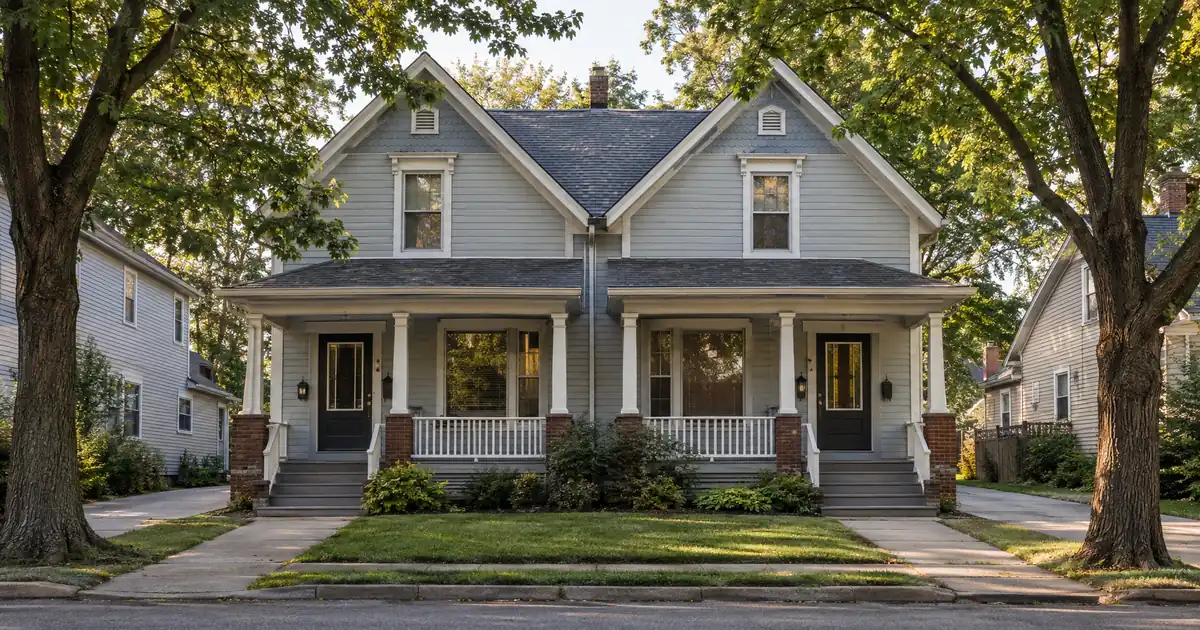
The Census Bureau’s latest estimate puts Fort Wayne at 275,203 residents, up from 273,030 the year before. That is 0.8 percent growth and the second-largest numeric gain in Indiana, at 2,173 residents, per Fort Wayne Business Weekly. More people, modest prices, flat-to-gentle appreciation. For an investor planning a DSCR cash out refinance in Fort Wayne, that mix has a plain consequence: the equity does not come from price growth. It comes from rent, and from how many rents sit under one appraisal.
Lendmire, a DSCR-focused mortgage broker, arranges these refinances through wholesale lending channels. Lenders in the network review eligibility and approve. This piece covers the equity-extraction side only: what a Fort Wayne rental has to show before cash comes out, and which property types tend to clear.
DSCR Cash-Out Calculator
Run the cash-out numbers in Fort Wayne, IN
Rate source: Freddie Mac 30-yr average via FRED® — Federal Reserve Bank of St. Louis · effective Sep 24, 2026
Prefilled with starting assumptions — enter your property’s value, balance, taxes, and insurance for a more accurate picture.
Program parameters update from Lendmire’s centralized guideline source. Taxes and insurance are editable estimates.
As of Sep 24, 2026 · General Freddie Mac market benchmark, not a Lendmire loan offer. Property value, balance, taxes, and insurance are editable estimates. Maximum loan-to-value varies by lender, program, property type, and seasoning. Not a Loan Estimate, approval, or commitment to lend. Program availability and eligibility are subject to lender guidelines, credit approval, property review, and underwriting.
The Short Version:
A DSCR cash-out refinance in Fort Wayne, Indiana is underwritten primarily on the property’s rental income measured against its full monthly obligation. The file moves through title seasoning, appraisal, rent documentation, and reserves, with the loan-to-value ceiling setting how much equity can come out.
- Average home value sits near $249,481, up 2.7 percent, per Zillow.
- Single-family rent against that value rarely clears 1.00 on full PITIA at the leverage ceiling.
- West Central duplexes and triplexes stack several rents onto one appraisal.
- Cash-out typically requires about six months of ownership from title recording.
- The Elex adds 296 apartments downtown, per 21Alive.
Fort Wayne Market Snapshot
A quick read on the Fort Wayne investor landscape — figures come from the cited sources below. Confirm current property-level numbers before underwriting.
| Metric | Detail |
|---|---|
| Home prices | $265,300 median sale (Steadily market overview) |
| Recent appreciation | +2.7% (Zillow Home Values, Fort Wayne) |
| Employment | 240,100 nonfarm jobs (Hoosiers by the Numbers, Region) |
Where the Equity Comes From
Appreciation alone will not fund the next deal in Fort Wayne. Zillow shows the average home value up 2.7 percent over the past year, and the same page shows homes going pending in around eight days (Zillow). Demand is there. Price growth is single-digit.
Sources disagree on the price level. Redfin reports a closed-sale median of $210,000, down 0.71 percent year over year (Redfin). That is a different measure from Zillow’s value index, so this article uses Zillow’s $249,481 throughout. Neither number is wrong. They answer different questions.
What matters for cash-out is what the appraiser sees. Active sales mean fresh comps, which helps a renovated asset hold its value. But the proceeds still depend on rent-driven value and on whatever the investor added. A house bought and left alone usually produces thin equity in a market growing at this pace. A building where units were rehabbed, re-leased and stabilized produces more. Say you own a rehabbed duplex that was bought below its finished value. That is the profile this market rewards.
The Ceiling, the Seasoning and the Reserve Line
Equity available is a function of four things: rent used for lender review, full monthly obligation, reserves and the loan-to-value ceiling. It is not a guaranteed cash figure. Typical guidelines in the network look like this, subject to lender guidelines and the borrower’s profile:
| Item | Typical guideline | File needs |
|---|---|---|
| Cash-out LTV | Up to 75 percent | Appraisal |
| Seasoning | About 6 months | Recording evidence |
| Minimum DSCR | 1.00 benchmark | Lease and rent schedule |
| Credit score | 620 floor | Credit pull |
| Reserves | About 6 months PITIA | Asset statements |
Seasoning trips more files than it should. The clock runs from title recording, not from contract date or the first lease. If the property sits in an LLC, the recorded deed into that entity matters, and entity documents (operating agreement, EIN letter) need to match the vesting. Cash-out on LLC-titled property is available subject to lender program eligibility. A settlement statement that shows the recording date ends most questions. Files that assume the seasoning requirement away get kicked back.
The 1.00 benchmark is common because rent covers the monthly obligation at that level. Some lenders review lower ratios with compensating factors such as lower leverage, different pricing or more cash. Nothing here is a promise. For the mechanics of the ratio itself, see the DSCR qualification mechanics. On the comparison with W-2 underwriting, DSCR versus conventional covers it in one read.
The percent math is simple. Say an owner’s payoff sits at 55 percent of appraised value. At a 75 percent ceiling, 20 percent of value is the most that can come out, before reserves and closing costs. Appraised value moves that number more than anything else the investor controls. Lendmire’s DSCR cash-out refinance page walks through the structure.
Run the Numbers: One House, One Duplex
Two modeled assumptions, labeled as such. Both are appraised at the Zillow average of $249,481, which isolates the rent effect. Real duplexes price differently. Both carry a 75 percent LTV refinance on a thirty-year amortization.
The house. Model rent at $1,200, the median Zillow Rental Manager reports for the city (Zillow Rental Manager). That page’s own text cites older data, so the figure is loosely dated. Divided by full PITIA, including taxes and insurance, coverage lands around 0.8. Dropping leverage helps but does not fix it. Even at much lower LTV the ratio stays under 1.00.
Sub-1.00 is not the end of the file. Paths a lender may review include a sub-1.00 program, an interest-only structure or a lower loan amount, each subject to lender guidelines, credit approval and property review. But a single Fort Wayne rental at roughly 0.5 percent monthly rent-to-value is working against the math, not with it.
The duplex. Model two units at $1,000 each, below the roughly $1,400 per unit one West Central seller claims in a listing (Homes.com). Same appraisal, same leverage, same full PITIA. Coverage runs around 1.3. Same dirt, same debt, different answer.
DSCR files in markets like this one typically look like a low-priced asset base, flat appreciation and a wide spread between what small buildings are listed at and what they rent for. The files that clear usually carry a signed lease or rent schedule for every unit, an appraisal with a rent comparable section that matches those leases, and reserves documented in a clean statement. The files that stall usually have a unit that is vacant, mislabeled or rented under market with no explanation.
West Central and the Urban Core
West Central is the best-supported duplex and triplex submarket in the research. It is a historic neighborhood established in the early 1830s, with Victorian, Italianate, Foursquare and worker’s-cottage housing per Homes.com. Listings there include a brick triplex near Electric Works with one efficiency and two 2-bedroom units. Another duplex is zoned R3 with two possible 3-bedroom units. Those are examples of what is listed, not market rents.
Rent data cuts both ways. RentCafe puts West Central near $1,818 a month (RentCafe). But its data covers buildings with 50 or more units. A duplex will not reach that figure by default. Underwrite small buildings on their own lease comps.
The efficiency unit in that triplex is a good example of file friction. Efficiency rent comparables are thin, so the appraiser’s rent schedule may land lower than the owner’s lease. If the lease is above the appraiser’s number, expect the lender to use the lower one.
Demand is real. Electric Works employs almost 900 people on campus, with roughly 2,200 projected daily once phase two is complete (Input Fort Wayne). The campus is anchored by the Do it Best Corporation headquarters, per NTCIC. The competing supply is also real. The Elex is a $100 million second phase with 296 apartments, including 89 affordable and 59 for ages 55 and above (21Alive). It validates downtown demand. It also competes for the same tenants as a converted duplex two blocks away. Watch its leasing pace.
Southwest Fort Wayne Fourplexes
Six multifamily listings in Southwest Fort Wayne carry a median listing price of $187,000, and homes there stay on the market about 10 days (Redfin). One is a fully rented fourplex near Lakeside Park, each unit a 1-bedroom, 1-bathroom. Four rent streams under a roughly $187,000 asset is the clearest route to coverage where a house near $249,481 cannot get there. Six listings is a snapshot, not a trend. The same search also surfaces a six-unit building, which falls outside typical 1-4 unit DSCR eligibility.
The Aboite end of southwest is a different story. Newer housing, higher values, lower rent-to-value. Poor fit for cash-out on rent alone. Same quadrant, opposite math.
Duplex pricing is wide everywhere. One local brokerage summarizing a Zillow search of 28 duplexes cites asking prices from $125,000 to $574,900 (Morken Real Estate). Directional only, but it makes the point. A value-add duplex at the low end and a turnkey duplex at the high end need separate underwriting, because the appraisal is built on the finished asset.
Southeast, Historic Northeast and Waynedale
The workforce layer is where single-family still works, with caveats. Southeast Fort Wayne is the lowest-rent, workforce-oriented submarket in the research, though submarket rent figures conflict by source and are left out here. Historic Northeast and East Central are a historic urban village with walkable streets and legacy parks near downtown, and East Central is home to the Indiana Tech campus (Visit Fort Wayne). Waynedale and Southwood Park carry older housing stock near Foster Park.
Tenant demand favors the small unit. Two-bedroom apartments make up 37 percent of Fort Wayne rentals, the largest share, per Point2Homes. That fits 2-bedroom-per-unit duplexes and 2-3 bedroom houses. Renter share itself is disputed across aggregators, so that figure is skipped here.
One honest note: the older housing stock here is where appraisal comps run light. A reconsideration packet with recent in-neighborhood sales and condition adjustments is a routine step, not an emergency move.
What Holds Rents Up
Jobs, mostly. Data USA lists resident employment in manufacturing at 24,159, health care and social assistance at 21,163, and retail trade at 15,868. The Fort Wayne metro has 240,100 nonfarm jobs and a $22.42 median wage, and the region’s industry base is centered on manufacturing and health care, per Hoosiers by the Numbers. Parkview Health calls itself the region’s largest employer, with more than 16,300 co-workers across 14 community hospitals, in its employee handbook. That is a system-wide figure spanning northeast Indiana and northwest Ohio.
Sweetwater Sound is the odd one out. Its 40,000 square foot store is the largest music store in the U.S., per Visit Fort Wayne. Employer diversity, in a city this size, is a quiet help to occupancy.
Students are not a driver. Purdue University Fort Wayne reports 6,261 undergraduates. Do not pitch this as a student-housing market.
On vacancy, the only figure found is multifamily vacancy of 5.8 percent with 3.1 percent rent growth and 6.00 to 6.75 percent cap rates, from a commercial brokerage report (CLS Commercial). It is not a 1-4 unit number. Apartment List shows a city median rent of $1,089, up 4.6 percent year over year (Apartment List). Both point to rising rents with no oversupply signal. But the rent figures disagree: CLS reports a median asking rent of $925, Apartment List $1,089, RentCafe $1,241 for a two-bedroom. Pick the one your appraiser’s rent schedule agrees with. This one’s a toss-up as to which is “right.” Underwriting will use whichever the file can support.
Where Files Stall
Seasoning, rent evidence and reserves. In that order, usually.
Build the packet before it goes in:
1. Recording evidence. The recorded deed and settlement statement showing the title date, with the vesting entity matching the borrower.
2. Rent evidence for every unit. Signed leases or a rent schedule, with the efficiency or odd unit explained.
3. Appraisal readiness. Access to every unit, plus recent comps ready if a reconsideration is needed on older stock.
4. Reserves documentation. Statements showing about six months of PITIA, with large deposits explained.
DSCR vs. conventional financing
There are two common ways to finance an investment property in Fort Wayne, IN, and they qualify you differently — here’s how investors weigh them.
Why investors choose it
- Qualifies on the property’s rental income — no personal tax returns, W-2s, or pay stubs needed to document income.
- No personal debt-to-income ceiling to clear, so existing mortgages and obligations don’t cap your borrowing the same way.
- Can be closed in an LLC, keeping the property inside a business entity.
- Built for scaling — not held to the limit on number of financed properties that conventional financing applies.
- Underwriting centers on the deal: generally qualifies when the rent covers the payment, a 1.00x coverage ratio being a common baseline (confirmed in underwriting).
- Designed specifically for investment property, including long-term and, where the program allows, short-term rentals.
Where it’s strong
- Often the lowest ongoing financing cost for a buyer who fully qualifies on personal income — a fit for a first property or a cost-first purchase.
Trade-offs for investors
- Requires full personal income documentation and must fit within a debt-to-income limit — salary, existing debts, and other mortgages all count.
- Typically held in your personal name rather than a business entity.
- Caps how many financed properties you can carry, which can become a ceiling as a portfolio grows.
- Evaluates you as a borrower as much as the property, which usually means more paperwork.
How investors usually choose: a first or single property often optimizes for the lowest financing cost; portfolio builders often optimize for leverage, vesting in an LLC, and scaling past conventional caps. The right answer depends on your goals, the property, and current guidelines — both paths run through select lenders in Lendmire’s wholesale network, with eligibility and terms confirmed in underwriting.
5. Unit count check. Confirm the building is 1-4 units. Five and up usually moves to commercial underwriting.
For the wider refinance picture, Lendmire’s guidance on refinancing an investment property and the state hub for Indiana DSCR financing are good places to start. Questions on a specific building can go to Lendmire at 828-256-2183. Verify current local rental rules, property taxes and insurance with qualified local professionals before committing.
Frequently Asked Questions
How long do I have to own a Fort Wayne rental before pulling cash out?
About six months, measured from title recording, on typical programs. A recent purchase is documented by the settlement statement. If the property was deeded into an LLC, the recording date into that entity is the one that counts, subject to program terms.
Will a single-family rental at the median Fort Wayne rent clear 1.00?
Usually not at the leverage ceiling. Modeled at the Zillow average value and Zillow’s $1,200 median rent, coverage including taxes and insurance runs around 0.8. A sub-1.00 program, interest-only structure or lower loan amount may be reviewed, subject to lender guidelines.
Why do Fort Wayne rent figures differ so much by source?
Definitions differ. RentCafe covers only buildings with 50 or more units, Zillow blends property types, and the commercial brokerage figure uses asking rents. None is a direct read on a duplex. Underwrite on leases and the appraiser’s rent schedule.
Does the Elex downtown hurt a West Central duplex?
It adds competition. The Elex brings 296 apartments, including 89 affordable, to the Electric Works district (21Alive). It also confirms downtown rental demand. The effect on small buildings is not yet measurable from the sources reviewed.
Can I use this program on a five-unit building in Fort Wayne?
Typically not. DSCR programs are generally built around 1-4 units, and 5-10 units usually move to commercial-adjacent underwriting. Confirm unit-count eligibility with the lender before ordering the appraisal.
If you only take one thing from this piece, it’s this: in Fort Wayne the equity is easy to find but the rent has to carry it, so cash-out clears where several rents sit under one appraisal and stalls where one rent sits under one.
For current guidelines and terms, see Lendmire’s DSCR loan programs page.
About Lendmire
Lendmire is a non-QM mortgage brokerage (NMLS# 2371349) arranging DSCR investor loans in 41 markets, including Washington, D.C., through wholesale and investor-lending channels. Lenders evaluate DSCR loans on the property’s rental income rather than personal income, subject to lender guidelines. That suits LLC-owned portfolios, self-employed investors and operators scaling past conventional loan caps. Lendmire was recognized by Scotsman Guide in 2025 and named a top-ranked workplace in 2026; see the 2025 listing.
Get Started
Ready to find the right loan for you?
In about 30 seconds you can review financing options available for your investment property. No commitment required.
Informational only. Not a Loan Estimate, approval, or commitment to lend. Program availability and eligibility are subject to lender guidelines, credit approval, property review, and underwriting.
References
5. Hoosiers by the Numbers, Region 3
6. Redfin Fort Wayne Housing Market
8. Homes.com
10. Input Fort Wayne
11. NTCIC
12. Redfin
14. Visit Fort Wayne
15. Point2Homes
17. parkview.com — 2025 August Employee Handbook 2025 July Ashx
18. Visit Fort Wayne
19. CLS Commercial Fort Wayne Report
20. Apartment List
21. Scotsman Guide — Top Workplaces 2026
22. Scotsman Guide — Top Workplaces 2025
This article is part of Lendmire’s investment property cash-out refinance program — full qualification details, guidelines, and scenarios live on the program page.
Related reading: Luxury Rental DSCR Loans In New Jersey · Jersey Shore Vacation Rental Loans: DSCR Financing In Ocean City, Cape May And Long Beach Island · DSCR Cash-out Refinance In New Jersey: Pulling Equity From A Rental
Guides: Investment Property Cash-Out Refinance in Fort Wayne, IN · Investment Property Cash-Out Refinance in Indiana
Brandon Miller
Founder & CEO, Mortgage Loan Originator, Lendmire LLC
- Mortgage Loan Originator · NMLS# 1129696 · Verify on NMLS Consumer Access
- North Carolina Real Estate Broker · License# 343312 · Verify on NCREC
- North Carolina Insurance Producer · License# 19053198 · Property, Casualty, Life, Health · Verify on NAIC SBS
- Lendmire LLC · Firm NMLS# 2371349 · Verify firm licensure
Important disclosures. Lendmire (NMLS# 2371349) is a licensed mortgage brokerage. Lendmire is not a direct lender, depository institution, or financial advisor. All loan inquiries are subject to lender underwriting; this article does not constitute a commitment to lend. Rates, terms, and program guidelines are subject to change without notice and vary by borrower profile, property type, and state. Information in this article is general in nature and is not financial, legal, or tax advice. Equal Housing Opportunity. NMLS Consumer Access: nmlsconsumeraccess.org.