
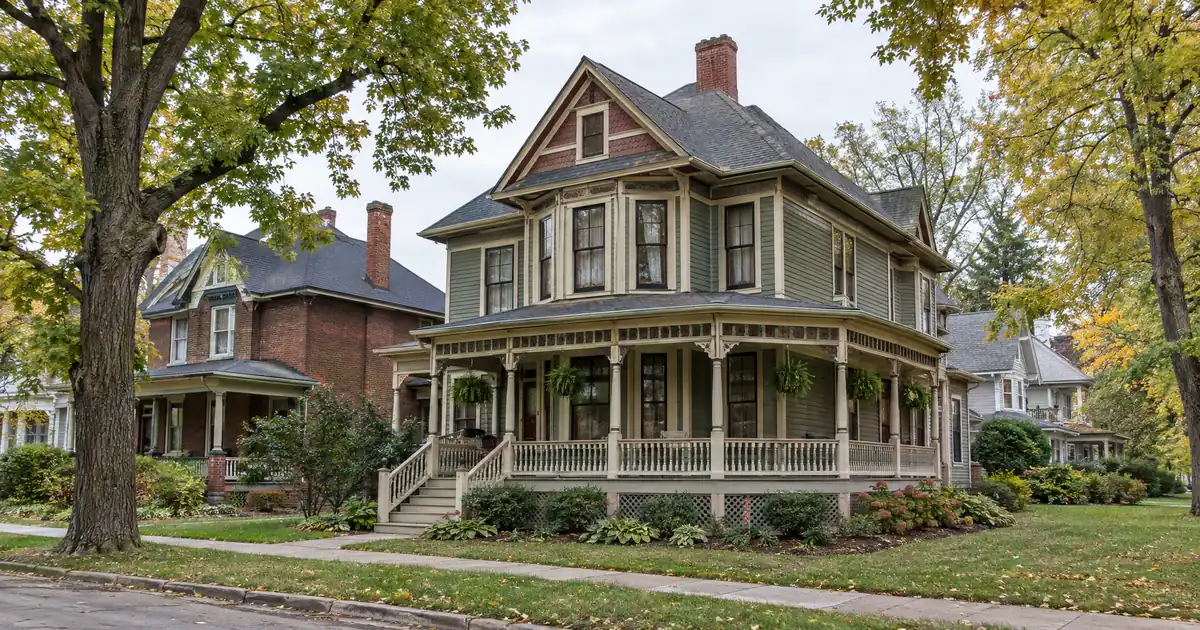
The knock on Galesburg is obvious. A median sale price around $120,000 means small loan balances, and small balances mean small cash-out checks. So why bother? Because the investors who already own here, especially those holding duplexes bought at a low basis, are sitting on a value gap that most Chicago-area landlords would envy in percentage terms. The real question is whether that gap is bankable, meaning whether an appraiser, a seasoning clock, and a coverage ratio will turn it into usable capital for the next deal.
This article is for owners, not buyers. The property is already yours, the title has a recording date, and the question is how much equity comes out and what could shrink it.
DSCR Cash-Out Calculator
Run the cash-out numbers in Galesburg, IL
Rate source: Freddie Mac 30-yr average via FRED® — Federal Reserve Bank of St. Louis · effective Sep 24, 2026
Prefilled with starting assumptions — enter your property’s value, balance, taxes, and insurance for a more accurate picture.
Program parameters update from Lendmire’s centralized guideline source. Taxes and insurance are editable estimates.
As of Sep 24, 2026 · General Freddie Mac market benchmark, not a Lendmire loan offer. Property value, balance, taxes, and insurance are editable estimates. Maximum loan-to-value varies by lender, program, property type, and seasoning. Not a Loan Estimate, approval, or commitment to lend. Program availability and eligibility are subject to lender guidelines, credit approval, property review, and underwriting.
The Short Version:
A DSCR cash-out refinance in Galesburg, Illinois is underwritten primarily on the property’s rental income measured against its full monthly obligation, so the file works when documented rent clears the lender’s coverage threshold, the title has seasoned, and the appraised value supports a loan at or below a 75 percent ceiling, subject to lender guidelines.
- Median sale price sits near $120,000, up 32.8 percent year over year per Redfin.
- ZIP 61401 shows $810 median gross rent against a $100,600 median home value, per Zip-Codes.com.
- A modeled duplex at two $800 units runs around 1.1 coverage including taxes and insurance.
- A single-family at median rent lands just under 1.00, so structure matters.
- Cash-out tops out at 75 percent LTV after roughly six months of title seasoning.
Galesburg Market Snapshot
A quick read on the Galesburg investor landscape — figures come from the cited sources below. Confirm current property-level numbers before underwriting.
| Metric | Detail |
|---|---|
| Home prices | $106,286 average home value (Zillow Home Values) |
| Typical rents | $675 median (Zumper) |
| Recent appreciation | +13.6% yoy (Zillow Home Values) |
| University enrollment | 1,108–1,136 students (fall 2024/2025) (Knox College) |
| Population | 29,481 population (Census Reporter) |
| Employment | 999 full-time employees (BNSF rail workers rally article) |
The Appreciation Is Real. Is It Bankable?
Galesburg’s price movement is large enough to fund a refinance, but small-market data is noisy, so treat the headline percentages as direction rather than appraisal value. Redfin puts the median sale price near $120,000, up 32.8 percent from a year earlier, with homes taking about 51 days to sell compared with 43 days the year before. That slower pace alongside rising prices is worth noticing.
Zillow’s average home value is lower at $106,286, up 13.6 percent, per Zillow. The gap is methodology: a median of recent sales versus a modeled average of all homes. Movoto shows a median list price of $127,000, up 10 percent. Three sources, three levels, one direction. This article uses the Redfin median as the citywide reference.
The tension is this. A 32.8 percent jump in a town of roughly 29,000 people can reflect a handful of closings as much as a durable trend. An appraiser doesn’t underwrite a headline. The appraiser pulls three to five comparable sales, and in a thin market those comps may be few, older, and scattered. The investor’s equity is whatever that appraisal says, not what a data aggregator says.
Appreciation is the first lever for an equity-extraction play. It isn’t the only one, and in Galesburg it isn’t the best one.
Why Duplexes Beat Single-Family Here
Small multifamily is where the Galesburg cash-out math holds up, and single-family at median rent is where it gets tight. Rents are low in absolute terms, but they sit against very low values, which creates a high rent-to-value ratio. The problem is that one unit’s rent has to carry a full debt load by itself.
Start with the rents. RentCafe shows one-bedrooms between $690 and $765, two-bedrooms between $690 and $950, and three-bedrooms between $915 and $950. Zumper reports a $675 median across all property types, but it flags limited inventory, so read that as directional only. The ZIP 61401 figure of $810 median gross rent against a $100,600 median home value works out to a gross yield near 9.7 percent on a single unit.
Run the numbers on a single-family. Assume a house appraising at the $120,000 citywide median and renting at $810, a modeled assumption based on the ZIP median. Refinanced at 75 percent LTV, with full taxes and insurance counted, coverage lands just under 1.00. That’s not a disaster, but it’s under the 1.00 benchmark most standard DSCR programs are built around. Sub-1.00 scenarios may be reviewed by select lenders, and options could include a sub-1.00 program, an interest-only structure, or lower leverage. Each of those usually costs the investor something in pricing, proceeds, or reserves, and eligibility review depends on lender guidelines, credit approval, and property review.
Now a duplex. Say you own a two-unit building that appraises at a modeled $200,000, with each unit renting at $800 (again, modeled inputs, not market quotes). At 75 percent LTV and counting taxes and insurance in the full obligation, coverage comes out around 1.1. That clears the baseline with some cushion. Illinois property taxes run heavy against low values, and those costs are already inside this math.
The pattern is simple. Two income streams against one building’s debt service is the structure that works in a sub-$130,000 market. Homes.com shows about eight multi-family listings at any given time, which means the acquisition channel is repeatable, not a one-off. That matters for the second half of an equity play, where the proceeds go back into another small multifamily.
Census data suggests the stock supports this. In the research brief, 38 percent of Galesburg housing is renter-occupied, 53 percent of apartments sit in buildings with fewer than 50 units, and 26 percent are single-family rentals. That’s a mom-and-pop landlord town, which fits this loan type.
Manufactured homes, log homes, and barndominiums fall outside these DSCR programs. Some rural-edge properties around Galesburg fit those descriptions, so check the property type before building a plan around one.
Six Months on the Title Clock
Seasoning and the 75 percent cap set the size of the check, and Galesburg’s low basis makes both worth modeling before the refinance application goes in. Cash-out programs typically look for about six months of ownership measured from title recording. Leverage on a cash-out caps at 75 percent LTV, which is lower than the 80 percent figure that applies on purchases. Most files also carry a minimum 1.00 coverage requirement, a credit floor of 620 with better tiers at 660, 680, and 700, and reserves of about six months of PITIA. These are typical guidelines, and exact eligibility turns on the lender, credit profile, reserves, and property review.
Here’s where the investor’s calendar matters. Consider a scenario where an investor buys a distressed duplex at a modeled $150,000, spends on rehab, and leases both units. By month six the title has seasoned, leases are in place, and the appraisal can reflect the renovated condition. The 75 percent ceiling then applies to a value that sits well above the original basis. Proceeds equal the new loan minus the payoff of whatever is already on the property, minus costs. Equity available is not a guaranteed cash figure. It moves with the appraisal, the rent used for lender review, the full monthly obligation, and reserves.
The smaller loan sizes common in Galesburg are workable. Standard programs run up to $3,000,000, and smaller balances route through select lenders in the network, so a modest loan here is a routing question, not a disqualifier. The guide “The Refi Options” covers the mechanics, and the investment property refinance options lay out the structures beyond cash-out.
Recycling matters more than the first check. With a repeatable pool of duplexes and triplexes, a refinance that returns even part of the original capital can seed the next acquisition, and that next property starts its own six-month clock. Investors who plan that sequence tend to outgrow investors who treat each refinance as a one-time event.
Rails, a Hospital, and Two Colleges
Galesburg’s rental demand rests on a handful of employers, and that matters because a lender reviewing a cash-out file wants to see a tenant base that doesn’t vanish. The anchor is rail. Galesburg is the convergence point for several BNSF lines at its classification yard, and KWQC reported that BNSF is adding a second hump lead track and a new connection track to increase railcar-switching capacity. A separate report in the Register-Mail via Yahoo describes BNSF as Knox County’s largest employer, with 999 full-time employees. Yard crews, train crews, and logistics staff are long-tenure renters and buyers, which suits workforce single-family and small multifamily.
Healthcare is the second leg. OSF St. Mary Medical Center is the primary hospital, and a Goodbill profile lists about 587 employees. Shift-based clinical and support jobs create steady, verifiable renters near the medical corridor. Per Census Reporter data used in the research, health care and social assistance is the largest employment sector among residents at 3,780 people, followed by retail trade at 3,112 and educational services at 2,750.
Education adds a modest layer. Knox College enrolls roughly 1,100 students and Carl Sandburg College about 1,603. Together they feed off-campus and staff rentals, though they’re too small to be a primary demand driver. They diversify a rent roll. They don’t carry one.
Working DSCR brokers see a recurring pattern in low-basis Midwest markets like this one. The rent-to-value ratio looks great on paper, but the file gets decided by appraisal support and by whether the borrower documented actual collected rent, not asking rent. Investors who bring signed leases and clean payment history to the refinance tend to avoid the repricing and proceeds trimming that come from a lender’s haircut on thin market rent evidence. Having leases in place before the application is often the difference between a clean file and a negotiated one.
Where in Town (and Where to Skip)
Granular public data is thin here, so the neighborhood read is qualitative, and that’s a feature of the market, not a flaw in the analysis. Don’t trust any source that claims a precise block-by-block price grid for a city this size.
Downtown and the historic core are the best fit for small multifamily. The area mixes shops, restaurants, and cultural sites, and it sits near the Amtrak station a few blocks from Knox College, with the rail corridor close by. Older two- and three-unit buildings here are the profile that appraises best against rent, since the comps are other income properties.
The West End offers historic homes alongside newer updates. It’s a better fit for single-family rentals and the occasional converted duplex. Expect coverage closer to the sub-1.00 to low-1.0 range on a single unit, so lean on structure and leverage choices instead of hoping rents jump.
East Galesburg is a separate village, and Redfin’s figure for it (a $45,000 median sale, down 91 percent) reflects a tiny sample rather than a trend. Skip it for cash-out planning. A comp set that thin will not support an appraisal, and any lender will see the same problem.
For all of it, verify current local rules, property taxes, and insurance with qualified local professionals before underwriting.
What Could Break the Pattern
The next 6 to 24 months will test the equity story, and there are four indicators worth tracking. Each can move the number that decides a cash-out.
Days on market. The jump from 43 to 51 days on Redfin is a yellow flag next to a 32.8 percent price increase. If days on market keep stretching while prices hold, appraisers get more conservative. If days on market tighten, comps get stronger.
DSCR vs. conventional financing
There are two common ways to finance an investment property in Galesburg, IL, and they qualify you differently — here’s how investors weigh them.
Why investors choose it
- Qualifies on the property’s rental income — no personal tax returns, W-2s, or pay stubs needed to document income.
- No personal debt-to-income ceiling to clear, so existing mortgages and obligations don’t cap your borrowing the same way.
- Can be closed in an LLC, keeping the property inside a business entity.
- Built for scaling — not held to the limit on number of financed properties that conventional financing applies.
- Underwriting centers on the deal: generally qualifies when the rent covers the payment, a 1.00x coverage ratio being a common baseline (confirmed in underwriting).
- Designed specifically for investment property, including long-term and, where the program allows, short-term rentals.
Where it’s strong
- Often the lowest ongoing financing cost for a buyer who fully qualifies on personal income — a fit for a first property or a cost-first purchase.
Trade-offs for investors
- Requires full personal income documentation and must fit within a debt-to-income limit — salary, existing debts, and other mortgages all count.
- Typically held in your personal name rather than a business entity.
- Caps how many financed properties you can carry, which can become a ceiling as a portfolio grows.
- Evaluates you as a borrower as much as the property, which usually means more paperwork.
How investors usually choose: a first or single property often optimizes for the lowest financing cost; portfolio builders often optimize for leverage, vesting in an LLC, and scaling past conventional caps. The right answer depends on your goals, the property, and current guidelines — both paths run through select lenders in Lendmire’s wholesale network, with eligibility and terms confirmed in underwriting.
Vacancy. ZIP 61401 shows an 11.10 percent vacancy rate, above the 10.12 percent national figure it cites. That cuts into the headline yield. Underwrite with a realistic turnover assumption, not full occupancy, and a lender will often do the same.
Employer concentration. BNSF’s 999 jobs are a strength and a single-point risk. The yard expansion is a positive signal. A contraction in rail employment would hit rental demand more than any apartment supply issue would. Watch yard staffing and capital announcements.
Comp depth. Cash-out proceeds are only as good as the appraisal. If a few high-priced sales drove the median, the next appraiser may not repeat them. Investors with renovated units should line up evidence of the improvements, not just rely on market momentum.
Think of this as a genuine toss-up between appreciation and cash flow. Galesburg’s price run argues for refinancing sooner, while vacancy and thin comps argue for stress-testing at a conservative value. The stronger play is usually to run the refinance at a value 10 to 15 percent below the optimistic case and see whether the file still works. If it does, the deal is sound. If it needs the optimistic appraisal, it’s a bet.
Frequently Asked Questions
How do you qualify for a DSCR cash-out refinance in Galesburg?
You qualify through the property, not your paycheck. The lender looks at rent used for lender review against the full monthly obligation (principal, interest, taxes, insurance, and any dues), typically wanting a 1.00 baseline, along with a credit score of at least 620, about six months of reserves, and roughly six months of title seasoning. Cash-out tops out at 75 percent LTV. Final eligibility is subject to lender guidelines, credit approval, and property review.
What are the requirements for an investment property loan in Galesburg, Illinois?
Expect a documented rental income picture, an appraisal, a credit profile in the 620-plus range, and reserves. Rents are verified through a lease or market rent analysis, and the property must be an eligible type. Manufactured homes, log homes, and barndominiums fall outside these programs. For a state-level overview, see DSCR loans in Illinois.
Does a roughly $120,000 market produce cash-out proceeds worth pursuing?
Yes on small multifamily, less so on a single low-value house. Proceeds depend on appraised value, the payoff on the existing loan, and the 75 percent LTV ceiling, so a duplex that appraises meaningfully above its original basis can return real capital. A single house near the citywide median leaves less room. Smaller balances route through select lenders in the network.
What if a Galesburg rental comes in under 1.00 coverage?
Options exist, but each one costs something. A lender may review a sub-1.00 program, an interest-only structure, or a lower LTV with stronger credit and more reserves. Whether any of those fits depends on the lender, the borrower, and the property. Investors with a single-family rental should model these scenarios against their own realistic rent estimate before applying, rather than assuming a typical market figure will apply to their property. To talk through a specific file, call 828-256-2183.
For current guidelines and terms, see Lendmire’s DSCR loan programs page.
The View from the Appraisal Desk
A local appraiser in Galesburg will tell you the same thing: the duplexes near the rail corridor and downtown sell to other landlords, so they appraise on income, and the single-family houses sell to owner-occupants, so they appraise on what the neighbors paid. Buy and refinance accordingly, and expect the two-unit buildings with signed leases to carry the numbers while the single houses wait on the comps.
About Lendmire
Lendmire, NMLS# 2371349, is a mortgage brokerage focused on investor financing, arranging DSCR loans in 40 states plus Washington, D.C. — 41 markets total. Qualification is based on the property’s income rather than personal income documentation, subject to lender guidelines, making it a fit for LLC-held rentals and scaling portfolios, subject to lender program eligibility. The brokerage is recognized as a 2026 Scotsman Guide Top Mortgage Workplace and a 2025 Scotsman Guide Top Mortgage Workplace, and further updates appear in Lendmire company announcements.
Get Started
Ready to find the right loan for you?
In about 30 seconds you can review financing options available for your investment property. No commitment required.
Informational only. Not a Loan Estimate, approval, or commitment to lend. Program availability and eligibility are subject to lender guidelines, credit approval, property review, and underwriting.
References
1. Redfin
3. Zillow
4. Zumper
5. Knox College
8. Movoto
9. RentCafe
10. Homes.com
11. KWQC reported
12. OSF St. Mary Medical Center
13. Goodbill profile
15. a 2026 Scotsman Guide Top Mortgage Workplace
16. a 2025 Scotsman Guide Top Mortgage Workplace
This article is part of Lendmire’s investment property cash-out refinance program — full qualification details, guidelines, and scenarios live on the program page.
Related reading: Luxury Rental DSCR Loans In New Jersey · Jersey Shore Vacation Rental Loans: DSCR Financing In Ocean City, Cape May And Long Beach Island · DSCR Cash-out Refinance In New Jersey: Pulling Equity From A Rental
Guides: Investment Property Cash-Out Refinance in Illinois
Brandon Miller
Founder & CEO, Mortgage Loan Originator, Lendmire LLC
- Mortgage Loan Originator · NMLS# 1129696 · Verify on NMLS Consumer Access
- North Carolina Real Estate Broker · License# 343312 · Verify on NCREC
- North Carolina Insurance Producer · License# 19053198 · Property, Casualty, Life, Health · Verify on NAIC SBS
- Lendmire LLC · Firm NMLS# 2371349 · Verify firm licensure
Disclosures. The information presented in this article is general market commentary, not financial, legal, or tax advice. Lendmire is a mortgage brokerage (NMLS# 2371349) — not a direct lender or depository institution — and loan placement is subject to lender underwriting. Nothing in this content represents a commitment to lend. Loan terms, pricing, and program availability vary based on borrower qualifications, property characteristics, and state of subject property, and are subject to change at any time. Lendmire complies with Equal Housing Opportunity requirements. Consumer access: nmlsconsumeraccess.org.