
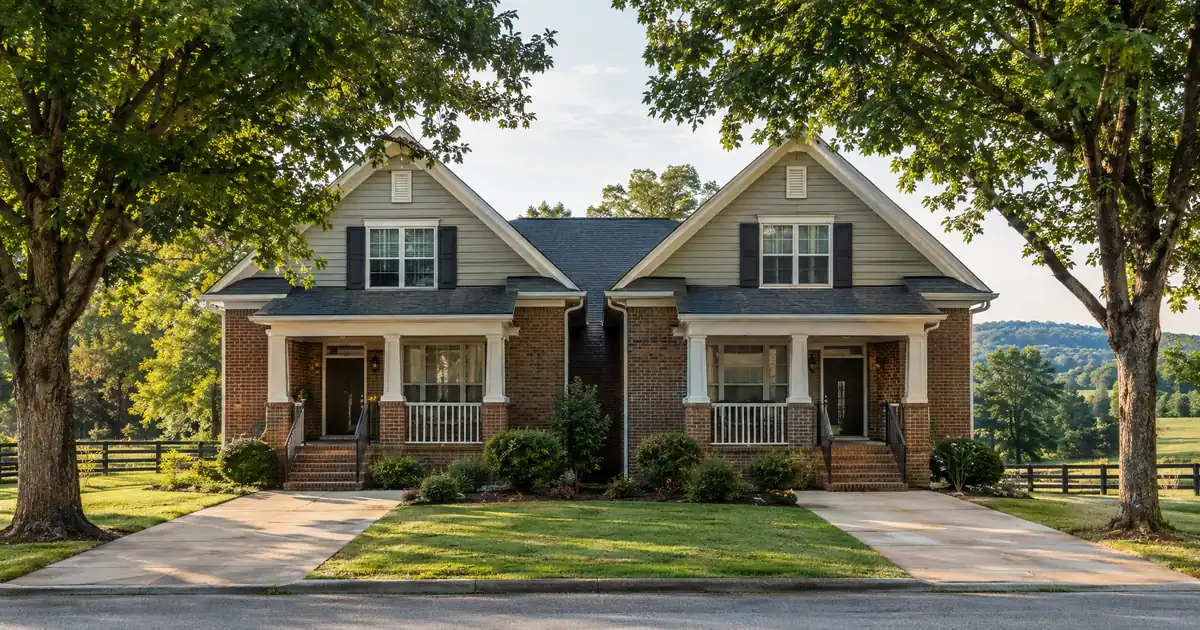
The Beltline Boulevard and South Cooper Industrial corridor, running along US 68/80, is the part of Glasgow where a rental owner’s next tenant is most likely to come from. The Barren County Economic Authority says the industrial park has graded sites ready and a speculative building planned, and the state has announced 400 new manufacturing jobs from Tate, a Kingspan company, the largest jobs announcement in Barren County in 18 years. Yet rents around that corridor are soft today. That gap, hiring ahead of rent growth, is what makes a DSCR cash out refinance in Glasgow, Kentucky a timing decision as much as a financing one.
For real estate investors in Glasgow, Kentucky, Lendmire (NMLS# 2371349) helps structure and place DSCR financing through wholesale lenders operating in 41 markets, including D.C. This article is about the owner who already holds a rental here and is deciding whether, when, and how to pull equity out of it.
DSCR Cash-Out Calculator
Run the cash-out numbers in Glasgow, KY
Rate source: Freddie Mac 30-yr average via FRED® — Federal Reserve Bank of St. Louis · effective Sep 24, 2026
Prefilled with starting assumptions — enter your property’s value, balance, taxes, and insurance for a more accurate picture.
Program parameters update from Lendmire’s centralized guideline source. Taxes and insurance are editable estimates.
As of Sep 24, 2026 · General Freddie Mac market benchmark, not a Lendmire loan offer. Property value, balance, taxes, and insurance are editable estimates. Maximum loan-to-value varies by lender, program, property type, and seasoning. Not a Loan Estimate, approval, or commitment to lend. Program availability and eligibility are subject to lender guidelines, credit approval, property review, and underwriting.
The Short Version:
A cash-out refinance on a Glasgow rental fits owners of small multi-unit or renovated workforce houses, because the loan is underwritten primarily on the property’s rental income measured against its full monthly obligation. Glasgow’s average home value is $220,561 per Zillow, so rent-to-price math decides who qualifies.
- Average Glasgow rents are soft, so single-family coverage often lands below 1.00 at cash-out leverage.
- Duplexes priced near the roughly $170K multifamily median tend to cover far better than houses.
- Cash-out leverage tops out at 75 percent, after about six months of ownership.
- Thin sales volume makes appraisal the likeliest place for proceeds to shrink.
Glasgow Market Snapshot
A quick read on the Glasgow investor landscape — figures come from the cited sources below. Confirm current property-level numbers before underwriting.
| Metric | Detail |
|---|---|
| Home prices | $170K median (Redfin Glasgow multifamily) |
| Typical rents | $1,350 per unit townhome (Redfin Glasgow multifamily) |
| University enrollment | 745+ students (WBKO) |
| Employment | 6,000+ manufacturing workers (Barren County Economic Authority) |
Why the Rent Math Looks Hard Here
Glasgow rents are soft, and single-family coverage is the place where that shows up first. Zillow’s rental data puts the average 3BR rent at $950 and the all-property average at $875, with rents down $120 over the prior year and the market labeled “COOL.” Zumper’s median of $850 comes with a 15 percent one-year decline and sits 19 percent below Bowling Green.
Now put those rents against a $220,561 average home value. The following is modeled, not sourced market data. It assumes the property appraises at that average value, rent equals the stated figure, and debt service includes principal, interest, taxes, and insurance at 75 percent LTV.
| Scenario (modeled) | Coverage ratio | Main friction |
|---|---|---|
| House at $950 rent | Low 0.7s | Well under 1.00 |
| Renovated house at $1,250 rent | Around 0.9 | Still short of 1.00 |
| Duplex near $170K, $1,350 combined rent | Roughly 1.25 | Thin appraisal comps |
| Five- or six-unit building | Varies | May fall outside 1-4 unit programs |
The $1,250 figure is an asking rent on a current Zillow house listing, and asks are not achieved rents. Even so, the pattern holds: single-family in Glasgow generally doesn’t clear the standard 1.00 benchmark at 75 percent leverage unless the owner bought well below the market average.
Most DSCR programs are built around 1.00 because rent covers the payment at that level. Some lenders review lower ratios, but those files usually bring lower leverage, stronger credit, more reserves, or different pricing. Eligibility depends on lender guidelines, credit profile, reserves, and property review.
Here’s the catch. An owner sitting on a house at 0.9 isn’t stuck, but the options change. A smaller cash-out percentage lifts coverage, because less debt means less monthly obligation. A sub-1.00 program, or an interest-only structure, may be reviewable by some lenders, subject to credit approval and property review. The harder question is whether the house should be the collateral at all, or whether the equity is better pulled from a property with stronger rent-to-value.
The Duplex Is the Better Collateral
Small multifamily is where Glasgow cash-out math improves, because units stack rent against a lower price per door. Redfin shows a median listing price near $170K for Glasgow multifamily, well under the single-family average. Sample rents on those listings include new 3-bed townhome units leased at $1,350 each and a renovated duplex with a $625 one-bedroom and a $725 two-bedroom. Those are listing data and current asks, not audited figures.
Run the numbers on a duplex appraising near that $170K median, with combined rent of $1,350. At 75 percent LTV with taxes and insurance included, coverage comes out around 1.25, rounded down. Two townhome-style units at $1,350 each would be stronger still, though building prices vary too much to model one.
Two things can break that picture.
Landlord-paid utilities. Some small Glasgow buildings, including a downtown five-unit property with mini-splits in each unit, are listed with the owner covering all utilities. Underwriting works from net income, so an utilities-included lease structure shaves the numerator that coverage depends on.
Unit count. Five-unit and six-unit buildings, like the duplex-plus-fourplex package listed on acreage, can be treated as commercial or 5+ unit loans rather than standard 1-4 unit DSCR products. A half-renovated six-unit package is also a value-add play, not a seasoned-rent one. Owners with those assets should expect a different conversation.
One more boundary: manufactured homes, log homes, and barndominiums fall outside these DSCR programs. Glasgow has plenty of owner-occupied mobile-home stock in older central neighborhoods, so this matters when screening collateral.
What 75 Percent and Six Months Mean in a Thin Market
The cash-out ceiling is 75 percent LTV, and it applies to the appraised value, which in Glasgow is the less certain number. Program guidance calls for about six months of ownership, measured from title recording, before a cash-out refinance. Reserves typically run about six months of full monthly obligation. Credit tiers generally start at a 620 floor and step up through 660, 680, and 700. Loan amounts run up to $3,000,000 on standard programs, and smaller balances, which describe most Glasgow files, route through select lenders in the network. All of this is subject to lender guidelines and varies by borrower, property, and loan scenario.
Glasgow’s sales volume is the real wildcard. Redfin’s multifamily page shows only 7 homes sold in the past month, and listing time stretches long (its 167-day figure is directional, since the scope isn’t fully clear). Few sales means few comps, and an appraiser working with few comps tends to be conservative.
Consider a scenario where an investor plans around a $200,000 valuation and the appraisal returns 10 percent lower. The 75 percent ceiling now applies to a smaller base, and the coverage ratio worsens too, since taxes and insurance don’t shrink with the appraisal. Proceeds drop, and so might the ratio. Plan around a lower appraised value than the listing data implies, and treat any equity figure as a range.
The pattern from Lendmire’s deal desk is consistent in markets structured like this one, with small populations, few comps, and mixed-quality rental stock. Files with clean lease documentation, a documented renovation scope, and a recent purchase price tend to hold together best at appraisal. Friction tends to show up when the rent being underwritten is well above the local averages, and the appraiser’s rent schedule lands lower than the owner’s lease.
The Appreciation Question (Flat Today, Possibly Not Forever)
Glasgow isn’t an appreciation story at the moment, and cash-out plans shouldn’t assume one. Zillow shows the average home value down 0.8 percent year over year, with homes going pending in around 34 days. Equity here comes from the purchase discount and the renovation, not market drift.
That changes who should do this. An owner who bought a dated house well under market and renovated it has equity that’s real but not yet proven by comps. An owner who bought at the market average a year ago probably has little to extract at 75 percent LTV. Honestly, that second owner might do better waiting than refinancing into a payment that doesn’t cover.
It’s a genuine toss-up for borrowers in the middle. The forward case is decent, but a Glasgow owner who refinances now locks in today’s appraisal, and the catalysts described below haven’t shown up in comps yet.
Tate and the Commuter Pool
The demand case rests on jobs, and the jobs are real. Barren Inc., the local chamber, says the county welcomes over 7,600 workers daily from 37 surrounding counties. A city of about 15,197 people, per Census Bureau QuickFacts, acts as a regional job magnet, which means a pool of commuters who might prefer to live in town. The same chamber lists T.J. Samson Regional Health, the Barren County School System, Walmart, Akebono, Nemak, NCH Healthcare, and Barren River Resort among the largest employers. The Barren County Economic Authority puts manufacturing at over 6,000 workers across more than 40 companies, five with more than 500 employees.
Two anchors are worth underwriting around. Tate’s 400 jobs, with a $61.2 million initial investment, land in a market where rents are currently falling. So it’s a catalyst that hasn’t been priced in, not a trend that has. And T.J. Regional Health hosts a University of Louisville family medicine residency, which adds rotating clinicians who need housing. The hospital is a 196-bed facility, per the Kentucky Medical Professions Placement Service.
The local housing gap reinforces this. A county housing gap study reported a deficit of 1,846 units, including 938 rental units, and a developer told the planning commission there is “a definite need for smaller, entry-level housing.” That study predates the recent rent softness, so weigh it against current trends. Both can be true: a shortage of the right product and soft blended averages. Averages include dated stock that’s hard to lease.
Where the Collateral Sits
Glasgow neighborhood-level price and rent data is thin, so these submarkets are described by tenant base, not by numbers.
N. Race Street and the T.J. Health corridor. Demand here comes from healthcare staff and residents, tied to the hospital and the 226,000-square-foot outpatient pavilion. It’s a stable tenant pool for duplexes and small rentals, and arguably the least cyclical of the submarkets.
Beltline and South Cooper. The manufacturing demand story is strongest here, with Tate’s hiring and the planned spec building. It’s also the submarket most exposed to timing risk, since hiring ahead of occupancy can leave a cash-out owner carrying debt against rents that haven’t moved.
Downtown and the Public Square. An active revitalization district, where downtown employers have added more than 100 jobs, per the Economic Authority’s profile. Likely tenants are small-business staff and younger workers. Small multi-unit buildings here sometimes come with utilities-included leases, so check the lease structure before trusting the gross rent.
KY-90 north and Royal Troon. This is new construction, with apartments and single-family homes planned when fully built, as Glasgow News 1 reports. Treat it as competing supply. A new unit with modern finishes can pull tenants from older stock, which matters for the rent schedule an appraiser uses.
WKU Glasgow and Liberty Street. This is a commuter and adult-learner campus with 745 or more students, not a student-housing market. Skip that thesis.
The Infill Wildcard
There’s a medium-term supply variable here. About 650 Glasgow lots fall below the minimum size for single-family homes, and the planning commission is studying an Urban and Infill Housing Initiative for them, including a flex-style multifamily design. It was presented but was not yet regulation.
If it’s adopted, it could add small-unit rental supply in established neighborhoods. That competes with existing duplex owners and opens a door for infill investors. Which way it cuts depends on whether an owner is holding or building. Check current local rules, taxes, and insurance with qualified local professionals before committing either way.
When Cash-Out Makes Sense, and When It Doesn’t
Pulling equity to acquire another duplex in the same submarket, where coverage clears 1.00 on a modeled basis, makes the cash-out argument straightforward. The proceeds buy a stronger asset than the one being refinanced.
Pulling equity from a house at 0.9 coverage to buy more houses at 0.9 is a different decision. Each purchase adds debt that rent doesn’t fully cover, and softening rents or a lower appraisal could compound the problem. If the numbers don’t support standard lender review anywhere in the submarkets being considered, that’s a signal to rethink property selection, not the loan type.
The investor profile matters as much as the property. A self-employed owner holding several rentals in an LLC, subject to lender program eligibility, is the classic fit for a DSCR file, because qualification leans on the property’s income rather than personal documentation. A salaried borrower with one rental and strong personal income might find conventional financing costs less, and the guide “Where DSCR and Conventional Diverge” is worth reading before choosing. The flip point is usually the third or fourth financed property, or sooner if traditional personal-income documentation doesn’t cleanly support the rental income.
DSCR vs. conventional financing
There are two common ways to finance an investment property in Glasgow, KY, and they qualify you differently — here’s how investors weigh them.
Why investors choose it
- Qualifies on the property’s rental income — no personal tax returns, W-2s, or pay stubs needed to document income.
- No personal debt-to-income ceiling to clear, so existing mortgages and obligations don’t cap your borrowing the same way.
- Can be closed in an LLC, keeping the property inside a business entity.
- Built for scaling — not held to the limit on number of financed properties that conventional financing applies.
- Underwriting centers on the deal: generally qualifies when the rent covers the payment, a 1.00x coverage ratio being a common baseline (confirmed in underwriting).
- Designed specifically for investment property, including long-term and, where the program allows, short-term rentals.
Where it’s strong
- Often the lowest ongoing financing cost for a buyer who fully qualifies on personal income — a fit for a first property or a cost-first purchase.
Trade-offs for investors
- Requires full personal income documentation and must fit within a debt-to-income limit — salary, existing debts, and other mortgages all count.
- Typically held in your personal name rather than a business entity.
- Caps how many financed properties you can carry, which can become a ceiling as a portfolio grows.
- Evaluates you as a borrower as much as the property, which usually means more paperwork.
How investors usually choose: a first or single property often optimizes for the lowest financing cost; portfolio builders often optimize for leverage, vesting in an LLC, and scaling past conventional caps. The right answer depends on your goals, the property, and current guidelines — both paths run through select lenders in Lendmire’s wholesale network, with eligibility and terms confirmed in underwriting.
For the mechanics, the guide “What Is a DSCR Loan” covers the ratio in detail, and the cash-out refinance details page covers seasoning and leverage. Lendmire’s refi programs and the state hub for DSCR loans in Kentucky round it out. Investors who want a file reviewed can connect with Lendmire or call 828-256-2183.
What to Track Over the Next 6 to 24 Months
Four indicators will tell an owner whether to refinance now or wait.
1. Rent direction. Zillow’s “COOL” label and the year-over-year declines need to flatten before coverage improves on single-family.
2. Tate’s hiring pace. The jobs are announced. Whether they turn into leases around the Beltline corridor is the open question.
3. Comparable sales. More closed sales means stronger appraisals and more predictable proceeds.
4. Infill and new supply. Royal Troon deliveries and any adoption of the infill initiative set the ceiling on small-unit rents.
The thing that could break the current pattern is a mismatch in timing. If hiring arrives before new supply, older duplexes benefit. If supply arrives first, rent comps stay flat and cash-out leverage gets harder to justify on anything but the best-covered buildings.
Frequently Asked Questions
Can a single-family rental in Glasgow qualify for a cash-out refinance?
Possibly, but coverage is the obstacle. On modeled math with full taxes and insurance at 75 percent LTV, a house near the $220,561 average value lands below 1.00 at typical asking rents. A lower cash-out percentage, a lower-priced house, or a sub-1.00 program may be worth a lender’s review, subject to credit approval and property review.
How long must I own a Glasgow property before pulling equity?
Guidance calls for about six months of ownership, measured from title recording. After that, the binding limits are the 75 percent LTV ceiling, rent used for lender review against full monthly obligation, and reserves of about six months. Equity available is not a guaranteed figure.
Will Glasgow’s thin sales market hurt my appraisal?
It can, because a thin market leaves appraisers with few comparable sales to work from, and they often lean conservative as a result. Redfin’s multifamily page shows only a handful of recent sales, which is a limited sample. Build the plan around an appraisal below your expectation, and keep renovation records and signed leases organized.
Do duplexes in Glasgow cover better than houses?
On a modeled basis, yes. A duplex near the roughly $170K multifamily median with about $1,350 in combined rent comes out around 1.25 including taxes and insurance, versus under 1.00 for a typical house. Listing rents are asks, so verify actual leases, and check who pays utilities.
Does a six-unit property qualify for DSCR cash-out?
Often not through the standard 1-4 unit programs. Buildings with five or more units can be treated as commercial or 5+ unit loans, which is a different product with its own guidelines. Confirm unit count and structure before assuming a standard DSCR program applies.
Where This Leaves Glasgow Owners
Glasgow’s rents are soft and its appraisals are uncertain, but its jobs pipeline is the strongest it has been in nearly two decades. The investors who stress-test their coverage on full taxes and insurance now, and pull equity into small multi-unit buildings before Tate’s hiring shows up in the rent comps, will come out ahead.
About Lendmire
Lendmire, NMLS# 2371349, is a mortgage brokerage focused on DSCR investor loans, arranging financing in 41 markets, Washington, D.C. included, through wholesale and investor-lending channels. Its model centers on the property’s rental income as reviewed by the lender instead of W-2 documentation, subject to lender guidelines, which suits entity-owned and multi-property investors. The firm was recognized by Scotsman Guide as a 2026 Top Workplace and recognized by Scotsman Guide in 2025.
Get Started
Ready to find the right loan for you?
In about 30 seconds you can review financing options available for your investment property. No commitment required.
Informational only. Not a Loan Estimate, approval, or commitment to lend. Program availability and eligibility are subject to lender guidelines, credit approval, property review, and underwriting.
References
2. 400 new manufacturing jobs from Tate, a Kingspan company
4. Redfin shows a median listing price near $170K for Glasgow multifamily
5. wbko.com — Wku Glasgow Adds New Courses Campus
6. Barren County Economic Authority
7. Zillow — Market Trends Glasgow KY
9. Zillow — Glasgow KY Rent Houses
10. Barren Inc., the local chamber
13. Kentucky Medical Professions Placement Service
14. glasgownews1.com — Housing Gap Study Shows Barren County Short Nearly 2000 Units
16. Urban and Infill Housing Initiative
17. recognized by Scotsman Guide as a 2026 Top Workplace
18. recognized by Scotsman Guide in 2025
This article is part of Lendmire’s investment property cash-out refinance program — full qualification details, guidelines, and scenarios live on the program page.
Related reading: Luxury Rental DSCR Loans In New Jersey · Jersey Shore Vacation Rental Loans: DSCR Financing In Ocean City, Cape May And Long Beach Island · DSCR Cash-out Refinance In New Jersey: Pulling Equity From A Rental
Guides: Investment Property Cash-Out Refinance in Kentucky
Brandon Miller
Founder & CEO, Mortgage Loan Originator, Lendmire LLC
- Mortgage Loan Originator · NMLS# 1129696 · Verify on NMLS Consumer Access
- North Carolina Real Estate Broker · License# 343312 · Verify on NCREC
- North Carolina Insurance Producer · License# 19053198 · Property, Casualty, Life, Health · Verify on NAIC SBS
- Lendmire LLC · Firm NMLS# 2371349 · Verify firm licensure
Disclosure information. Lendmire is a state-licensed mortgage brokerage under NMLS# 2371349. Lendmire is not a depository institution, direct lender, or financial advisor — all loans referenced are placed through wholesale lender partners and are subject to each lender's underwriting standards. This article is provided for general informational purposes and is not a commitment to lend, nor does it constitute financial, legal, or tax advice. Loan programs, terms, rates, and qualification standards change without notice and depend on borrower profile, property type, and the state in which the subject property is located. Equal Housing Opportunity provider. NMLS Consumer Access: nmlsconsumeraccess.org.