
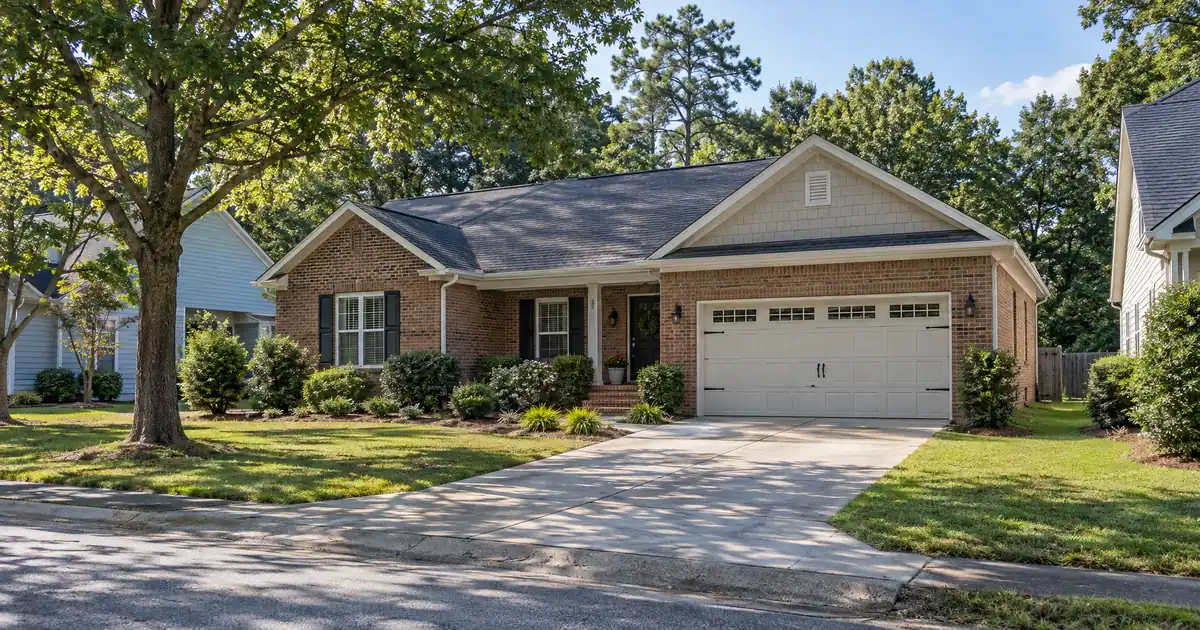
Greenville’s sales market is cooling while its tenant base keeps growing. Redfin shows days on market climbing from 28 to 43 year over year, with monthly sales slipping from 314 to 277. Meanwhile, East Carolina University reported total enrollment of 27,153, its third straight year of gains. Sales are slowing and demand is not. That gap matters for anyone planning a cash-out refinance on a Greenville rental over the next 6 to 18 months, because the appraisal and the rent schedule will not always agree.
At a Glance: A DSCR cash-out refinance on a Greenville, North Carolina rental is underwritten primarily on the property’s rental income measured against its full monthly obligation, with proceeds capped by loan-to-value and reserves rather than by the owner’s personal income paperwork.
DSCR Cash-Out Calculator
Run the cash-out numbers in Greenville, NC
Rate source: Freddie Mac 30-yr average via FRED® — Federal Reserve Bank of St. Louis · effective Sep 24, 2026
Prefilled with starting assumptions — enter your property’s value, balance, taxes, and insurance for a more accurate picture.
Program parameters update from Lendmire’s centralized guideline source. Taxes and insurance are editable estimates.
As of Sep 24, 2026 · General Freddie Mac market benchmark, not a Lendmire loan offer. Property value, balance, taxes, and insurance are editable estimates. Maximum loan-to-value varies by lender, program, property type, and seasoning. Not a Loan Estimate, approval, or commitment to lend. Program availability and eligibility are subject to lender guidelines, credit approval, property review, and underwriting.
- Cash-out LTV tops out at 75 percent, subject to lender guidelines.
- Ownership seasoning is about 6 months, measured from title recording. Redfin puts median sale price near $270,000, up 2.8 percent.
- Typical single-family coverage lands near 1.0. Duplexes clear it more comfortably.
- ECU and the medical district supply the tenant pool.
Lendmire (NMLS# 2371349) structures DSCR scenarios for investors targeting Greenville, North Carolina and places them with wholesale lenders across 41 markets, including D.C. The firm is a mortgage broker. It does not lend or approve. Lenders review eligibility, and the notes below cover what those lenders tend to ask for on a Greenville file.
Greenville Market Snapshot
A quick read on the Greenville investor landscape — figures come from the cited sources below. Confirm current property-level numbers before underwriting.
| Metric | Detail |
|---|---|
| University enrollment | 27,153 total (ECU Institutional Research) |
| Employment | 15,500+ jobs (Pitt County Government) |
The Equity Story Is Real, but Sources Disagree
Prices in Greenville are up on every measure, though by different amounts. Redfin’s median sale price is about $270,000, up 2.8 percent. Zillow’s typical home value runs lower at $228,359, up 8.0 percent, reflecting a different methodology (typical value across the whole market versus median of recent sales). Both point the same direction. Neither tells you what an appraiser will land on for your specific bungalow.
Rents are messier. RentCafe shows average apartment rent of $1,385, up 1.42 percent, though its data skews toward complexes with 50 or more units. Apartment List shows a median of $1,224, down 4.9 percent. Zumper, which is listing-based, shows $1,375 and a 10 percent increase. Three sources, three stories.
The practical read: size the cash-out on the conservative appraisal and the lowest credible rent, not the most bullish source. Lenders will do the same. A file that pencils only on the Zumper number is a file waiting for a kickback.
What a Cash-Out File Actually Needs Here
Cash-out on a rental you already own is mechanically simple. Three items decide how much comes out.
First, the 75 percent LTV ceiling. Cash-out sits below the purchase cap, and no Greenville appraisal changes that. Second, seasoning: about 6 months of ownership, documented by the recorded title. Investors who bought recently and assume seasoning away get sent back. Third, reserves, typically about 6 months of PITIA, which lenders want documented with statements, not described.
The coverage floor is typically 1.00, meaning rent used for lender review covers the full monthly obligation including taxes and insurance. Some lenders will look below that with lower leverage or stronger compensating factors. Credit tiers typically start at a 620 floor and step up through 660, 680, and 700. Loan sizes run up to $3,000,000 on standard programs. All of this is what DSCR qualification actually looks like in practice, and exact terms vary by borrower, property, and lender.
If the property sits in an LLC, that is workable, subject to lender program eligibility. Get the operating agreement and good-standing certificate into the file at the start. Entity paperwork is the quiet gap that stalls otherwise clean Greenville files.
Where the Coverage Math Holds (and Where It Doesn’t)
Greenville’s citywide gross rent-to-value is thin. Zillow’s typical value against Zumper’s median rent works out to roughly 0.60 percent a month. Against Redfin’s higher median price it drops to about 0.51 percent. Those are ratios, not payment figures, and they say the same thing: a median-priced house is a tight fit for high leverage.
Run the numbers on a single-family rental valued near the Zillow typical figure of $228,359, using a modeled rent of $1,375 and a 75 percent cash-out. Including taxes and insurance at North Carolina average levels, coverage lands right around 1.0x. Break-even, not comfortable. Buy below the median and it improves. Buy at or above it and it sags.
Now a duplex. Assume a modeled $260,000 value and two units at a modeled $1,000 each, also at 75 percent. Including taxes and insurance, coverage runs roughly 1.25x. Same leverage, better ratio, because two rents sit against one purchase price and one tax bill. Local duplex listings show per-unit asking rents in that neighborhood, though they come from one manager’s inventory and work as an illustration, not a benchmark.
Here’s the catch on the single-family case. If coverage falls under 1.00 at 75 percent, the paths a lender may review include a lower LTV, a sub-1.00 program, or an interest-only structure. Each carries its own pricing, reserves, and credit requirements, and none is a given. Qualification stays subject to lender guidelines, credit approval, and property review.
DSCR files in markets like this one typically look like a mix of older single-family rentals and small multifamily, with rent schedules built from a thin comp set. The recurring friction is the rent-schedule support. Appraisers pull from a small pool of leased comps, and when the lease in the file sits well above them, the lender uses the lower number. Files that arrive with a signed lease, proof of deposits, and a market rent survey ready tend to have fewer questions to answer.
Lendmire covers the refinance mechanics elsewhere, and pulling equity out covers the structure in more detail.
The Grid and College View: Multifamily Conversions
The stronger play for equity extraction is probably the ECU-adjacent blocks, though investors focused on turnover risk could argue for the medical corridor instead.
Per Homes.com, neighborhoods close to campus, like The Grid, are student-rental heavy, and many bungalows, Colonial Revivals, and ranch homes were converted to multifamily as the university grew. A local broker quoted there puts entry-level condos near $175,000 and the median closer to $230,000. That is one broker’s estimate, not a dataset, and it says nothing on rents.
Why it matters for cash-out: converted small multifamily is where the per-unit rent stacking works. If you bought a duplex or fourplex there and it has appreciated, the refinance ratio can hold at 75 percent. The risk is seasonality. Student leases turn over each summer, so a conservative vacancy allowance belongs in the underwriting.
Enrollment supports the demand side. ECU’s total of 27,153 splits into 21,693 undergraduates and 5,460 graduate students, and the university employs 6,230 people, which adds a faculty and staff renter pool. One caveat: 683 students are in online Flight Path programs and live elsewhere, so base local demand on the on-campus count, not the headline. College View is also a local and National Historic District, which is worth knowing before any renovation plans.
The Medical District: 12-Month Leases
ECU Health Medical Center has 974 licensed beds and serves more than 1.4 million people across 29 counties. It is the teaching hospital for the Brody School of Medicine and is generally described as the largest employer in Eastern North Carolina. The wider system has nine hospitals and more than 12,000 employees.
Hospital staff, residents, and clinicians rent differently than students. Leases run 12 months, and they do not empty out in May. A two- or three-bedroom unit along the Fifth Street corridor, which Livability describes as the main artery linking campus, downtown, West Greenville, and the medical district, suits that demand. For a DSCR file, a lease history showing continuous 12-month terms is cleaner evidence than a student-cycle rent roll.
The county’s economy backs this up. Pitt County reports healthcare and social assistance as its largest driver, contributing about $1.95 billion to county GDP and employing over 15,500 people. Two large institutions carry Greenville’s demand, not one.
Elmhurst-Englewood and Lynndale: Workforce Single-Family
South of campus and downtown, Elmhurst-Englewood is filled with traditional bungalows, split levels, and ranches. Lynndale reads as more apartment-heavy and renter-dominated. There is no reliable neighborhood-level rent or price source for either, so treat any number you see for them with suspicion.
What can be said: this is workforce housing, and the metro backs it with depth. RentCafe shows 67 percent of households renting, and the largest rent band, $1,000 to $1,500, makes up about 41 percent of rentals. Two-bedrooms are the biggest bedroom share. A two-bedroom unit priced into that band sits where the pool is deepest.
Single-family here is the tight-coverage case described above. It can work as a cash-out at lower leverage or with a rent above the neighborhood average. It is not a place to assume a full 75 percent will clear.
Brook Valley, the higher-priced owner-occupied area, is a low-yield contrast. Prestige addresses tend to appreciate on paper and cover poorly on rent. Skip it for DSCR cash-out unless the numbers say otherwise.
Uptown and Dickinson Avenue
Downtown sits between the Tar River and ECU’s main campus. Per the Greenville-Pitt County CVB, Dickinson Avenue holds a National Register historic district designation and is being reshaped as an arts hub. New apartment supply here, including a student-oriented project and a lofts project, adds competition for older stock. Any owner refinancing nearby should compare their rents to the newer units, not the older ones. No reliable price or rent data exists for the district, so this stays qualitative.
Lenders will also want the usual diligence on location and property condition. Verify current local rules, taxes, and insurance with qualified local professionals before underwriting.
DSCR vs. conventional financing
Two common ways to finance an investment property in Greenville, NC. They qualify you differently — here’s how investors weigh them.
Why investors choose it
- Qualifies on the property’s rental income — no personal tax returns, W-2s, or pay stubs needed to document income.
- No personal debt-to-income ceiling to clear, so existing mortgages and obligations don’t cap your borrowing the same way.
- Can be closed in an LLC, keeping the property inside a business entity.
- Built for scaling — not held to the limit on number of financed properties that conventional financing applies.
- Underwriting centers on the deal: generally qualifies when the rent covers the payment, a 1.00x coverage ratio being a common baseline (confirmed in underwriting).
- Designed specifically for investment property, including long-term and, where the program allows, short-term rentals.
Where it’s strong
- Often the lowest ongoing financing cost for a buyer who fully qualifies on personal income — a fit for a first property or a cost-first purchase.
Trade-offs for investors
- Requires full personal income documentation and must fit within a debt-to-income limit — salary, existing debts, and other mortgages all count.
- Typically held in your personal name rather than a business entity.
- Caps how many financed properties you can carry, which can become a ceiling as a portfolio grows.
- Evaluates you as a borrower as much as the property, which usually means more paperwork.
How investors usually choose: a first or single property often optimizes for the lowest financing cost; portfolio builders often optimize for leverage, vesting in an LLC, and scaling past conventional caps. The right answer depends on your goals, the property, and current guidelines — both paths run through select lenders in Lendmire’s wholesale network, with eligibility and terms confirmed in underwriting.
Using the Proceeds
Cash-out proceeds are only capital if the next deal covers itself. Two ways Greenville investors typically deploy them: buying another small multifamily near campus, or paying down a higher-cost balance elsewhere in the portfolio. Both work when the new property’s coverage clears on its own, without leaning on the old one. Where DSCR and conventional financing diverge is covered in “Where DSCR and Conventional Diverge”, and the state-level picture sits on the page for DSCR loans in North Carolina.
Investors who want to test a specific property can talk through the file or call 828-256-2183.
Frequently Asked Questions
How much equity can I pull from a Greenville rental?
Up to 75 percent of appraised value, less the existing balance, is the ceiling, subject to lender guidelines. The actual figure depends on rent used for lender review, the full monthly obligation, and reserves. With flat-to-mixed rent data and a slower sales pace, appraisals and rent schedules deserve conservative assumptions.
Do I need to own the property for a set period first?
Lenders typically want about 6 months of ownership, measured from title recording. The settlement statement documents it. A recent purchase inside that window generally waits.
Will a median-priced Greenville house clear 1.00 coverage?
Often only near break-even at 75 percent, including taxes and insurance. Citywide rent-to-value runs roughly 0.51 to 0.60 percent a month. Duplexes and below-median purchases clear more comfortably.
Does ECU enrollment guarantee tenant demand?
No. Enrollment of 27,153 is the highest in several years, but 683 online students live elsewhere and do not add local demand. Base underwriting on the on-campus population, and allow for summer turnover.
Is this the same as Greenville, South Carolina?
No. Greenville, NC is in Pitt County and is anchored by ECU and ECU Health. Greenville, SC is a separate market with different rents, prices, and lender overlays, so confirm the state on every quote and appraisal.
For current guidelines and terms, see Lendmire’s DSCR loan programs page.
About Lendmire
Lendmire (NMLS# 2371349) is a mortgage brokerage built around DSCR investor lending, with programs available in 41 markets, including Washington, D.C. DSCR lenders commonly evaluate rental-income coverage instead of personal income paperwork, which is a practical fit for LLC-owned and multi-property investors. Terms vary by lender, property, leverage, and program. Lendmire was recognized by Scotsman Guide as a 2026 Top Workplace and is a 2025 Scotsman Guide Top Workplace.
Greenville’s cash-out math rests on one number: Data USA puts homeownership at 32.7 percent, which means roughly two of every three households are tenants.
Get Started
Ready to find the right loan for you?
In about 30 seconds you can review financing options available for your investment property. No commitment required.
Informational only. Not a Loan Estimate, approval, or commitment to lend. Program availability and eligibility are subject to lender guidelines, credit approval, property review, and underwriting.
References
1. Redfin
3. ipar.ecu.edu — Accrd Resources Description of Ecu
4. Pitt County
5. Zillow’s typical home value
6. RentCafe
8. Zumper
9. Homes.com
11. Livability
12. RentCafe
13. Greenville-Pitt County CVB
14. recognized by Scotsman Guide as a 2026 Top Workplace
15. a 2025 Scotsman Guide Top Workplace
16. Data USA
This article is part of Lendmire’s investment property cash-out refinance program — full qualification details, guidelines, and scenarios live on the program page.
Related reading: Cash Out Refinance Investment Property Greenville North Carolina · Cash Out Refinance Investment Property in Indian Trail NC · Cash Out Refinance Investment Property Brevard North Carolina
Guides: Investment Property Cash-Out Refinance in Greenville, NC · Investment Property Cash-Out Refinance in North Carolina
Brandon Miller
Founder & CEO, Mortgage Loan Originator, Lendmire LLC
- Mortgage Loan Originator · NMLS# 1129696 · Verify on NMLS Consumer Access
- North Carolina Real Estate Broker · License# 343312 · Verify on NCREC
- North Carolina Insurance Producer · License# 19053198 · Property, Casualty, Life, Health · Verify on NAIC SBS
- Lendmire LLC · Firm NMLS# 2371349 · Verify firm licensure
Compliance and disclosures. Lendmire (NMLS# 2371349) is a licensed mortgage broker and is not a direct lender, depository institution, financial advisor, or tax professional. Content in this article is general market analysis and educational information — not financial, legal, or tax advice for any specific situation. Lendmire does not guarantee loan approval; every transaction is subject to underwriting by the funding lender. Mortgage pricing and loan program guidelines are subject to change at any time without notice and vary by borrower characteristics, property type, and state regulations. Lendmire complies with Equal Housing Opportunity. Licensure verification: NMLS Consumer Access.