
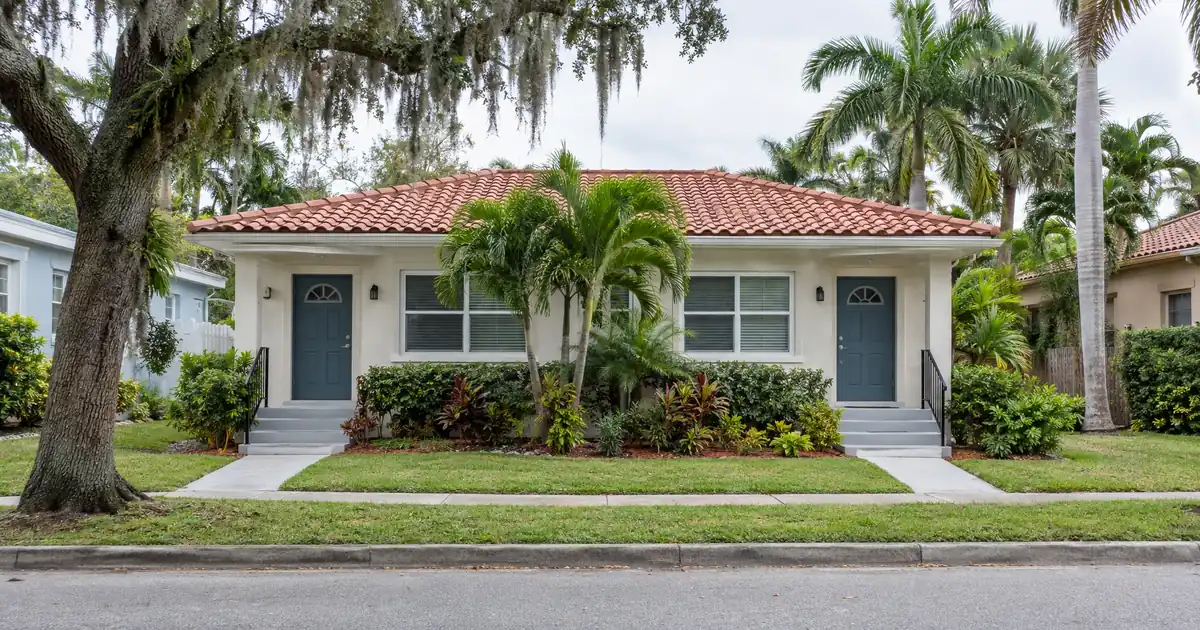
Park Side averages $2,848 a month in rent while Liberia averages $1,088, and both neighborhoods sit inside the same city limits. That 2.6x spread is the most useful number for anyone planning to pull equity out of a Hollywood rental. It explains why two owners with the same appreciation can get very different cash-out results.
Lendmire is a non-QM mortgage broker that arranges DSCR investor loans through wholesale lenders. Lendmire’s DSCR program footprint covers Hollywood, Florida as part of a 41-market reach that includes Washington, D.C. This article covers the equity-extraction side only: owners who already hold a property and want to recycle capital into the next one.
DSCR Cash-Out Calculator
Run the cash-out numbers in Hollywood, FL
Rate source: Freddie Mac 30-yr average via FRED® — Federal Reserve Bank of St. Louis · effective Sep 24, 2026
Prefilled with starting assumptions — enter your property’s value, balance, taxes, and insurance for a more accurate picture.
Program parameters update from Lendmire’s centralized guideline source. Taxes and insurance are editable estimates.
As of Sep 24, 2026 · General Freddie Mac market benchmark, not a Lendmire loan offer. Property value, balance, taxes, and insurance are editable estimates. Maximum loan-to-value varies by lender, program, property type, and seasoning. Not a Loan Estimate, approval, or commitment to lend. Program availability and eligibility are subject to lender guidelines, credit approval, property review, and underwriting.
The Short Version:
A DSCR cash-out refinance in Hollywood, Florida is underwritten primarily on the property’s rental income measured against its full monthly obligation, and the gap between neighborhood rents means the appraiser’s market rent schedule, not the purchase price, decides how much equity a 75 percent loan-to-value ceiling actually releases.
- Liberia rents sit far below those in Park Side, per RentCafe.
- Citywide median sale price has edged up modestly year over year, per Redfin.
- Cash-out typically caps at 75 percent LTV after about 6 months of ownership, subject to lender guidelines.
- Duplexes and triplexes carry more coverage cushion than workforce single-family rentals.
- Coverage is reviewed against a 1.00 floor on select programs, calculated on full payment including taxes and insurance.
Hollywood Market Snapshot
A quick read on the Hollywood investor landscape — figures come from the cited sources below. Confirm current property-level numbers before underwriting.
| Metric | Detail |
|---|---|
| Home prices | $485K median sale price (Redfin Hollywood Housing Market) |
| Typical rents | $2,267 average (RentCafe Average Rent Hollywood) |
| Population | 159,072 population (Census Reporter profile) |
| Employment | 204,300 jobs supported (Port Everglades) |
| Vacancy | 6.9% (Matthews Multifamily Market) |
Why Hollywood Equity Extraction Is a Duplex Story
Small multifamily in the inland workforce corridors is the strongest cash-out fit in Hollywood. Combined unit rents produce cushion above 1.00 that a single lease on a median-priced house rarely matches.
The math behind that is plain. Redfin’s citywide median sale price sits at a level where homes take a while to sell and draw only a couple of offers on average. A single-family rental at that basis tends to sit near the breakeven line once taxes and insurance are in the payment. One illustrative workforce-priced Hollywood property in the research landed just under 1.00, which is the usual result when a buyer pays a coastal-metro price for a house that rents like a workforce unit.
Cash-out makes this worse, not better. A larger new loan raises the monthly obligation, and coverage drops with it. A house that barely cleared at purchase can fall under 1.00 after a cash-out, and the loan gets resized to fit.
Duplexes, triplexes, and fourplexes avoid most of that. Rent rolls scale with unit count, while the payment scales with price. Owners weighing this against a conventional cash-out can read the guide “Where DSCR and Conventional Diverge”, and the general mechanics are laid out in “What Is a DSCR Loan”.
Tenant demand here is not exotic. Hollywood has 159,072 residents across 27.3 square miles, per Census Reporter’s ACS analysis, and 41 percent of households rent, per RentCafe. Residents’ largest employment sectors are retail trade, health care and social assistance, and accommodation and food services. Those are steady, year-round, lease-friendly occupations.
What the 75 Percent Cap Does to a Hollywood File
The cash-out ceiling is 75 percent of appraised value, and on a recently acquired property the usable equity is thinner than most owners expect. Seasoning also matters: about 6 months of ownership, measured from title recording, before cash-out is typically available.
Run the numbers on a modeled scenario. Say an investor bought a duplex with 25 percent down, so the original loan was 75 percent of the purchase price. The property later appraises 15 percent higher than that price. Seventy-five percent of the new value is 86.25 percent of the original purchase price. Subtract the existing balance, and the gross equity available is about 11 percent of the original price, before closing costs and before the coverage test. Those are assumptions for illustration, not market data.
Now change one input. Hollywood prices are up 3.1 percent year over year, not 15. At that pace, appreciation alone does not release meaningful cash. The proceeds come from principal paydown, from a value-add that shows up in the appraisal, or from buying below market. Files that assume a big cash-out from a modest appreciation curve are the ones that shrink during review.
The second gate is coverage. The lender divides rent used for lender review by the full monthly obligation, including principal, interest, taxes, insurance, and any HOA dues. Most standard programs are built around a 1.00 benchmark. Some lenders review lower or no-ratio scenarios, but those usually mean more cash down, lower leverage, or different pricing. Equity available depends on rent used for lender review, the full payment, reserves of about 6 months, and the 75 percent ceiling. It is never a fixed amount. Credit tiers generally run 620, 660, 680, and 700, with 620 as the floor, and all of it is subject to lender guidelines. The details are in the cash-out qualification details.
Loan sizes on standard programs run up to $3,000,000. Smaller balances route through select lenders in the network, which matters for owners of lower-priced duplexes in the inland corridors.
Liberia, Washington Park, and Driftwood: The Low-Basis Corridors
These are the neighborhoods where rent-to-value holds up best, and they are the strongest candidates for a cash-out that stays above 1.00. Lower basis meets rents that do not scale down proportionally.
Rent.com shows one-bedroom averages of $1,200 in East Hollywood and Gracewood, $1,395 in Driftwood, $1,450 in Liberia, and $1,490 in Washington Park, against a $912 citywide one-bedroom average. Listing-level figures run higher than neighborhood averages. Apartments.com shows Liberia studios near $1,410 and one-bedrooms near $1,692, while RentCafe’s neighborhood average is the lower $1,088. The difference comes from method: asking rents on current listings versus an average across all stock.
That gap matters to the appraiser. A cash-out rent schedule is built by the appraiser, not copied from the lease or from a listing site. Older inland duplexes with below-market in-place leases tend to come in under the asking comps, and coverage follows the appraiser’s number. Clean leases, rent rolls, and proof of payment history give the appraiser something to reconcile against.
Working DSCR brokers see a recurring pattern in South Florida workforce-corridor files: the lease says one number, the appraiser’s schedule says another, and the ratio is won or lost in that gap. Owners who bring a full rent roll, signed leases, and current evidence of insurance before the appraisal is ordered spend less time answering conditions afterward.
Here is the honest tradeoff. Lower-basis corridors give better coverage but thinner absolute equity. A 15 percent gain on a modest purchase price releases less cash than the same gain on a Hollywood Lakes house. Owners who want maximum cash may prefer the higher-basis property. Owners who want to keep coverage safely above 1.00 and keep the cash-out repeatable will lean toward the inland duplex. Both are defensible.
Hollywood Hills, the Lakes, and the Beach: Strong Appreciation, Thin Coverage
Higher-priced submarkets produce equity but rarely produce coverage. Buyers there are paying for location, and the rent roll does not always follow.
Hollywood Lakes shows a median sale price of $700K at about $373 per square foot. Hollywood Hills shows a three-month median of $636K, though the average price there is higher and the two measures are moving in different directions. Emerald Hills sits near $497,891 on average and has been drifting down. Hollywood Beach comes in at $484K, much of it condo stock.
Mixed direction is a problem for an appraiser pulling comps. A median that is falling while an average rises means the comp set is uneven, and the cash-out value can land below the owner’s expectation. An appraisal reconsideration request, backed by recent in-neighborhood sales and condition adjustments, is a routine step here. It is not an emergency move.
Condos are the weakest fit. The HOA questionnaire has to be complete, the condo certification has to clear, and the appraiser’s market rent schedule tends to cap income well below what an owner hopes. Delinquent dues or an incomplete questionnaire can stall a file on their own. Owners with beach-side condos should get the questionnaire started early.
One more thing on the higher-basis side. The math flips if the owner’s plan is to fund a purchase in a low-basis corridor. Pulling cash from a $700K-median neighborhood to buy a duplex in Liberia can lift total portfolio coverage even if the source property’s coverage is thin. It has to clear 1.00 on its own first, so the owner needs either a large enough rent schedule or a lower loan amount.
The Supply Question (and Why Downtown Looks Different)
New apartment supply in the Hollywood and Dania Beach submarket is a real headwind for lease-up product, but it is less of a threat to older small-scale stock. That distinction shapes which property types to refinance.
Matthews reports that more than 2,100 combined units have been delivered in the submarket in recent years, with 8,831 units under construction county-wide, about 6.1 percent of existing inventory. Class-A lease-up leans on concessions, and concessions pull down the rent comps appraisers see.
Downtown looks different. The City of Hollywood’s downtown market vitality report shows the newest development, Hollywood Heights, 65 percent occupied within about six months of opening, with a path to under 10 percent vacancy. So the vacancy pressure is not uniform. It is sharper in new-build pockets than in the core. That is useful for comp selection: an appraiser working a 2-4 unit near Young Circle can point to a healthy absorption story, while one working beside a new complex may be handed a concession-heavy comp set.
Broward leasing volume also helps.
Sitting on this one, it is a toss-up whether the supply wave hurts older duplexes. Older product competes on price, not finish, and the new units are priced well above it. But concessions in the new buildings can widen the effective rent gap and pull some tenants up-market. Stress-test the rent schedule a little below the current in-place rents before committing to a loan size.
Rail Stations: An Appreciation Thesis, Not a Cash-Flow One
Properties near planned rail stops are an appreciation bet that will not help coverage today. The Commuter Rail South project is described as 11.5 miles at $712 million, with stations planned for Hollywood, the airport, and south Fort Lauderdale. Nothing there is complete, and timing is not guaranteed.
An owner near a future stop can reasonably expect station-area value to show up in later comps. But a lender underwrites the rent schedule that exists now, not the one a station might create. Fund the cash-out off current rent. Treat any transit premium as upside.
Employment Anchors That Support the Rent Schedule
Hollywood’s demand base rests on health care, the airport and port economy, and one very large resort. Together they give lease evidence a steady tenant pool to lean on.
Memorial Healthcare System is headquartered in Hollywood, and a press release puts its workforce at more than 15,000 people across six hospitals, including Memorial Regional. Shift-working clinical and support staff tend to sign and renew long-term leases, which is the profile a DSCR file favors over transient demand.
Port Everglades, partly inside Hollywood, supports more than 204,300 jobs through cargo and cruise activity. The Seminole Hard Rock Hotel & Casino Hollywood operates 1,271 guest rooms on tribal land inside the city. Few comparable Florida cities have a deepwater port and a resort of that scale inside their borders. The hospitality and maritime payrolls feed rental demand in the inland corridors.
There is a gap worth stating plainly. No major university has its main campus in Hollywood, and no reliable Hollywood-specific enrollment figure turned up. Nearby schools may send some commuter renters into the affordable neighborhoods, but that demand should not be counted in a rent schedule.
DSCR vs. conventional financing
Two common ways to finance an investment property in Hollywood, FL. They qualify you differently — here’s how investors weigh them.
Why investors choose it
- Qualifies on the property’s rental income — no personal tax returns, W-2s, or pay stubs needed to document income.
- No personal debt-to-income ceiling to clear, so existing mortgages and obligations don’t cap your borrowing the same way.
- Can be closed in an LLC, keeping the property inside a business entity.
- Built for scaling — not held to the limit on number of financed properties that conventional financing applies.
- Underwriting centers on the deal: generally qualifies when the rent covers the payment, a 1.00x coverage ratio being a common baseline (confirmed in underwriting).
- Designed specifically for investment property, including long-term and, where the program allows, short-term rentals.
Where it’s strong
- Often the lowest ongoing financing cost for a buyer who fully qualifies on personal income — a fit for a first property or a cost-first purchase.
Trade-offs for investors
- Requires full personal income documentation and must fit within a debt-to-income limit — salary, existing debts, and other mortgages all count.
- Typically held in your personal name rather than a business entity.
- Caps how many financed properties you can carry, which can become a ceiling as a portfolio grows.
- Evaluates you as a borrower as much as the property, which usually means more paperwork.
How investors usually choose: a first or single property often optimizes for the lowest financing cost; portfolio builders often optimize for leverage, vesting in an LLC, and scaling past conventional caps. The right answer depends on your goals, the property, and current guidelines — both paths run through select lenders in Lendmire’s wholesale network, with eligibility and terms confirmed in underwriting.
Where the Answer Flips
Whether to cash out at all depends on a few conditions, and each one can reverse the decision.
- Coverage after cash-out is under 1.00. The loan gets resized, which shrinks the proceeds. Some owners are better off keeping the existing loan and funding the next deal another way.
- The property is a single-family house near the median price. Coverage starts near breakeven. A larger loan makes it worse. Cash-out here usually needs lower leverage than the 75 percent ceiling.
- The property is a duplex or triplex in an inland corridor. This is the structure that most often holds coverage after a cash-out.
- The property is a condo. Clean HOA paperwork is required, and the rent schedule tends to cap the result.
- The owner has less than about 6 months of seasoning. The refinance is not yet available, so this is a wait, not a denial.
Entity-held properties add one documentation layer. Loans to LLC-titled entities are available subject to lender program eligibility, and the file needs the operating agreement, articles, and EIN documentation in order. Reserves of about 6 months of the full payment also need statements, and funds that moved recently need an explained paper trail. Recurring friction points are entity documents, a stale or incomplete lease set, an open HOA questionnaire, and reserves that cannot be sourced.
Owners whose property has a clean rent roll and equity above the 75 percent cut can review my scenario, or call 828-256-2183. Owners considering a rate-and-term move rather than cash-out can start from the refinance pathway for investor properties. More on the state program is at DSCR loans in Florida.
Verify current local rental rules, taxes, and insurance requirements with qualified local professionals before underwriting any deal. Hollywood has flood exposure in several zip codes, so keep that line in the budget.
What a Local Appraiser Would Tell You
In Hollywood, the rent schedule follows the block, not the zip code, and a duplex in Liberia will usually cash-out cleaner than a house in Hollywood Lakes that appraised higher. Buy and hold where the rents are, refinance on what the leases prove, and leave the beachfront condos and the big-ticket houses for owners who care more about appreciation than coverage.
Frequently Asked Questions
How do you qualify for a DSCR cash-out refinance in Hollywood, Florida?
Qualification centers on the property’s rent against its full monthly obligation, including taxes, insurance, and any HOA dues, with 1.00 as the common benchmark. Lenders also review credit (620 is the floor), about 6 months of reserves, and seasoning of about 6 months from title recording. The appraiser’s market rent schedule sets the income figure, and everything is subject to lender guidelines.
What are the requirements for an investment property loan refinance in Hollywood, Florida?
Expect an appraisal with a rent schedule, proof of ownership and seasoning, lease evidence, entity documents if an LLC holds title, and reserves documentation. Condos add an HOA questionnaire and condo certification. Loan sizes run up to $3,000,000 on standard programs, and cash-out is capped at 75 percent LTV.
Why do Hollywood duplexes often out-perform single-family homes on cash-out coverage?
Citywide median prices sit at a level where a single-family rental tends to land near breakeven on coverage. A duplex or triplex in a corridor like Liberia or Washington Park adds unit rents without adding a proportional purchase price. The same 75 percent ceiling therefore leaves more room above 1.00.
Does Hollywood’s new apartment supply hurt cash-out appraisals?
It can, mainly when comps come from new lease-up buildings offering concessions. Matthews reports thousands of units delivered and under construction in the Hollywood and Dania Beach submarket, but downtown absorption looks healthy. A well-documented appraisal reconsideration with in-neighborhood comps usually addresses a low rent or value comp.
What credit score ranges may DSCR lenders review for a Hollywood rental property?
Lenders in the network generally review tiers at 620, 660, 680, and 700, with 620 as the floor. Lendmire (NMLS# 2371349) arranges DSCR investor loans, and higher tiers may support higher leverage, subject to lender guidelines. Credit, reserves, and the coverage ratio are reviewed together, not separately.
For current guidelines and terms, see Lendmire’s DSCR loan programs page.
About Lendmire
Lendmire (NMLS# 2371349), a non-QM mortgage broker serving investors in 41 markets including Washington, D.C., helps structure DSCR scenarios commonly evaluated around a property’s rental income rather than personal income paperwork, subject to lender guidelines. Recognized as a top-ranked workplace in 2026 and a 2025 Scotsman Guide Top Workplace, Lendmire places loans through wholesale investor lenders and is not a direct lender. Details are in the 2026 Top Workplace recognition announcement.
Get Started
Ready to find the right loan for you?
In about 30 seconds you can review financing options available for your investment property. No commitment required.
Informational only. Not a Loan Estimate, approval, or commitment to lend. Program availability and eligibility are subject to lender guidelines, credit approval, property review, and underwriting.
References
1. RentCafe Average Rent Hollywood FL
2. Redfin Hollywood Housing Market
4. Port Everglades Economic Impact News Release
5. Matthews Multifamily Market Report, Broward County
6. Census Reporter: Hollywood, FL
7. RentCafe
8. Rent.com shows one-bedroom averages
9. Apartments.com shows Liberia studios near $1,410 and one-bedrooms near $1,692
10. Hollywood Lakes shows a median sale price of $700K
11. Hollywood Hills shows a three-month median of $636K
12. Emerald Hills sits near $497,891 on average
13. Hollywood Beach comes in at $484K
14. The Commuter Rail South project
15. prweb.com — Memorial Healthcare System Hollywood FL Raises Wages for Nearly 2,000 Employees
16. Seminole Hard Rock Hotel & Casino Hollywood
17. Scotsman Guide — Top Workplaces 2026
18. a 2025 Scotsman Guide Top Workplace
19. the 2026 Top Workplace recognition announcement
This article is part of Lendmire’s investment property cash-out refinance program — full qualification details, guidelines, and scenarios live on the program page.
Related reading: Cash Out Refinance Investment Property Hollywood Florida · DSCR Loans Los Angeles: Investor Financing for Hollywood, Downtown, South LA, the Valley & Real Estate Investors · DSCR Cash Out Refinance in Lauderdale Lakes, Florida: The 2026 DSCR Guide to the SR-7 Corridor
Guides: Investment Property Cash-Out Refinance in Hollywood, FL · Investment Property Cash-Out Refinance in Florida
Brandon Miller
Founder & CEO, Mortgage Loan Originator, Lendmire LLC
- Mortgage Loan Originator · NMLS# 1129696 · Verify on NMLS Consumer Access
- North Carolina Real Estate Broker · License# 343312 · Verify on NCREC
- North Carolina Insurance Producer · License# 19053198 · Property, Casualty, Life, Health · Verify on NAIC SBS
- Lendmire LLC · Firm NMLS# 2371349 · Verify firm licensure
Disclosure information. Lendmire is a state-licensed mortgage brokerage under NMLS# 2371349. Lendmire is not a depository institution, direct lender, or financial advisor — all loans referenced are placed through wholesale lender partners and are subject to each lender's underwriting standards. This article is provided for general informational purposes and is not a commitment to lend, nor does it constitute financial, legal, or tax advice. Loan programs, terms, rates, and qualification standards change without notice and depend on borrower profile, property type, and the state in which the subject property is located. Equal Housing Opportunity provider. NMLS Consumer Access: nmlsconsumeraccess.org.