
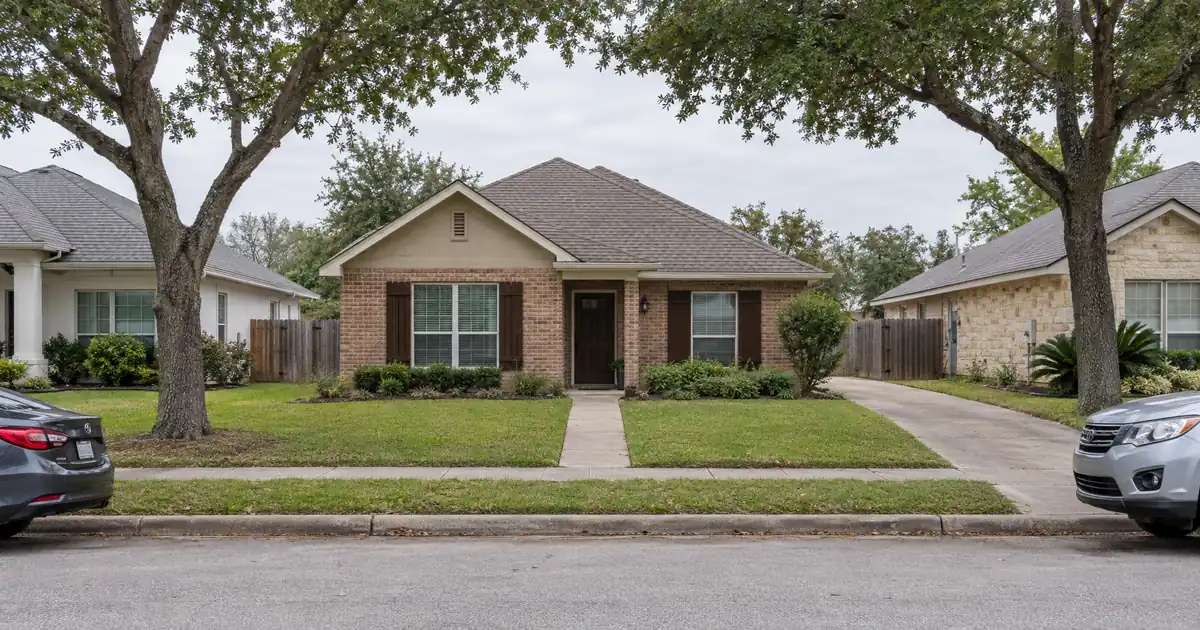
A cash-out in Texas City starts with a coverage problem, not an equity problem. Citywide rents sit between roughly $1,199 and $1,307 depending on the source, while the median sale price runs close to $296,000. That gap decides how much leverage a single-family rental can carry once taxes and insurance are in the debt number. Lendmire (NMLS# 2371349), a DSCR-focused mortgage broker, sees this pattern often in Gulf Coast industrial towns. Through Lendmire’s DSCR program footprint — 41 markets, including Washington, D.C. — lenders may review qualifying rental income subject to program guidelines for Texas City, Texas investors.
At a Glance: A DSCR cash-out refinance in Texas City, Texas is underwritten primarily on the property’s rental income measured against its full monthly obligation, and the tight rent-to-price spread here makes that ratio, not available equity, the binding constraint.
DSCR Cash-Out Calculator
Run the cash-out numbers in Texas City, TX
Rate source: Freddie Mac 30-yr average via FRED® — Federal Reserve Bank of St. Louis · effective Sep 24, 2026
Prefilled with starting assumptions — enter your property’s value, balance, taxes, and insurance for a more accurate picture.
Program parameters update from Lendmire’s centralized guideline source. Taxes and insurance are editable estimates.
As of Sep 24, 2026 · General Freddie Mac market benchmark, not a Lendmire loan offer. Property value, balance, taxes, and insurance are editable estimates. Maximum loan-to-value varies by lender, program, property type, and seasoning. Not a Loan Estimate, approval, or commitment to lend. Program availability and eligibility are subject to lender guidelines, credit approval, property review, and underwriting.
- Redfin put the median sale price near $296,000, with 96 days on market, up from 61 a year earlier.
- Typical program guidance caps cash-out leverage at 75 percent LTV, with about 6 months of seasoning.
- Single-family rent at the citywide median struggles to reach 1.00x at high leverage.
- Duplexes stack two rents against one price and are the more realistic path to coverage.
- Tenant demand leans on refinery, petrochemical and port employment, which is steady but cyclical.
Texas City Market Snapshot
A quick read on the Texas City investor landscape — figures come from the cited sources below. Confirm current property-level numbers before underwriting.
| Metric | Detail |
|---|---|
| Typical rents | $1,199 median (Zumper Texas City rent research) |
| Population | 55,364 residents (Census Reporter (ACS 2024 5-yr)) |
| Employment | 1,550 employees (Wikipedia, Galveston Bay) |
The Coverage Math Comes First
Single-family rent at the citywide median will not comfortably carry a 75 percent cash-out in Texas City. That is the central finding, and everything else follows from it.
Redfin’s Texas City data showed a median sale price of about $296,000, up 5.7 percent year over year, with days on market stretching to 96. Prop-Metrics shows a lower figure for the ZIP, a median near $243,000, down 1.8 percent. The two sources use different methodologies and geographies, so treat $296,000 as the working citywide median and the lower number as a warning about how much medians swing. On rent, Zumper shows a median near $1,199 across property types, and Niche reports $1,307. A broker blog cites $1,560 to $1,585, which looks like a single-family-heavy read.
Run the numbers on a modeled property valued at $296,000 and renting at $1,560. These are modeled assumptions, not market data. DSCR is monthly rent divided by the full monthly obligation: principal, interest, taxes and insurance. Using full PITIA with Texas-average tax and insurance loads, that rent produces coverage in the high-0.7x range at 75 percent LTV. At 60 percent leverage it still lands around 0.9x. Coverage only reaches the low-1.0x zone near 50 percent leverage. At a modeled $1,199 rent, none of those structures clears.
Most standard DSCR programs are built around a 1.00x benchmark because rent covers the payment at that level. Some lenders review sub-1.00 files, but those usually come with lower leverage, different pricing or more cash down, and eligibility depends on lender guidelines, credit, reserves and property review. A borrower looking at a sub-1.00 single-family could ask about a sub-1.00 program or an interest-only structure. Neither is assured.
Why the Duplex Changes the Answer
Two rents against one price is the cleanest fix available here. Zumper shows a Texas City duplex listing with a 2-bedroom unit at $1,300 a month. One listing is not a market average, so verify it against several duplex comps before building a file around it.
Take the same modeled $296,000 value, assuming two units at $1,300 each for $2,600 gross. At 75 percent LTV, coverage including taxes and insurance comes out around 1.25x. That is a different file from the single-family one. The assumption doing the work is that a duplex trades near the single-family median, so check that against actual sales. In practice duplexes can price differently, and the ratio moves with them.
This is a genuine toss-up for some investors. The duplex gives stronger coverage but thinner exit liquidity, and Redfin counted only 55 closed sales in the month cited, so comps are scarce. The better plan for most owners is probably a duplex or small multifamily held for coverage rather than a single-family bought for appreciation. Investors who already own single-family rentals can argue the other way: lower leverage, smaller proceeds, less appraisal risk.
Where the Tenants Come From
Texas City is a petroleum refining and petrochemical center with a deepwater port. The Galveston Bay Refinery lists 631,000 barrels per day of capacity and 1,550 employees, and contractor headcount across the corridor is far larger. Valero’s Texas City refinery is an active local presence through the chamber and the school foundation. Older reporting from the Galveston Daily News also names BP Texas City Chemicals, Dow, Eastman Chemical, INEOS Styrenics and NuStar. Texas Highways calls the Port of Texas City the largest privately owned port in the nation.
A broker blog, citing the Texas City Economic Development Corporation, reports over 4,000 manufacturing and petrochemical jobs in the city. The figure is secondhand, so verify it at the source. No official employer table with headcounts turned up in the research. Qualitatively, the picture holds: turnaround crews and contractors create a tenant pool most Houston-area suburbs lack.
The catch is concentration. Demand is steady but cyclical and tied to one industry. Lenders will not penalize that directly, but an owner sizing a cash-out should assume rent growth tracks industrial employment, not broad migration. Census Bureau QuickFacts counts 55,364 residents across 66.3 square miles, so the base is real but not large.
Submarkets: Where the Math Has a Chance
Downtown and Sixth Street come first. Homes.com describes historic brick buildings, taverns and eateries, and a revitalization effort running since the early 2000s. Older stock makes this the most plausible area for duplex and small-multifamily acquisitions, though no reliable neighborhood-level rent or price data turned up. Expect to build comps by hand.
The Palmer Highway, North Highway 146 and Amburn Road corridor suits workforce and staff tenants. College of the Mainland sits at Palmer Highway and Amburn Road. U.S. News reports total enrollment of 4,335, while Niche’s count differs, so roughly 4,000 to 5,000 students is the safe framing. A city notice flags a major roadway project on FM-1764/Palmer Highway, so check timing before assuming construction disruption is over.
The Mall of the Mainland, Tanger Outlets and Emmett F. Lowry Expressway area is the newer side of the city. Newer-build single-family there is the likeliest product to appraise cleanly (and the likeliest to be priced well above the rent supports). Healthcare demand adds some support. HCA Houston Healthcare Mainland is the local hospital, and a UTMB Health clinic operates on the Expressway.
Skip Grand Cay Harbour for cash-out purposes. A broker blog describes entry prices well above the citywide median plus recurring community assessments. Rent will not close that gap at 75 percent leverage. Nessler Park’s mature-lot streets and Pearlbrook’s newer construction are fine holds, but no price or rent data was found for either, so neither can be modeled here.
Appraisal Risk Is the Quiet Problem
What does the appraiser see in a market with 96 days on market? Probably a number lower than the owner expects.
Redfin’s days on market rose from 61 to 96 over the year. A broker blog citing local data shows about 4.7 months of supply, a 72-day median on market and only 18.8 percent of homes selling above list. Price direction is disputed across sources: Redfin showed gains, while other aggregators showed declines of between 1.8 and 3.6 percent. Prices look flat to softening with inventory building, not hot.
For a cash-out, that means underwrite to the current appraised value, not a hoped-for post-rehab value. Small monthly sales volume makes any single median unreliable, so sizing a refinance around one month’s number is a mistake. Program guidance typically asks for about 6 months of ownership measured from title recording before cash-out, and proceeds depend on rent used for lender review, PITIA, reserves and the 75 percent LTV ceiling. Pulling equity with a DSCR cash-out works when value has held, not when it has merely been assumed.
What a Working Deal Desk Sees
In markets structurally like this one, the common friction point is not the credit file. It is the gap between the rent the owner collects and the rent the lender will use. Files with a signed lease and a clean market rent comparison tend to move through review more smoothly than those relying on a single listing. Borrowers who arrive with reserves already documented, typically around six months of PITIA on standard programs, avoid a second round of conditions. Credit tiers generally start at a 620 floor, though better scores can improve the structure.
What to Do With the Proceeds
The reason to pull equity is the next acquisition, and in this market the next acquisition should itself carry coverage. Cash-out proceeds from a seasoned duplex, redeployed into another multi-unit near Downtown or the Palmer Highway corridor, stack coverage on coverage. Proceeds redeployed into a high-priced single-family just recreate the problem. Investors weighing the sequence can read the refinance side of the process, review Lendmire’s DSCR walkthrough for the mechanics or see the guide “Where DSCR and Conventional Diverge” for how the two financing types compare. Broader program detail for the state lives under DSCR loans in Texas.
Coastal exposure is a factor in every Gulf Coast hold. Verify current local rental rules, property taxes and insurance with qualified local professionals before sizing any file. Review details remain subject to lender overlays.
Frequently Asked Questions
How do you qualify for a DSCR loan in Texas City, Texas?
Qualification centers on the property’s rent measured against its full monthly obligation, typically with a 1.00x benchmark, a credit floor around 620 and reserves near six months of PITIA. Because citywide single-family rent is low relative to price, most Texas City files need lower leverage or multi-unit income to reach that number. Final eligibility depends on lender guidelines, credit, reserves and property review.
DSCR vs. conventional financing
There are two common ways to finance an investment property in Texas City, TX, and they qualify you differently — here’s how investors weigh them.
Why investors choose it
- Qualifies on the property’s rental income — no personal tax returns, W-2s, or pay stubs needed to document income.
- No personal debt-to-income ceiling to clear, so existing mortgages and obligations don’t cap your borrowing the same way.
- Can be closed in an LLC, keeping the property inside a business entity.
- Built for scaling — not held to the limit on number of financed properties that conventional financing applies.
- Underwriting centers on the deal: generally qualifies when the rent covers the payment, a 1.00x coverage ratio being a common baseline (confirmed in underwriting).
- Designed specifically for investment property, including long-term and, where the program allows, short-term rentals.
Where it’s strong
- Often the lowest ongoing financing cost for a buyer who fully qualifies on personal income — a fit for a first property or a cost-first purchase.
Trade-offs for investors
- Requires full personal income documentation and must fit within a debt-to-income limit — salary, existing debts, and other mortgages all count.
- Typically held in your personal name rather than a business entity.
- Caps how many financed properties you can carry, which can become a ceiling as a portfolio grows.
- Evaluates you as a borrower as much as the property, which usually means more paperwork.
How investors usually choose: a first or single property often optimizes for the lowest financing cost; portfolio builders often optimize for leverage, vesting in an LLC, and scaling past conventional caps. The right answer depends on your goals, the property, and current guidelines — both paths run through select lenders in Lendmire’s wholesale network, with eligibility and terms confirmed in underwriting.
What are the requirements for an investment property cash-out refinance in Texas City, Texas?
Typical guidance asks for about six months of seasoning from title recording, leverage capped at 75 percent LTV and qualifying coverage of at least 1.00x. Loan amounts up to $3,000,000 fit standard programs. Manufactured homes, log homes and barndominiums fall outside these programs. Proceeds depend on rent, obligations, reserves and appraised value, so no cash figure is assured. These specifics are subject to lender guidelines and a full review of property, leverage, and credit.
Does a Texas City duplex cash out better than a single-family rental?
Usually, yes, on coverage. Two rents against one price and one set of comps lifts the ratio where a single unit’s rent falls short. One listed 2-bedroom duplex unit showed $1,300 a month, but that is one data point. Gather several unit-level comps first, and expect appraisers to be cautious given slow sales volume.
Can refinery and turnaround tenants support a DSCR file here?
They support demand, but the lender underwrites the lease and market rent, not the tenant’s employer. Contractor and turnaround demand is cyclical, so a file with a standard long-term lease reads cleaner than one built on short, project-based occupancy.
Can Lendmire help arrange DSCR financing for investment properties in Texas City?
Yes. Lendmire arranges DSCR investor loans through wholesale lending channels. Eligibility centers on property rental income, and the files can be structured for LLC-titled borrowers, subject to lender program eligibility. A conversation with the team at 828-256-2183 starts the review.
For current guidelines and terms, see Lendmire’s DSCR loan programs page.
The Takeaway
If you only take one thing from this piece, it’s this: in Texas City the duplex, not the median single-family rental, is what carries a 75 percent LTV cash-out past 1.00x, so underwrite to unit-level rent comps before assuming any equity can be pulled.
About Lendmire
As a non-QM mortgage broker (NMLS# 2371349), Lendmire facilitates DSCR investor loans across 41 markets, including Washington, D.C. Eligibility is generally reviewed around the property’s rental income rather than personal income documentation, subject to lender guidelines, and the platform serves LLC-structured portfolios and self-employed borrowers who don’t fit conventional boxes. Lendmire is a 2026 Scotsman Guide Top Workplace and a top-ranked workplace in 2025.
Get Started
Ready to find the right loan for you?
In about 30 seconds you can review financing options available for your investment property. No commitment required.
Informational only. Not a Loan Estimate, approval, or commitment to lend. Program availability and eligibility are subject to lender guidelines, credit approval, property review, and underwriting.
References
1. Zumper
2. Census Reporter (ACS 2024 5-yr)
5. Prop-Metrics
6. Valero’s Texas City refinery
8. secondhand
10. Homes.com
13. a 2026 Scotsman Guide Top Workplace
14. Scotsman Guide — Top Workplaces 2025
This article is part of Lendmire’s investment property cash-out refinance program — full qualification details, guidelines, and scenarios live on the program page.
Related reading: Cash Out Refinance Investment Property League City Texas · DSCR Cash Out Refinance in Weslaco, Texas: Will Rents Cover the Loan After Pulling Equity? · DSCR Cash Out Refinance in Baytown, Texas: Equity Extraction in a Refinery Town With Soft Rents
Guides: Investment Property Cash-Out Refinance in Texas City, TX · Investment Property Cash-Out Refinance in Texas
Brandon Miller
Founder & CEO, Mortgage Loan Originator, Lendmire LLC
- Mortgage Loan Originator · NMLS# 1129696 · Verify on NMLS Consumer Access
- North Carolina Real Estate Broker · License# 343312 · Verify on NCREC
- North Carolina Insurance Producer · License# 19053198 · Property, Casualty, Life, Health · Verify on NAIC SBS
- Lendmire LLC · Firm NMLS# 2371349 · Verify firm licensure
Important disclosures. Lendmire (NMLS# 2371349) is a licensed mortgage brokerage. Lendmire is not a direct lender, depository institution, or financial advisor. All loan inquiries are subject to lender underwriting; this article does not constitute a commitment to lend. Rates, terms, and program guidelines are subject to change without notice and vary by borrower profile, property type, and state. Information in this article is general in nature and is not financial, legal, or tax advice. Equal Housing Opportunity. NMLS Consumer Access: nmlsconsumeraccess.org.