
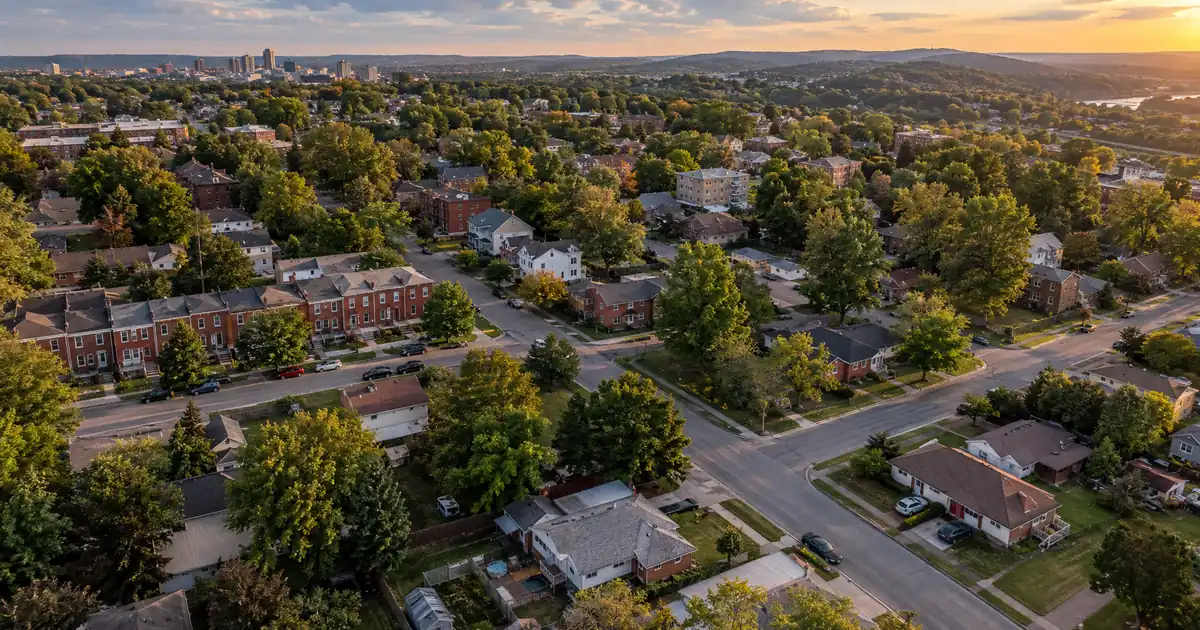
Picture two Independence owners, both sitting on paid-down rentals. One holds an older duplex near the historic core, with unit rents in the $700-$900 range. The other holds a newer four-bedroom on the southeast side, priced well above the city’s typical home. On paper the southeast house looks like the stronger asset. Once coverage includes taxes and insurance, the math tends to favor the older, cheaper stock, because rent-to-value stays healthier where the purchase price is low. Independence’s median rent is $1,268 per Apartment List, against a Zillow average home value of $214,173. That gap is why cash-out refinancing here is more about protecting coverage than chasing appreciation.
Lendmire (NMLS# 2371349), a DSCR-focused mortgage broker, works with Independence, Missouri investors through a DSCR program footprint spanning 40 states plus Washington, D.C. Everything below assumes the property is already owned and the question is how to pull equity out without breaking the coverage ratio.
DSCR Cash-Out Calculator
Run the cash-out numbers in Independence, MO
Rate source: Freddie Mac 30-yr average via FRED® — Federal Reserve Bank of St. Louis · effective Sep 24, 2026
Prefilled with starting assumptions — enter your property’s value, balance, taxes, and insurance for a more accurate picture.
Program parameters update from Lendmire’s centralized guideline source. Taxes and insurance are editable estimates.
As of Sep 24, 2026 · General Freddie Mac market benchmark, not a Lendmire loan offer. Property value, balance, taxes, and insurance are editable estimates. Maximum loan-to-value varies by lender, program, property type, and seasoning. Not a Loan Estimate, approval, or commitment to lend. Program availability and eligibility are subject to lender guidelines, credit approval, property review, and underwriting.
Key Takeaways:
A DSCR cash-out refinance in Independence, Missouri is underwritten primarily on the property’s rental income measured against its full monthly obligation, then sized by a 75% loan-to-value ceiling on an owned rental. Lender guidelines, credit approval, and appraisal determine what equity is actually available.
- Cash-out LTV tops out at 75%, and seasoning runs about 6 months from title recording.
- Zillow shows average values up 3.5% year over year, so equity usually comes from rehab, not market lift.
- Modeled 3-bedroom coverage lands near 1.2x including taxes and insurance; 2-bedrooms can dip under 1.00.
- Duplexes and fourplexes near Independence Square spread income across leases, but 5-unit buildings may exceed program unit caps.
- Independence sits within a metro of 2.1 million people, per the City of Independence.
Independence Market Snapshot
A quick read on the Independence investor landscape — figures come from the cited sources below. Confirm current property-level numbers before underwriting.
| Metric | Detail |
|---|---|
| Home prices | $218K median price (Prop-Metrics, Independence 64055) |
| Typical rents | $700 ×3 and $750 ×1 rents (Wardell Holmes (broker listings)) |
| Population | 113,288 (Advisory Council on Historic) |
Procter and the Historic Core: Where Small Multifamily Cash-Outs Start
The 64050 and 64052 ZIPs around Independence Square hold the city’s best small-multifamily story. Apartment List describes Procter as an established neighborhood with homes from various eras, traditional houses mixed with smaller apartment buildings, and rents that stay accessible compared with Kansas City proper. It also sits on I-70 connections into the metro.
Demand here is workforce-driven: local government, school district, and service employers. The city names HCA Healthcare, Mid-Continent Public Library, and the Independence School District as major employers. Nobody publishes a reliable neighborhood-level median for Procter, so treat any rent-to-value ratio quoted for it as an estimate. The sources describe the stock. They do not price it.
Homes.com showed 27 multi-family listings in Independence, priced from $175,000 to $1,085,000. That spread covers duplexes, triplexes, fourplexes, and larger buildings, including a 5-unit example near the Square with a 2-bed/2-bath, a 1-bed/1-bath, and three studios. Twenty-seven listings is a rough gauge, but it suggests enough comps to support an appraisal on a 2-4 unit property. Here’s the catch: a 5-unit building may fall outside residential DSCR programs, so confirm the unit cap before you plan a cash-out around one.
The Fourplex Arithmetic
One listing in the historic-core area shows a fourplex with three units at $700 and one at $750, tenant-paid utilities, separate meters, and leases renewed through the next cycle, per a Wardell Holmes listing. That is about $2,850 in gross monthly rent. The listing shows no price, so no rent-to-price ratio can be stated from it. Redfin’s multi-family listings add a duplex with one side at $899 and another with two 2-bed/1.5-bath units, both leased. Together they give a working band of roughly $700-$900 per unit for older one- and two-bedroom apartments.
Underwriters like this structure for a plain reason. Rent spread over four leases means one vacancy costs about a quarter of income, not all of it. Separately metered, tenant-paid utilities keep the gross income figure clean.
The skeptical read is that low per-unit rents leave little room for error. Redfin’s citywide average rent is only about $1,097 (a different methodology than Apartment List’s median), so a duplex has to produce $1,400-$1,800 combined to be worth stacking. Model each unit at the low end of the band, not the average, and don’t count rent increases you haven’t yet collected.
Eastland, Blue Village, and the Apartment Competition
The 64055 corridor near Independence Center and the Bass Pro flagship store is single-family rental territory. Apartment List describes Blue Village as convenient to mall shopping with quiet residential streets. Residents need cars, but they get more yard and square footage than in Kansas City proper. Tenants are largely retail and hospitality workers and I-70 and I-470 commuters, an inference from the corridor’s commercial base.
Rentcast data via Prop-Metrics shows medians of $1,190 for 2-bedrooms, $1,700 for 3-bedrooms, and $1,900 for 4-bedrooms. The page labels its figures “Independence, MO,” so they may be city-wide, not ZIP-specific. Use them as a band, not a promise.
Newer apartment communities are the real competition here. Redfin’s rental listings show three-bedroom asking rents in the mid-$1,500s to $1,600s at recent Eastland-area complexes. A single-family landlord asking $1,700 is competing against a leasing office with amenities. Before you underwrite a cash-out on a 64055 house, ask whether your rent survives that comparison. If your refinance depends on the top of the range, the number is softer than it looks.
Southeast and Centerpoint: Premium Rents, Thin Proof
The 64057 ZIP around Centerpoint Medical Center, a 285-bed HCA hospital, has newer construction and higher prices. Listing examples run from about $260,000 for a small two-bedroom to near $370,900 for a four-bedroom. Healthcare employment anchors demand, so long-term tenant turnover should stay manageable.
Here’s the tension. Brokerage marketing claims $1,800-$2,100 rents in the newer 64055-64057 stock, but that figure isn’t independently verified. A house priced near $370,900 needs rent well above the citywide band to cover full debt service including taxes and insurance at a 75% LTV. Newer construction has little renovation upside for a cash-out, so the equity you can pull depends almost entirely on market movement. This is the weakest fit for an equity-extraction strategy. Owners here should stress-test at the citywide 4-bedroom rent, not the marketing number. Every figure here varies by lender and program — guidelines, property type, leverage, and credit profile all apply.
Eastern Independence and the Industrial Park Question
The city spans about 78 square miles, transitioning from urban in the west to rural in the east. Listings in 64056 and 64058 range from around $240,000 to $442,000, reflecting both older and newer stock.
The eastern demand story is logistics. The city approved a 1,200-acre industrial park in eastern Jackson County, described by KCUR as the largest project in city history. Its current status was not verified, so don’t build a refinance thesis on jobs that may not exist yet. A bigger labor pool helps long-term rental demand only if the employers arrive.
The north and northwest (64053 and the Noland Road corridor) have modest working-class stock along I-70, but no reliable price or rent data turned up. Cash-out underwriting there is guesswork until a comp set proves otherwise.
Appreciation Won’t Do the Work
Independence is one of the lower-priced markets in the Kansas City metro, and its trend data disagrees with itself. Zillow shows values rising modestly year over year, with homes going pending quickly. Resideline reports a higher median closing price drawn from a set of closed sales over a recent multi-month window. That is a closed-sale median, not an average value index, so the two figures sit apart by method and not necessarily by market direction. Redfin’s more recent median came in lower, with a modest gain of its own.
Low-single-digit appreciation has one practical consequence. Equity on an Independence rental grows mainly through forced appreciation, meaning rehab, not market lift. The housing stock is mostly postwar and older detached homes, so condition drives much of the price difference between houses on the same block. Appraisers weigh condition heavily. Keep renovation receipts, photograph the before and after, and budget for a conservative appraisal.
The parameters shape the strategy. A cash-out refinance on an investment property generally caps at 75% LTV, with roughly 6 months of ownership measured from title recording. Coverage is usually built around a 1.00x baseline, credit ranges from a 620 floor upward through 660, 680, and 700 tiers, and reserves run about 6 months of PITIA. Smaller balances, which many Independence rentals will produce, route through select lenders in the network, since standard programs go up to $3,000,000. All of this is subject to lender guidelines, credit approval, and property review, and none of it guarantees a cash figure. For the mechanics, see cash-out refinance details and the guide “What Is a DSCR Loan”.
What Coverage Actually Looks Like
These are modeled assumptions, not market data. Each case uses a 75% LTV, an assumed 30-year term, and a rate assumption in line with the current environment, with property tax and insurance estimated at typical Missouri levels relative to price. Coverage includes taxes and insurance. Final terms depend on lender guidelines, property type, leverage, and the borrower’s complete credit picture.
| Scenario | Modeled value | Assumed rent | Coverage |
|---|---|---|---|
| Newer 3-bed house | $220,000 | $1,700 | About 1.2x |
| Older 3-bed house | $195,000 | $1,400 | Low-1.1s |
| 2-bed house | $200,000 | $1,190 | Just under 1.00 |
| Duplex | $200,000 | $1,600 combined | High-1.2s |
The 2-bedroom row is the one to look at twice. At a mid-$1,100s rent, taxes and insurance push coverage just below the 1.00 baseline. Some lenders may review sub-1.00 files through a specific program, an interest-only structure, or lower leverage, but those come with stronger credit, more cash, or different pricing, and eligibility review depends on lender guidelines and property review. If an investor only reaches 1.00 by assuming rent above what the neighborhood supports, the fix is a different property, not a different loan.
The duplex row does better than the single-family rows for a structural reason. Two rents against one debt payment cushion small-balance properties, where fixed costs like insurance weigh heavier. Compare that with a single-family rental that is either fully rented or empty.
Lendmire’s deal desk tends to see the same pattern on files from older-stock, low-median markets like this one. The cleaner files come with a rent roll or lease in hand, a fresh insurance quote, and rehab receipts that match the appraisal narrative. The common friction point is a stated rent that outruns what the appraiser’s rent schedule supports. Coverage gets recalculated on the lower number, and the cash-out shrinks with it.
Where the Proceeds Should (and Shouldn’t) Go
Redeploying into another Independence 2-4 unit property where coverage clears works. Pulling equity to chase a higher-priced house in 64057 or a speculative eastern parcel is a different bet. Independence’s rental base leans small: two-bedrooms make up 37.1% of stock and one-bedrooms 29.5%. Small units are where the math holds, so the proceeds should stay near that profile.
DSCR vs. conventional financing
Two common ways to finance an investment property in Independence, MO. They qualify you differently — here’s how investors weigh them.
Why investors choose it
- Qualifies on the property’s rental income — no personal tax returns, W-2s, or pay stubs needed to document income.
- No personal debt-to-income ceiling to clear, so existing mortgages and obligations don’t cap your borrowing the same way.
- Can be closed in an LLC, keeping the property inside a business entity.
- Built for scaling — not held to the limit on number of financed properties that conventional financing applies.
- Underwriting centers on the deal: generally qualifies when the rent covers the payment, a 1.00x coverage ratio being a common baseline (confirmed in underwriting).
- Designed specifically for investment property, including long-term and, where the program allows, short-term rentals.
Where it’s strong
- Often the lowest ongoing financing cost for a buyer who fully qualifies on personal income — a fit for a first property or a cost-first purchase.
Trade-offs for investors
- Requires full personal income documentation and must fit within a debt-to-income limit — salary, existing debts, and other mortgages all count.
- Typically held in your personal name rather than a business entity.
- Caps how many financed properties you can carry, which can become a ceiling as a portfolio grows.
- Evaluates you as a borrower as much as the property, which usually means more paperwork.
How investors usually choose: a first or single property often optimizes for the lowest financing cost; portfolio builders often optimize for leverage, vesting in an LLC, and scaling past conventional caps. The right answer depends on your goals, the property, and current guidelines — both paths run through select lenders in Lendmire’s wholesale network, with eligibility and terms confirmed in underwriting.
Independence had 113,288 residents as of the latest Census estimate, per Every City in the USA, and about 148,000 workers sit within a 10-minute drive, per the city’s labor page. That base supports steady demand, not a boom. Vacancy figures weren’t available from a reliable source, so a plan that only works at full occupancy hasn’t been tested.
Two other paths are worth considering. If the goal is a straight rate-and-term payoff, the investor refinance breakdown covers that lane. Investors with traditional employment income and one or two properties should also compare conventional and DSCR investor loans, since conventional can carry lower cost when personal income cleanly supports the file. Investors with entity-held or larger portfolios usually find DSCR the more practical path, subject to program eligibility. Lendmire’s Missouri DSCR platform lays out the state’s program options. Before any cash-out, verify current local rental rules, taxes, and insurance with qualified local professionals.
Frequently Asked Questions
How do you qualify for a DSCR cash-out refinance in Independence, Missouri?
Qualification centers on the property’s rent against its full monthly obligation, typically with a 1.00x baseline, a 620 minimum credit score, and about 6 months of reserves. The property generally needs about 6 months of ownership from title recording, and the loan sits at or below 75% LTV. Final eligibility depends on lender guidelines, credit, and appraisal.
What are the requirements for an investment property loan on an Independence duplex or fourplex?
Duplexes through fourplexes fit standard residential DSCR programs, while 5-unit buildings may fall outside them, so confirm the unit cap first. Lenders look at lease-supported rent, coverage including taxes and insurance, reserves, and the 75% cash-out LTV ceiling. Smaller balances route through select lenders in the network. These specifics are subject to lender guidelines and a full review of property, leverage, and credit.
Will an appraiser value older Independence rentals high enough for a meaningful cash-out?
Often not without documented improvements. With appreciation in the low single digits and stock that is mostly postwar, condition drives value more than market movement. Renovation receipts and photos help the appraiser, but a conservative value reduces the available equity at the 75% LTV cap.
Does the eastern industrial park justify buying or refinancing out east?
Not on its own. The city approved a 1,200-acre park, but its current status was not verified. Underwrite the cash-out on rents that exist today, not on employers that may arrive.
Can Lendmire help arrange DSCR financing for an investment property in Independence?
Yes. Lendmire arranges DSCR investor loans through wholesale lending channels. A key program feature is that qualification centers on the property’s rental income, subject to lender guidelines. To talk through a specific file, call 828-256-2183 or talk through the file.
For current guidelines and terms, see Lendmire’s DSCR loan programs page.
About Lendmire
Lendmire (NMLS# 2371349), a non-QM mortgage broker serving investors in 41 markets including Washington, D.C., helps structure DSCR scenarios commonly evaluated around a property’s rental income rather than personal income paperwork, subject to lender guidelines. Recognized as a 2026 Scotsman Guide Top Workplace and a top-ranked workplace in 2025, Lendmire places loans through wholesale investor lenders and is not a direct lender.
Get Started
Ready to find the right loan for you?
In about 30 seconds you can review financing options available for your investment property. No commitment required.
Informational only. Not a Loan Estimate, approval, or commitment to lend. Program availability and eligibility are subject to lender guidelines, credit approval, property review, and underwriting.
References
1. Apartment List, Independence
2. Zillow Home Values, Independence
3. City of Independence, The Independence Story
4. Prop-Metrics
6. Advisory Council on Historic
7. Homes.com, Independence multi-family
9. HCA Healthcare, Centerpoint Medical Center
10. KCUR, Independence industrial park
11. Resideline, Independence housing market
13. a 2026 Scotsman Guide Top Workplace
14. Scotsman Guide — Top Workplaces 2025
This article is part of Lendmire’s investment property cash-out refinance program — full qualification details, guidelines, and scenarios live on the program page.
Related reading: Cash Out Refinance Investment Property Belton Missouri · Summer Renovations and Refinancing: Funding Your Home Improvement Projects Ahead of the Independence Day Holiday · DSCR Loans in Norfolk, Virginia: Investor Financing for Ghent, Wards Corner, Ocean View & Real Estate Investors
Guides: Investment Property Cash-Out Refinance in Independence, MO · Investment Property Cash-Out Refinance in Missouri
Brandon Miller
Founder & CEO, Mortgage Loan Originator, Lendmire LLC
- Mortgage Loan Originator · NMLS# 1129696 · Verify on NMLS Consumer Access
- North Carolina Real Estate Broker · License# 343312 · Verify on NCREC
- North Carolina Insurance Producer · License# 19053198 · Property, Casualty, Life, Health · Verify on NAIC SBS
- Lendmire LLC · Firm NMLS# 2371349 · Verify firm licensure
Disclosure information. Lendmire is a state-licensed mortgage brokerage under NMLS# 2371349. Lendmire is not a depository institution, direct lender, or financial advisor — all loans referenced are placed through wholesale lender partners and are subject to each lender's underwriting standards. This article is provided for general informational purposes and is not a commitment to lend, nor does it constitute financial, legal, or tax advice. Loan programs, terms, rates, and qualification standards change without notice and depend on borrower profile, property type, and the state in which the subject property is located. Equal Housing Opportunity provider. NMLS Consumer Access: nmlsconsumeraccess.org.