
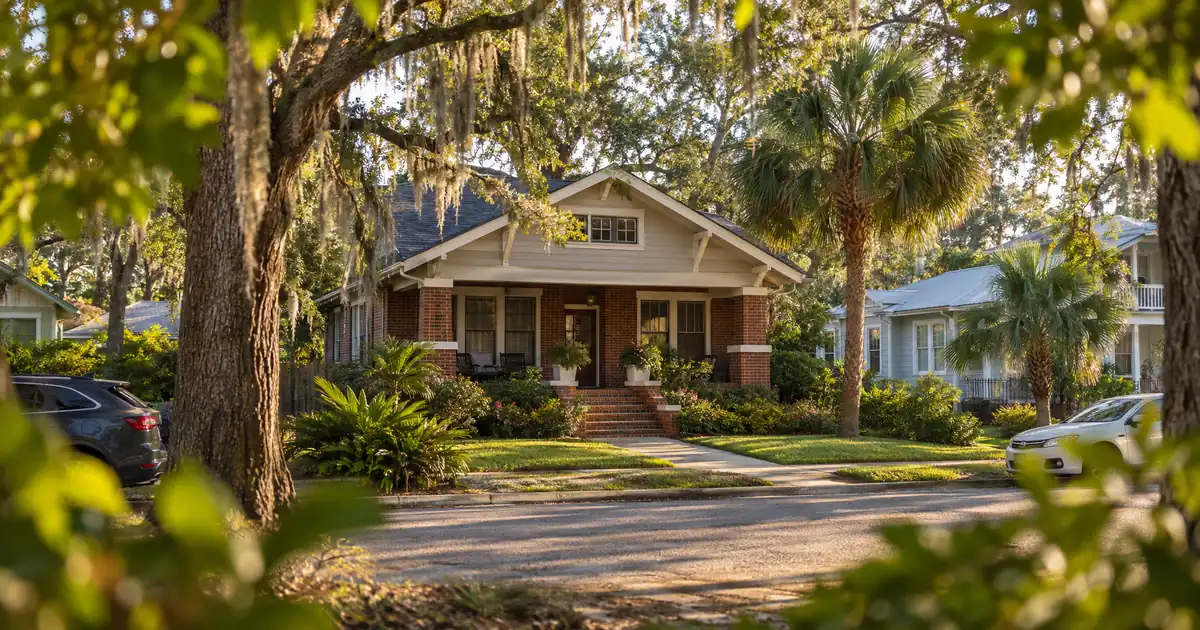
A Jacksonville Beach home averages well above the citywide median sale price, according to Zillow and Redfin. An owner holding beach-side equity and an owner holding an inland fourplex both have “equity,” but only one of them has rent that comfortably carries a cash-out at a 75% loan-to-value ceiling. The inland fourplex wins, and it isn’t close. Beach rents look healthy in absolute terms, yet they trail the price of the asset by a wide margin. Workforce-priced small multifamily is the profile the math favors, and this piece is about getting capital out of it.
TL;DR: A DSCR cash-out refinance on a Jacksonville, Florida rental is underwritten primarily on the property’s rental income measured against its full monthly obligation, letting an owner who has held the asset about six months pull equity up to a 75% loan-to-value ceiling, with the exact amount depending on rent, reserves, and lender review.
DSCR Cash-Out Calculator
Run the cash-out numbers in Jacksonville, FL
Rate source: Freddie Mac 30-yr average via FRED® — Federal Reserve Bank of St. Louis · effective Sep 24, 2026
Prefilled with starting assumptions — enter your property’s value, balance, taxes, and insurance for a more accurate picture.
Program parameters update from Lendmire’s centralized guideline source. Taxes and insurance are editable estimates.
As of Sep 24, 2026 · General Freddie Mac market benchmark, not a Lendmire loan offer. Property value, balance, taxes, and insurance are editable estimates. Maximum loan-to-value varies by lender, program, property type, and seasoning. Not a Loan Estimate, approval, or commitment to lend. Program availability and eligibility are subject to lender guidelines, credit approval, property review, and underwriting.
- Median sale prices in Jacksonville stack up against average three-bedroom rents in a way that leaves single-family cash-out coverage thin. Rent data comes from RentCafe.
- Fourplex listings near Avondale and Riverside show $1,200 per unit, which stacks income against one loan. Multifamily vacancy of 12.2% versus roughly 4.9% for single-family rentals favors small properties over big complexes.
- Flat citywide values mean equity comes from basis and value-add, not appreciation.
Jacksonville Market Snapshot
A quick read on the Jacksonville investor landscape — figures come from the cited sources below. Confirm current property-level numbers before underwriting.
| Metric | Detail |
|---|---|
| Home prices | $295,910 typical home value (Zillow Home Value Index) |
| Typical rents | $1,317 median (Apartment List Rent Report) |
| Employment | 30,000 jobs (Action News Jax JAXPORT) |
| Vacancy | 7.81% (2019) (deptofnumbers.com Jacksonville) |
Why Appreciation Won’t Do the Work Here
Jacksonville equity is mostly a function of when you bought and what you did to the property, not of a market that lifted everything. Values have been roughly flat. Zillow puts the typical home at $295,910, down 2.3% year over year, while Redfin shows its $310K median up 1.9%. The two sources measure differently (typical value versus median sale), and together they say the same thing: no tailwind to lean on.
An owner who bought in a softer-priced corner several years ago may be sitting on real equity. An owner who bought last year at the top of a neighborhood’s range may have almost none. A cash-out appraisal will tell the truth either way.
The Census Bureau counts 1,017,689 residents, up 7.2% since 2020 with 68,082 added. Household formation keeps underpinning rental demand even when sale prices stall. So the investor-friendly read is this: the demand side is healthy, the price side is sideways, and the equity you extract will come from rent growth, renovation, and loan paydown rather than a market surge.
That changes what a good candidate looks like. The strongest cash-out files here are properties where income has been pushed up since purchase, like a renovated unit, a re-leased fourplex, or a stabilized conversion. The appraiser and the lender both see income, and the DSCR underwriting reads the same rent.
Fresh to the mechanics? Lendmire’s DSCR guide covers the basics, and the guide “The Refi Options” walks through the structure. The rest of this article assumes you already own the asset.
Small Multifamily Is Where the Coverage Lives
Duplexes through fourplexes clear a cash-out coverage test far more easily than single-family homes at Jacksonville’s price points, because income scales with door count while the loan sits on one appraisal. That is the single most useful structural fact in this market.
Run the numbers on a modeled fourplex. One active listing near Avondale and Riverside shows estimated market rents of $1,200 per unit, about $4,800 gross a month. Assume a $500,000 appraised value (a modeled input, not a market quote), a 75% LTV cash-out, and a 30-year structure with taxes and insurance included. Rent divided by full PITIA lands around 1.4x, rounded down. That is comfortable headroom against a 1.00x benchmark, and it leaves room for a vacant unit without sinking the file. These specifics are subject to lender guidelines and a full review of property, leverage, and credit.
Now the same exercise on a single-family home at the citywide median. Take the $310K median sale price and a three-bedroom rent of $1,902 (average). At 75% LTV with taxes and insurance included, coverage comes out just under 1.0x. It’s borderline at best. Not dead, but not clean. Terms vary by lender guidelines, property type, leverage, credit profile, and full file review.
Sub-1.00 scenarios like that one may be reviewed by select lenders, but the file gets harder. Options include a sub-1.00 program, an interest-only structure, or lower leverage and stronger credit. Whether any of those fit depends on lender guidelines, credit approval, and property review. Many single-family owners are better off leaving the loan-to-value cushion alone than forcing a 75% pull that barely clears.
Newer product versus older conversions
Both fourplex flavors show up in Jacksonville listings, and they behave differently. A recently built fourplex in the 32244 zip code shows two units rented at $1,325 and $1,249 per month. New construction carries less deferred-maintenance drag on net income, which keeps coverage steadier and makes the appraisal less of a wildcard.
Older conversions work differently. Riverside has pre-war three-to-five-unit buildings, including a brick fourplex built in 1942 with all four units leased. Those often carry below-market in-place rents with renovation upside. Bring rents up, then refinance on the stronger income, and you’ve manufactured the equity yourself. The catch is that older buildings can surprise you with capital needs, and a cash-out that strips the equity cushion before those needs surface leaves little margin.
The vacancy picture backs the small-property preference. ManageCasa reports multifamily vacancy near 12.2% in Jacksonville against about 4.9% for single-family rentals. Hoodline notes the multifamily figure easing from about 12.7% to roughly 11%, so the trend is improving, but large complexes are still the ones absorbing new supply. A local management firm, CrossView Property Management, describes single-family vacancy around 5%. One caution on these figures: they come from property-management and industry sources rather than a single official series, so treat them as directional.
Where Extraction Pencils: Arlington, Riverside, and the Westside
Rent-to-value dispersion in Jacksonville is wide enough that the neighborhood decides the deal more than the city does. RentCafe shows Cedar Hills Estates averaging $1,066 a month while Forest Trails averages $2,139, against a citywide average of $1,517. Two properties a few miles apart can have rent-to-price ratios that differ by 50% or more, so underwrite the block, not the zip code.
Jacksonville is also enormous. The city and Duval County consolidated in 1968, and Jacksonville Today puts the total area at 874.46 square miles including water. One jurisdiction covers urban core, suburb, and beach, which makes citywide averages nearly useless for a lender’s eye.
Arlington: the workhorse
Arlington is mid-century, working-class, and the natural home for duplex and small multifamily income stacking. One-bedroom rents average around $771, and Jacksonville University (2,946 undergraduates and 1,301 postgraduates in the latest figures available) adds a steady student-and-staff tenant base on top of workforce demand. Lower acquisition cost per door is what lets multiple rent streams clear 1.0x coverage. If you bought here at a sensible basis and have lifted rents, this is among the cleaner cash-out candidates in the city.
Riverside, Avondale, and San Marco: the deeper comps
For a lower-volatility cash-out, established neighborhoods matter because of comp depth. A local investment-focused source, DJ and Lindsey, contrasts Riverside, Avondale, and San Marco (long appreciation history) with Springfield and Murray Hill (higher upside, more uncertainty). For extraction, the distinction matters. Thin comps can make a cash-out appraisal land soft, and an appraisal that comes in light is the quickest way to watch a planned refinance shrink.
Springfield still earns a look on income. Zumper shows rents around $1,287, among the more affordable in the city. Just know your appraisal risk is higher there than in Avondale.
Westside and Brentwood: more affordable rents, most cautious math
Mid Westside rents average about $950 and Brentwood about $1,000, per Zumper. Entry prices are low, so rent-to-price can look strong. But low rent also means low absolute income against fixed costs, so a cash-out at full leverage can get tight quickly if a single unit sits empty. Better here to take a smaller pull than the ceiling allows.
Northside and the 32226/32246 corridors
Newer suburban growth areas show Zillow values of roughly $314K to $387K in the 32226 and 32246 zip codes. Proximity to Naval Air Station Jacksonville supports tenant demand, and JAXPORT activity is concentrated in Northside and Westside corridors near the terminals. These are single-family-heavy, so the coverage math mirrors the near-1.0x single-family picture above. Duplexes here do better than detached homes.
Skip the Beach. Watch Downtown.
Skip Jacksonville Beach for cash-out proceeds. Average values of $639,131 against median rent of $2,675 a month produce a rent-to-price gap that no 75% ceiling will rescue. Borrowers there are holding for appreciation, and a DSCR cash-out is the wrong tool for that thesis. The result is a low coverage ratio and a thin pull.
Downtown is a different story, and an honest one. Zillow shows the average home value at $174,927, down 8.3% year over year, the lowest entry point in the metro. A large capital wave is arriving: Capital Analytics Associates cites a $7 billion pipeline with $809 million delivered in a single year, and Krista Fracke tracks a $250 million Brooklyn redevelopment that delivered 271 apartments and a Whole Foods. A University of Florida graduate campus is expected to add a renter cohort as well.
Here’s the catch. That thesis is appreciation-led. Investors who bought ahead of the pipeline are underwriting future refinance value, not current rent coverage, and a recent 8.3% value decline means appraisals can disappoint today. The better read might be to wait for deliveries to show up in comps before pulling equity out. The alternative view is that early owners benefit most when the appraisal finally catches up. Both are defensible, and neither is a reason to rush a cash-out.
Who Actually Rents Here
Tenant demand rests on several independent legs, which is the real argument for holding Jacksonville rentals through a cycle. JAXUSA Partnership lists corporate operations, logistics, advanced manufacturing, financial services, and life sciences as anchors, with healthcare the largest sector by employment at more than 69,500 workers. Its large-employer list (an older dataset, so treat headcounts as approximate) shows:
- Naval Air Station Jacksonville at 14,390 employees
- Duval County Public Schools at 12,000
- Baptist Health at 12,000
- UF Health at 9,951
- Mayo Clinic at 8,450
- Amazon at 8,000
- A large national bank at 8,000
On the port side, JAXPORT reports that JAXUSA Partnership has helped more than 100 companies relocate or expand since 2019, producing 17,000-plus direct jobs. Industrial and logistics wages underpin a renter base that doesn’t depend on office hiring. The University of North Florida expects enrollment above 18,500 students this fall, up from roughly 17,600, per WOKV.
For a lender reviewing lease-length and rent data, this is a reassuring mix: military, healthcare, logistics, finance, and education. Renters make up 42% of households. The citywide median rent is $1,317 per Apartment List, essentially flat year over year. Steady demand, flat rents. That’s exactly why you underwrite conservatively.
The Six-Month Clock and the 75% Ceiling
Most DSCR cash-out programs ask for roughly six months of ownership measured from title recording, cap leverage at 75% of appraised value, and expect the property’s rent to cover its full obligation at a 1.00x benchmark, subject to lender guidelines. That ceiling is firm for cash-out, and it is lower than the 80% ceiling that applies on purchases.
A few practical pieces on the parameters for Jacksonville owners:
- Seasoning. The clock starts at title recording. An investor who bought and immediately rehabbed a Riverside fourplex still waits out the window, then refinances on the improved income.
- Credit. Credit tiers typically run at 620, 660, 680, and 700, with 620 as the floor. Higher tiers generally support better terms and leverage.
- Reserves. About six months of PITIA is typical, moving to about nine months above $1,500,000.
- Loan size. Standard programs run up to $3,000,000. Smaller balances route through select lenders in the network.
- Entity ownership. LLC-titled properties are reviewable, subject to lender program eligibility.
Proceeds aren’t a guaranteed figure. Equity available depends on rent used for lender review, PITIA, reserves, and the 75% ceiling. Anything that doesn’t fit, such as manufactured homes, log homes, or barndominiums, falls outside these programs entirely. Program details change, so confirm current terms before structuring anything. Also verify current local rental rules, taxes, and insurance with qualified local professionals.
DSCR files in markets like this one typically look like a fork. Small multifamily files arrive with healthy coverage and a short debate over how much to pull. Single-family files arrive near 1.0x and a long debate over whether to pull at all. The deals that move smoothly usually have current leases, a clean rent roll, and a borrower who sized the extraction to the coverage number rather than to the ceiling. The ones that stall often rely on a projected rent instead of in-place rent, or an appraisal assumption the comps don’t support.
Picture an investor who bought a Riverside fourplex, brought two below-market units up to current rents, and waited out seasoning. At 75% LTV, the appraisal now reflects the higher income, and the extraction is whatever gap remains between the new value and the existing payoff. The same investor with a mid-range Northside single-family home at identical leverage would see a far slimmer cushion. Exact terms depend on the lender’s guidelines, property type, leverage, and a full review of the borrower’s file.
Turning proceeds into the next deal
The best use of extracted capital is a down payment on another small multifamily, or the renovation budget for an under-rented unit. Both raise future coverage rather than merely adding debt. Pulling cash to fund a deal that itself sits near 1.0x just stacks thin files on top of each other. Investors weighing the broader refinance landscape can review the refinance side, and those comparing structures can see the guide “Where DSCR and Conventional Diverge”. Owners mapping a Jacksonville scenario can review my scenario or call 828-256-2183. More context on the state program is under Florida DSCR investor loans.
Frequently Asked Questions
How do you qualify for a DSCR cash-out refinance on a Jacksonville rental?
Qualification centers on the property’s rent against its full PITIA, typically at a 1.00x benchmark, plus about six months of ownership, a credit score at or above 620, and roughly six months of reserves. The 75% LTV ceiling then caps how much equity is available. Final eligibility depends on lender guidelines, credit approval, and property review.
DSCR vs. conventional financing
Two common ways to finance an investment property in Jacksonville, FL. They qualify you differently — here’s how investors weigh them.
Why investors choose it
- Qualifies on the property’s rental income — no personal tax returns, W-2s, or pay stubs needed to document income.
- No personal debt-to-income ceiling to clear, so existing mortgages and obligations don’t cap your borrowing the same way.
- Can be closed in an LLC, keeping the property inside a business entity.
- Built for scaling — not held to the limit on number of financed properties that conventional financing applies.
- Underwriting centers on the deal: generally qualifies when the rent covers the payment, a 1.00x coverage ratio being a common baseline (confirmed in underwriting).
- Designed specifically for investment property, including long-term and, where the program allows, short-term rentals.
Where it’s strong
- Often the lowest ongoing financing cost for a buyer who fully qualifies on personal income — a fit for a first property or a cost-first purchase.
Trade-offs for investors
- Requires full personal income documentation and must fit within a debt-to-income limit — salary, existing debts, and other mortgages all count.
- Typically held in your personal name rather than a business entity.
- Caps how many financed properties you can carry, which can become a ceiling as a portfolio grows.
- Evaluates you as a borrower as much as the property, which usually means more paperwork.
How investors usually choose: a first or single property often optimizes for the lowest financing cost; portfolio builders often optimize for leverage, vesting in an LLC, and scaling past conventional caps. The right answer depends on your goals, the property, and current guidelines — both paths run through select lenders in Lendmire’s wholesale network, with eligibility and terms confirmed in underwriting.
What are the requirements for an investment property refinance loan in Jacksonville, Florida?
Expect a rent-based coverage test, seasoning measured from title recording, an appraisal, and reserves in the neighborhood of six months. LLC ownership is reviewable subject to lender program eligibility. Manufactured homes, log homes, and barndominiums fall outside the programs.
Which Jacksonville properties usually clear coverage best on a cash-out?
Duplexes through fourplexes in Arlington, Riverside, and Avondale-area pockets, where income scales with door count. Single-family homes near the $310K median sit close to 1.0x including taxes and insurance, so they often support a smaller pull. Beach properties rarely pencil.
Does Jacksonville’s flat price trend hurt cash-out potential?
It limits equity that comes from appreciation, so extraction depends more on purchase basis and on rent growth or renovation since acquisition. Recent owners near a neighborhood’s price ceiling may find little to pull. Long-term holders and value-add investors usually have more.
The Number to Carry Into Any Jacksonville Cash-Out
Underwrite the block, not the zip code, and keep the gap in mind: the spread between Cedar Hills Estates at $1,066 and Forest Trails at $2,139 is more than 100%, and that spread is what separates a deal that clears coverage from one that doesn’t.
For current guidelines and terms, see Lendmire’s DSCR loan programs page.
About Lendmire
Lendmire, NMLS# 2371349, is a mortgage brokerage focused on DSCR investor loans, arranging financing across 41 markets, including Washington, D.C., through wholesale and investor-lending channels. The model centers on property-level rental income reviewed by the lender rather than W-2 documentation, subject to lender guidelines, which suits entity-owned and multi-property investors. Lendmire is a 2026 Scotsman Guide Top Workplace and a 2025 Scotsman Guide Top Workplace.
Get Started
Ready to find the right loan for you?
In about 30 seconds you can review financing options available for your investment property. No commitment required.
Informational only. Not a Loan Estimate, approval, or commitment to lend. Program availability and eligibility are subject to lender guidelines, credit approval, property review, and underwriting.
References
2. Redfin Jacksonville Housing Market
3. RentCafe Jacksonville Rent Market Trends
4. Redfin — Southwest Jacksonville Multi Family Homes for Sale
5. Multifamily vacancy of 12.2% versus roughly 4.9% for single-family rentals
6. Zillow Home Value Index, Jacksonville
9. deptofnumbers.com Jacksonville
10. U.S. Census Bureau QuickFacts: Jacksonville city, Florida
11. Homes.com — Jacksonville FL Multi Family Homes for Sale
12. Redfin — Northwest Jacksonville Multi Family Homes for Sale
13. Hoodline
14. CrossView Property Management
16. $771
17. DJ and Lindsey
18. Zumper
19. JAXPORT Economic Opportunity
20. Zillow
21. Capital Analytics Associates
22. Krista Fracke
23. JAXUSA Partnership, Duval County
24. jaxusa.org — Large Employers
25. WOKV
26. a 2026 Scotsman Guide Top Workplace
27. a 2025 Scotsman Guide Top Workplace
This article is part of Lendmire’s investment property cash-out refinance program — full qualification details, guidelines, and scenarios live on the program page.
Related reading: Investment Property Loans in Jacksonville, FL: Westside Jobs Beat Beach Views · Cash Out Refinance Investment Property in Edgewater, Florida: How the Rent Math Clears at 75% LTV · DSCR Cash Out Refinance in Jacksonville, North Carolina: Pulling Equity From Gate-Area Duplexes
Guides: Investment Property Cash-Out Refinance in Jacksonville, FL · Investment Property Cash-Out Refinance in Florida
Brandon Miller
Founder & CEO, Mortgage Loan Originator, Lendmire LLC
- Mortgage Loan Originator · NMLS# 1129696 · Verify on NMLS Consumer Access
- North Carolina Real Estate Broker · License# 343312 · Verify on NCREC
- North Carolina Insurance Producer · License# 19053198 · Property, Casualty, Life, Health · Verify on NAIC SBS
- Lendmire LLC · Firm NMLS# 2371349 · Verify firm licensure
Important disclosures. Lendmire (NMLS# 2371349) is a licensed mortgage brokerage. Lendmire is not a direct lender, depository institution, or financial advisor. All loan inquiries are subject to lender underwriting; this article does not constitute a commitment to lend. Rates, terms, and program guidelines are subject to change without notice and vary by borrower profile, property type, and state. Information in this article is general in nature and is not financial, legal, or tax advice. Equal Housing Opportunity. NMLS Consumer Access: nmlsconsumeraccess.org.