
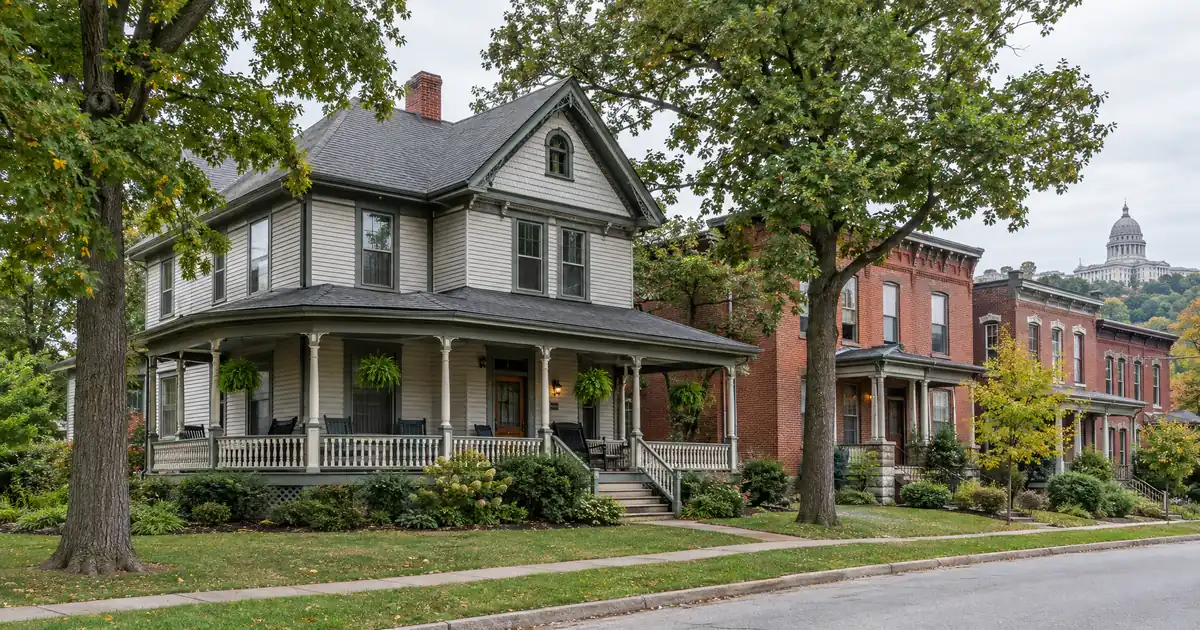
A Cole County community report puts the State of Missouri at 15,356 employees, nearly ten times the next-largest local employer. That one number explains Jefferson City’s rental market better than any rent chart. The tenant base is stable, government-paid, and not especially exciting. For an investor planning a DSCR cash out refinance on a property already owned, the question isn’t whether tenants will show up. It’s whether a thin rent-to-value ratio leaves enough coverage to pull equity out.
Sometimes it does. Often it doesn’t, and sorting out which is most of the work.
DSCR Cash-Out Calculator
Run the cash-out numbers in Jefferson City, MO
Rate source: Freddie Mac 30-yr average via FRED® — Federal Reserve Bank of St. Louis · effective Sep 24, 2026
Prefilled with starting assumptions — enter your property’s value, balance, taxes, and insurance for a more accurate picture.
Program parameters update from Lendmire’s centralized guideline source. Taxes and insurance are editable estimates.
As of Sep 24, 2026 · General Freddie Mac market benchmark, not a Lendmire loan offer. Property value, balance, taxes, and insurance are editable estimates. Maximum loan-to-value varies by lender, program, property type, and seasoning. Not a Loan Estimate, approval, or commitment to lend. Program availability and eligibility are subject to lender guidelines, credit approval, property review, and underwriting.
Lendmire (NMLS# 2371349), a DSCR-focused mortgage broker, helps arrange DSCR financing for Jefferson City, Missouri investors as part of a broader non-QM footprint reaching 41 markets, including D.C.
The Short Version: A DSCR cash-out refinance on a Jefferson City, Missouri rental is underwritten primarily on the property’s rental income measured against its full monthly obligation, so the path runs from ownership seasoning through an appraisal, a coverage test, and a capped loan-to-value against the value the appraiser supports.
- Multi-unit buildings carry the coverage; single-family rent-to-value sits near 0.40 percent, per Ark7.
- Cash-out is capped at 75 percent LTV, after about six months of ownership from title recording.
- Vacancy sources land between roughly 9 and 12 percent, so haircut the rents.
- Brick duplexes and fourplexes near the Capitol and hospital are the best-fit collateral.
Jefferson City Market Snapshot
A quick read on the Jefferson City investor landscape — figures come from the cited sources below. Confirm current property-level numbers before underwriting.
| Metric | Detail |
|---|---|
| Home prices | Median price $256,000 (+5.2%) (Prop-Metrics) |
| Typical rents | $3,400 and $3,700-$3,850 rent roll (Redfin Jefferson City) |
| Recent appreciation | +8.7% (Ark7 Missouri rental guide) |
| Employment | +9.8% headcount (Lincoln University) |
Equity Is the Story Here, Not Cash Flow
Jefferson City rewards patient owners more than new buyers. Zillow puts the typical home value at $275,376, up 7.3 percent over the past year. Ark7 reports a median sale price of $278,467 that sits roughly 53.5 percent above where it stood a few years back. Against that, Ark7 shows average rent of $1,105. That works out to about 0.40 percent monthly rent-to-value, and Ark7 itself tags the city an “appreciation play.”
An owner who bought and improved a few years ago may be sitting on real equity. Converting it to cash is another matter, because coverage has to survive the math.
Here’s a modeled example, not a sourced market fact. Take a single-family rental valued near the citywide typical value and rented at the $1,105 average. Run full PITIA (principal, interest, taxes, and insurance at typical Missouri levels) at the 75 percent LTV ceiling, and coverage lands in the mid-0.6x range. Drop leverage to 60 percent and it still sits below 1.00x. Push rent to the $1,500 three-bedroom figure Prop-Metrics reports for ZIP 65101, and coverage gets to roughly 0.85x including taxes and insurance. That is an improvement, but it is still short of 1.00x.
Most standard DSCR programs are built around a 1.00x benchmark because rent covers the payment at that level. Some lenders review sub-1.00 files, but those usually demand lower leverage, stronger credit, more reserves, or different pricing, and eligibility depends on guidelines and property review. For this kind of single-family file, the sub-1.00 path, an interest-only structure, or a smaller cash-out request are the options a lender would review. None is a given.
Where the Coverage Actually Clears
Small multifamily is the Jefferson City answer. A 10 Federal Storage neighborhood guide describes the city as having fewer large apartment complexes and more single-family rentals, duplexes, and smaller buildings. That matches where the coverage math improves.
Start with the downtown numbers. Redfin shows nine multifamily listings downtown at a $224K median list price, and one fully rented fourplex was listed at $2,925 in monthly rent, about $730 a door. Run the numbers on that rent roll against a modeled appraised value near that listing range (an assumption, since the median isn’t that building’s price). Coverage comes out comfortably above 1.0x including taxes and insurance at the 75 percent ceiling. The same collateral type that fails as a single-family clears as four doors.
Per-door rents support the pattern. Current Redfin multifamily listings cite new leases near $850 with the market supporting about $925 without major upgrades. Rentometer puts downtown one-bedrooms in the $800s and two-bedrooms around $1,000 to $1,100. Treat $850 to $1,100 a door as the underwriting ceiling. Appraisers use rent comps, and a value-add story of $925 is plausible but not guaranteed.
Old Munichburg
Old Munichburg is the strongest fit. A regional health system describes red brick homes where tenants can walk or bike to the Capitol and state offices, and Capital Region Medical Center sits on the south side nearby. The tenant pool is state workers, hospital staff, and young professionals, the same employment base that carries the whole city. Older brick stock converts to duplexes and small buildings well.
Here’s the catch. Redfin flags flood exposure for about 20 percent of Old Munichburg properties over a 30-year horizon. That can complicate appraisal and lender review, so check a property’s status before building a refinance around it.
Downtown and the Capitol District
Walkable, close to state offices, and a natural home for legislative-staff and state-employee renters. Small multifamily here is the collateral most likely to show the coverage profile above. Pricing isn’t cheap relative to rents, so underwrite each building on its own rent roll.
East End and the Lincoln University Area
The Capitol Avenue and East End streets carry older Victorian and converted stock, and the east side near Lincoln University of Missouri offers some of the city’s most affordable rentals. Lincoln’s enrollment rose 9.83 percent to 2,256 students. That helps, but it’s a modest, mostly commuter campus, not a college-town demand engine. Expect lower rents and lower values. Coverage depends on basis more than anywhere else.
Skip the Growth Edge for This Purpose
Southwest Jefferson City is where new construction and family-oriented development have concentrated. Newer single-family rentals there make sense for some buyers. For a cash-out, they carry the same 0.40-percent problem as any single-family rental, so the coverage won’t stretch.
What Does the Appraisal Do to Your Cash-Out?
The appraisal decides the outcome, and in a market this small it can surprise you. Equity available depends on rent used for lender review, PITIA, reserves, and the 75 percent LTV ceiling. It isn’t a guaranteed figure. Typical program guidance asks for about six months of ownership measured from title recording, credit generally in the 620-and-up range, and reserves around six months of PITIA, all subject to lender guidelines and borrower profile.
The price history argues for conservatism. Trading Economics, republishing metro data, shows the median listing price at $269,900 in February, against a June peak of $334,900. Listing medians and Zillow’s value index measure different things, so don’t read the gap as a crash. But a peak-to-current spread can flatten the comps an appraiser uses. Redfin’s city page showed a November median of $260K up 29.9 percent on only 49 sales. A number that swings like that is a small-sample artifact, not a trend to underwrite.
Build the refinance around a conservative appraisal, not the peak.
Working DSCR brokers see a recurring pattern in small government-anchored markets: sellers and owners anchor on headline appreciation, then the appraiser lands on a handful of nearby comps and the usable value comes in lower. Files that hold up usually model the refinance at the low end of the value range and carry enough rent cushion that a modest appraisal miss doesn’t push coverage under 1.00x.
Also consider loan size. Many central-Missouri properties carry balances that sit below the minimums some lenders prefer. Standard programs reach up to $3,000,000, and smaller balances route through select lenders in the network, which can change pricing and terms.
Vacancy: Haircut the Rent
Vacancy is the number investors most want to ignore here. Ark7 shows 9.43 percent vacancy with 40.80 percent of units renter-occupied and says the market isn’t undersupplied. StayRentals, citing Census ACS data, gives a rental vacancy rate of 11.6 percent. Those are aggregators, so treat them as directional. Still, a vacancy factor of 8 to 10 percent and a conservative rent haircut belong in the model. They also undercut any assumption that rents jump to full market right after purchase.
Rents are moving modestly. Apartments.com reports rent up 3.8 percent over the past year, with averages near $571 for a one-bedroom and $762 for a two-bedroom. Sources conflict on level (Prop-Metrics’ ZIP 65101 two-bedroom figure is $779), which is one more reason to underwrite from each property’s actual leases.
Why the Tenant Base Is Steady
The demand side is easier than the math side. The city’s population was 43,228 in the 2020 count and about 42,552 by the latest Census estimate, flat to slightly down. The metro holds about 151,500 people, up roughly 1 percent since 2010. No growth story. A stability story.
Behind the state payroll: Quaker Windows & Doors (1,669 employees), Jefferson City School District (1,557), Capital Region Medical Center (1,495), Scholastic (1,366), Central Bancompany (1,286), Hitachi Energy (1,060), and SSM Health St. Mary’s (982), all per that same Cole County report. The Jefferson City Regional Economic Partnership counts more than 20 industry sectors. Long-term renters with steady paychecks mean lease stability, which is what a lender wants behind the rent number.
The soft spot is job growth. One ranking site rates the job market weaker than comparable metros. Government anchoring protects against downturns and mutes upside, so don’t build a refinance on rising rents.
Where the Answer Flips
Weigh this honestly. A cash-out works well when the building is multi-unit, the rent roll is documented, the owner has held long enough to have meaningful equity, and the appraisal comes in at or near expectation. It works poorly when the collateral is a single-family rental with $1,105-type rents, the equity came mostly from a recent price spike, or the request assumes peak-level value.
Honestly, it’s closer than people assume in one situation: the owner with a low basis on a duplex or triplex, where rents clear 1.00x even at full LTV. There, extraction is straightforward. For the owner of a single-family rental with thin coverage, the better move might be waiting, or pursuing a smaller cash-out at lower leverage. The appreciation argument says pull equity now; the coverage argument says wait. Both are defensible.
Program details, guidelines, and eligibility vary by borrower, property, and lender. Verify current local rental rules, taxes, and insurance with qualified local professionals.
Turning Proceeds Into the Next Deal
The point of extracting equity is redeploying it. In a market with a sub-0.50-percent rent-to-value on single-family, the logical next purchase is another small multifamily, where per-door rents of $850 to $1,100 against an entry price in the low-to-mid $200s produce coverage the typical house doesn’t. Some investors reinvest into the same submarket they refinanced from, which keeps management simple. Others take Jefferson City equity to cheaper basis elsewhere. Either way, the refinance should fund a purchase that clears 1.00x on its own, not one that depends on the next refinance.
DSCR vs. conventional financing
Two common ways to finance an investment property in Jefferson City, MO. They qualify you differently — here’s how investors weigh them.
Why investors choose it
- Qualifies on the property’s rental income — no personal tax returns, W-2s, or pay stubs needed to document income.
- No personal debt-to-income ceiling to clear, so existing mortgages and obligations don’t cap your borrowing the same way.
- Can be closed in an LLC, keeping the property inside a business entity.
- Built for scaling — not held to the limit on number of financed properties that conventional financing applies.
- Underwriting centers on the deal: generally qualifies when the rent covers the payment, a 1.00x coverage ratio being a common baseline (confirmed in underwriting).
- Designed specifically for investment property, including long-term and, where the program allows, short-term rentals.
Where it’s strong
- Often the lowest ongoing financing cost for a buyer who fully qualifies on personal income — a fit for a first property or a cost-first purchase.
Trade-offs for investors
- Requires full personal income documentation and must fit within a debt-to-income limit — salary, existing debts, and other mortgages all count.
- Typically held in your personal name rather than a business entity.
- Caps how many financed properties you can carry, which can become a ceiling as a portfolio grows.
- Evaluates you as a borrower as much as the property, which usually means more paperwork.
How investors usually choose: a first or single property often optimizes for the lowest financing cost; portfolio builders often optimize for leverage, vesting in an LLC, and scaling past conventional caps. The right answer depends on your goals, the property, and current guidelines — both paths run through select lenders in Lendmire’s wholesale network, with eligibility and terms confirmed in underwriting.
Lendmire’s DSCR walkthrough explains how the ratio is built. Investors comparing structures can review refi programs, the refi options specific to cash-out, and the guide “Where DSCR and Conventional Diverge” from conventional underwriting. The statewide picture lives on the Missouri DSCR financing page. To test a specific property, review my scenario or call 828-256-2183.
Frequently Asked Questions
How do you qualify for a DSCR cash-out refinance in Jefferson City?
Qualification centers on the property’s rent against its full PITIA, typically with a 1.00x benchmark, a credit floor around 620, and about six months of reserves. The property must also have roughly six months of ownership from title recording, and cash-out is capped at 75 percent LTV. Final eligibility depends on lender guidelines, credit, and property review.
What are the requirements for an investment property loan in Jefferson City, Missouri?
Expect a rent-based coverage test, an appraisal, reserves, and eligible property types. Single-family, duplex, triplex, and fourplex stock typical of the area generally fits. Manufactured homes, log homes, and barndominiums fall outside these programs. Smaller balances common in central Missouri may route through select lenders in the network.
Will a typical Jefferson City single-family rental clear 1.00x on a cash-out?
Usually not at high leverage. With rent-to-value near 0.40 percent, modeled coverage including taxes and insurance runs below 1.00x even at reduced LTV. Multi-unit properties with documented rent rolls are the better candidates, and sub-1.00 structures would be a lender-review question.
How do DSCR lenders review rental income instead of traditional tax-return income in Missouri?
Lenders weigh the property’s rent used for lender review against its monthly obligation rather than the borrower’s personal income. Lendmire arranges DSCR investor loans and the rent-based review suits self-employed investors, subject to program terms.
Does Old Munichburg’s flood flag rule it out?
No, but it adds a checkpoint. Redfin flags about 20 percent of properties there for flood exposure over 30 years. Confirm a building’s status before committing, since it can affect appraisal and program review.
About Lendmire
As a DSCR and non-QM mortgage broker, Lendmire — NMLS# 2371349 — connects investors with wholesale lending channels across 41 markets, including Washington, D.C. The property’s rental income, not the borrower’s traditional personal-income documentation, is central to eligibility review, which works for self-employed operators and portfolios beyond four financed properties. Lendmire is recognized by Scotsman Guide as a 2026 Top Workplace and was recognized by Scotsman Guide in 2025. Loans are arranged through lending partners, subject to lender guidelines and credit approval.
Get Started
Ready to find the right loan for you?
In about 30 seconds you can review financing options available for your investment property. No commitment required.
Informational only. Not a Loan Estimate, approval, or commitment to lend. Program availability and eligibility are subject to lender guidelines, credit approval, property review, and underwriting.
References
1. Cole County community report
2. Ark7
3. Prop-Metrics reports for ZIP 65101
4. Redfin multifamily listings
7. 10 Federal Storage neighborhood guide
8. Redfin — Downtown Jefferson City Multi Family Homes for Sale
9. Rentometer
10. about 20 percent of Old Munichburg properties
11. Lincoln University of Missouri
12. median listing price at $269,900 in February, against a June peak of $334,900
14. StayRentals
15. Apartments.com
16. U.S. Census Bureau QuickFacts
17. USAFacts, Jefferson City metro population
18. Jefferson City Regional Economic Partnership
19. recognized by Scotsman Guide as a 2026 Top Workplace
20. recognized by Scotsman Guide in 2025
This article is part of Lendmire’s investment property cash-out refinance program — full qualification details, guidelines, and scenarios live on the program page.
Related reading: Luxury Rental DSCR Loans In New Jersey · Jersey Shore Vacation Rental Loans: DSCR Financing In Ocean City, Cape May And Long Beach Island · DSCR Cash-out Refinance In New Jersey: Pulling Equity From A Rental
Guides: Investment Property Cash-Out Refinance in Jefferson City, MO · Investment Property Cash-Out Refinance in Missouri
Brandon Miller
Founder & CEO, Mortgage Loan Originator, Lendmire LLC
- Mortgage Loan Originator · NMLS# 1129696 · Verify on NMLS Consumer Access
- North Carolina Real Estate Broker · License# 343312 · Verify on NCREC
- North Carolina Insurance Producer · License# 19053198 · Property, Casualty, Life, Health · Verify on NAIC SBS
- Lendmire LLC · Firm NMLS# 2371349 · Verify firm licensure
Disclosure information. Lendmire is a state-licensed mortgage brokerage under NMLS# 2371349. Lendmire is not a depository institution, direct lender, or financial advisor — all loans referenced are placed through wholesale lender partners and are subject to each lender's underwriting standards. This article is provided for general informational purposes and is not a commitment to lend, nor does it constitute financial, legal, or tax advice. Loan programs, terms, rates, and qualification standards change without notice and depend on borrower profile, property type, and the state in which the subject property is located. Equal Housing Opportunity provider. NMLS Consumer Access: nmlsconsumeraccess.org.