
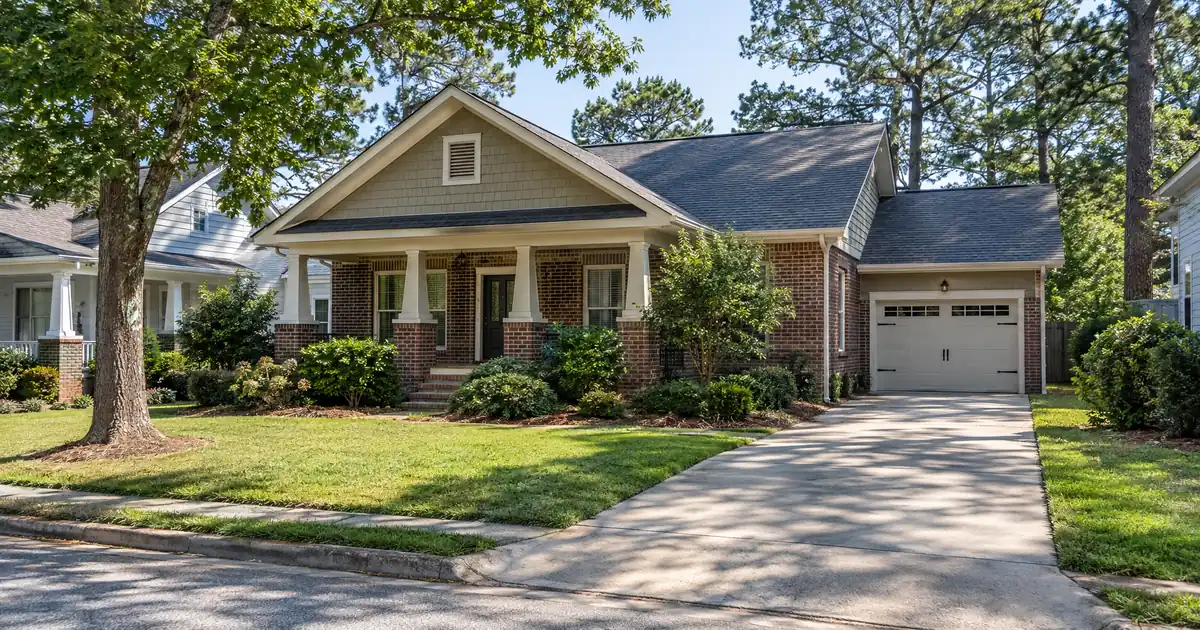
Picture an investor holding a 3BR bought at $110,000 on Montgomery’s east side. The investor has rented it steadily for a year, and an appraiser now comes back at $130,000. The instinct is to call that a win. Then the payoff, the 75% LTV ceiling, and six months of required reserves get run against it, and the released equity turns out to be a down payment, not a war chest. Those numbers are modeled assumptions, not market data. The pattern they show is real in Montgomery: coverage is rarely the problem, and dollar proceeds are. Terms vary by lender guidelines, property type, leverage, credit profile, and full file review.
DSCR Cash-Out Calculator
Run the cash-out numbers in Montgomery, AL
Rate source: Freddie Mac 30-yr average via FRED® — Federal Reserve Bank of St. Louis · effective Sep 24, 2026
Prefilled with starting assumptions — enter your property’s value, balance, taxes, and insurance for a more accurate picture.
Program parameters update from Lendmire’s centralized guideline source. Taxes and insurance are editable estimates.
As of Sep 24, 2026 · General Freddie Mac market benchmark, not a Lendmire loan offer. Property value, balance, taxes, and insurance are editable estimates. Maximum loan-to-value varies by lender, program, property type, and seasoning. Not a Loan Estimate, approval, or commitment to lend. Program availability and eligibility are subject to lender guidelines, credit approval, property review, and underwriting.
The Quick Read:
A DSCR cash-out refinance in Montgomery, Alabama is underwritten primarily on the property’s rental income measured against its full monthly obligation. So the binding constraints are appraised value and the 75% LTV ceiling, not the coverage ratio, and low price points keep the dollar proceeds modest even when the ratio clears comfortably. Exact terms depend on the lender’s guidelines, property type, leverage, and a full review of the borrower’s file.
- Redfin puts the citywide median near $200K, essentially flat year over year.
- Zillow’s typical value of $152,082 sits far below Redfin’s median, so appraisal risk is real.
- Cash-out tops out at 75% LTV after about six months of seasoning from title recording.
- RentCafe’s 3BR average is $1,349, though that sample covers large complexes only. Every figure here varies by lender and program — guidelines, property type, leverage, and credit profile all apply.
Montgomery Market Snapshot
A quick read on the Montgomery investor landscape — figures come from the cited sources below. Confirm current property-level numbers before underwriting.
| Metric | Detail |
|---|---|
| Typical rents | $900–$1,050 market rents |
| University enrollment | 34,000+ students (montgomerychamber.com — Economic Diversity) |
| Employment | 7,500+ hospital jobs (Business Alabama) |
The East Side Ratio Play (With a Catch)
The east side zips are where the coverage math is strongest. A local property manager ranks 36109 (East Montgomery and Dalraida) first for rent-to-price, and says 36108 and 36110 also offer the best ratios in the city. That source is a commercial blog, so treat it as directional.
Here is why it matters for a refi. Investor-grade 3BR/2BA homes in solid rental areas reportedly sell for $85,000 to $140,000, with 3BR rents running $950 to $1,300 depending on location and condition. Take a modeled $1,150 rent against a $130,000 appraised value at 75% LTV. Run full PITIA, taxes and insurance included, and coverage lands comfortably north of 1.3x. That clears the 1.00 benchmark most DSCR programs are built around, subject to lender guidelines. It is also the good news.
The catch is the comps. Zips with the best ratios tend to have the thinnest sales history and the lowest appraised values. A cash-out sized on the purchase price plus your renovation budget can get marked down to whatever the last three closings say. Order the appraisal mentally before you order it formally. Price the refi off a conservative value, not the one you hope for.
The 3BR is the right product here. A local manager estimates that moving from a 2BR (about $890 FMR) to a 3BR (about $1,150 FMR) adds roughly $260 a month. The price difference is often only $10,000 to $15,000. More rent per dollar of basis also means more coverage cushion when you refinance.
Why the Dollars Stay Small
Montgomery’s price picture is scattered, and that scatter is itself a risk. Redfin’s city median is about $200,000, down 0.55% year over year, with homes averaging 60 days on market. The county runs higher, at $248,000. Data USA puts the Census-based median property value at $161,900, and Zillow’s typical value comes in at $152,082 (up 2.2%). Same city, four answers. A “hot market” story isn’t supported by any of them.
Two consequences follow:
- Appraisers will pick a lane, and it may not be yours. If your underwriting value sits near the Redfin end and comps support the Zillow end, your proceeds shrink before the lender even looks at rent. Low price bands cap the dollar proceeds even at the full 75%. A sub-$150K house simply does not release much equity. Loan amounts up to $3,000,000 are available on standard programs, and smaller balances route through select lenders in the network. Plenty of Montgomery rentals live in that smaller zone. Final terms depend on lender guidelines, property type, leverage, and the borrower’s complete credit picture.
One aggregator reports a median sale price up 27% in a year, with 89 days on market. Ignore it as a planning number. That is a low-authority source, and a jump that size alongside slow sales usually means a thin sample, not a real surge. Apartment List’s citywide rent report shows a $1,226 median, up 2.6%. That is enough to hold coverage steady but not enough to build a cushion, so underwrite in-place rents and skip the pro forma bumps.
Cloverdale and the Garden District: Appreciation Country
Old Cloverdale is where appreciation-minded owners refinance, and where cash-flow purists shouldn’t go looking for ratio. The early-1900s cottages are walkable to shops and restaurants, and Huntingdon College and downtown sit nearby. The price data conflicts, though. Movoto shows a $224K listing median that was down about 23% year over year on a thin sample, while Homes.com lists $279,900. Don’t pick the flattering one. Use the wide band and let the appraisal settle it.
The Garden District has the same split: $191K on Movoto and $145,000 on Homes.com. The 315-acre historic district holds 678 contributing buildings from the 1870s to the 1930s. It sits close to the Capitol, so state workers are a natural tenant pool. Some of the older stock has been converted to small units, which matters because duplexes and small buildings are only 5.54% of Montgomery’s housing stock, per NeighborhoodScout. Single-family detached homes are 69.23%. Scarcity favors the small multifamily owner at refinance time.
Consider an investor with a converted duplex in this core. The stronger play might be holding and refinancing there for the appraised value, while the east side 3BR funds the cash flow. A genuine toss-up: the east side gives you coverage, the core gives you a better shot at a value that supports a real equity pull. No sourced per-unit rents exist for Montgomery duplexes, so run your own lease comps rather than trusting a blog.
Demand Anchors That Hold the Rent Roll Up
Montgomery’s rental demand rests on government, military, and manufacturing, not on any single employer. The Montgomery Regional Chamber says Maxwell Air Force Base carries more than 17,000 military, civil service, and contracted personnel, with student throughput above 34,000 a year through Air University. HMMA, the Hyundai plant off I-65, employs about 4,200, and Business Alabama says it supports more than 40,000 jobs statewide. Health care is the largest resident employment sector at 11,317 people, with Baptist Health and Jackson Hospital as the two big private systems.
Education adds a steady renter layer. Preliminary ACHE enrollment shows 4,565 students at Alabama State University near downtown and 4,751 at Auburn University at Montgomery on the I-85 corridor. Huntingdon College adds a smaller base in Cloverdale. About 46% of households rent, so tenant depth isn’t the worry here.
Working DSCR brokers see a recurring pattern in government-and-base markets like this one: the tenant pool is stable, but the rent ceiling is low and the value ceiling follows it. Files clear coverage easily and then stall on appraisal, because comps are sparse and the subject gets valued against a more affordable recent sale. The borrowers who get the best outcomes pull lease comps and a fresh insurance quote before the appraisal is ordered, not after.
Skip These for a Cash-Out Play
Downtown and the Riverfront. Demand is real (government staff, hospitality workers, ASU students), but Redfin showed one home sold there in a recent month. One sale is not a comp set. Skip it for refi math until the sample thickens.
The Maxwell-adjacent neighborhoods (Dalraida, Normandale, Halcyon Park, Maxwell Heights). Rotating officers and contractors are a strong tenant story, and the Chamber is prioritizing redevelopment of Maxwell Boulevard. But the research found no reliable price or rent figures for any of them. A rotating tenant base can also mean shorter leases, which lenders will look at. Good story, unproven numbers.
Capitol Heights. It is a BRRRR area, with a $139K listing median at about $81 a square foot, and it is among the most affordable neighborhoods on Apartments.com. But local market rents for 3BRs in Capitol Heights and parts of West Montgomery run $900 to $1,050. Rent that light against a low basis leaves little margin for repairs, vacancy, or a soft appraisal. Work it only with a lease already in place.
Eastchase and the Hyundai corridor. Eastchase apartments average $1,582 a month and South–Woodley Square $827, but those are apartment averages, not house rents, and no home-price data was found for either. Use them as context, not underwriting inputs.
The Mechanics: Seasoning, Leverage, and Where the Proceeds Go
The structure is simple. Cash-out refinance on an investment property caps at 75% LTV, with about six months of ownership measured from title recording. Minimum DSCR is 1.00 on rent used for lender review versus PITIA, credit tiers start at a 620 floor (with tiers at 660, 680, and 700), and reserves run about six months of PITIA. Equity available depends on rent used for lender review, PITIA, reserves, and the 75% ceiling, so it is never a guaranteed figure. All of it is subject to lender guidelines, and Lendmire arranges these through wholesale and investor channels. The guide “What Is a DSCR Loan” covers the coverage formula. Lendmire’s DSCR cash-out refinance page covers the program, and refinancing options lays out the rate-and-term alternative. For the conventional comparison, it helps to see how conventional and DSCR financing differ on investor loans. LLC-titled properties are common on these files, subject to lender program eligibility.
One structure specific to 2–4 unit buildings: lender marketing says FHA house-hack financing is available on them in Montgomery. The owner lives in one unit, then converts to a pure investment after the occupancy year and refinances into DSCR. That is a structure, not quantified coverage math. No sourced Montgomery duplex or fourplex rents exist to back a number.
As for where proceeds go, the honest answer in a market like this one is often the next similar house, not a jump to a bigger asset. That is fine. It is the same compounding, in smaller steps. Investors who want to see the range of options can start with DSCR loans in Alabama or call Lendmire at 828-256-2183.
Frequently Asked Questions
Can a low-priced Montgomery rental support a cash-out refinance?
Often yes on coverage, but proceeds are small. A sub-$150K house at 75% LTV releases limited equity after payoff and reserves. Smaller balances route through select lenders in the network, so the lender channel matters as much as the property.
DSCR vs. conventional financing
Two common ways to finance an investment property in Montgomery, AL. They qualify you differently — here’s how investors weigh them.
Why investors choose it
- Qualifies on the property’s rental income — no personal tax returns, W-2s, or pay stubs needed to document income.
- No personal debt-to-income ceiling to clear, so existing mortgages and obligations don’t cap your borrowing the same way.
- Can be closed in an LLC, keeping the property inside a business entity.
- Built for scaling — not held to the limit on number of financed properties that conventional financing applies.
- Underwriting centers on the deal: generally qualifies when the rent covers the payment, a 1.00x coverage ratio being a common baseline (confirmed in underwriting).
- Designed specifically for investment property, including long-term and, where the program allows, short-term rentals.
Where it’s strong
- Often the lowest ongoing financing cost for a buyer who fully qualifies on personal income — a fit for a first property or a cost-first purchase.
Trade-offs for investors
- Requires full personal income documentation and must fit within a debt-to-income limit — salary, existing debts, and other mortgages all count.
- Typically held in your personal name rather than a business entity.
- Caps how many financed properties you can carry, which can become a ceiling as a portfolio grows.
- Evaluates you as a borrower as much as the property, which usually means more paperwork.
How investors usually choose: a first or single property often optimizes for the lowest financing cost; portfolio builders often optimize for leverage, vesting in an LLC, and scaling past conventional caps. The right answer depends on your goals, the property, and current guidelines — both paths run through select lenders in Lendmire’s wholesale network, with eligibility and terms confirmed in underwriting.
Does the six-month seasoning clock restart after renovation?
Seasoning is measured from title recording, at about six months on these programs. Finishing a renovation doesn’t reset it. The appraisal is what reflects the work, so document the scope and keep receipts for the appraiser.
Which Montgomery zips show the strongest rent-to-price ratios?
A local property manager points to 36109, then 36108 and 36110. That is a commercial source, so verify with your own lease comps. Those zips also tend to have the thinnest comps, which can drag down appraised value.
Do Maxwell’s rotating officers make a rental safer for a DSCR file?
Not automatically. Maxwell’s 17,000-plus personnel and 34,000-plus annual students create steady demand, but rotating tenancy can mean shorter leases. Lenders review lease terms and rent schedules, so a documented lease history helps more than the base’s headcount does.
Why do Montgomery price sources disagree so much?
They measure different things. Redfin’s median reflects closed sales, Zillow’s typical value models the whole housing stock, and Data USA reflects Census-based owner estimates. Underwrite the refi to the conservative end of the range, not the headline.
The Biggest Blind Spot: Trusting the Wrong Value
Montgomery’s rent coverage is easy to clear. Its valuation is the problem. Four credible sources put the citywide value between roughly $152,000 and $200,000, neighborhood medians swing by tens of thousands between portals, and some of the highest-ratio zips have the fewest comps. Investors who size a cash-out on the optimistic end of that spread tend to find out at appraisal. In Montgomery, the question isn’t whether the rent covers the loan. It is whether the house is worth what you plan to borrow against.
For current guidelines and terms, see Lendmire’s DSCR loan programs page.
About Lendmire
Lendmire is a non-QM mortgage brokerage (NMLS# 2371349) arranging DSCR investor loans in 41 markets, including Washington, D.C., through wholesale and investor-lending channels. DSCR loans are evaluated by the lender on rental income rather than personal income, subject to lender guidelines. They suit LLC-owned portfolios, self-employed investors, and operators scaling past conventional loan caps. Lendmire was recognized by Scotsman Guide as a 2026 Top Workplace and a top-ranked workplace in 2025 as a Scotsman Guide Top Mortgage Workplace.
Get Started
Ready to find the right loan for you?
In about 30 seconds you can review financing options available for your investment property. No commitment required.
Informational only. Not a Loan Estimate, approval, or commitment to lend. Program availability and eligibility are subject to lender guidelines, credit approval, property review, and underwriting.
References
1. Redfin, Montgomery housing market
2. Zillow, Montgomery home values
3. RentCafe, Montgomery rent trends
4. Montgomery Regional Chamber of Commerce, Economic Base
7. Apartment List — Rent Report Montgomery
8. Homes.com
9. VisitMontgomery, Historic Neighborhoods
11. Business Alabama, Alabama automakers
12. ACHE Preliminary Fall Enrollment
13. Auburn University at Montgomery
14. recognized by Scotsman Guide as a 2026 Top Workplace
15. Scotsman Guide — Top Workplaces 2025
This article is part of Lendmire’s investment property cash-out refinance program — full qualification details, guidelines, and scenarios live on the program page.
Related reading: Luxury Rental DSCR Loans In New Jersey · Jersey Shore Vacation Rental Loans: DSCR Financing In Ocean City, Cape May And Long Beach Island · DSCR Cash-out Refinance In New Jersey: Pulling Equity From A Rental
Guides: Investment Property Cash-Out Refinance in Montgomery, AL · Investment Property Cash-Out Refinance in Alabama
Brandon Miller
Founder & CEO, Mortgage Loan Originator, Lendmire LLC
- Mortgage Loan Originator · NMLS# 1129696 · Verify on NMLS Consumer Access
- North Carolina Real Estate Broker · License# 343312 · Verify on NCREC
- North Carolina Insurance Producer · License# 19053198 · Property, Casualty, Life, Health · Verify on NAIC SBS
- Lendmire LLC · Firm NMLS# 2371349 · Verify firm licensure
Disclosure information. Lendmire is a state-licensed mortgage brokerage under NMLS# 2371349. Lendmire is not a depository institution, direct lender, or financial advisor — all loans referenced are placed through wholesale lender partners and are subject to each lender's underwriting standards. This article is provided for general informational purposes and is not a commitment to lend, nor does it constitute financial, legal, or tax advice. Loan programs, terms, rates, and qualification standards change without notice and depend on borrower profile, property type, and the state in which the subject property is located. Equal Housing Opportunity provider. NMLS Consumer Access: nmlsconsumeraccess.org.