
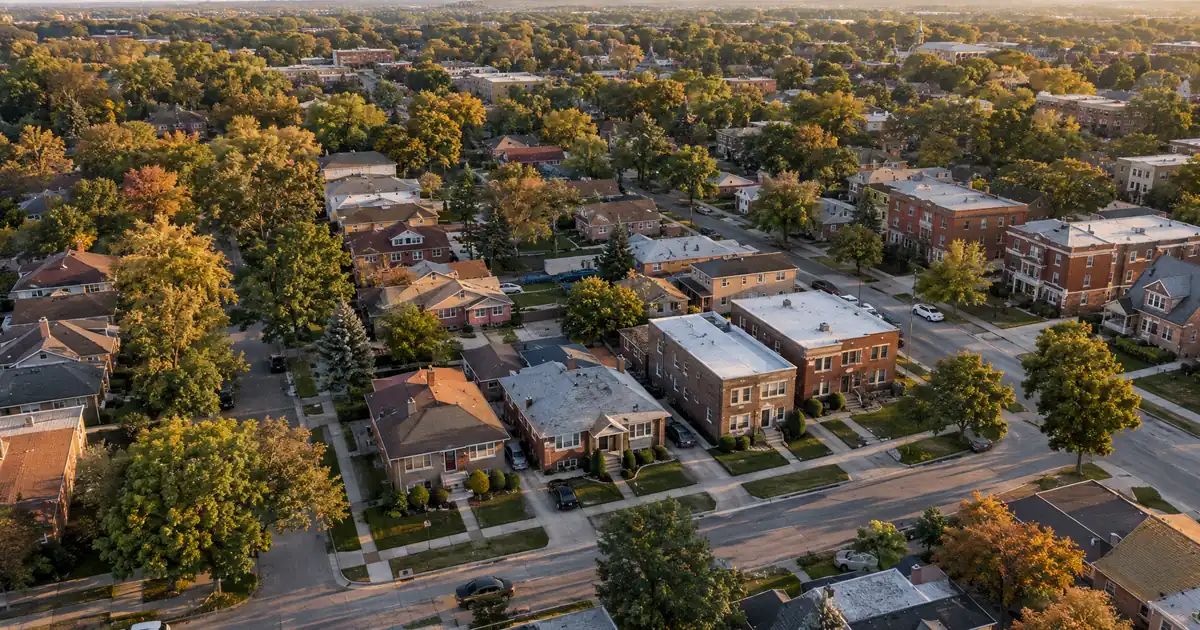
Most owners in Mount Prospect assume equity is the thing that limits a cash-out. It usually isn’t. A DSCR cash-out refinance in Mount Prospect, Illinois tends to run into the rent side of the ratio long before it runs out of value, because a village where the median sale price sits near $450,000 doesn’t produce single-family rents that carry a loan that size.
That changes the question. The useful one isn’t how much equity you have. It’s which property on your balance sheet produces enough rent to carry a refinance, and which one needs to be restructured, sold or left alone.
DSCR Cash-Out Calculator
Run the cash-out numbers in Mount Prospect, IL
Rate source: Freddie Mac 30-yr average via FRED® — Federal Reserve Bank of St. Louis · effective Sep 24, 2026
Prefilled with starting assumptions — enter your property’s value, balance, taxes, and insurance for a more accurate picture.
Program parameters update from Lendmire’s centralized guideline source. Taxes and insurance are editable estimates.
As of Sep 24, 2026 · General Freddie Mac market benchmark, not a Lendmire loan offer. Property value, balance, taxes, and insurance are editable estimates. Maximum loan-to-value varies by lender, program, property type, and seasoning. Not a Loan Estimate, approval, or commitment to lend. Program availability and eligibility are subject to lender guidelines, credit approval, property review, and underwriting.
TL;DR: A DSCR cash-out refinance in Mount Prospect, Illinois is underwritten primarily on the property’s rental income measured against its full monthly obligation, which makes it a fit for owners of multi-unit or well-basis workforce rentals more than for single-family holders with a high purchase price. Redfin puts the citywide median sale price at $449,755.
- Single-family rent-to-value runs near half a percent monthly, so coverage is thin on houses.
- Duplexes stack two rents against one loan, which is how the number gets above 1.00.
- Typical cash-out guidelines cap LTV at 75 percent with about six months of seasoning, subject to lender guidelines.
- Downtown values have softened while rents wobble, so underwrite to conservative appraisals.
- Proceeds work best redeployed into units where coverage already clears, not into thin-coverage houses.
Why Rent, Not Equity, Sets the Ceiling
Single-family rent in Mount Prospect covers roughly half a percent of the property’s value each month, and that is the root of every constraint in this market. Redfin’s rental data shows a median rent of $2,115 in the Golden Corridor and $1,981 in Downtown, against sale medians of $410,000 and $374,900 in Redfin’s city guide. Run the division and both land near 0.5 percent.
Two caveats before anyone treats that as gospel. The rent and price snapshots come from different dates, so the ratio is a screen rather than an underwriting figure. And Downtown’s rent figure has been volatile month to month. What holds up is the shape of the picture: neither submarket is a clear cash-flow winner for houses, and the choice between them comes down to purchase basis.
The ownership mix reinforces this. Per RentCafe, 6,592 households (30 percent) rent while 15,411 (70 percent) own. Rental stock here is a minority product, mostly sitting inside an owner-occupied single-family fabric. Rents are also soft. RentCafe shows the average apartment rent at $1,759, down 1.08 percent from a year earlier, and Zumper shows rents down about 2 percent. Three independent sources agree that rents are flat to slightly falling.
One catch on the RentCafe data: it covers buildings with 50 or more units. It’s a ceiling reference for professionally managed apartments, not a duplex rent source. Use it to sanity-check, then underwrite from actual leases or an appraiser’s rent schedule.
Walking Through the Coverage Test Step by Step
The coverage test divides the property’s qualifying monthly rent by its full monthly obligation: principal, interest, taxes, insurance and any association dues. Most standard programs are built around a 1.00 benchmark because rent covers the obligation at that level. Some lenders will look below it with compensating factors, but that usually means lower leverage, different pricing or more reserves. For the full mechanics, here is how the qualification works.
Run the numbers this way. These are modeled assumptions, not sourced market facts, and every coverage figure includes taxes and insurance at Illinois averages.
Scenario one: a single-family house. Assume a $450,000 house at 75 percent LTV renting at $3,150, which is Zumper’s average house rent. Coverage lands right around 1.00, and that is the optimistic case because the house average comes from a mixed pool of listings. Swap in the Golden Corridor’s $2,115 rent against a $410,000 price and the number slides into the low-to-mid 0.7s.
Scenario two: a duplex. Assume a $450,000 duplex at the same 75 percent LTV with two-bedroom units at Zumper’s $1,839 average. That’s roughly $3,680 in combined rent against a single loan balance. Coverage comes out around 1.1x including taxes and insurance, and the extra rent comes from a unit count, not from a better address. Zumper’s own averages show the same pattern: two average two-bedrooms outrun the average house rent by roughly 17 percent. That compares averages, not like-for-like properties, but the direction is clear.
When a house falls into 0.7 territory, a sub-1.00 program, an interest-only structure or a lower loan amount are the paths a lender would review. Each comes with tradeoffs in leverage, pricing or reserves, and eligibility depends on lender guidelines, credit approval and property review. The question to ask first is whether you should use one. If a house only works under a sub-1.00 structure, the cash-out may be telling you the property belongs in a different bucket, such as sell, hold or refinance without pulling cash.
Thin coverage is also why unit stacking matters so much in a village where single-family rents are low relative to price. Zumper’s figures show the average house rent is also the most volatile number in the local data, so a duplex’s two smaller leases spread the risk across tenants.
Which Value Does the Appraiser Believe?
Cash-out proceeds are set by appraised value, so the first job in this market is deciding which value number to trust. Redfin’s median sale price of $449,755 is up 1.1 percent year over year. Zillow’s home value index reads $370,149, up 2.1 percent. The gap is methodological: Redfin reports a sale median that swings with sales mix, while Zillow publishes a smoothed index. The practical range for planning is about $370,000 to $450,000.
A lender’s appraiser works from comparable sales, not from headlines. In a market with modest appreciation, a conservative value estimate beats a median sale price that happened to include larger homes. If your cash-out plan only works at the top of that range, it doesn’t work. Underwrite the refinance on the lower value and treat anything above as a bonus.
Typical cash-out guidelines on this type of program cap LTV at 75 percent. That is a different cap from the 80 percent often seen on purchases, so don’t assume the purchase leverage applies to an equity pull. Seasoning generally runs about six months of ownership measured from title recording, which matters for anyone who bought, renovated and wants to refinance fast. All of this is subject to lender overlays and program changes.
For the broader mechanics of extracting equity, see pulling equity with a DSCR cash-out. In Mount Prospect specifically, the comps problem is acute for multi-unit owners. Zillow’s duplex and triplex search for the village shows only a handful of listings, and no meaningful fourplex inventory. With few 2-4 unit sales on record, an appraiser may reach outside the village or lean hard on the rent schedule. That makes your documentation, including leases, a rent roll and a clean income statement, more valuable than in a market with deep multi-unit sales history.
Downtown Mount Prospect (Handle With a Cushion)
Downtown near the Metra stations is the most transit-connected part of the village and the part where I’d be most careful about assuming appreciation. Redfin’s Downtown data shows a median sale price of $415,000, down 18.7 percent year over year, with price per square foot at $256, down 12.9 percent. Redfin still scores the area 79 out of 100 for competitiveness, so demand hasn’t collapsed.
That combination matters for a refinance. Falling values can shrink proceeds even when rents hold, so a Downtown cash-out needs a value cushion rather than an assumption that prices will bounce back. Downtown also has new supply coming. The Village’s downtown development page notes 73 rental units approved in the 20 West project, and RTAMS lists a planned five-story building at Central and Main for 97 units. Project timelines in those sources are dated, so don’t assume current construction status. The point is that newer Class A apartments could cap rents on older small multi-unit buildings nearby.
Tenants here are commuters. The Village’s business page describes two Metra rail lines, access to I-90 and I-294, a 20-minute drive to O’Hare and a location 23 miles from downtown Chicago. That’s a durable demand story for long-term leases, but it’s competing with new product.
Honestly, this is a genuine toss-up for cash-out candidates. A lower basis helps coverage, but falling values and new apartment supply push the other way. The stronger play is usually an older duplex bought at a basis the new buildings can’t undercut, with the refinance sized conservatively.
The Golden Corridor, ZIP 60056 and the Randhurst Node
The Golden Corridor carries a $410,000 median in Redfin’s city guide and the higher of the two submarket rents in the brief, $2,115. I found no sourced rent or character data beyond that, so there’s no more to say responsibly. The submarket sits at about the same half-percent ratio as Downtown, which means house owners there face the same thin coverage and duplex owners get the same stacking benefit.
ZIP 60056 gives a broader read. Redfin’s ZIP data shows a three-month median of $466,000, up 8.1 percent year over year, with homes selling in about 45 days. Compare that to Downtown’s drop and you see a split market: the broader ZIP is pushing higher while the transit core cools. For cash-out purposes, the ZIP’s strength supports appraisals on conventional-sized homes, but higher purchase prices don’t improve coverage. They worsen it.
Randhurst Village matters as a job and traffic node rather than a residential submarket. The Rand and Elmhurst Roads center spans more than 94 acres anchored by Costco, Jewel-Osco and The Home Depot, per REBusinessOnline, which reported a sale of about $95 million. The Village announced the buyer as Rhino Investments Group. The Daily Herald reports about 8.6 million annual visitors and roughly 69,000 vehicles daily. Retail traffic at that scale supports service-sector tenants, though it’s a demand driver, not a rent guarantee.
Who Actually Rents Here?
Mount Prospect’s tenant base is workforce-oriented and dispersed, which is a different thesis from a university town or a single-hospital suburb. The Village’s top employers, as listed in its annual financial report and reproduced on Wikipedia, include CVS Caremark at 655 employees, Robert Bosch Tool Corporation at 650, the Village itself at 334, Costco at 277 and Wal-Mart at 271. Several school districts and a roofing and logistics-adjacent mix round out the list. Verify against the Village’s actual report before relying on exact headcounts.
Data USA shows the largest resident industries as Health Care & Social Assistance with 3,392 people, Manufacturing with 3,385 and Retail Trade with 2,942. It also shows resident employment slipping 3.16 percent to 28.1 thousand. No single employer dominates, which means no single layoff or hiring spree drives the market. The tradeoff is that nothing anchors demand the way a big university or health system would.
Two- and three-bedroom units aimed at retail, logistics and public-sector workers fit this profile best. For reference, RentCafe’s 3-bedroom average is $2,618 in larger buildings, and 58 percent of rentals in its dataset fall between $1,501 and $2,000. Nearby colleges and hospital systems draw some tenants, but none is located inside the village, and I’d treat them as soft demand support, not a core thesis.
One pattern worth knowing from Lendmire’s deal desk: in inner-ring suburbs where median prices outrun single-family rents, the cleaner files tend to be small multi-unit properties with documented leases and a rent roll that matches the appraiser’s schedule. The common friction point is a house with a single lease at or below market and an owner expecting value to carry the file. Coverage and appraised value are separate tests, and a file has to pass both.
What Happens to the Proceeds?
Cash-out proceeds are only as good as the next deal’s coverage. The straightforward use here is buying another small multi-unit in the same submarkets, where the number already clears. The harder use is pulling equity from a duplex at 1.1x and redeploying into a single-family house at 0.7x, which converts a healthy file into a drag on the portfolio.
Reserves matter too. Typical guidelines call for about six months of full monthly obligation in reserves, rising to roughly nine months for loan balances above $1,500,000. Credit tiers commonly start at a 620 floor with better terms at 660, 680 and 700, and standard programs generally go up to $3,000,000, all subject to lender guidelines and property review. Equity available depends on rent used for lender review, reserves and the 75 percent ceiling, so it’s never a guaranteed cash figure. Lendmire’s refi programs cover both cash-out and rate-and-term paths for investment properties.
DSCR vs. conventional financing
There are two common ways to finance an investment property in Mount Prospect, IL, and they qualify you differently — here’s how investors weigh them.
Why investors choose it
- Qualifies on the property’s rental income — no personal tax returns, W-2s, or pay stubs needed to document income.
- No personal debt-to-income ceiling to clear, so existing mortgages and obligations don’t cap your borrowing the same way.
- Can be closed in an LLC, keeping the property inside a business entity.
- Built for scaling — not held to the limit on number of financed properties that conventional financing applies.
- Underwriting centers on the deal: generally qualifies when the rent covers the payment, a 1.00x coverage ratio being a common baseline (confirmed in underwriting).
- Designed specifically for investment property, including long-term and, where the program allows, short-term rentals.
Where it’s strong
- Often the lowest ongoing financing cost for a buyer who fully qualifies on personal income — a fit for a first property or a cost-first purchase.
Trade-offs for investors
- Requires full personal income documentation and must fit within a debt-to-income limit — salary, existing debts, and other mortgages all count.
- Typically held in your personal name rather than a business entity.
- Caps how many financed properties you can carry, which can become a ceiling as a portfolio grows.
- Evaluates you as a borrower as much as the property, which usually means more paperwork.
How investors usually choose: a first or single property often optimizes for the lowest financing cost; portfolio builders often optimize for leverage, vesting in an LLC, and scaling past conventional caps. The right answer depends on your goals, the property, and current guidelines — both paths run through select lenders in Lendmire’s wholesale network, with eligibility and terms confirmed in underwriting.
Picture an owner of a Mount Prospect duplex with two paid-down units and a rent roll near the averages above. That owner could extract equity and still carry enough rental coverage on the refinanced balance, then use the proceeds on a second unit. Picture instead an owner of a house in the Golden Corridor with a single lease near $2,115. The coverage number likely won’t support meaningful cash-out, and the better move may be holding without refinancing or restructuring the debt.
Investors who file with LLC-titled properties should also confirm entity requirements, depending on program guidelines, before starting. For statewide context, see DSCR loans in Illinois.
When Conventional Wins
DSCR makes sense for the investor who holds several rentals, owns through an LLC or has traditional personal-income documentation that understates real cash flow. Conventional financing can be the better call for a W-2 borrower with one or two properties, clean personal income documentation and a house that doesn’t clear coverage. Conventional underwriting looks at personal debt-to-income, not the property’s rent, so a low-rent house isn’t automatically a disadvantage there. The comparison lays out the tradeoffs.
The flip point tends to arrive when your portfolio grows past what personal debt-to-income can carry. Until then, a thin-coverage Mount Prospect house probably belongs in the conventional lane.
Frequently Asked Questions
How do you qualify for a DSCR cash-out refinance in Mount Prospect?
Qualification centers on the property’s rent compared with its full monthly obligation, with a typical 1.00 benchmark, a credit score floor around 620, about six months of seasoning and roughly six months of reserves. The loan can’t exceed about 75 percent LTV on cash-out. Final eligibility depends on lender guidelines, credit review and the appraisal.
What are the requirements for an investment property loan in Mount Prospect, Illinois?
Expect to document the property’s lease or an appraiser’s rent schedule, show reserves, meet credit minimums and satisfy lender property-type rules. Manufactured homes, log homes and barndominiums fall outside these programs. Entity-held properties are reviewed subject to program terms.
Does a duplex in Mount Prospect cash-out better than a single-family house?
Usually yes, because two rents stack against one loan balance while single-family rent-to-value runs near half a percent monthly. A $450,000 duplex with two average two-bedrooms can reach roughly 1.1x in modeled coverage, while a similar house often falls below 1.00. The tradeoff is thinner comparable sales for appraisers.
Will falling Downtown values hurt a refinance?
Yes, they can. Recent Redfin data shows Downtown’s median value declining year over year, so an appraiser may value a property below what the owner expects. Rents can hold while cash-out proceeds shrink, so a Downtown refinance needs a value cushion rather than an assumption of rebound.
The Blind Spot: Soft Rents Meet Thin Comps
The biggest risk for DSCR-financed investors in Mount Prospect isn’t the loan structure. It’s the combination of flat-to-falling rents and few multi-unit comparables, which can squeeze coverage and appraised value at the same time. The only vacancy figure available is the 2020 Census rental vacancy of 7.2 percent, so there’s no current vacancy data to lean on.
That means underwriting at in-place rents with no growth assumption, stress-testing the coverage number against a lower appraisal and keeping extra reserves beyond the program minimum. A file that only works if rents rise or values jump is a file that’s relying on a market that isn’t currently delivering either. Verify current local rental rules, taxes and insurance with qualified local professionals before you commit. In a village this transit-rich and this expensive, the investors who do well will be the ones who treat 1.00 coverage as the starting point, not the finish line.
For current guidelines and terms, see Lendmire’s DSCR loan programs page.
About Lendmire
Lendmire (NMLS# 2371349), a non-QM mortgage broker serving investors in 41 markets including Washington, D.C., helps structure DSCR scenarios commonly evaluated around a property’s rental income rather than personal income paperwork, subject to lender guidelines. Recognized as a 2025 Scotsman Guide Top Mortgage Workplace and a 2026 Scotsman Guide Top Workplace, Lendmire places loans through wholesale investor lenders and is not a direct lender.
Get Started
Ready to find the right loan for you?
In about 30 seconds you can review financing options available for your investment property. No commitment required.
Informational only. Not a Loan Estimate, approval, or commitment to lend. Program availability and eligibility are subject to lender guidelines, credit approval, property review, and underwriting.
References
2. Redfin Mount Prospect rental market
6. Redfin Downtown housing market
7. RTAMS
8. Village of Mount Prospect business page
10. REBusinessOnline
11. Daily Herald
12. Wikipedia — Mount Prospect, Illinois
13. Data USA
14. a 2025 Scotsman Guide Top Mortgage Workplace
15. a 2026 Scotsman Guide Top Workplace
This article is part of Lendmire’s investment property cash-out refinance program — full qualification details, guidelines, and scenarios live on the program page.
Related reading: Luxury Rental DSCR Loans In New Jersey · Jersey Shore Vacation Rental Loans: DSCR Financing In Ocean City, Cape May And Long Beach Island · DSCR Cash-out Refinance In New Jersey: Pulling Equity From A Rental
Guides: Investment Property Cash-Out Refinance in Mount Prospect, IL · Investment Property Cash-Out Refinance in Illinois
Brandon Miller
Founder & CEO, Mortgage Loan Originator, Lendmire LLC
- Mortgage Loan Originator · NMLS# 1129696 · Verify on NMLS Consumer Access
- North Carolina Real Estate Broker · License# 343312 · Verify on NCREC
- North Carolina Insurance Producer · License# 19053198 · Property, Casualty, Life, Health · Verify on NAIC SBS
- Lendmire LLC · Firm NMLS# 2371349 · Verify firm licensure
Compliance and disclosures. Lendmire (NMLS# 2371349) is a licensed mortgage broker and is not a direct lender, depository institution, financial advisor, or tax professional. Content in this article is general market analysis and educational information — not financial, legal, or tax advice for any specific situation. Lendmire does not guarantee loan approval; every transaction is subject to underwriting by the funding lender. Mortgage pricing and loan program guidelines are subject to change at any time without notice and vary by borrower characteristics, property type, and state regulations. Lendmire complies with Equal Housing Opportunity. Licensure verification: NMLS Consumer Access.