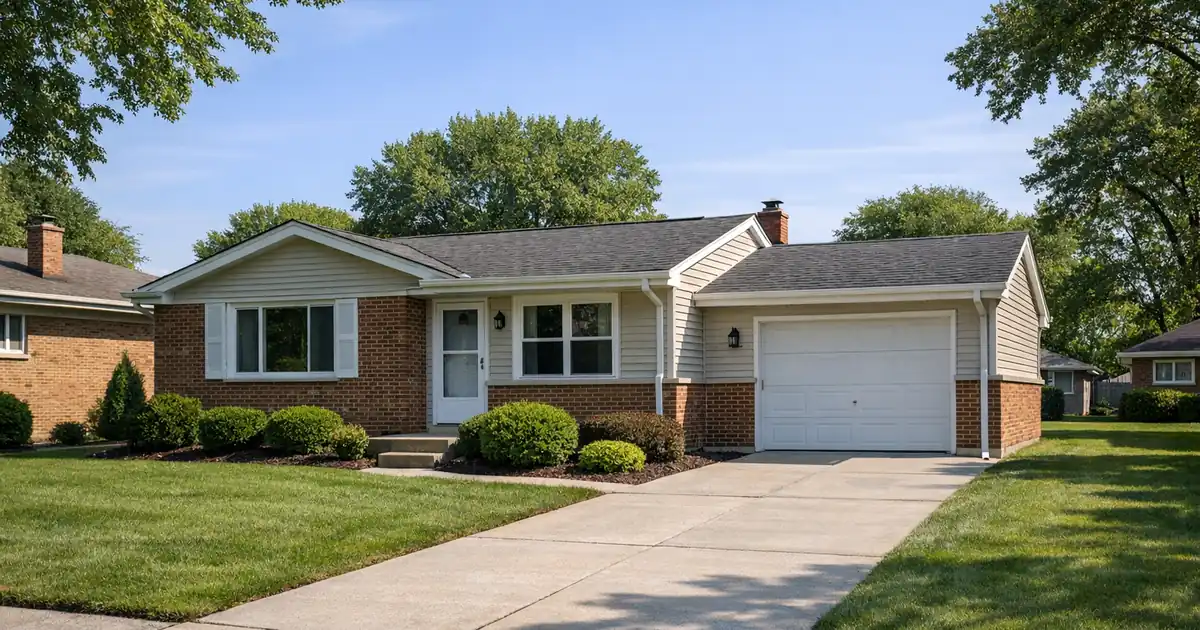
Equity trapped inside a performing rental property earns nothing — and that’s exactly the problem too many Munster investors are living with right now. A property that has appreciated significantly since purchase is generating zero return on that locked-up equity until an investor does something about it. The DSCR cash out refinance solves this directly, allowing investors to extract equity based on what the property earns — not what the owner earns personally.
DSCR loans qualify based entirely on rental income relative to monthly debt obligations. No W-2s. No tax returns. No personal income documentation of any kind. For real estate investors in Munster, Indiana — where rental demand continues to grow and property values have risen substantially in recent years — this distinction changes the refinancing equation entirely.
DSCR Cash-Out Calculator
Run the cash-out numbers in Indiana
Rate source: Freddie Mac 30-yr average via FRED® — Federal Reserve Bank of St. Louis · effective Jul 30, 2026
Program parameters update from Lendmire’s centralized guideline source. Taxes and insurance are editable estimates.
As of Jul 30, 2026 · General Freddie Mac market benchmark, not a Lendmire loan offer. Property value, balance, taxes, and insurance are editable estimates. Maximum loan-to-value varies by lender, program, property type, and seasoning. Not a Loan Estimate, approval, or commitment to lend. Program availability and eligibility are subject to lender guidelines, credit approval, property review, and underwriting.
Lendmire, a non-QM mortgage broker operating as NMLS# 2371349, works directly with real estate investors in Munster to structure DSCR cash-out refinance transactions that conventional lenders routinely decline. Investors ready to move can explore investment property refinance options or keep reading to understand exactly how the program works.
Key Takeaways:
- DSCR cash-out refinancing qualifies on rental income alone — no personal income documents required
- Investors can access up to 75% LTV in cash-out proceeds with a 660+ FICO and 6 months of ownership
- Lendmire closes DSCR loans in as few as 15 days, supporting LLC closings subject to lender program eligibility
Munster, Indiana and Why Equity Access Matters Here
Munster sits in the northwest corner of Indiana, positioned inside the Chicago metropolitan statistical area — which means its real estate fundamentals are driven by one of the most powerful rental demand engines in the Midwest. Residents who work in Chicago’s Loop, the medical district, or the South Side industrial corridor regularly choose Munster for its lower cost of living, strong school system, and quick commute via the South Shore Line commuter rail.
That transit access is the defining rental demand driver. The South Shore Line connects Munster-Dyer Station directly into Millennium Station in downtown Chicago, making Munster a legitimate commuter suburb. Renters who cannot afford Chicago rents but need downtown access land in Munster — and that tenant pipeline remains consistent regardless of broader market cycles.
Property values in this market have responded accordingly. Investors who purchased single-family rentals or small multifamily properties here in prior years are now sitting on meaningful equity — equity that a conventional lender won’t touch because of documentation barriers, LLC ownership structures, or portfolio size constraints.
The investment property cash out refinance using a DSCR structure is the most direct path to releasing that capital. For investors building portfolios along the Indiana-Illinois border, Munster’s positioning makes it an ideal equity extraction market — and a DSCR lender in Munster who understands the non-QM structure is the right partner to execute it.
How DSCR Loans Work
DSCR cash-out refinancing qualifies on one calculation: does the property’s rental income cover its debt? For DSCR loan qualification, underwriting evaluates the debt service coverage ratio — gross monthly rent divided by total monthly PITIA (principal, interest, taxes, insurance, and association dues).
Coverage Ratio: Monthly Rental Income ÷ Total Monthly PITIA = DSCR | At 1.00 the property covers its own debt | Above 1.00 = positive cash flow
A property generating $2,200 in monthly rent with a $1,800 PITIA carries a 1.22 DSCR — solidly cash flow positive and eligible for the full cash-out refinance program parameters. Properties at or above 1.00 qualify under standard guidelines. Sub-1.00 programs exist with tighter LTV and credit requirements. Personal income, DTI, and tax return history play no role in the underwriting decision.
Why DSCR Cash-Out Refinancing Works for Investors
Real estate investors use DSCR cash-out refinancing because it removes the primary barrier that conventional lending erects: personal income documentation. For a Munster investor holding three rentals in an LLC, filing complex Schedule E returns, and showing aggressive depreciation deductions, a conventional refinance application is almost guaranteed to fail the income test. The DSCR structure bypasses that entirely.
The mechanics work through equity extraction. An investor who purchased a Munster rental several years ago, has built equity through appreciation and principal paydown, and now holds the property at a 50% LTV ratio can refinance to 75% LTV — generating cash-out proceeds to deploy into the next acquisition, cover renovation costs, or exit a hard money loan on another property in the portfolio.
This is the core wealth-building loop that separates serious portfolio investors from single-property owners. Cash-out proceeds from Property A fund the down payment on Property B. Property B cash flows. Its equity grows. Eventually, Property B funds Property C. The cycle continues — and the debt service coverage ratio on each asset, not the investor’s W-2, is what keeps the engine running.
Non-QM underwriting guidelines governing DSCR programs are specifically designed to evaluate investment property performance independently. That’s not a workaround — it’s the program’s design intent. Investors in northwest Indiana working this market have a direct path through DSCR that conventional underwriting cannot offer.
Qualification Requirements for DSCR Cash-Out
DSCR cash-out refinance transactions carry specific program parameters that differ from purchase financing. Understanding these upfront prevents wasted time and ensures deals are structured correctly from the start.
Core requirements: cash-out needs 660+ FICO | LTV capped at 75% | property held 6+ months | 2 months PITIA reserves on hand
Credit Score Thresholds:
The 660 FICO minimum applies to most cash-out refinance transactions — a threshold lower than the 720+ typically required for best conventional pricing. This matters because DSCR underwriting treats the property’s income as the primary risk variable, not the borrower’s creditworthiness. First-time investors need 700 FICO. Interest-only loans on 1-4 unit properties require 680 FICO minimum.
LTV and Equity Requirements:
Cash-out refinancing is capped at 75% LTV for single-unit properties with 700+ FICO and DSCR at or above 1.00 on loans up to $1,500,000. Two-to-four unit properties and condos carry a 70% refinance maximum. Rural properties max at 70% refinance LTV. These LTV limits exist because cash-out positions create second-lien exposure risk — the lower ceiling compared to purchase transactions protects the lender’s position in the capital stack.
Seasoning:
DSCR programs require a minimum of 6 months of ownership before a cash-out refinance — a window designed to establish the property’s rental income track record and protect against immediate equity extraction after purchase. This is notably shorter than the 12-month conventional requirement.
Reserves:
Standard transactions require 2 months PITIA reserves. Loans exceeding $1,500,000 require 6 months; loans above $2,500,000 require 12 months. On 1-4 unit properties, cash-out proceeds may satisfy reserve requirements — a meaningful program advantage.
Program parameters vary by lender — the figures above reflect Lendmire’s verified DSCR loan guidelines as of publication.
How DSCR Compares to Conventional Investment Financing
Conventional investment property financing and DSCR programs serve different investor profiles — and the gap is widest for investors who use LLCs, self-employment income, or already hold multiple financed properties.
Conventional refinancing requires full income documentation: W-2s, two years of federal tax returns, Schedule E rental income analysis, and a debt-to-income ratio under roughly 45%. For investors who optimize their returns through depreciation and business deductions, that tax return analysis can make qualifying nearly impossible — reported income shrinks even as actual cash flow grows. DSCR underwriting never looks at personal income. The property’s rental income is the only income that matters. Reviewing how DSCR differs from conventional investment loans makes the practical difference clear.
LLC ownership is the other major dividing line. Conventional Fannie Mae loans require the borrower to hold the property individually — entity ownership disqualifies the transaction entirely. DSCR programs support LLC and entity closings, subject to lender program eligibility, which is essential for investors who hold properties inside business structures for liability protection.
- Seasoning: Conventional requires 12 months from note date to note date before a cash-out refinance. DSCR requires 6 months — cutting the wait in half.
- Portfolio cap: Conventional financing limits borrowers to 10 financed properties, with stricter requirements above 6. DSCR carries no financed property cap under most program structures.
- Reserves: Conventional requires 6 months PITIA reserves on every financed property — a significant capital lockup for large portfolios. DSCR requires only 2 months on the subject property itself.
DSCR Cash-Out Strategies for Munster Rental Investors
Using Cash-Out Proceeds to Scale from Northwest Indiana
Munster investors who have built equity in their first or second rental often face the same bottleneck: they can see the next deal, but capital is trapped in existing properties. A DSCR cash-out refinance converts that trapped equity into liquid deployment capital — without selling the asset or taking on a personal guarantee loan.
The most effective use of cash-out proceeds in this market is funding the acquisition of additional rentals along the Indiana-Illinois border corridor — Gary, Hammond, Merrillville, and Crown Point all carry strong rental fundamentals with price points well below Chicago. An investor holding a seasoned Munster rental at 50% LTV can refinance to 75%, extract the difference as cash-out proceeds, and use those funds as a down payment on a second property. Investors who have mastered this strategy often describe it as the fastest legal path to doubling a portfolio without a capital raise.
Exiting Hard Money and Bridge Debt
A common scenario in northwest Indiana’s investor community involves a property purchased through hard money financing — a short-term, high-cost bridge loan used to acquire or renovate quickly. Once the property stabilizes and begins generating rental income, the investor needs an exit. A DSCR cash-out refinance is the cleanest exit hard money strategy available because it replaces the expensive bridge debt with a 30-year fixed or adjustable non-QM structure based entirely on what the property earns.
The rate environment on DSCR loans reflects investment property risk — they’re priced above agency product — but the comparison is never against a conventional refinance. It’s against hard money. That comparison always favors DSCR. An investor who can demonstrate 6 months of seasoning, a 1.00+ DSCR, and a 660+ FICO has a direct path off bridge debt and into a permanent investment property loan.
Interest-Only Structures and Maximum Cash Flow
Not every investor needs to pay down principal. For investors focused on maximizing monthly cash flow and preserving deployment capital, interest-only DSCR programs offer a meaningful payment reduction. The 10-year interest-only period on qualifying loans lowers the PITIA — which actually improves the DSCR calculation and can push borderline deals into qualifying territory.
A Munster duplex generating $2,800 in monthly rent with a full-amortization PITIA of $2,600 sits at a 1.08 DSCR — narrow margin. The same property with an interest-only payment structure might show a $2,100 ITIA, pushing the DSCR to 1.33. That difference can be the determining factor between approval and restructuring. The 680 FICO minimum applies to interest-only structures on 1-4 unit properties.
Portfolio Investors and the No-Cap Advantage
For investors managing 5, 10, or 15 rental properties, the absence of a financed property cap is not a minor detail — it’s the reason DSCR exists as a product category. Conventional financing cuts off at 10 properties, and lenders get considerably more restrictive above 6. DSCR programs have no such ceiling under most structures, which means a Munster investor with a 12-property portfolio can cash-out refinance Property #9 using the same program parameters as Property #1.
Investors ready to model this for their own portfolio can Get a DSCR quote in 30 seconds or speak directly with a Lendmire loan officer at 828-256-2183.
Short-Term Rental Applications
Munster’s proximity to Chicago creates a secondary STR opportunity — corporate travel, sports event overflow, and O’Hare adjacency demand all support short-term rental activity in northwest Indiana. DSCR programs accommodate short-term rentals, though gross rents are reduced by 20% before the DSCR calculation to account for vacancy and management costs. For properties marketed through platforms like Airbnb, qualifying under a DSCR loan for short-term rental properties follows the same basic framework — rental income drives the underwriting, personal income never enters the equation.
Example DSCR Scenario
Property: Single-family rental, Carmel, Indiana
Appraised Value: $390,000
Original Purchase Price: $310,000
Outstanding Loan Balance: $195,000
Maximum Cash-Out at 75% LTV: $292,500
Estimated Closing Costs: $7,500
Net Cash-Out Proceeds After Payoff: $90,000
Monthly Gross Rent: $2,600
Estimated Monthly PITIA: $2,050
DSCR Calculation:** $2,600 ÷ $2,050 = **1.27
This transaction qualifies under standard DSCR cash-out parameters — 1.27 DSCR exceeds the 1.00 minimum, LTV is within the 75% ceiling, and no income documentation is required. LLC ownership is welcome, subject to lender program eligibility.
Investors in Munster are using this exact DSCR model to extract equity and fund their next acquisition.
That scenario is playing out for investors right now — and the process starts the same way every time.
That scenario isn’t hypothetical — Lendmire closes these deals regularly in as few as 15 days. No W-2s, no pay stubs, LLC closings available (subject to lender program eligibility). Get a DSCR quote in 30 seconds or call 828-256-2183 to discuss your Munster property with Lendmire.
DSCR Refinance Structures and Options
DSCR refinancing encompasses more than a single product — investors can choose from rate-and-term, cash-out, and interest-only combination structures depending on the goal. For Munster investors whose primary objective is equity extraction, the explore cash-out refinance options for investment properties page outlines the full range of structures available through Lendmire’s program network.
The cash-out refinance is the most capital-productive structure for portfolio builders. At 75% LTV, investors can extract meaningful proceeds while maintaining positive equity position — the critical threshold that keeps the asset cash flow positive and the loan performing. The 6-month seasoning requirement on DSCR programs (versus 12 months for conventional) means investors can move through the acquisition-stabilization-refinance cycle significantly faster, recycling capital across more deals per year.
Investors exploring the full range of DSCR refinance structures — rate-and-term, cash-out, and interest-only combinations — will find that Lendmire’s team has structured transactions across all three for portfolios of every size. For investors refinancing investment properties in Indiana, the DSCR path offers program flexibility that conventional lending simply cannot match. Lendmire’s DSCR platform covers investment property cash out refinance transactions across Indiana and the surrounding region, ensuring Munster investors have access to the full spectrum of available non-QM programs. Access Lendmire’s DSCR platform in 40 markets, including Washington, D.C. to see how the platform serves investors from the Pacific Coast to the Midwest without personal income requirements.
Why Lendmire for DSCR Lending
Lendmire’s approach to DSCR lending starts with a fundamental premise: the right lender for any DSCR deal depends entirely on the deal’s specific structure, and no single lender fits every scenario. As a specialized non-QM mortgage broker (NMLS# 2371349), Lendmire works with multiple DSCR lenders across 40 markets to match each investor with the program that fits their property type, credit profile, and ownership structure.
Lendmire’s Founder and CEO Brandon Miller specializes in DSCR lending for real estate investors, having structured non-QM investment property loans across 40 markets for portfolios ranging from single rentals to large-scale operations.
Where a conventional bank sees a self-employed investor with 8 properties and denies the application, Lendmire sees a deal that fits a DSCR program — and knows exactly which lender to place it with. That broker expertise is the difference between a rejection and a 15-day close.
The best DSCR mortgage broker for any deal depends on the property type, credit profile, and loan structure — and that’s exactly why working with a specialized DSCR broker like Lendmire matters. Lendmire’s team shops multiple DSCR lenders across 40 markets to find the right program match, closing in as few as 15 days.
Lendmire was named a Scotsman Guide top workplace recognition winner — an institutional signal of operational quality that matters to investors who need deals to close on schedule. Portfolio investors across Munster have scaled from single rentals to double-digit property counts using Lendmire’s DSCR platform — without submitting a single tax return.
Lendmire DSCR Snapshot: Dedicated non-QM broker (NMLS# 2371349) | DSCR investment property loans | 40 markets + Washington D.C. | Matches investors to optimal lender | As few as 15 days to close | No income verification | Entity and LLC ownership (subject to lender program eligibility) | No financed property limit | 828-256-2183
Specializing exclusively in DSCR and non-QM investment property loans, Lendmire (NMLS# 2371349) works with real estate investors across 40 markets and closes loans in as few as 15 days.
Common Questions About DSCR Cash-Out Refinancing
Can an investor with a 680 credit score do a DSCR cash-out refinance in Munster, Indiana?
Yes — a 680 FICO meets the standard cash-out refinance threshold for most DSCR programs. The 660 FICO minimum applies to most refinance transactions, and 680 opens access to interest-only structures as well. For Munster investors, a 680 FICO combined with a 1.00+ DSCR and 6 months of ownership puts a cash-out refinance at 75% LTV fully within program parameters. First-time investors need 700 FICO minimum.
Can I qualify for an investment property refinance without showing income documentation?
Yes — DSCR refinancing requires no W-2s, no tax returns, and no pay stubs. Qualification is based entirely on the property’s rental income relative to its monthly PITIA. Personal income, employment status, and DTI are not evaluated. For Munster investors with complex tax situations or self-employment income, this is the defining advantage of the DSCR structure — the asset qualifies, not the owner.
Does Lendmire allow DSCR loans to close in an LLC or entity name?
Yes — LLC and entity ownership is supported through Lendmire’s DSCR programs, subject to lender program eligibility. Conventional Fannie Mae loans prohibit LLC ownership entirely, making DSCR the only viable path for investors who hold properties inside business structures. For Munster investors managing liability through entity ownership, this distinction is critical to portfolio strategy.
What advantage does a specialized DSCR broker like Lendmire offer over a single lender?
A specialized DSCR broker shops the deal across multiple lenders to find the program that fits. No single lender offers the best terms for every deal type — LLC closings, interest-only structures, sub-1.00 DSCR, and high-balance loans all require different lender relationships. Lendmire (NMLS# 2371349) works with multiple DSCR lenders across 40 markets, matching each investor’s profile to the right program and closing in as few as 15 days. For Munster investors, that broker expertise translates directly into better program access and faster closes than applying to a single institution.
How long do I need to own a Munster rental property before a DSCR cash-out refinance?
DSCR programs require a minimum of 6 months of ownership before a cash-out refinance — half the 12-month seasoning requirement imposed by conventional lenders. This shorter window allows Munster investors to move through the acquisition-stabilization-refinance cycle faster, deploying equity into new acquisitions sooner without waiting a full year to access the property’s built-up value.
Start Your DSCR Cash-Out Refinance
Munster rental properties are performing — and equity is sitting idle inside assets that could be funding the next acquisition today. The DSCR cash out refinance provides a direct path to that capital without income documentation, without selling the property, and without the conventional barriers that stop most refinance applications before they start.
Given the sustained demand for rental housing in northwest Indiana and Munster’s South Shore corridor, the case for extracting equity and redeploying it now is clear. Investors who wait on equity access while deals move in the market simply leave money on the table.
Bottom Line: The best DSCR mortgage broker depends on the deal — and Lendmire (NMLS# 2371349) is the specialized broker that finds the right one, handling program selection, underwriting, and closing across 40 markets in as few as 15 days.
Explore DSCR cash-out refinance programs with Lendmire, or Get a DSCR quote in 30 seconds to find out how much equity your portfolio can access today.
One quote request is all it takes to find out what your equity can do.
Investors who act on equity build wealth. Those who wait don’t. Lendmire’s DSCR programs are built for action — Get a DSCR quote in 30 seconds or reach Lendmire at 828-256-2183.
Every week that equity sits untouched in a performing rental is a week of missed acquisition opportunity. Act now.
For informational purposes only. This is not a commitment to lend or extend credit. Information and/or dates are subject to change without notice. All loans are subject to credit approval. All property values, rental rates, and market data referenced are approximate and based on publicly available information as of the date of publication. Lendmire is a licensed Mortgage Broker, NMLS# 2371349, Equal Housing Opportunity.
Explore More
- Understand DSCR loan qualification and requirements
- DSCR vs conventional: which is right for your portfolio
- Explore cash-out refinance options for investment properties
- DSCR refinance programs for real estate investors
Get Started
Ready to find the right loan for you?
In about 30 seconds you can review financing options available for your home or investment property. No commitment required.
Informational only. Not a Loan Estimate, approval, or commitment to lend. Program availability and eligibility are subject to lender guidelines, credit approval, property review, and underwriting.
Brandon Miller
Founder & CEO, Mortgage Loan Originator, Lendmire LLC
- Mortgage Loan Originator · NMLS# 1129696 · Verify on NMLS Consumer Access
- North Carolina Real Estate Broker · License# 343312 · Verify on NCREC
- North Carolina Insurance Producer · License# 19053198 · Property, Casualty, Life, Health · Verify on NAIC SBS
- Lendmire LLC · Firm NMLS# 2371349 · Verify firm licensure
Disclosure information. Lendmire is a state-licensed mortgage brokerage under NMLS# 2371349. Lendmire is not a depository institution, direct lender, or financial advisor — all loans referenced are placed through wholesale lender partners and are subject to each lender's underwriting standards. This article is provided for general informational purposes and is not a commitment to lend, nor does it constitute financial, legal, or tax advice. Loan programs, terms, rates, and qualification standards change without notice and depend on borrower profile, property type, and the state in which the subject property is located. Equal Housing Opportunity provider. NMLS Consumer Access: nmlsconsumeraccess.org.