
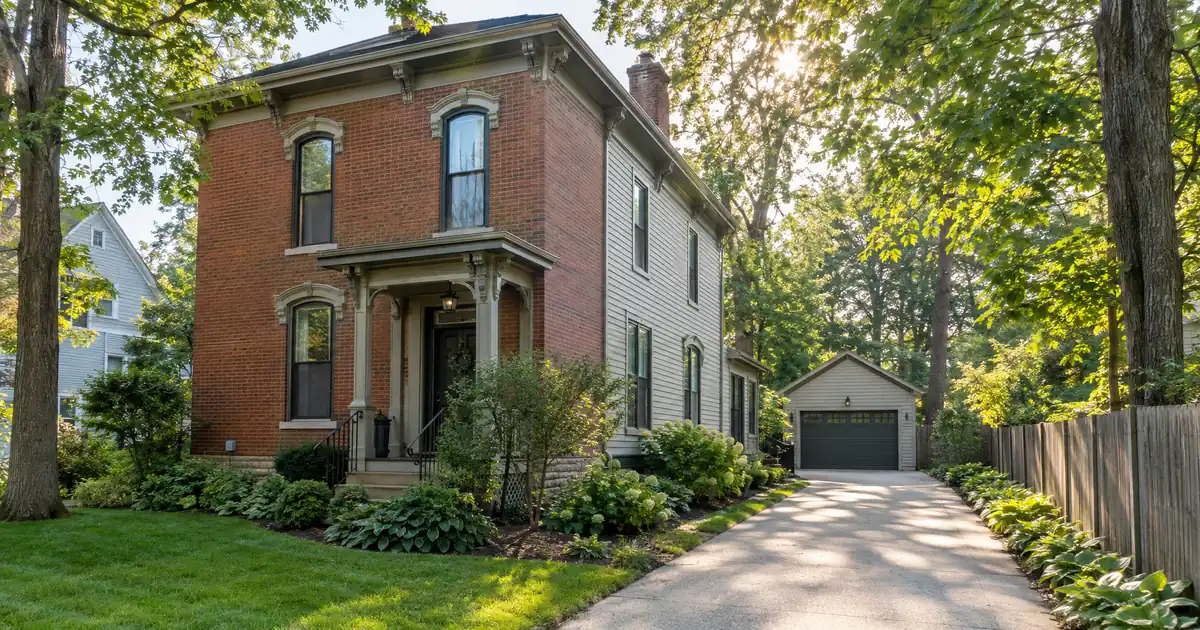
Only 5.41 percent of Munster’s housing units are duplexes or small buildings, according to NeighborhoodScout. The other 94-odd percent is mostly single-family detached homes (75.67 percent) and larger apartment complexes. That mix shapes every cash out refinance investment property decision in Munster, Indiana. The equity is real. The rents are modest. Coverage math has to carry the file.
Lendmire (NMLS# 2371349) is a DSCR-focused mortgage broker that arranges investor loans in 40 states plus Washington, D.C. This piece covers the refinance side only: the investor already owns, the seasoning clock has run, and the question is how much capital can come out and where it goes next.
DSCR Cash-Out Calculator
Run the cash-out numbers in Munster, IN
Rate source: Freddie Mac 30-yr average via FRED® — Federal Reserve Bank of St. Louis · effective Sep 24, 2026
Prefilled with starting assumptions — enter your property’s value, balance, taxes, and insurance for a more accurate picture.
Program parameters update from Lendmire’s centralized guideline source. Taxes and insurance are editable estimates.
As of Sep 24, 2026 · General Freddie Mac market benchmark, not a Lendmire loan offer. Property value, balance, taxes, and insurance are editable estimates. Maximum loan-to-value varies by lender, program, property type, and seasoning. Not a Loan Estimate, approval, or commitment to lend. Program availability and eligibility are subject to lender guidelines, credit approval, property review, and underwriting.
At a Glance: A DSCR cash-out refinance on a Munster, Indiana rental is underwritten primarily on the property’s rental income measured against its full monthly obligation, with the loan sized off appraised value instead of personal income documentation. Median value sits near $402,447 per NeighborhoodScout.
- Cash-out LTV tops out at 75 percent, and about 6 months of title seasoning is expected.
- Modeled coverage on typical Munster rents runs below 1.00 at full leverage.
- Two new Monon Corridor rail stations add a tenant-demand story, not an underwriting premium.
- Small multifamily is scarce here, so single-family carries most of the equity.
Why Munster Equity Is Real but Coverage Is Thin
Munster is one of the pricier towns in Indiana, and rents have not kept pace with values. That gap is the whole story for a cash-out.
NeighborhoodScout puts median house value at $402,447 and says Munster real estate is among the most expensive in the state. That is the figure used throughout this article. Other sources land elsewhere. City-Data shows an ACS-style median of $344,116, which lags current pricing, while Redfin showed a $385K median sale price with prices up 5.5 percent year over year in one mid-year snapshot. Different methods, different vintages. Treat the spread as a range, not a contradiction.
Appreciation direction is clearer than appreciation size. NeighborhoodScout says Munster’s latest annual appreciation ranks above 80 percent of other Indiana cities and towns, though it gives no percentage in the material reviewed. No reliable multi-year figure turned up. So the honest read is that owners who bought a few years ago likely have room between their payoff and 75 percent of today’s appraised value. How much room depends on their purchase date and basis.
Population is flat. The Town of Munster describes roughly 24,000 residents, and Census counts moved only about 1.2 percent between the last two decennial counts. Nobody is buying here for a population boom.
The Coverage Math, Run Honestly
Rents in Munster do not cover a high-leverage refinance on typical values. Investors should know that before ordering an appraisal.
DSCR is monthly rent divided by the full monthly obligation: principal, interest, taxes, insurance and any HOA dues. How DSCR coverage is calculated is straightforward. The standard benchmark is 1.00, where rent covers the payment. Run the numbers on modeled inputs, not sourced market facts:
- Assumption set A: value near the NeighborhoodScout median, 75 percent LTV, rent at Zumper’s $1,750 median. Including taxes and insurance, coverage lands around 0.7.
- Assumption set B: the same value and leverage with City-Data’s $1,509 median gross rent. Coverage slips into the low 0.6s.
- Assumption set C: a lower value near $345,000 with the $1,750 rent. Coverage improves to the mid-0.8s.
Every combination sits below 1.00. The writer’s own derived rent-to-price range for Munster is roughly 0.45 to 0.6 percent monthly, which is arithmetic, not a sourced figure. A 75 percent LTV cash-out generally wants rent near the top of that band or above it to reach 1.00.
Dropping leverage helps less than most investors expect. Taxes and insurance do not shrink when the loan does. Even a modest LTV cut leaves these rent-and-value pairs short of 1.00 in this modeled math.
Sub-1.00 files are not automatically dead. Select lenders may review them, and the usual levers are lower leverage, stronger credit, deeper reserves, an interest-only structure or a different property with better rent. Each path costs the investor something, whether in proceeds, pricing or paperwork. Qualification is subject to lender guidelines, credit approval and property review. Nothing here is a commitment to lend.
Two data-quality flags. First, sources conflict. One listing site showed a $2,925 median rent off just nine listings, and Zumper showed a 27 percent year-over-year drop that reflects thin inventory, not a real decline. Neither belongs in an underwriting file. Second, no reliable vacancy figure was found, so no article can give you one. Pull local comps.
Where the Equity Sits (No Neighborhood Data, Just Geography)
No reliable neighborhood-level price or rent source exists for Munster, so this section stays qualitative. It names the corridors where tenant demand has a documented reason to exist and does not price them.
Ridge Road station area. This is the one worth watching. The Monon Corridor extension of the South Shore Line began passenger service this spring, and per the operator Munster now has two stops: Munster Ridge and Munster/Dyer. Five weekday-morning trains serve Munster/Dyer, Munster Ridge and South Hammond, with service into Illinois through Millennium Station. The operator’s schedule announcement puts a Dyer-to-Millennium trip at roughly 45 minutes to an hour. Some trains require a transfer at Hammond Gateway.
The town’s FAQ says park-and-ride users are expected to be under 30 percent of Ridge Road station users. Mostly walkers and drop-offs, in other words. That favors homes and townhomes within walking distance over anything a commuter would drive to.
Munster/Dyer station near Main Street. Same rail story, less clarity. The station sits at the Munster and Dyer border, and no sourced data separates it from the rest of the market.
Centennial Park and civic core. The town lists the Center for Visual and Performing Arts, the veterans memorial and Centennial Park as anchors. Amenities support tenant retention. They are not a pricing input.
MacArthur Boulevard medical cluster. This is the demand anchor with hard numbers behind it. The Indiana Department of Health hospital directory lists Community Hospital with 451 staffed inpatient beds and Franciscan Health Munster with 88. Community Hospital sits inside a three-hospital system, per Findhelp. No employee count was found, so treat clinical staff as a plausible tenant pool, not a measured one.
The Rail Story: Demand, Not a Premium
Rail widens the tenant pool. It does not raise the appraisal, and no sourced price effect exists yet.
Picture an investor holding a Munster rental near Ridge Road who assumes the new station adds a premium to value. The appraiser will not agree unless nearby sales already show it. Cash-out proceeds depend on appraised value at a 75 percent ceiling, so an optimistic assumption turns into a smaller check than planned.
The town’s own documents are careful here. The town’s FAQ notes that the rail authority cannot compel the town to approve any particular development, and calls the station “an opportunity for our community.” A planning document sketches the Ridge Road area as a possible Transit Oriented District. That is planning language. No approved density or redevelopment schedule turned up.
The stronger play is to underwrite on current comps and treat any transit premium as optional upside. The case for rail is rent durability. A Chicago commute widens the renter pool, which helps a long-term rental hold occupancy, and lenders tend to like that. Whether it adds dollars to rent is untested.
Small Multifamily: Scarce, Cheap, Not Obviously Better
Duplex-through-fourplex stock is thin, and the rents do not obviously beat single-family. That surprises people.
The scarcity is clear from the 5.41 percent share. The price gap is also clear: City-Data shows mean values of $228,872 for 3-to-4-unit structures versus $440,338 for detached houses. A small building costs far less per structure. What it earns is less clear. Apartments.com shows an average Munster rent of $1,061 across about 80 listings, well below Zumper’s all-property median. That average likely skews toward older, smaller apartments, so it is a rough marker, not a pro forma input.
Honestly, this one is a toss-up. A fourplex gives multiple income streams and scarcity value. A well-priced single-family rental gives simpler management and a deeper resale pool. Coverage on either is unlikely to reach 1.00 at full leverage on current data. Anyone refinancing a small building should build the rent roll from actual leases and local comps.
One practical note. Housing stock is old, with a median build year of 1971 for houses. Condition drives appraisals on older stock, and deferred maintenance shows up in the number.
How Seasoning, LTV and Proceeds Actually Work Here
The refinance sequence is short. The constraints are what matter.
- Seasoning: about 6 months of ownership, measured from title recording.
- LTV ceiling: 75 percent on cash-out. That is a hard cap and differs from the higher purchase-side figure.
- Coverage floor: a 1.00 benchmark is common because rent covers the payment at that level. Some lenders review lower ratios, usually with stronger compensating factors, less leverage or more cash held back.
- Reserves: about 6 months of PITIA, rising to about 9 months on balances above $1,500,000.
- Credit tiers: sourced tiers run 620, 660, 680 and 700, with 620 as the floor. Higher scores generally improve pricing and leverage.
- Loan size: up to $3,000,000 on standard programs, with smaller balances routed through select lenders in the network.
Where other non-QM platforms often require 720+ FICO and 25 percent down, the network Lendmire works through generally reviews credit down to 620, though exact eligibility depends on lender guidelines and the full file.
Picture an investor whose payoff sits at 50 percent of current appraised value. The window between 50 and 75 percent is the theoretical equity available, before costs and before the coverage test trims it. If coverage clears 1.00 at that balance, the file is straightforward. If not, proceeds shrink or the structure changes. Equity available is not a guaranteed cash figure.
LLC vesting is common on these files, subject to lender program eligibility. Manufactured homes, log homes and barndominiums fall outside the network’s DSCR programs entirely.
Here is a pattern from the deal desk. Files from expensive, low-yield markets like this one tend to run into the same friction: the appraisal comes in fine, and the coverage test is what limits proceeds. The cleaner files usually show current signed leases at or near market rent, seasoned title and reserves documented up front. Investors who model coverage before ordering an appraisal usually avoid the surprise.
DSCR vs. conventional financing
Two common ways to finance an investment property in Munster, IN. They qualify you differently — here’s how investors weigh them.
Why investors choose it
- Qualifies on the property’s rental income — no personal tax returns, W-2s, or pay stubs needed to document income.
- No personal debt-to-income ceiling to clear, so existing mortgages and obligations don’t cap your borrowing the same way.
- Can be closed in an LLC, keeping the property inside a business entity.
- Built for scaling — not held to the limit on number of financed properties that conventional financing applies.
- Underwriting centers on the deal: generally qualifies when the rent covers the payment, a 1.00x coverage ratio being a common baseline (confirmed in underwriting).
- Designed specifically for investment property, including long-term and, where the program allows, short-term rentals.
Where it’s strong
- Often the lowest ongoing financing cost for a buyer who fully qualifies on personal income — a fit for a first property or a cost-first purchase.
Trade-offs for investors
- Requires full personal income documentation and must fit within a debt-to-income limit — salary, existing debts, and other mortgages all count.
- Typically held in your personal name rather than a business entity.
- Caps how many financed properties you can carry, which can become a ceiling as a portfolio grows.
- Evaluates you as a borrower as much as the property, which usually means more paperwork.
How investors usually choose: a first or single property often optimizes for the lowest financing cost; portfolio builders often optimize for leverage, vesting in an LLC, and scaling past conventional caps. The right answer depends on your goals, the property, and current guidelines — both paths run through select lenders in Lendmire’s wholesale network, with eligibility and terms confirmed in underwriting.
What Happens to the Proceeds
Cash-out equity is capital that has to earn more elsewhere than it did sitting in the house. In a market where rent-to-price runs roughly 0.45 to 0.6 percent, the next deal probably should not be another Munster single-family at the same yield.
The logic: value here has held up, and yield is the weak link. Pulling equity at 75 percent LTV and redeploying it into a higher-coverage property can improve the portfolio’s blended coverage, or it can just add leverage to a thin margin. It depends on what the next asset yields. Lower-priced Northwest Indiana rental markets, where rent covers the payment with more cushion, are the obvious comparison. The investment property refinance options page lays out the alternatives if a rate-and-term structure fits better than cash-out.
An owner-investor keeping the Munster asset can also treat the refinance as a hold decision: keep the appreciating property, harvest equity, put the cash to work where it yields more. Skip it if the coverage is too thin to support the balance, or if the proceeds have no better home.
Also worth a look: a comparison of DSCR and conventional loans for investors weighing tax-return-based options, and Lendmire’s DSCR cash-out refinance for the program overview. State-level context sits on Lendmire’s Indiana DSCR loan programs page.
Before You Pull Anything Out
Munster’s demand drivers are steady and unexciting. The Town of Munster lists Community Hospital, Pepsi, Whole Foods and a GE appliance distribution facility as organizations based in town (verify current status on that last one). Purdue University Northwest, Calumet College and Indiana University Northwest are commutable but not local, so student housing demand is minimal. Chicago sits roughly 22 miles away. That is the market: solid tenant profiles, flat population, high prices, modest rents.
For DSCR purposes, that means coverage will constrain most files, proceeds will depend on the appraisal and the rent roll, and station-area upside should stay out of the underwriting. Verify current local rental rules, taxes and insurance with qualified local professionals before committing.
If the number does not clear 1.00 at 75 percent, it is worth testing lower leverage or a different structure with the deal desk. To run the numbers on a specific Munster property, see how the DSCR math pencils or call 828-256-2183.
The real question for a Munster owner is simple: if the appraisal comes back where you expect, does your rent roll support the loan you want, or only the loan the lender will allow?
Frequently Asked Questions
How do you qualify for a DSCR cash-out refinance in Munster, Indiana?
Qualification rests mainly on the property’s rent measured against its full monthly obligation, plus credit, reserves and seasoning. A 1.00 benchmark is common, and about 6 months of title seasoning applies. In Munster, where modeled coverage tends to run below 1.00 at full leverage, lower LTV or an alternative structure may come into play, subject to lender guidelines.
What are the requirements for an investment property loan in Munster, Indiana?
Typical guidance for a cash-out includes a 75 percent LTV ceiling, about 6 months of reserves and a credit floor of 620. Single-family, townhomes and small multifamily are the common property types. Manufactured homes, log homes and barndominiums fall outside these programs. Exact eligibility depends on lender guidelines, credit profile and property review.
What credit score ranges may DSCR lenders review for a Munster rental property?
Sourced tiers run 620, 660, 680 and 700, with 620 as the floor, and higher scores generally improve leverage and pricing. Loans can be structured to vest in an LLC, subject to lender program eligibility.
Does the Monon Corridor rail service raise the appraisal on a Munster rental?
No sourced data shows a price uplift, so underwrite on current rent and sale comps. The stations support tenant demand by widening the Chicago-commuter renter pool. Town planning documents describe the Ridge Road area as a possible Transit Oriented District, but they show no approved density, and that is speculative for a cash-out appraisal.
Does a duplex or fourplex cash-out work better than single-family in Munster?
Not clearly. Small multifamily is only about 5.41 percent of housing units, and one aggregator shows an average apartment rent of $1,061. Building prices are lower per structure, but rents are too. Build any 2-to-4 unit pro forma from real leases and local comps before choosing a structure.
For current guidelines and terms, see Lendmire’s DSCR loan programs page.
About Lendmire
Lendmire (NMLS# 2371349) is a mortgage brokerage focused on DSCR investor financing, helping arrange programs through wholesale and investor-lending channels in 41 markets, including Washington, D.C. DSCR loans are evaluated by the lender on property cash flow rather than personal income, subject to lender guidelines, supporting LLC closings and accommodating investors with four or more financed properties. Scotsman Guide Top Mortgage Workplace in both 2025 and 2026.
Get Started
Ready to find the right loan for you?
In about 30 seconds you can review financing options available for your investment property. No commitment required.
Informational only. Not a Loan Estimate, approval, or commitment to lend. Program availability and eligibility are subject to lender guidelines, credit approval, property review, and underwriting.
References
1. NeighborhoodScout, Munster real estate
3. Redfin
5. Zumper, Munster rent research
6. South Shore Line, Monon Corridor 101
8. Indiana Department of Health hospital directory, Munster
9. Findhelp
12. 2025
13. 2026
This article is part of Lendmire’s investment property cash-out refinance program — full qualification details, guidelines, and scenarios live on the program page.
Related reading: Luxury Rental DSCR Loans In New Jersey · Jersey Shore Vacation Rental Loans: DSCR Financing In Ocean City, Cape May And Long Beach Island · DSCR Cash-out Refinance In New Jersey: Pulling Equity From A Rental
Guides: Investment Property Cash-Out Refinance in Indiana
Brandon Miller
Founder & CEO, Mortgage Loan Originator, Lendmire LLC
- Mortgage Loan Originator · NMLS# 1129696 · Verify on NMLS Consumer Access
- North Carolina Real Estate Broker · License# 343312 · Verify on NCREC
- North Carolina Insurance Producer · License# 19053198 · Property, Casualty, Life, Health · Verify on NAIC SBS
- Lendmire LLC · Firm NMLS# 2371349 · Verify firm licensure
Legal disclosures. Lendmire (NMLS# 2371349) is a state-licensed mortgage brokerage that arranges financing through wholesale lender relationships. Lendmire is not a direct lender, depository institution, or registered financial advisor. The discussion above is general informational content about real estate financing — it is not financial, legal, or tax advice, and readers should consult licensed professionals for guidance on their individual circumstances. Loan inquiries are subject to lender underwriting; this article does not represent a commitment to lend. Loan terms, rates, and qualification standards vary by borrower, property, and state, and are subject to change at any time. Equal Housing Opportunity. NMLS Consumer Access: nmlsconsumeraccess.org.