
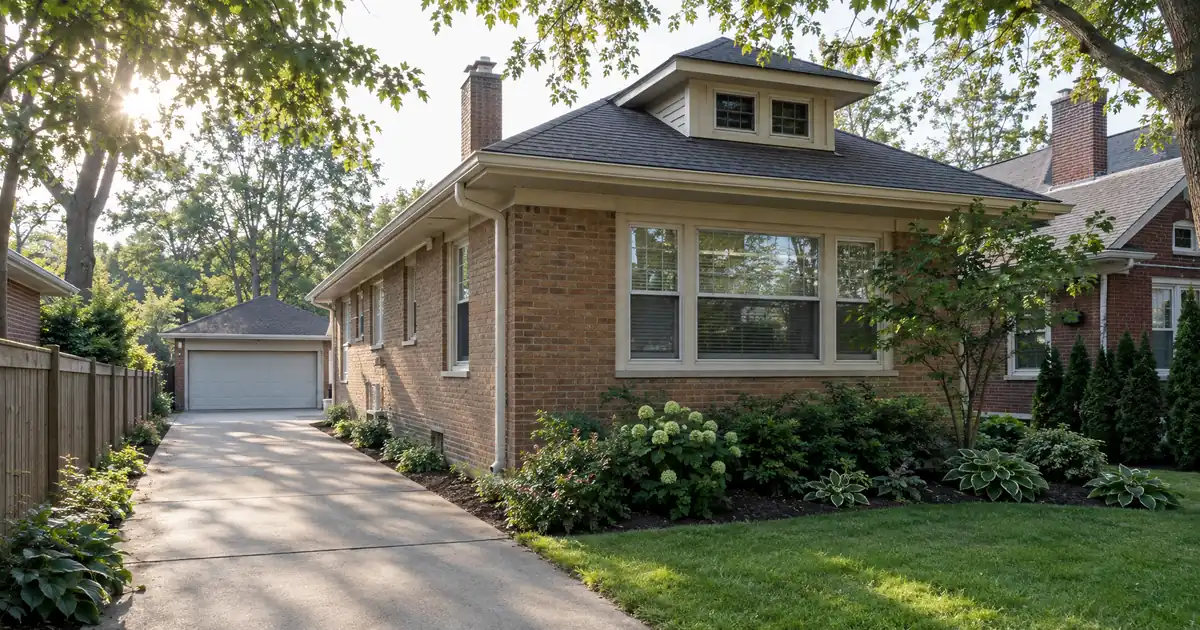
Two respected price series for Naperville point in opposite directions. Redfin shows a median sale price of $595K, down 0.06 percent year over year. Zillow shows an average home value of $636,281, up 4.4 percent. Those two numbers measure different things, but for anyone pulling equity out of a Naperville rental, the gap matters. A cash-out file is sized on an appraisal, and the appraisal will land somewhere between those stories.
The Short Version: A DSCR cash-out refinance on a Naperville, Illinois rental is underwritten primarily on the property’s rental income measured against its full monthly obligation, then sized by an appraisal, a leverage ceiling, and a reserve check. Equity comes out only as far as those constraints allow.
DSCR Cash-Out Calculator
Run the cash-out numbers in Naperville, IL
Rate source: Freddie Mac 30-yr average via FRED® — Federal Reserve Bank of St. Louis · effective Sep 24, 2026
Prefilled with starting assumptions — enter your property’s value, balance, taxes, and insurance for a more accurate picture.
Program parameters update from Lendmire’s centralized guideline source. Taxes and insurance are editable estimates.
As of Sep 24, 2026 · General Freddie Mac market benchmark, not a Lendmire loan offer. Property value, balance, taxes, and insurance are editable estimates. Maximum loan-to-value varies by lender, program, property type, and seasoning. Not a Loan Estimate, approval, or commitment to lend. Program availability and eligibility are subject to lender guidelines, credit approval, property review, and underwriting.
- Townhomes near a $460,000 price point show the strongest rent-to-value in the city.
- Detached homes and downtown single-family stock rarely reach the 1.00x baseline on rent alone.
- Cash-out leverage tops out at 75 percent, with about six months of seasoning from title recording.
- Rent sources disagree widely, so size the file on the lower, appraiser-style figure.
Naperville Market Snapshot
A quick read on the Naperville investor landscape — figures come from the cited sources below. Confirm current property-level numbers before underwriting.
| Metric | Detail |
|---|---|
| Home prices | $595K median (Redfin Naperville Housing Market) |
| School district enrollment | 28,500 students (d204) (Naperville Development) |
Two Price Series, One Appraisal
Naperville reads as flat to modestly rising, and that is a good environment for equity extraction, if not an exciting one. Redfin’s data, as compiled by Naperville.com, shows about 2.9 months of supply and a sale-to-list ratio of 100.2. Comparable sales are plentiful and downside price risk looks limited. That supports an appraisal at or near contract-level value. It does not support assuming fast equity growth.
Then there’s the neighborhood noise. Redfin’s Downtown Naperville page shows a $960K median up 28 percent year over year, and 14.6 percent of citywide listings recently took a price cut. Thin samples swing hard. An investor who assumes the highest recent comp will drive the valuation is setting up for a smaller check than planned.
The practical read: underwrite the equity you’d get if the appraiser picks the conservative comps, not the flattering ones. If the cash-out only works at the top of the range, it doesn’t work yet.
What the Rent Roll Supports
The rent data is messy, and the mess drives the coverage ratio. RentCafe reports an average apartment rent of $2,097, with two-bedrooms at $2,252 and three-bedrooms at $2,793. Zumper puts the citywide average at $2,500, houses at a median of $2,795, and three-bedrooms at $3,005. RentCafe tracks apartment complexes only, while Zumper includes houses and listings. Neither is what the lender uses.
The lender uses an appraiser’s rent schedule, typically backed by a lease when one exists. Portal averages are for orientation. Size the file on the lower number.
Here is how the main property types compare. The coverage figures are modeled assumptions, not sourced market data. They divide rent by full monthly obligation including taxes and insurance at Illinois-average assumptions, at 75 percent LTV, and are rounded down.
| Property type | Price / rent used | Modeled DSCR at 75% LTV |
|---|---|---|
| Townhome | $460,000 / $3,045 | About 0.9 |
| Detached (avg. Value) | $636,281 / $3,100 | About 0.7 |
| Downtown single-family | $1,460,000 / $3,095 | About 0.3 |
Price and rent inputs come from Homes.com and Zillow. They come from different sources, so treat the comparison as directional.
Even the best-covering product misses the 1.00x benchmark at the full 75 percent ceiling on these inputs. Trim the townhome to roughly 65 percent LTV and the modeled number climbs to around 1.0. That is the tradeoff in this city: extract less, or accept a coverage shortfall that some files can address through a sub-1.00 program or an interest-only structure. Those are options a lender would review, with eligibility subject to credit, reserves, and the appraisal. Detached and downtown properties sit well below the line, which is why they tend to be appreciation holds rather than coverage plays. A local brokerage guide reaches the same conclusion and calls the market better suited to long-term appreciation than high short-term cash flow (agent source, so read it qualitatively).
Where the Coverage Holds
Naperville is mostly single-family subdivisions with rental supply clustered in a handful of pockets. The tenant pool is thin but well-paid. Renters make up 25 percent of households (13,827), against a 75 percent owner base. The City of Naperville reports median household income of $150,360, and about 12,989 people worked in health care and social assistance in an earlier JobsEQ snapshot from Choose DuPage, with professional services close behind at 12,897.
Downtown and the Historic District. This is the Metra-and-college pocket, with the city center packed into 16 square blocks. Trains reach Chicago Union Station in roughly 35 to 50 minutes. North Central College enrolled a record 3,179 students, which is a demand source but a small one. Apartments.com lists an average downtown rent of $3,488, though that’s a listing-based figure. Sale prices here are high enough that rent-based coverage falls far short. Equity extraction downtown is an appreciation-and-hold decision, and a DSCR appraisal can land well away from the online estimates.
Route 59 corridor. Larger apartment communities sit near big-box retail and the Route 59 Metra stop. Rent.com lists River Run at $1,823 for a one-bedroom and Brookdale at $1,900. For small-building or condo owners, this is where a defensible appraiser rent schedule is easiest to support, since there are many like-kind comparables.
Cress Creek and the north side. Rent.com puts one-bedroom rent at Cress Creek at $1,695, among the more affordable readings in the city. Lower rent paired with lower entry price is what a coverage-driven investor should be scanning for, though no reliable neighborhood-level sale series exists to confirm it.
The economic backbone helps with tenant durability. Edward Hospital, operated by Endeavor Health, is among the city’s largest employers, alongside the two public school districts, per the Naperville Development Partnership. Employment anchors like these tend to keep longer-term tenants in place. Vacancy data for Naperville isn’t reliably published, so that point stays qualitative.
Seasoning, Reserves, and the 75 Percent Ceiling
This is the plumbing. Cash-out on an investment property typically requires about six months of ownership measured from title recording, and leverage is capped at 75 percent LTV. Not 80. That higher figure belongs to purchases.
The minimum DSCR baseline is 1.00x, meaning rent used for lender review covers the full monthly obligation. Credit tiers commonly run 620, 660, 680, and 700, with 620 as the floor, and reserves of about six months of payment obligation (about nine months above $1,500,000). Standard programs go up to $3,000,000. Everything is subject to lender guidelines, borrower profile, and property review. Investors holding title in an LLC should confirm entity treatment, subject to lender program eligibility.
Here’s what reviewers typically want to see: a current lease or market rent schedule, the vesting and recording date, a fresh insurance quote, and HOA dues where the property is a townhome or condo. HOA dues count in the monthly obligation, and condo projects may draw additional project-level review. Missing any of those pieces is where files stall. Not dramatic. Just avoidable.
DSCR files in markets like this one typically look like a high-value property with modest rent, where the appraisal and the rent schedule decide the outcome more than credit does. The stronger files carry a lease that matches the appraiser’s rent figure, reserves documented in advance, and a leverage request that leaves room for the coverage number to clear 1.00x. The weaker ones assume a portal rent or an online value estimate, then get resized when the appraisal comes in lower.
For the mechanics behind the ratio, the guide “What Is a DSCR Loan” covers how coverage is calculated. Where a borrower’s traditional personal-income documentation shows strong income and the property doesn’t cover, the conventional-vs-DSCR tradeoffs are worth reading, since conventional financing can be the better route for a single personally held property.
What Happens to the Proceeds?
Naperville’s coverage math changes what the cash-out is for. Pulling equity to buy a second rental in a lower-priced, better-covering product type, such as a townhome or a smaller property near the Route 59 corridor, is a coherent plan. Pulling equity from a coverage-poor downtown property to fund a similarly coverage-poor purchase compounds the problem.
Picture an investor holding a detached home in a Naperville subdivision that has appreciated modestly. Rent covers only around 0.7x on modeled full-obligation math. A cash-out at the ceiling would land there. A lower LTV improves the ratio but shrinks the proceeds. If the goal is to redeploy, the investor should test whether the next property clears coverage on its own, because a cash-out that funds a below-1.00 purchase merely moves the shortfall.
Consider the reverse. An owner of a townhome with a modeled ratio near 1.0 at roughly 65 percent LTV has a file that a lender can review straightforwardly. The proceeds are smaller, and that is the honest price of coverage in a high-price market.
The math depends on the property, not the city. Lendmire’s investment property refinance options explain how rate-and-term and cash-out differ, and the refi options cover the cash-out specifics. To run a specific Naperville property, see what the numbers look like or call 828-256-2183.
Verify current local rental rules, taxes, and insurance with qualified local professionals before committing proceeds.
DSCR vs. conventional financing
Two common ways to finance an investment property in Naperville, IL. They qualify you differently — here’s how investors weigh them.
Why investors choose it
- Qualifies on the property’s rental income — no personal tax returns, W-2s, or pay stubs needed to document income.
- No personal debt-to-income ceiling to clear, so existing mortgages and obligations don’t cap your borrowing the same way.
- Can be closed in an LLC, keeping the property inside a business entity.
- Built for scaling — not held to the limit on number of financed properties that conventional financing applies.
- Underwriting centers on the deal: generally qualifies when the rent covers the payment, a 1.00x coverage ratio being a common baseline (confirmed in underwriting).
- Designed specifically for investment property, including long-term and, where the program allows, short-term rentals.
Where it’s strong
- Often the lowest ongoing financing cost for a buyer who fully qualifies on personal income — a fit for a first property or a cost-first purchase.
Trade-offs for investors
- Requires full personal income documentation and must fit within a debt-to-income limit — salary, existing debts, and other mortgages all count.
- Typically held in your personal name rather than a business entity.
- Caps how many financed properties you can carry, which can become a ceiling as a portfolio grows.
- Evaluates you as a borrower as much as the property, which usually means more paperwork.
How investors usually choose: a first or single property often optimizes for the lowest financing cost; portfolio builders often optimize for leverage, vesting in an LLC, and scaling past conventional caps. The right answer depends on your goals, the property, and current guidelines — both paths run through select lenders in Lendmire’s wholesale network, with eligibility and terms confirmed in underwriting.
Frequently Asked Questions
How do you qualify for a DSCR loan in Naperville, Illinois?
Qualification centers on the property’s rent covering its full monthly obligation, with 1.00x as the common baseline. Credit tiers typically start at a 620 floor, and reserves of about six months are common. Lenders review rent, credit, reserves, and the appraisal together, so exact eligibility varies by file.
What are the requirements for cash-out refinancing an investment property in Naperville?
Expect about six months of ownership from title recording and a leverage ceiling of 75 percent. Standard programs go up to $3,000,000, and smaller balances route through select lenders. Manufactured homes, log homes, and barndominiums fall outside these programs. All terms are subject to lender guidelines and property review.
Do townhomes or detached homes work better for Naperville DSCR cash-out?
Townhomes generally cover better. Homes.com data implies a rent-to-value near 0.66 percent for townhomes versus about 0.49 percent for the average home, and detached properties often need a large equity cushion or reduced leverage to approach 1.00x. If the investor is buying for appreciation and can carry a coverage shortfall, detached can still make sense.
Why do Naperville rent figures differ so much between sources?
RentCafe reports $2,097 for apartments while Zumper reports $2,500 across listings, and the difference is what each source counts. Portal averages don’t drive the loan. The appraiser’s rent schedule does, so underwrite to the lower, defensible figure.
Where This Leaves Naperville Investors
Naperville rewards patience more than yield. Prices are steady, tenants are well-paid, and land is scarce, but rent rarely covers a high-priced home on its own. The investors who size the cash-out to the coverage number rather than to the equity figure, and who use proceeds on lower-priced, better-covering product, are the ones who will come out ahead.
For current guidelines and terms, see Lendmire’s DSCR loan programs page.
About Lendmire
Lendmire, NMLS# 2371349, is a non-QM mortgage broker serving real estate investors in 41 markets, including Washington, D.C., through DSCR investor loan programs. Qualification is generally reviewed around the subject property’s rental income rather than the borrower’s W-2 history, which suits LLC-titled portfolios and self-employed investors. Every scenario remains subject to lender review and program guidelines. The brokerage has been recognized as a 2026 Scotsman Guide Top Mortgage Workplace and a top-ranked workplace in 2025.
For broader investor-financing rules and property-type coverage across the state, see Illinois DSCR loans.
Get Started
Ready to find the right loan for you?
In about 30 seconds you can review financing options available for your investment property. No commitment required.
Informational only. Not a Loan Estimate, approval, or commitment to lend. Program availability and eligibility are subject to lender guidelines, credit approval, property review, and underwriting.
References
1. Redfin, Naperville Housing Market
2. Zillow, Naperville Home Values
3. Naperville Development Partnership, Major Employers
7. Zumper, Naperville Rent Research
8. sandyhunterhomes.com — Are Naperville Singlefamily Homes a Smart Investment
9. City of Naperville, Demographics and Key Facts
10. JobsEQ snapshot from Choose DuPage
11. North Central College, Enrollment Release
12. Rent.com
13. Endeavor Health
14. a 2026 Scotsman Guide Top Mortgage Workplace
15. Scotsman Guide — Top Workplaces 2025
This article is part of Lendmire’s investment property cash-out refinance program — full qualification details, guidelines, and scenarios live on the program page.
Related reading: Cash Out Refinance Investment Property in Naperville IL · DSCR Cash Out Refinance DeKalb Illinois · DSCR Cash Out Refinance Mount Prospect Illinois
Guides: Investment Property Cash-Out Refinance in Naperville, IL · Investment Property Cash-Out Refinance in Illinois
Brandon Miller
Founder & CEO, Mortgage Loan Originator, Lendmire LLC
- Mortgage Loan Originator · NMLS# 1129696 · Verify on NMLS Consumer Access
- North Carolina Real Estate Broker · License# 343312 · Verify on NCREC
- North Carolina Insurance Producer · License# 19053198 · Property, Casualty, Life, Health · Verify on NAIC SBS
- Lendmire LLC · Firm NMLS# 2371349 · Verify firm licensure
Legal disclosures. Lendmire (NMLS# 2371349) is a state-licensed mortgage brokerage that arranges financing through wholesale lender relationships. Lendmire is not a direct lender, depository institution, or registered financial advisor. The discussion above is general informational content about real estate financing — it is not financial, legal, or tax advice, and readers should consult licensed professionals for guidance on their individual circumstances. Loan inquiries are subject to lender underwriting; this article does not represent a commitment to lend. Loan terms, rates, and qualification standards vary by borrower, property, and state, and are subject to change at any time. Equal Housing Opportunity. NMLS Consumer Access: nmlsconsumeraccess.org.