
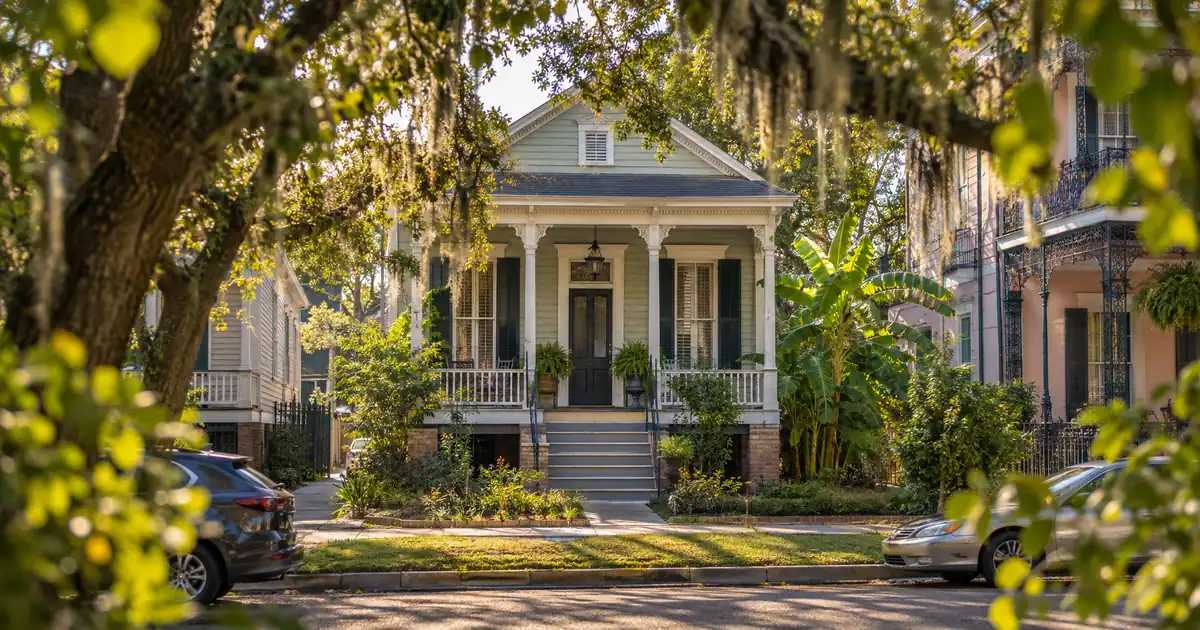
The standard objection to cash-out refinancing in New Orleans is that the market gives you nothing to refinance into. Redfin puts the citywide median sale price at $340K, down 1.5% year over year. Appreciation is not carrying anyone. That objection is fair, and it changes the question. In this city, equity gets earned through purchase basis, rehab, and rent, then measured by an appraiser. Lendmire, a DSCR-focused mortgage broker, arranges these refinances for investors who already own the property. This report tests where the math holds and where it doesn’t.
DSCR Cash-Out Calculator
Run the cash-out numbers in New Orleans, LA
Rate source: Freddie Mac 30-yr average via FRED® — Federal Reserve Bank of St. Louis · effective Sep 24, 2026
Prefilled with starting assumptions — enter your property’s value, balance, taxes, and insurance for a more accurate picture.
Program parameters update from Lendmire’s centralized guideline source. Taxes and insurance are editable estimates.
As of Sep 24, 2026 · General Freddie Mac market benchmark, not a Lendmire loan offer. Property value, balance, taxes, and insurance are editable estimates. Maximum loan-to-value varies by lender, program, property type, and seasoning. Not a Loan Estimate, approval, or commitment to lend. Program availability and eligibility are subject to lender guidelines, credit approval, property review, and underwriting.
The Short Version:
A DSCR cash-out refinance on a New Orleans, Louisiana rental is underwritten primarily on the property’s rental income measured against its full monthly obligation, so the process runs from seasoning and appraisal through a coverage review, with the lender, not the investor’s paystubs, deciding fit.
- Redfin shows a $340K citywide median, so equity must come from basis, rehab, or rent, not market lift.
- Small doubles and 2-4 unit buildings clear coverage more easily than single-family at the same price.
- Cash-out is capped at 75% LTV and needs about six months of ownership from title recording.
- Appraisal risk varies by ZIP: some Orleans ZIPs are falling while others are rising. Terms vary by lender guidelines, property type, leverage, credit profile, and full file review.
New Orleans Market Snapshot
A quick read on the New Orleans investor landscape — figures come from the cited sources below. Confirm current property-level numbers before underwriting.
| Metric | Detail |
|---|---|
| Typical rents | $1,150 (Ark7) |
| Population | 362,701 population (Census Reporter (ACS 2024 1-yr)) |
| Employment | 5,000+ jobs (GNO, Inc. Advanced Manufacturing) |
Flat Prices, Real Equity: Where the Cash Comes From
Citywide appreciation is absent, so equity extraction here depends on what the investor did after closing. Redfin’s citywide data shows a $340K median over three months, $187 per square foot (down 2.9%), and homes selling about 4% below list. Days on market improved to 65 from 74 a year earlier. Liquidity is getting better while prices drift lower. That helps appraisers find comps, but it doesn’t inflate values.
The price sources also disagree, and the gap matters. Zillow reports a typical home value of $243,781, down 1.9%. Propcash explains that sold-price medians and Zillow’s modeled index measure different things and shouldn’t be averaged. It adds that the Zillow index is pulled down by lower-value homes in New Orleans East and Gentilly. Redfin’s $340K is the canonical figure used throughout this report. The Zillow number is a lower read on a different methodology.
The practical takeaway: an investor whose property sits in the lower-value tier should expect an appraisal nearer the modeled figures than the headline medians. Size the cash-out to conservative comps.
The 75% Ceiling and the Six-Month Clock
Cash-out on an investment property is capped at 75% LTV, and most files need about six months of ownership measured from title recording. The minimum coverage benchmark is 1.00x, meaning rent used for lender review against full PITIA. Credit tiers typically run from a 620 floor up through 660, 680, and 700, with reserves generally around six months of PITIA. These are guideline ranges across a wholesale lender network, not commitments, and exact eligibility depends on lender guidelines, credit profile, reserves, and property review.
Two features deserve attention.
First, the 75% ceiling is a hard stop on refinances. Purchase leverage runs higher, but cash-out does not borrow that number. If an appraisal lands soft, the cash-out shrinks immediately. Equity available is a function of rent used for lender review, PITIA, reserves, and the ceiling, so it is never a guaranteed figure. Standard programs go up to $3,000,000, with smaller balances routed through select lenders in the network.
Second, a 1.00x baseline is common because rent covers the payment at that level. Some lenders review lower-ratio scenarios, but those typically need lower leverage, stronger compensating factors, or different pricing. For the mechanics, see Lendmire’s primer on DSCR loans and the guide “The Refi Options”. Investors holding title in an LLC can generally proceed, subject to lender program eligibility. Louisiana specifics live on the Louisiana DSCR investor loans page.
Which Submarkets Actually Pencil?
Rent varies far less across New Orleans than price does, which is the whole story. The lower-basis submarkets clear coverage on a smaller loan. The catch is a thinner comp base and slower sales.
Algiers. Redfin shows a $208K median, down 9.57% year over year, with 75 days on market. Ark7, an investment-platform blog and a weak source, lists Old Aurora, an Algiers neighborhood, at a $210,000 median sale price and a $1,150 median rent. Treat both as directional. Gross yield in that band runs roughly a point above the citywide figure, and that gap decides whether a single-family rental reaches 1.00x. The falling price trend is the risk: an investor seasoned into a declining ZIP may see the appraisal undercut the rehab thesis.
New Orleans East. Redfin’s neighborhood page shows a $180K median, up 1.9%, with 88 days on market. It is the lowest basis in this report and the slowest to sell. The tenant story is NASA’s Michoud Assembly Facility, covered below. Coverage looks best here on paper. Comp depth is the constraint.
Mid-City and Bayou St. John. Redfin puts the average house price at $295K, down 6.3%, with about 72 days to sell. The stock is a mix of shotguns and doubles. The neighborhood sits next to the downtown medical district, so demand from clinicians and students is the case for holding. The price decline is the case for caution. It’s a genuine toss-up: strong tenant proximity, soft valuation trend.
Gentilly. Lower prices and a suburban feel, with the University of New Orleans, Dillard, and Southern University at New Orleans nearby. Neighborhood-level rent data is thin, so underwrite from an appraiser’s rent schedule rather than from listings.
Bywater and Marigny. Zillow puts the average home value at $375,589, up 7.5%. Other aggregators show materially higher medians, so the estimates conflict. The upside is real appreciation and small apartment buildings. The downside is a higher basis, which lowers coverage at 75% LTV. Exact terms depend on the lender’s guidelines, property type, leverage, and a full review of the borrower’s file.
Skip Uptown (For Yield, Anyway)
Uptown is a high-basis, lower-yield submarket. Per Propcash’s read of Zillow data, only two Orleans ZIP codes sit above $500,000: 70115 and Lakeview’s 70124. Tulane, Loyola, and Audubon Park supply tenants, and the tenants pay. But 75% of a very high value against typical rents pushes coverage below the baseline.
Uptown makes sense for an investor who wants low-volatility appraisal support and can accept a sub-1.00 file or a lower-leverage cash-out. It rarely makes sense for coverage.
Run the Numbers: Single-Family Versus a Double
Coverage math in New Orleans favors small multi-unit buildings, and the arithmetic is not close. The inputs below are modeled assumptions, not sourced market data, and coverage figures include taxes and insurance.
Run the numbers on a single-family house at the citywide median of $340K. RentCafe reports an average 3-bedroom rent of $1,641 (its data covers buildings with 50+ units, so single-family rents may differ). At 75% LTV with full PITIA, coverage lands near 0.8x. Not close to 1.00x. Every figure here varies by lender and program — guidelines, property type, leverage, and credit profile all apply.
Now an Algiers-band single-family at $208K and a $1,150 modeled rent. Coverage improves to the low-0.9s, still short of the baseline. Cheap basis helps. It doesn’t fully solve it.
Now consider a double appraised at $300K, with two units at a modeled $1,150 each. At 75% LTV, coverage runs about 1.3x. Two rent streams against one mortgage is the mechanism. It isn’t magic, and it depends on the appraisal supporting a $300K value on a small older building. Final terms depend on lender guidelines, property type, leverage, and the borrower’s complete credit picture.
When a scenario falls below 1.00x on long-term rent alone, several structures may apply: a sub-1.00 program, interest-only restructuring, or a lower-leverage cash-out. Each is reviewed subject to lender guidelines, credit approval, and property review. None is a promise.
Multi-unit inventory exists in volume. The listing screener fourplex.io reports a $349,000 median price across New Orleans multi-unit listings, only about $9K above Redfin’s citywide median. That is a directional listing figure, not a transaction median, and stated rents on those listings are unverified. The direction still matters: multi-unit income against a near-median price is what lifts coverage above single-family. Verify with rent rolls or an appraiser’s rent schedule.
Who Is Actually Renting These Buildings?
Tenant demand rests on hospitals, a university, and an aerospace plant, and none of them depends on visitors. U.S. Census Bureau data via Census Reporter shows 362,701 residents in the city, with 43.3% holding a bachelor’s degree or higher. RentCafe counts 76,077 renter households, about 49% of the total. That is a large renter pool for a city this size.
Healthcare. LCMC Health lists about 9,368 staff and operates Children’s Hospital New Orleans, Touro, University Medical Center, and New Orleans East Hospital. Ochsner Health has roughly 40,000 employees system-wide (a multi-state figure), and its flagship sits in Jefferson Parish, just outside the city line. The downtown medical district near Canal and Tulane Avenue concentrates clinicians, residents, and students within reach of Mid-City.
Aerospace. NASA says about 3,000 people work on-site at Michoud in New Orleans East, including civil servants, contractors, and tenants. GNO, Inc. puts the workforce at roughly 3,500 to 4,200. Depending on the source, that is 3,000 to 4,200 workers. It’s an aerospace tenant base that Baton Rouge, Lafayette, and Shreveport lack.
Education. Tulane University runs an 110-acre uptown campus plus a downtown medical campus. U.S. News reports 6,839 undergraduates. Loyola and Xavier add thousands more students within a few miles, and the schools cross-enroll through a consortium agreement.
Working DSCR brokers see a recurring pattern in older, thinly-comped urban markets: the file that clears coverage on paper stalls at appraisal, because the appraiser has only two or three usable comps for a building type. The investors who fare better bring an appraiser-ready rent schedule, documented rehab, and a range of comparable doubles before the order goes in. In a city where 28% of rentals were built in 1939 or earlier, per Point2Homes, that preparation carries real weight.
Rents Are Flat. Underwrite Them That Way.
Rent growth is roughly flat, and two sources disagree on the level. RentCafe shows an average rent of $1,387 (down 1.67% year over year), with 2-bedrooms at $1,472. Apartment List shows a $1,220 median, with 2-bedrooms at $1,270. The difference reflects methodology. RentCafe’s data covers larger buildings, and Apartment List reports a median rather than an average.
Underwrite to the lower number. Two-bedroom units make up the largest share of rentals, at 39% of the stock, so that is the rent to test against a double.
Vacancy is the missing number. No reliable rental-vacancy source turned up in the research. One data point: Zillow’s rent research lists New Orleans among the markets with the largest monthly drops in the share of rentals offering concessions, a 2.3 percentage-point decline. That is a one-month reading and not a vacancy rate. Build a vacancy allowance into any coverage model.
The Appraisal Is the Whole Game
Cash-out proceeds depend on the appraised value at the time of the refinance, so underwrite by ZIP, not by city. Propcash’s read of Zillow ZIP-level data shows 70125 (Broadmoor and Gert Town) down 6.3%, while 70116 and 70129 are each up 5.1%. Same city. Opposite trends.
The median itself is contested. Propcash cites the New Orleans Metropolitan Association of Realtors at a $354,000 median for Orleans Parish, against an average of $493,953, a spread that shows how much high-end stock pulls the average. A cash-out sized to the average is a cash-out sized to a different market.
DSCR vs. conventional financing
Two common ways to finance an investment property in New Orleans, LA. They qualify you differently — here’s how investors weigh them.
Why investors choose it
- Qualifies on the property’s rental income — no personal tax returns, W-2s, or pay stubs needed to document income.
- No personal debt-to-income ceiling to clear, so existing mortgages and obligations don’t cap your borrowing the same way.
- Can be closed in an LLC, keeping the property inside a business entity.
- Built for scaling — not held to the limit on number of financed properties that conventional financing applies.
- Underwriting centers on the deal: generally qualifies when the rent covers the payment, a 1.00x coverage ratio being a common baseline (confirmed in underwriting).
- Designed specifically for investment property, including long-term and, where the program allows, short-term rentals.
Where it’s strong
- Often the lowest ongoing financing cost for a buyer who fully qualifies on personal income — a fit for a first property or a cost-first purchase.
Trade-offs for investors
- Requires full personal income documentation and must fit within a debt-to-income limit — salary, existing debts, and other mortgages all count.
- Typically held in your personal name rather than a business entity.
- Caps how many financed properties you can carry, which can become a ceiling as a portfolio grows.
- Evaluates you as a borrower as much as the property, which usually means more paperwork.
How investors usually choose: a first or single property often optimizes for the lowest financing cost; portfolio builders often optimize for leverage, vesting in an LLC, and scaling past conventional caps. The right answer depends on your goals, the property, and current guidelines — both paths run through select lenders in Lendmire’s wholesale network, with eligibility and terms confirmed in underwriting.
There is also a regional caveat. The Data Center reports a 970,849 metro population, a 3.6% decrease from 2020 and about 85% of the 2000 level. Demand anchors are real. Population momentum isn’t.
Using the Proceeds
Investors typically redeploy cash-out proceeds into the next acquisition, and in this market that usually means a lower-basis duplex or a rehab. The loop only works if the refinance leaves the original property above 1.00x, or on a structure a lender will review. A refinance that pulls too much cash and pushes coverage below the baseline can leave the investor with a file that needs a different program.
Investors weighing program types can compare how conventional and DSCR financing differ on investor loans and how refinance options fit their plans. Investors ready to test a specific property can get a rental-income loan quote or call 828-256-2183. Verify current local rental rules, taxes, and insurance with qualified local professionals before sizing any deal.
Frequently Asked Questions
How do you qualify for a DSCR loan in New Orleans?
Qualification centers on the property’s rent against its full PITIA, with 1.00x as the common baseline, plus credit and reserves. Credit tiers typically start at a 620 floor, and reserves are generally around six months of PITIA. Lenders review the appraisal, rent schedule, and property condition. Older doubles and shotguns often draw closer scrutiny on condition. Final eligibility is subject to lender guidelines.
What are the requirements for an investment property loan in New Orleans, Louisiana?
For a cash-out, expect a 75% LTV ceiling and about six months of ownership from title recording. Manufactured homes, log homes, and barndominiums fall outside these DSCR programs. Loan sizes reach $3,000,000 on standard programs, with smaller balances routed through select lenders. Requirements vary by borrower, property, and lender. These specifics are subject to lender guidelines and a full review of property, leverage, and credit.
Does a flat New Orleans market limit how much cash I can take out?
Yes, in a practical sense. With Redfin showing a $340K median and prices roughly flat, there is no citywide appreciation to lift the appraisal. The 75% ceiling applies to whatever value the appraiser supports. Purchase discount, rehab, and rent growth are what move the number.
Is a double or a single-family house the better cash-out candidate here?
On modeled math, the double. Two rent streams against one mortgage push coverage well above what a single-family house at the citywide median produces. The tradeoff is that small multi-unit stock is older, and appraisers may have fewer comps to work with.
For current guidelines and terms, see Lendmire’s DSCR loan programs page.
About Lendmire
Lendmire is a DSCR-focused mortgage brokerage, NMLS# 2371349, placing investor loans across 41 markets, including Washington, D.C. DSCR eligibility is generally reviewed by the lender on a property’s rental income rather than personal income documentation, which fits LLC-held rentals, self-employed investors, and portfolios scaling past conventional financed-property limits. The firm has been recognized by Scotsman Guide as a 2026 Top Workplace and recognized by Scotsman Guide in 2025.
Get Started
Ready to find the right loan for you?
In about 30 seconds you can review financing options available for your investment property. No commitment required.
Informational only. Not a Loan Estimate, approval, or commitment to lend. Program availability and eligibility are subject to lender guidelines, credit approval, property review, and underwriting.
References
1. Redfin, New Orleans housing market
2. Ark7
3. Census Reporter (ACS 2024 1-yr)
4. GNO, Inc., Advanced Manufacturing
5. Zillow
6. Propcash
7. Redfin
9. Redfin
10. Zillow
11. RentCafe, New Orleans average rent
12. Census Reporter, New Orleans profile
13. LCMC Health
14. Ochsner Health
15. NASA, Michoud Assembly Facility
17. Point2Homes
18. Apartment List
20. The Data Center, Who Lives in New Orleans Now
21. recognized by Scotsman Guide as a 2026 Top Workplace
22. recognized by Scotsman Guide in 2025
This article is part of Lendmire’s investment property cash-out refinance program — full qualification details, guidelines, and scenarios live on the program page.
Related reading: Cash Out Refinance Investment Property in New Orleans · DSCR Loans New Orleans: Investor Financing for French Quarter, Marigny, Garden District, Uptown & Real Estate Investors · DSCR Cash Out Refinance Louisiana
Guides: Investment Property Cash-Out Refinance in New Orleans, LA · Investment Property Cash-Out Refinance in Louisiana
Brandon Miller
Founder & CEO, Mortgage Loan Originator, Lendmire LLC
- Mortgage Loan Originator · NMLS# 1129696 · Verify on NMLS Consumer Access
- North Carolina Real Estate Broker · License# 343312 · Verify on NCREC
- North Carolina Insurance Producer · License# 19053198 · Property, Casualty, Life, Health · Verify on NAIC SBS
- Lendmire LLC · Firm NMLS# 2371349 · Verify firm licensure
Compliance and disclosures. Lendmire (NMLS# 2371349) is a licensed mortgage broker and is not a direct lender, depository institution, financial advisor, or tax professional. Content in this article is general market analysis and educational information — not financial, legal, or tax advice for any specific situation. Lendmire does not guarantee loan approval; every transaction is subject to underwriting by the funding lender. Mortgage pricing and loan program guidelines are subject to change at any time without notice and vary by borrower characteristics, property type, and state regulations. Lendmire complies with Equal Housing Opportunity. Licensure verification: NMLS Consumer Access.