
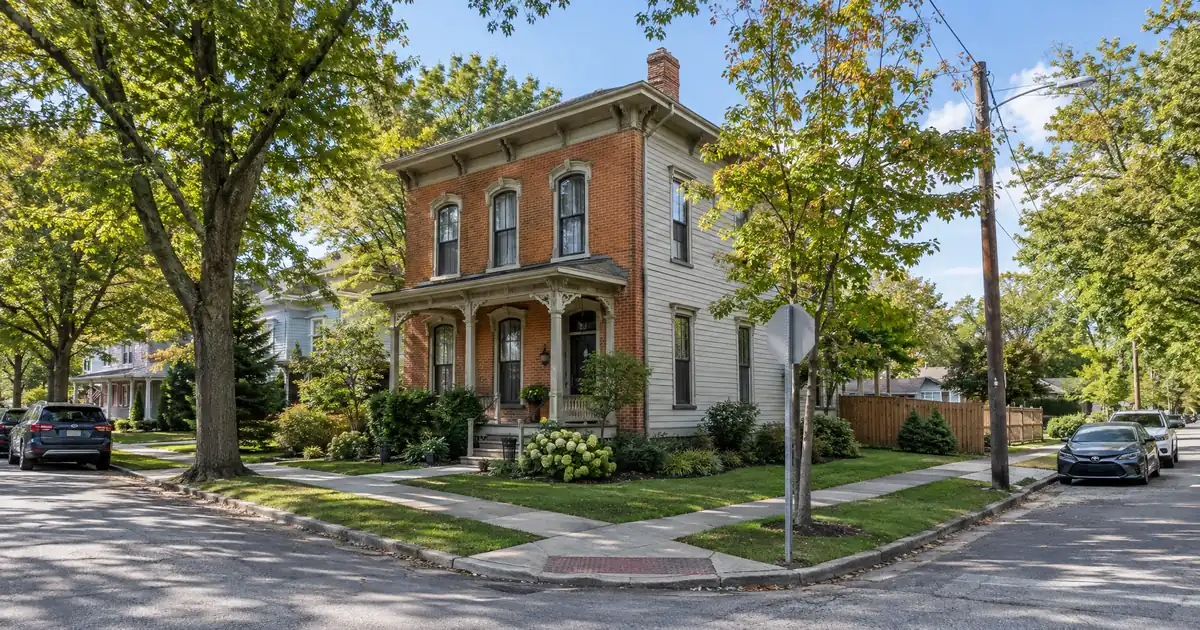
Noblesville’s median sale price reached $417K, up 8.4% year over year, according to Redfin. Over the same stretch, Apartment List puts median rent at $1,373, up just 0.4%. That gap is the central fact for anyone planning a DSCR cash out refinance in Noblesville, Indiana. Owners are sitting on rising equity, but the rent that has to cover the new loan is barely moving. Pulling capital out works here, but the property has to carry its own weight on rental coverage.
DSCR Cash-Out Calculator
Run the cash-out numbers in Noblesville, IN
Rate source: Freddie Mac 30-yr average via FRED® — Federal Reserve Bank of St. Louis · effective Sep 24, 2026
Prefilled with starting assumptions — enter your property’s value, balance, taxes, and insurance for a more accurate picture.
Program parameters update from Lendmire’s centralized guideline source. Taxes and insurance are editable estimates.
As of Sep 24, 2026 · General Freddie Mac market benchmark, not a Lendmire loan offer. Property value, balance, taxes, and insurance are editable estimates. Maximum loan-to-value varies by lender, program, property type, and seasoning. Not a Loan Estimate, approval, or commitment to lend. Program availability and eligibility are subject to lender guidelines, credit approval, property review, and underwriting.
The Short Version:
A DSCR cash-out refinance on a Noblesville, Indiana rental is underwritten primarily on the property’s rental income measured against its full monthly obligation, so the loan hinges on rent-to-debt coverage and appraised value rather than personal-income documentation, with proceeds limited by a 75% loan-to-value ceiling and subject to lender guidelines.
- Redfin shows a $417K median sale price, up 8.4%, so equity is building.
- Apartment List shows rent up only 0.4%, so coverage tightens on pricier homes.
- Cash-out typically needs about six months of ownership, measured from title recording.
- Downtown rentals skew small: RentCafe finds 67% sit in complexes under 50 units.
- A second rental unit adds far more income than a bedroom upgrade.
Noblesville Market Snapshot
A quick read on the Noblesville investor landscape — figures come from the cited sources below. Confirm current property-level numbers before underwriting.
| Metric | Detail |
|---|---|
| Home prices | $405,000 median (Homes.com, Noblesville) |
Appreciation Is Running Ahead of Rent
Noblesville is an appreciation-led market, not a cash-flow-led one. Prices are climbing at roughly twenty times the pace of rents. That is good for equity extraction and hard on the coverage number.
Redfin’s data for the three months ending in June shows 421 homes sold, up from 318 a year earlier. Average time to sale stretched to 18 days from 10. Comps are deep and active, which helps a cash-out appraisal. One detail cuts the other way: median price per square foot was $165, down 4.1%. That suggests the headline median is being pulled up by larger and newer homes rather than like-for-like appreciation. An older, smaller rental may not see an appraiser credit the full 8.4%.
Size matters too. World Population Review estimates the city at 77,376 residents, up 10.21% from the 70,206 counted at the last census. A growing base supports tenant depth. Per RentCafe, though, only 28% of households rent (7,252 renter-occupied versus 19,102 owner-occupied). Rental stock is a minority product here, which supports small landlords but also means the rent data is thin and mostly drawn from larger apartment buildings.
Different rent sources also disagree. Apartment List says $1,373. RentCafe reports an average of $1,570, but only for buildings with 50 or more units. Zumper shows an all-property median of $1,799. The spread comes from methodology: apartments only versus all property types. An investor’s own rent comps will outweigh any of these averages.
What Six Months of Seasoning and a 75% Cap Do to the Plan
A cash-out refinance on an investment property is capped at a 75% loan-to-value ceiling, and that is a hard limit. Seasoning typically runs about six months of ownership, measured from title recording. Proceeds depend on appraised value, rent used for lender review, reserves, and that ceiling, so no cash figure is guaranteed.
The mechanics matter more in a market like this one. The new loan must pay off the existing balance and still fit inside 75% of the appraised value. If an investor’s current balance already sits near 70% of value, the cash-out is nearly nil. If it sits at 50%, there is real room. Strong appreciation helps because it moves the balance-to-value ratio in the investor’s favor without any paydown.
The other test is coverage. The standard baseline for a DSCR program is 1.00, meaning rent used for lender review covers the full monthly obligation of principal, interest, taxes, insurance, and any HOA dues. Many programs are built around that benchmark. Some lenders review lower scenarios, but those usually mean lower leverage, different pricing, or stronger compensating factors. Beyond the ratio, typical guidelines include credit tiers starting at a 620 floor and stepping up through 660, 680, and 700. Reserves generally run about six months of the full obligation, rising to about nine months above $1,500,000. Loan amounts on standard programs reach up to $3,000,000, with smaller balances routed through select lenders. All of this is subject to lender guidelines, and entity-titled loans (LLCs, for example) remain subject to lender program eligibility.
For the full mechanics, pulling equity out covers the structure in more depth, and Lendmire’s primer on DSCR loans explains how the ratio is built.
Run the Numbers: Three Property Profiles
The coverage math in Noblesville splits sharply by price point. The figures below are modeled assumptions, not sourced market data. Each ratio is rent divided by the full obligation on a 30-year structure, including taxes and insurance, at the 75% LTV ceiling. Rents come from the sourced averages above. Every figure here varies by lender and program — guidelines, property type, leverage, and credit profile all apply.
The median home. Take a single-family rental valued near Redfin’s $417K median and rented at Zumper’s $1,799 all-property median. Modeled coverage lands around 0.7. That is well under the 1.00 baseline. Investors in this position typically look at options a lender would review: a program that accepts sub-1.00 coverage, an interest-only structure, or a lower loan-to-value request to reduce the obligation. Qualification would remain subject to lender guidelines, credit approval, and property review.
The $250K–$300K lane. Red Door Rents, a local property manager, flags this range as the one where investor demand holds. That is a manager’s opinion, not market data, but the math supports it. Picture a home valued at $275,000 and rented at $1,799. Modeled coverage runs roughly 1.05 to 1.10. Swap in the apartment-heavy $1,373 rent and the ratio falls to around 0.8. Same house, very different answer. The rent assumption does the work, which is why a signed lease or a well-supported local comp matters more than a citywide average.
The duplex. Multi-unit stock is where the numbers clear most comfortably. RentCafe’s bedroom-level averages are $1,378 for a one-bedroom, $1,623 for a two-bedroom, and $1,879 for a three-bedroom. Moving from a two-bedroom to a three adds only about $256 a month. A second two-bedroom unit adds about $1,623. A duplex of two-bedroom units would gross about $3,246 a month at those averages.
Run the numbers on a hypothetical duplex valued at $400,000 (a modeled value, since no sourced duplex price range exists for Noblesville). At the averages, coverage runs about 1.3. Cut the rent 15%, since RentCafe’s figures come from newer, larger buildings and older small units likely rent below them, and coverage falls to about 1.1. The property still clears the baseline, but with a thinner cushion.
Working DSCR brokers see a recurring pattern in appreciation-led suburbs like this one: the equity looks generous on paper, and then coverage becomes the binding constraint. Investors who bought a single-family rental at an earlier price often find that the new loan amount is limited less by the 75% cap than by what the rent supports. The files that move smoothly tend to be small multifamily or lower-priced single-family homes with a documented lease at or near market.
Where Coverage Holds: Downtown, Exit 210, and the New-Build Fringe
Of the submarkets with any sourced basis, downtown Noblesville has the strongest case for small-balance rentals. Neighborhood-level rent and price figures were not available, so this section stays qualitative.
Downtown, Old Town, and the riverfront. RentCafe’s downtown page shows 31% of homes renter-occupied. None of the downtown apartments sit in 50-plus-unit buildings. About 67% are in complexes under 50 units, and 22% are single-family rentals. That is the best evidence in the research that small multifamily and scattered-site rentals cluster here. New downtown apartment projects exist, including East Bank and The Levinson, with another called The Granary announced. They add competition at the higher end, but the older small-building stock sits in a different tier.
Exit 210, Innovation Mile, and the Deer Creek District. The corridor around Exit 210 is the city’s entertainment and innovation hub. Riverview Health Arena at Innovation Mile has 3,400 fixed seats and is home to the Noblesville Boom, the Pacers’ NBA G League affiliate, according to Visit Hamilton County. The city’s Deer Creek District branding covers a 5,000-acre corridor around Ruoff Music Center, a nearly 25,000-seat amphitheater, per Apartments.com. Hotels, restaurants, and housing are part of the mix. Whether this translates into steadier long-term rental demand is inference only. No data confirms it, so treat the corridor as an upside story, not an underwriting input.
Southwest Noblesville. The city’s housing page cites Noble West with 284 apartments and 150 townhomes. That is competing professionally managed supply. A small landlord nearby should underwrite to current rents, not projected increases.
Morse Reservoir and golf communities. These appear on the city’s housing page as housing types. They are likely higher-end for-sale product, and the research found no rental data. Skip them as DSCR targets unless local comps prove otherwise.
The Demand Anchors Underneath the Rents
Employment in Noblesville is anchored by healthcare and a manufacturing base, and that diversity supports long-term lease demand. Riverview Health calls itself the city’s largest employer, with a staff of more than 1,800. It runs a 156-bed hospital in Noblesville, is county-owned, and recently entered a management agreement with Parkview Health, per the City of Noblesville.
Choose Noblesville lists a manufacturing and medical-products cluster. Ambu makes breathing circuits, face masks, and anesthesia products. GE HealthCare handles ultrasound refurbishment. Gaylor Electric does electrical construction, and IDI Composites makes composite molding compounds. OPENLANE also appears on the site-selection page. No headcounts were available for these, and no college is based in the city. Tenant demand here comes from employers rather than students.
The city’s economic development office also cites $1.8 billion in development, 2,400 new jobs, and 11,000 residential units in its pipeline. Those are promotional figures from the city itself, so read them as direction rather than precision.
One more piece of context: a Hamilton County news report describes a stubborn shortage of affordable housing, citing a county housing study that found nearly 19,000 households spending more than 30% of income on housing. That supports tenant depth for lower-priced rentals. Income-restricted units are not market comps, though, and should never be used to underwrite market-rate rent.
What Could Break the Pattern Over the Next 6–24 Months
The current setup, where equity builds quickly on paper while coverage stays tight, depends on a few variables. These are worth watching.
New-build supply. A city newsletter says roughly 2,500 single-family homes and 600 townhome and duplex units are under construction or approved but unbuilt. The city is building more for-sale homes than apartments. That favors tenant scarcity for small rentals. It also means more owner-occupied inventory competing for the same buyers who might otherwise rent. If the townhome and duplex share grows, the thin multi-unit niche could get less scarce.
Rent trend. Apartment List’s 0.4% year-over-year gain is slight, and monthly movement was slightly negative in its latest report. Apartments.com reported a 2.2% annual decline in an older reading. Neither points to a collapse, but together they say rent growth should not be built into an underwriting rent. No reliable vacancy rate was found, so none should be assumed.
DSCR vs. conventional financing
There are two common ways to finance an investment property in Noblesville, IN, and they qualify you differently — here’s how investors weigh them.
Why investors choose it
- Qualifies on the property’s rental income — no personal tax returns, W-2s, or pay stubs needed to document income.
- No personal debt-to-income ceiling to clear, so existing mortgages and obligations don’t cap your borrowing the same way.
- Can be closed in an LLC, keeping the property inside a business entity.
- Built for scaling — not held to the limit on number of financed properties that conventional financing applies.
- Underwriting centers on the deal: generally qualifies when the rent covers the payment, a 1.00x coverage ratio being a common baseline (confirmed in underwriting).
- Designed specifically for investment property, including long-term and, where the program allows, short-term rentals.
Where it’s strong
- Often the lowest ongoing financing cost for a buyer who fully qualifies on personal income — a fit for a first property or a cost-first purchase.
Trade-offs for investors
- Requires full personal income documentation and must fit within a debt-to-income limit — salary, existing debts, and other mortgages all count.
- Typically held in your personal name rather than a business entity.
- Caps how many financed properties you can carry, which can become a ceiling as a portfolio grows.
- Evaluates you as a borrower as much as the property, which usually means more paperwork.
How investors usually choose: a first or single property often optimizes for the lowest financing cost; portfolio builders often optimize for leverage, vesting in an LLC, and scaling past conventional caps. The right answer depends on your goals, the property, and current guidelines — both paths run through select lenders in Lendmire’s wholesale network, with eligibility and terms confirmed in underwriting.
Price momentum. Days on market lengthened from 10 to 18 in Redfin’s data, though sales volume rose. If sales volume cools while time-to-sale keeps stretching, appraisal comps could soften. Falling price per square foot is the leading indicator to watch.
Hospital and arena momentum. The Parkview management agreement and the planned USA Gymnastics Training and Wellness Center at Innovation Mile are both announced developments. Neither is a rental-demand guarantee. They are worth tracking as employment signals.
Investors should also verify current local rental rules, taxes, and insurance with qualified local professionals before committing to a refinance.
Recycling the Proceeds
Cash-out proceeds are most useful when they move into a property that pays for itself. In a market where median-priced homes sit under 1.00 coverage, the logical destination is the lower-priced single-family lane or small multifamily, where the rent-to-debt ratio is stronger. Some investors will look beyond the city for that stock; Lendmire’s Indiana DSCR investor loans page covers the state-level picture.
Two decisions follow from there. First, whether to refinance the existing rental now or wait for more appreciation, which depends on whether the current appraisal would support a worthwhile extraction. Second, whether to hold the new acquisition as a long-term rental or pursue another cash-out cycle later. For a broader view of the choices, see these refinancing options, and for a side-by-side with bank financing, see the guide “Where DSCR and Conventional Diverge”, which compares DSCR loans against conventional loans. Investors with questions can reach the brokerage at 828-256-2183.
The Diligence Step Before You Order an Appraisal
Pull three rent comps for the specific unit type and block, using leases signed in the last few months rather than citywide averages. Then compare them against the monthly obligation the new loan would carry. In Noblesville, where the apartment-heavy averages run well below the all-property median, that single exercise decides whether a refinance is worth pursuing and how much of the 75% ceiling is usable.
Frequently Asked Questions
How do you qualify for a DSCR cash-out refinance in Noblesville, Indiana?
Qualification centers on the property’s rent relative to its full monthly obligation, typically with a 1.00 baseline, along with a credit score (620 is the usual floor), about six months of reserves, and roughly six months of ownership. The loan amount cannot exceed 75% of appraised value. Final eligibility depends on lender guidelines, credit approval, and property review.
What are the requirements for an investment property loan in Noblesville, Indiana?
Most programs ask for a rentable property type, a credit score at or above the lender’s tier, and reserves of about six months of the full obligation. Standard programs reach up to $3,000,000, with smaller balances placed through select lenders. Manufactured homes, log homes, and barndominiums fall outside these programs. Terms vary by borrower, property, and loan scenario.
Why does Noblesville’s median price make coverage harder than the equity suggests?
Prices are up 8.4% while Apartment List shows rent up only 0.4%, so the rent-to-value relationship has compressed. On a home near the $417K median, modeled coverage including taxes and insurance lands well below 1.00. Lower-priced single-family homes and 2–4 unit properties are where the ratio typically recovers.
Do duplexes and small multifamily clear coverage more easily in Noblesville?
Generally yes, because a second unit adds far more rent than a bedroom upgrade. At RentCafe’s two-bedroom average, a duplex grosses about $3,246 a month. Inventory is thin, though, and older small units likely rent below those new-building averages, so investors should use their own comps.
For current guidelines and terms, see Lendmire’s DSCR loan programs page.
About Lendmire
Lendmire (NMLS# 2371349) is a mortgage brokerage focused on DSCR investor financing, helping arrange programs through wholesale and investor-lending channels in 41 markets, including Washington, D.C. DSCR loans are evaluated by the lender on property cash flow rather than personal income, subject to lender guidelines, supporting LLC closings and accommodating investors with four or more financed properties. Lendmire was named a Scotsman Guide Top Mortgage Workplace in both 2025 and 2026.
Get Started
Ready to find the right loan for you?
See your offer in seconds. No credit pull, no obligation.
Informational only. Not a Loan Estimate, approval, or commitment to lend. Program availability and eligibility are subject to lender guidelines, credit approval, property review, and underwriting.
References
1. Redfin, Noblesville Housing Market
2. Apartment List, Noblesville
3. RentCafe, Downtown Noblesville
5. World Population Review, Noblesville
6. Zumper, Noblesville Rent Research
7. Red Door Rents, Noblesville Market Report
8. Visit Hamilton County, Arena at Innovation Mile
9. Visit Hamilton County, Ruoff Music Center
10. Apartments.com, Noblesville
11. Choose Noblesville, Housing
12. City of Noblesville, Newsroom
13. Choose Noblesville, Employers
14. 2025
15. 2026
This article is part of Lendmire’s investment property cash-out refinance program — full qualification details, guidelines, and scenarios live on the program page.
Related reading: Cash Out Refinance Investment Property Noblesville Indiana · Cash Out Refinance Investment Property in Valparaiso, Indiana: Will the Rent Cover a Cash-Out Loan? · DSCR Cash Out Refinance in Crown Point, Indiana: Equity Recycling Near the Hospital Campus
Guides: Investment Property Cash-Out Refinance in Noblesville, IN · Investment Property Cash-Out Refinance in Indiana
Brandon Miller
Founder & CEO, Mortgage Loan Originator, Lendmire LLC
- Mortgage Loan Originator · NMLS# 1129696 · Verify on NMLS Consumer Access
- North Carolina Real Estate Broker · License# 343312 · Verify on NCREC
- North Carolina Insurance Producer · License# 19053198 · Property, Casualty, Life, Health · Verify on NAIC SBS
- Lendmire LLC · Firm NMLS# 2371349 · Verify firm licensure
Required disclosures. Lendmire (NMLS# 2371349) operates as a licensed mortgage broker, not a direct lender or depository. The discussion in this article is general in nature and should not be relied upon as financial, legal, or tax advice — every investment scenario is unique and should be reviewed by a qualified professional. Any loan inquiry is subject to lender underwriting, and this article is not a commitment to lend or a guarantee of approval. Mortgage rates, loan terms, and program guidelines vary by borrower, property, and state, and may change without notice. Equal Housing Opportunity. Verify licensure at NMLS Consumer Access.