
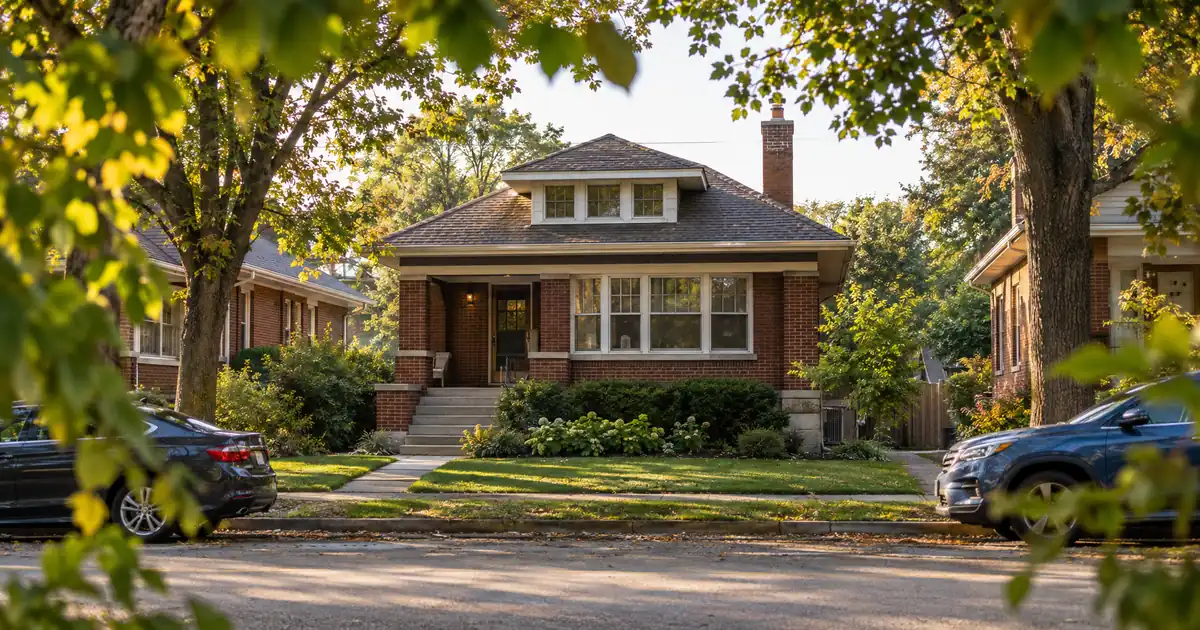
Most investors read Normal as a boom story: an EV plant, a growing university, an insurance giant next door. The cash-out refinance on an investment property here works differently. The median sale price sits at $276,834, up just 2.5% year over year, so the equity you pull usually comes from what you paid, what you fixed, and how many rent checks stack on one deed. Market drift contributes little. A DSCR cash out refinance in Normal, Illinois rewards the investor who underwrites today’s rent and doesn’t count on tomorrow’s appreciation.
DSCR Cash-Out Calculator
Run the cash-out numbers in Normal, IL
Rate source: Freddie Mac 30-yr average via FRED® — Federal Reserve Bank of St. Louis · effective Sep 24, 2026
Prefilled with starting assumptions — enter your property’s value, balance, taxes, and insurance for a more accurate picture.
Program parameters update from Lendmire’s centralized guideline source. Taxes and insurance are editable estimates.
As of Sep 24, 2026 · General Freddie Mac market benchmark, not a Lendmire loan offer. Property value, balance, taxes, and insurance are editable estimates. Maximum loan-to-value varies by lender, program, property type, and seasoning. Not a Loan Estimate, approval, or commitment to lend. Program availability and eligibility are subject to lender guidelines, credit approval, property review, and underwriting.
Key Takeaways:
A DSCR cash-out refinance in Normal, Illinois fits investors holding below-median-basis or multi-unit rentals near Illinois State University and the major employers, because the loan is underwritten primarily on the property’s rental income measured against its full monthly obligation, with proceeds limited by a 75% LTV ceiling, seasoning, and reserves, all subject to lender guidelines.
- Median rent near $1,250 against a roughly $277K median price makes single-family coverage thin.
- Rents fell about 2% year over year while prices rose 2.5%, so underwrite current rent.
- Seasoning runs about 6 months from title recording; the LTV ceiling is 75%.
- Multi-unit rent stacking is the most direct path to clearing 1.00x here.
- Illinois State University’s 21,994 students anchor demand near Uptown.
Lendmire (NMLS# 2371349) works with investors buying or refinancing in Normal, Illinois, helping place DSCR financing across 41 markets, including Washington, D.C. It operates as a DSCR-focused mortgage broker, so lenders in its network, not Lendmire, review and approve each file.
Normal Market Snapshot
A quick read on the Normal investor landscape — figures come from the cited sources below. Confirm current property-level numbers before underwriting.
| Metric | Detail |
|---|---|
| Recent appreciation | +9.9% (Redfin) |
| University enrollment | 21,994 total (Illinois State University News) |
| Population | 132,000 twin cities residents (Illinois State University News) |
| Vacancy | 2% in 2021 (WGLT) |
Why the Boom Story Misleads Cash-Out Math
Normal’s demand is real, but it doesn’t produce fast equity. Prices are up modestly, rents are flat to slightly down, and Zillow’s home value index sits near $267,616, down 0.2%. The two sources disagree on direction, which tells you the trend is roughly flat.
Next door, Bloomington is up 9.9% on price. Normal’s slower climb means a rental bought at a fair price and left alone won’t generate much refinanceable equity on its own. The equity comes from the entry discount or from rehab. Appreciation is a bonus, not the plan.
The demand side is durable. The Town of Normal, home to roughly 53,000 people per Census Bureau QuickFacts, lists Carle Health, Rivian, Illinois State University, Unit 5 and Bridgestone among its largest employers. The metro’s biggest employer, per VisitBN, is State Farm at 14,436 workers, followed by Illinois State at 3,940. That mix supports long-term tenancy, which is what a lender wants to see behind a cash-out. It doesn’t make the coverage number work by itself.
Run the Coverage Math First
The single-family median doesn’t clear 1.00x, and investors should accept that before shopping. Monthly rent runs about 0.45% of the median price. At 75% LTV, counting full taxes and insurance in the monthly obligation, that produces coverage around 0.6x. A 1.00x baseline is common because it means rent covers the payment. Some programs review lower ratios, but they usually want lower leverage, stronger credit, or different pricing. Eligibility depends on lender guidelines, reserves, and property review.
Multi-unit changes the picture. Run the numbers on a modeled fourplex, with two one-bedrooms and two two-bedrooms at older-stock asking rents. The listing rents on Apartments.com run $840 to $1,000 for one-bedrooms. That rent roll lands around $3,900 to $4,200 a month. These are modeled assumptions, not a sourced market median, and they’re asking rents.
That rent roll is about three times the single-unit median. If the building’s value lands near twice the city median, coverage moves to roughly 1.0x including taxes and insurance. At two and a half times the median, it slips back into the low 0.8s. The stacking helps only if multi-unit pricing hasn’t climbed to erase it. Redfin has shown only a handful of multi-family listings at a time, so test pricing before assuming the math holds.
| Property type | Rent-to-value read | Coverage read |
|---|---|---|
| Median single-family | About 0.45% monthly | Low 0.6x range |
| Older small multifamily | Stacked rents, one loan | Near 1.0x at ~2x median value |
| Per-bedroom student house | Depends on lease structure | Varies by rent schedule |
DSCR files in markets like this one typically look the same on paper: a modest purchase basis, a rehab that lifts rent toward the renovated floor, and a coverage ratio that lands just above or just below 1.00x depending on the tax and insurance lines. The stronger files usually carry a current lease or rent schedule, a realistic vacancy assumption and reserves that were verified before the application, not after. Files that assume rent growth from a few years back tend to need restructuring once the appraisal rent comes in.
If the number lands under 1.00x, the structures a lender may review include a lower-leverage cash-out, an interest-only option where the program offers it, or a sub-1.00 program. Each comes with tradeoffs in leverage, pricing and cash to close. Approval stays subject to credit review and lender guidelines. The question to ask first is whether the property should be refinanced at all. A file that only works at sub-1.00 in every submarket you own is telling you something about the submarket.
Where Equity Actually Hides
Uptown Normal and the ISU fringe carry the most dependable tenant base. Apartments.com puts Uptown’s average rent at $1,229, with campus-adjacent streets lined with apartment buildings. Per-bedroom pricing shows up in student listings, around $500 to $600 a bedroom. That can stack income on a single house, but it adds lease-turnover risk, and appraisers may not credit per-bedroom rents the way an investor does. Underwrite the lower of the two.
Downtown Normal is the lowest-priced entry point in the research. Redfin shows a median near $188K, down 6.3%, though the sample is thin and the data is stale. Cheaper basis means better rent-to-value, but it also means a cash-out appraisal built on few comps. That’s a genuine toss-up. The basis advantage is real, yet a thin comp set can cap the appraised value you need for proceeds.
Central Normal, including Pleasant Hills, Parkside and Wintergreen, is where workforce and grad-student rentals meet. Homes.com lists Pleasant Hills townhomes from $175,000 to $290,000, and ForRent shows three-bedroom houses in Normal averaging $1,959. Tenants skew toward grad students, young households, and staff from State Farm, Carle and Rivian.
Bunker Hill and North Normal, near the I-55 corridor, is mostly workforce single-family. The research found no price or rent data there, so treat it as a qualitative fit. Broadway-Fell, near Illinois Wesleyan on the Normal/Bloomington line, is a candidate for older converted units, also without hard numbers.
The Vineyards, Westbrooke and Kelley Glen carry newer, suburban-style stock priced well above the city median. Rent-to-value is likely tighter there. For a DSCR cash-out, those are the properties least likely to clear coverage.
Here’s a contrast worth sizing. Older small-format units rent roughly $620 to $780 below new-build asks. Carden Springs asks $1,620 for a one-bedroom, and older-stock listings sit near the $840 to $1,000 range. That gap is the affordability niche small multifamily serves. Renovated older stock has shown a proven floor near $1,000, as WGLT reported for renovated units at a former student complex. The new-build tier also caps how much a rehabbed unit can charge.
Seasoning, LTV, and Reserves
The cash-out ceiling is 75% LTV, a hard cap that’s lower than the purchase limit. Seasoning runs about 6 months of ownership, measured from title recording. Reserves typically run about 6 months of full PITIA, and more on larger balances. Credit tiers generally start at a 620 floor, with pricing and leverage improving at 660, 680 and 700. Standard programs reach up to $3,000,000, and smaller balances route through select lenders in the network. All of this is guidance that varies by borrower, property and loan scenario, not a commitment to lend.
What matters in Normal is what the seasoning period does to value. Sales volume rose to 155 homes in May from 125 a year earlier, which improves comp depth for a post-rehab appraisal. But with prices growing only about 2.5%, proceeds depend on the appraised after-repair value, not on drift while you wait. Equity available also depends on rent used for lender review, full PITIA and the reserve requirement. It isn’t a guaranteed cash figure, and the cash-out refinance details are worth reading before you pick a target. These specifics are subject to lender guidelines and a full review of property, leverage, and credit.
For LLC-held rentals, title and vesting matter: ownership through an entity is accepted subject to lender program eligibility. If your portfolio is one or two houses held personally and your traditional employment income is strong, conventional financing may carry a lower cost and be simpler. The key differences tip toward DSCR once you’re scaling, self-employed, or entity-held. For a refresher on the mechanics, see the guide “What Is a DSCR Loan” and the broader investor refinance options.
What do you do with the proceeds? Redeploying into another below-median Normal rental or small multifamily, where coverage still clears, is a straightforward case. Moving the money into a market where the math doesn’t pencil at current pricing deserves a stress test first. Lendmire’s Illinois DSCR platform covers the state-level options, and investors can reach the team at 828-256-2183 to sort out which structure fits.
What Changes Over the Next 6-24 Months?
Three indicators will move the cash-out math more than any rate headline.
Rivian’s ramp. The plant’s paint-shop upgrades raised capacity to 215,000 units annually, and a second shift is planned. If hiring follows, it pulls on the same workforce housing this article is about. If it stalls, the east side loses its marginal tenant. Rivian no longer shares its Normal headcount, so investors are working with less visibility than the employer tables suggest.
Vacancy drift. Local operators told WGLT occupancy has held near 95% for over a year, down from 99% at the pandemic peak. That’s a normalized market, not an oversupplied one. Underwrite a 5% to 8% vacancy factor instead of the near-zero of the peak years, and expect appraisers to do the same.
Rent growth. McLean County rent per square foot is up 46% since 2019, and Zumper shows the last year slightly negative. Those two facts together argue against pro formas with aggressive rent bumps. New supply is thin, which protects existing small rentals, but the run-up already happened.
The stronger play might be buying small multifamily slightly under market and refinancing after stabilization. An investor betting on appreciation in the ISU fringe could argue the other way. Both can work. Only one depends on a trend the data doesn’t currently show.
Frequently Asked Questions
How do you qualify for a DSCR loan in Normal, Illinois?
Qualification centers on the property’s rent compared against its full monthly obligation, including taxes and insurance. A 1.00x coverage ratio is the common baseline, though lenders may review lower scenarios with compensating factors. Credit, reserves and property review also matter, all subject to lender guidelines.
What are the requirements for an investment property loan in Normal, Illinois?
Expect a minimum credit score floor near 620, about 6 months of reserves and a property that’s a standard rental type. Manufactured homes, log homes and barndominiums fall outside these programs. For cash-out, the property also needs about 6 months of seasoning and a 75% LTV ceiling. Terms vary by lender guidelines, property type, leverage, credit profile, and full file review.
DSCR vs. conventional financing
Two common ways to finance an investment property in Normal, IL. They qualify you differently — here’s how investors weigh them.
Why investors choose it
- Qualifies on the property’s rental income — no personal tax returns, W-2s, or pay stubs needed to document income.
- No personal debt-to-income ceiling to clear, so existing mortgages and obligations don’t cap your borrowing the same way.
- Can be closed in an LLC, keeping the property inside a business entity.
- Built for scaling — not held to the limit on number of financed properties that conventional financing applies.
- Underwriting centers on the deal: generally qualifies when the rent covers the payment, a 1.00x coverage ratio being a common baseline (confirmed in underwriting).
- Designed specifically for investment property, including long-term and, where the program allows, short-term rentals.
Where it’s strong
- Often the lowest ongoing financing cost for a buyer who fully qualifies on personal income — a fit for a first property or a cost-first purchase.
Trade-offs for investors
- Requires full personal income documentation and must fit within a debt-to-income limit — salary, existing debts, and other mortgages all count.
- Typically held in your personal name rather than a business entity.
- Caps how many financed properties you can carry, which can become a ceiling as a portfolio grows.
- Evaluates you as a borrower as much as the property, which usually means more paperwork.
How investors usually choose: a first or single property often optimizes for the lowest financing cost; portfolio builders often optimize for leverage, vesting in an LLC, and scaling past conventional caps. The right answer depends on your goals, the property, and current guidelines — both paths run through select lenders in Lendmire’s wholesale network, with eligibility and terms confirmed in underwriting.
How may credit score affect DSCR terms for a Normal rental property?
Pricing and available terms vary by lender, borrower profile, property type, and full underwriting review. Lendmire arranges DSCR investor loans, and stronger credit tiers may support higher leverage or better pricing on the file.
Can per-bedroom student rents near ISU support a cash-out?
They can help, but the lender and appraiser decide how much of the stacked income counts. Appraisal rent schedules often come in below what a per-bedroom lease roll suggests. Underwrite the conservative figure and keep lease documentation clean.
Does Rivian or State Farm news affect DSCR cash-out files in Normal?
Only indirectly. The underwriting looks at the property, not the employer, but tenant demand follows the workforce. State Farm announced a voluntary exit program, and Rivian cut customer service and marketing roles while saying manufacturing wasn’t affected. Watch lease renewals more than headlines.
The Blind Spot in Normal
The biggest risk for a DSCR-financed investor here is underwriting the story instead of the rent. Three strong tenant pools make it easy to assume coverage will take care of itself, yet the median rent-to-price math sits well below 1.00x, rents have slipped, and appreciation won’t rescue a thin file. The investors who do well treat a cash-out as a reward for a disciplined purchase basis or a finished rehab. They rarely treat it as a way to buy their way out of a weak deal, and they keep a reserve cushion for the day the anchor employers change course.
About Lendmire
Lendmire, NMLS# 2371349, is a mortgage brokerage focused on investor financing, arranging DSCR loans in 40 states plus Washington, D.C., 41 markets total. Qualification leans on the property’s income instead of personal income documentation, subject to lender guidelines, which suits LLC-held rentals and growing portfolios. The firm has been recognized as a top-ranked workplace in 2026 and a 2025 Scotsman Guide Top Workplace.
Get Started
Ready to find the right loan for you?
In about 30 seconds you can review financing options available for your investment property. No commitment required.
Informational only. Not a Loan Estimate, approval, or commitment to lend. Program availability and eligibility are subject to lender guidelines, credit approval, property review, and underwriting.
References
2. Zumper: Normal rent research
3. Illinois State University News: enrollment growth
4. Bloomington is up 9.9% on price
5. Illinois State University News
6. WGLT reported for renovated units at a former student complex
7. Zillow — Home Values Normal IL
8. Census Reporter: Normal, IL
9. Town of Normal: About Normal
11. Apartments.com — Normal IL
12. Apartments.com puts Uptown’s average rent at $1,229
13. Redfin shows a median near $188K, down 6.3%
14. Pleasant Hills townhomes from $175,000 to $290,000
15. ForRent.com — Normal House
16. Carden Springs asks $1,620 for a one-bedroom
17. Sales volume rose to 155 homes in May from 125 a year earlier
19. 25newsnow.com — Rivian Adds 2nd Shift Produce Electric Vehicles Normal
20. wglt.org — Getting Millions in Tax Breaks Rivian Now Won’t Say How Many People Work in Normal
21. WGLT: Bloomington-Normal housing shortage
22. wglt.org — Wglts Most Read Stories of 2025 Feature State Farm Rivian and a Child Care Center
23. pantagraph.com — Government Politics Article Efd
24. Scotsman Guide — Top Workplaces 2026
25. a 2025 Scotsman Guide Top Workplace
This article is part of Lendmire’s investment property cash-out refinance program — full qualification details, guidelines, and scenarios live on the program page.
Related reading: Luxury Rental DSCR Loans In New Jersey · Jersey Shore Vacation Rental Loans: DSCR Financing In Ocean City, Cape May And Long Beach Island · DSCR Cash-out Refinance In New Jersey: Pulling Equity From A Rental
Guides: Investment Property Cash-Out Refinance in Normal, IL · Investment Property Cash-Out Refinance in Illinois
Brandon Miller
Founder & CEO, Mortgage Loan Originator, Lendmire LLC
- Mortgage Loan Originator · NMLS# 1129696 · Verify on NMLS Consumer Access
- North Carolina Real Estate Broker · License# 343312 · Verify on NCREC
- North Carolina Insurance Producer · License# 19053198 · Property, Casualty, Life, Health · Verify on NAIC SBS
- Lendmire LLC · Firm NMLS# 2371349 · Verify firm licensure
Important disclosures. Lendmire (NMLS# 2371349) is a licensed mortgage brokerage. Lendmire is not a direct lender, depository institution, or financial advisor. All loan inquiries are subject to lender underwriting; this article does not constitute a commitment to lend. Rates, terms, and program guidelines are subject to change without notice and vary by borrower profile, property type, and state. Information in this article is general in nature and is not financial, legal, or tax advice. Equal Housing Opportunity. NMLS Consumer Access: nmlsconsumeraccess.org.