
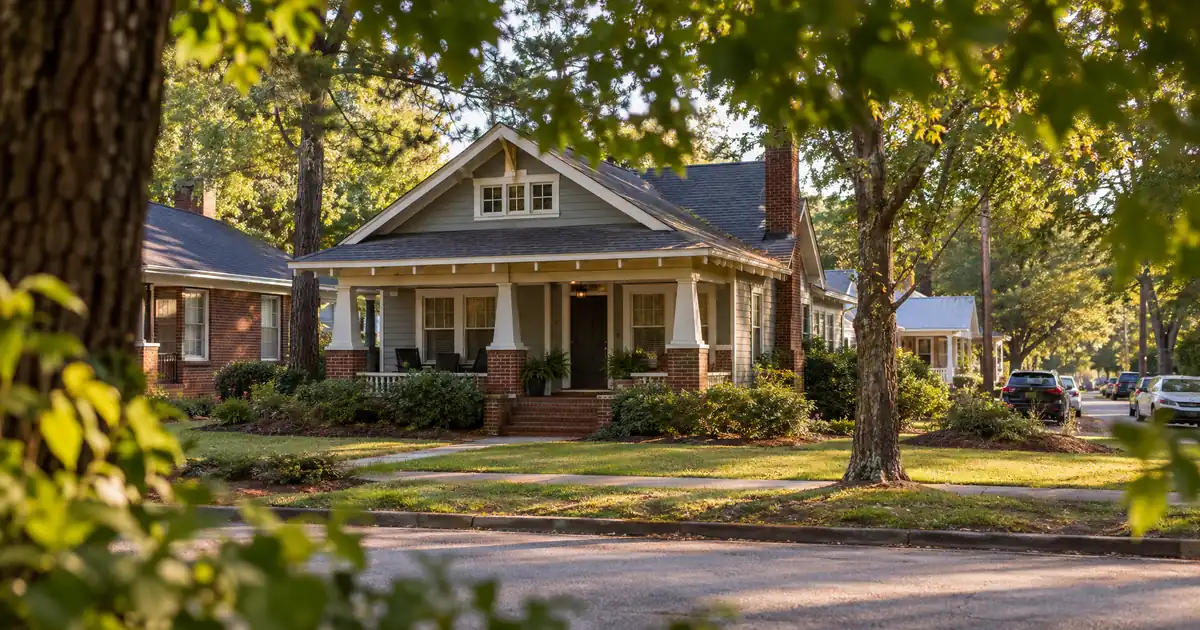
Can an Opelika rental that rents near the $1,750 Zillow average clear a cash-out refinance at 75 percent loan-to-value? Sometimes, but the margin is thin. Zillow’s Opelika value index puts the average home at $310,676, and Zillow Rental Manager shows the average house rent at $1,750. Modeled with full taxes and insurance, that pairing lands near 1.0x at the 75 percent ceiling. Rent-to-price ratios here sit well below the 1 percent rule, so the property’s basis, the leverage chosen, and the rent comps decide the outcome.
Lendmire (NMLS# 2371349) is a DSCR-focused mortgage broker. For Opelika, Alabama rental property financing, Lendmire helps arrange DSCR loans through lenders operating in 41 markets, including Washington, D.C. This piece covers the equity-extraction side only. It assumes the reader already owns the asset and wants to know what it can support today.
DSCR Cash-Out Calculator
Run the cash-out numbers in Opelika, AL
Rate source: Freddie Mac 30-yr average via FRED® — Federal Reserve Bank of St. Louis · effective Sep 24, 2026
Prefilled with starting assumptions — enter your property’s value, balance, taxes, and insurance for a more accurate picture.
Program parameters update from Lendmire’s centralized guideline source. Taxes and insurance are editable estimates.
As of Sep 24, 2026 · General Freddie Mac market benchmark, not a Lendmire loan offer. Property value, balance, taxes, and insurance are editable estimates. Maximum loan-to-value varies by lender, program, property type, and seasoning. Not a Loan Estimate, approval, or commitment to lend. Program availability and eligibility are subject to lender guidelines, credit approval, property review, and underwriting.
The Quick Read:
A cash-out refinance on an Opelika, Alabama rental is underwritten primarily on the property’s rental income measured against its full monthly obligation, with the lender reviewing coverage, seasoning, reserves, and appraised value before any proceeds are sized.
- Average house rent of $1,750 against a $310,676 value models near 1.0x at 75 percent LTV (Zillow).
- Cash-out LTV tops out at 75 percent; the purchase-side 80 percent figure does not apply.
- Ownership of about six months, measured from title recording, is the typical seasoning marker.
- Duplex list pricing near $485,000 only works with top-of-range unit rents.
- Appreciation near 3.5 percent means proceeds depend on basis, not market lift.
Opelika Market Snapshot
A quick read on the Opelika investor landscape. Figures come from the cited sources below. Confirm current property-level numbers before underwriting.
| Metric | Detail |
|---|---|
| Home prices | ~$335,000 sale (+3.2%) (Laura Sellers, REALTOR®) |
| Typical rents | $1,750 avg house (Zillow Rental Manager) |
| Recent appreciation | +3.5% yoy (Zillow Home Values) |
| University enrollment | 35,733 total (Auburn University Institutional) |
| Employment | 12,000+ auburn employees (HUD PD&R Auburn-Opelika Housing) |
Reading the Price Data Without Fooling Yourself
Opelika’s pricing sources disagree by roughly $25,000, and a refinance appraisal will land wherever the nearest closed comps do, not where any index sits. This article uses Zillow’s $310,676 as the primary reference because it is the most recent and the most clearly defined.
A local agent’s summary of Redfin data puts the three-month median sale price near $335,000, up 3.2 percent year over year, with the Realtor.com median listing price near $350,000 (Laura Sellers, REALTOR). That is a secondary source, and median sale prices skew toward whatever mix of homes happened to trade. Zillow measures value across the housing stock, and it shows 3.5 percent appreciation with homes going pending in about 29 days.
Both appreciation prints sit in the low single digits. An earlier Redfin snapshot showed double-digit growth, but it rested on a thin month of 45 sales, so treat it as noise. The takeaway is that Opelika is a steady market now, not a surging one.
Steady has a direct consequence for cash-out sizing. Proceeds come from basis, improvements made, and the time since purchase. Market lift contributes little. An owner who bought at a discount, renovated, and then stabilized the rent has a real equity story. An owner who bought at list near the top of the range has about 3.5 percent a year working in their favor. Underwrite to the second case.
The Coverage Math, Laid Out
At 75 percent LTV, Opelika single-family rentals model between the low 0.9s and roughly 1.0x, and small multifamily spans a wider range. The figures below are the article’s own modeled arithmetic, not published market data. They divide rent by full monthly obligation: a 30-year amortization at an assumed rate, plus taxes and insurance at Alabama averages. Rounded down, with loan-to-value as shown.
| Scenario | Value basis | Rent assumption | Modeled coverage |
|---|---|---|---|
| SFR at Zillow average | $310,676 | $1,750 | About 1.0x |
| SFR at median sale price | $335,000 | $1,750 | Low 0.9s |
| Same SFR at 65 percent LTV | $335,000 | $1,750 | About 1.0x |
| Duplex, low-end unit rents | $485,000 | Two units at $1,244 | About 0.9x |
| Duplex, high-end unit rents | $485,000 | Two units at $1,889 | About 1.3x |
The rent-to-price ratio explains why. Dividing the $1,750 average rent by $310,676 gives about 0.56 percent a month, and by $335,000 about 0.52 percent. Both are well short of 1 percent. (That is the article’s arithmetic on cited inputs, and the average rent is skewed by high-end listings, so run live comps before relying on it.)
Notice the third row. Taking the same $335,000 appraisal down to 65 percent LTV pushes coverage back to roughly the 1.0x benchmark. Most standard DSCR programs are built around that 1.00x baseline because the rent covers the obligation at that level. Some lenders review lower ratios, but those files usually carry lower leverage, different pricing, or more cash from the borrower. Eligibility turns on lender guidelines, credit profile, reserves, and property review.
So there is a tradeoff. Pulling less cash out can make the file work. Pulling the maximum can take the number below the baseline. Which is better depends on what the proceeds will do next. If a lower-leverage refinance still funds a down payment on the next deal, it beats a maxed-out loan that stalls at review.
The program parameters that matter most here, typically and subject to lender guidelines:
- A 75 percent LTV ceiling on cash-out.
- About six months of ownership from title recording.
- A credit floor of 620, with pricing tiers at 660, 680, and 700.
- Reserves of about six months of full obligation.
- A minimum coverage ratio of 1.00.
Equity available depends on rent, reserves, and the cap. It is never a guaranteed figure. The calculator converts these percentages to dollars. The details are in the equity-extraction mechanics.
Duplexes: The Product That Looks Better Than It Is
Small multifamily is Opelika’s mainstream rental form, but at current list pricing it does not rescue coverage by default. RentCafe, citing Census data, puts the renter share at 31 percent. Small complexes under 50 units make up 48 percent of rentals, and rental buildings average about 31 years old. Older, smaller stock is the norm here, so capex reserves belong in the plan.
Pricing is the problem. Homes.com lists multifamily homes between $485,000 and $901,000. Apartments.com shows duplex and apartment rents averaging $1,244, in a range of $1,229 to $1,889. That page mixes duplexes and apartments, so treat it as a rough guide.
At a $485,000 entry, two units at the low end of that range model below 1.0x. Two units at the top of the range model near 1.3x. A duplex works when the basis is below list or when renovated units rent at the top of the band. It fails when an owner assumes a second door doubles the cushion. The real swing factor is the unit-level rent comp.
The stronger play might be an owner who already holds a duplex bought below list. For that owner, appraised value against the original basis creates the extractable equity. Buying at list and refinancing at list does not.
Where the Equity Tends to Sit: Opelika Submarkets
Neighborhood-level rent data does not exist in the sources reviewed, so submarket analysis here is about price position and demand anchors, not published coverage. That gap is real. Anyone claiming precise rents by street is working from private comps.
Wecoba and St. Elmo’s. This is the lowest-priced named neighborhood in the Zillow neighborhood table, at about $186,098. Listing-page snapshots vary by date. Dividing the city-average rent by that value implies a ratio near 0.9 percent a month. That uses a citywide rent, so it is not a supported neighborhood claim. The accurate read is that it is the lowest basis in the local data and warrants local rent comps. Lower basis plus workforce-grade rent is the profile that clears 1.0x with room.
North Hills, Highland, and Ward Heights. Homes.com describes North Hills as 1970s ranches and newer traditional homes near Municipal Park, Highland as 1960s ranches near downtown with easy access to downtown dining and I-85, and Ward Heights as midcentury homes on rolling terrain with I-85 access. These are older ranch product, so appraisals lean on closed comps and renovation scope matters. Price bands are not sourced. Interstate access matters for tenants commuting to plant jobs.
Stephens Woods. Homes built in the 2000s near West Ridge Park and the Opelika SportsPlex, per the same Homes.com description. Newer construction usually means a higher basis and thinner coverage. It suits an owner with a conservative leverage target, not one hunting for maximum proceeds.
Northeast Opelika Industrial Park. The Miele plant is located here, per WTVM. No rent data was found, but proximity to a large new employer is the demand logic for nearby workforce rentals.
The Tenant Base Behind the Rent Line
Opelika’s rent support comes from manufacturing payroll, a hospital system, and spillover from the university next door, not from a single sector.
The city has roughly 32,820 residents per Census Bureau QuickFacts. Other aggregators show up to about 35,000, so the roughly 33,000-to-35,000 range is the safer framing. HUD’s regional profile put the metro at 184,800, growing 1.7 percent a year. That is an older vintage, but it shows steady growth. Among residents, manufacturing employs 2,421, health care 2,292, and education 1,872, per Data USA.
On the industrial side, the City of Opelika reports that Pharmavite has invested more than $173 million and grown to over 600 local employees. Miele’s first U.S. plant is slated to start with 150 jobs, per Business Alabama. Local reporting cites projections of 700 to 800 jobs and about $700 million in investment, which depend on phased expansion. Hanwha’s defense facility starts with about 40 jobs, per the City. It’s small, but a new category for the city. Phase one jobs are not a rent-growth forecast.
Health care is the steadier layer. East Alabama Health reports about 4,100 employees across two hospitals, one of them outside Opelika, so the figure overstates the Opelika-only headcount. The City describes East Alabama Medical Center as its largest employer. Clinical staff on 12-month leases are the kind of tenant that supports a lender’s rent assumptions.
The university sits next door. Auburn University reports a total headcount of 35,733, with 29,693 undergraduates and 6,040 graduate students. Opelika’s demand tie is overflow: staff, graduate students, and young professionals priced out of Auburn rents. No Opelika-versus-Auburn rent differential was found, so that’s a thesis, not a figure.
One risk applies. No Opelika-specific vacancy rate surfaced, and Zillow tags the rental market “cool,” with rent up $79 over the year. Metro permits ran 367 units in a recent January, up from 107 in an earlier September, in the Census permit data. Permits aren’t deliveries, and the series is volatile, but new supply can cap rent growth on newer product. Rent-based underwriting should lean on conservative comps.
What Operators See on Files Like This
DSCR files in markets like this one typically look like a mid-priced single-family rental with rent that covers the obligation at the benchmark but not by much. The deals that move cleanly tend to have a documented lease, a rent comp within the same submarket, and an owner willing to pick a leverage level that gives the number some cushion instead of chasing the cap. Files stall when the appraisal comes in below the owner’s expectation and the proceeds shrink. In a market with 3-to-4-percent appreciation, that is the most common friction point. Entity-held rentals can be eligible subject to lender program eligibility.
Equity Out, Next Deal In
The refinance is a funding mechanism, so judge it by what the proceeds buy. An investor holding a stabilized Opelika SFR for more than six months, with a payoff well under 50 percent of appraised value, has roughly 25 points of value as gross proceeds at the 75 percent ceiling, before costs and reserves. Those points are the raw material for the next down payment. Whether the next deal clears coverage depends on its own rent-to-price, which in Opelika means a lower basis, small multifamily bought below list, or product near the lower-priced neighborhoods.
The coverage test also applies to the new, larger loan, not the old one. Pulling cash raises the obligation, and coverage falls with it. Some investors run the numbers at two or three leverage levels and take the highest that holds the benchmark. For the broader refinance framework, Lendmire’s guide to refinancing investor properties explains the structure, and its comparison of programs shows how this differs from conventional underwriting for investors who have hit financed-property limits. Statewide context lives on the Alabama DSCR financing page.
To model a specific property, investors can request a scenario quote or call Lendmire at 828-256-2183. Verify current local rental rules, taxes, and insurance with qualified local professionals before committing.
DSCR vs. conventional financing
There are two common ways to finance an investment property in Opelika, AL, and they qualify you differently — here’s how investors weigh them.
Why investors choose it
- Qualifies on the property’s rental income — no personal tax returns, W-2s, or pay stubs needed to document income.
- No personal debt-to-income ceiling to clear, so existing mortgages and obligations don’t cap your borrowing the same way.
- Can be closed in an LLC, keeping the property inside a business entity.
- Built for scaling — not held to the limit on number of financed properties that conventional financing applies.
- Underwriting centers on the deal: generally qualifies when the rent covers the payment, a 1.00x coverage ratio being a common baseline (confirmed in underwriting).
- Designed specifically for investment property, including long-term and, where the program allows, short-term rentals.
Where it’s strong
- Often the lowest ongoing financing cost for a buyer who fully qualifies on personal income — a fit for a first property or a cost-first purchase.
Trade-offs for investors
- Requires full personal income documentation and must fit within a debt-to-income limit — salary, existing debts, and other mortgages all count.
- Typically held in your personal name rather than a business entity.
- Caps how many financed properties you can carry, which can become a ceiling as a portfolio grows.
- Evaluates you as a borrower as much as the property, which usually means more paperwork.
How investors usually choose: a first or single property often optimizes for the lowest financing cost; portfolio builders often optimize for leverage, vesting in an LLC, and scaling past conventional caps. The right answer depends on your goals, the property, and current guidelines — both paths run through select lenders in Lendmire’s wholesale network, with eligibility and terms confirmed in underwriting.
Frequently Asked Questions
Does a cash-out refinance on an Opelika duplex pencil better than on a single-family home?
Not automatically. Duplex list prices run from $485,000 to $901,000 on Homes.com, while unit rents average about $1,244 on Apartments.com. At the low end of that range, modeled coverage sits near 0.9x. It improves to roughly 1.3x only with top-of-range rents or a below-list basis, subject to lender guidelines.
How much equity can an Opelika owner pull with appreciation running in the low single digits?
The ceiling is 75 percent of appraised value, so the usable figure is that cap minus the current payoff, reserves, and costs. With value growth near 3.5 percent a year per Zillow, proceeds depend mostly on purchase basis and renovation, not market lift. Equity is not a guaranteed cash figure.
Does Miele’s arrival mean Opelika rents will jump?
Not on current evidence. Miele started with 150 jobs, and the 700-to-800 figure is a projection tied to phased expansion. Zillow still describes the rental market as cool. The plants support tenant demand, but underwrite today’s rents.
How long must an owner hold before a cash-out refinance?
Programs typically look for about six months of ownership, measured from title recording. Lenders vary, and the ownership clock is separate from the appraisal and reserve requirements. Credit generally needs to clear a 620 floor, with better pricing tiers at 660, 680, and 700.
Is the East Alabama Health payroll relevant to a DSCR refinance?
It matters only indirectly. Lenders underwrite the property’s rent, not the tenant’s employer. But a large hospital system, with a sizable workforce across two hospitals per East Alabama Health, supports steady leasing in nearby neighborhoods, which makes rent assumptions easier to defend.
Three Indicators to Track Next Quarter
Three signals will show whether Opelika’s refinance math is improving or slipping:
1. Zillow’s rent trend versus its value trend. Rent is up $79 over the year, and value is up 3.5 percent. If rent growth outpaces value growth, rent-to-price improves and coverage follows.
2. Miele’s hiring pace. Watch whether the 150 initial jobs scale toward the projected 700 to 800, and whether Hanwha’s phase one of about 40 jobs expands.
3. Metro permit volume. The 367-unit January reading is a spike, not a trend. Repeat prints at that level would raise lease-up risk for newer product.
Opelika’s equity-extraction case rests on basis. Owners who bought below the roughly $310,676 average have room, and owners who paid list have a slim margin.
About Lendmire
Lendmire is a DSCR-focused mortgage brokerage, NMLS# 2371349, placing investor loans across 41 markets, including Washington, D.C. Lenders generally review DSCR eligibility around a property’s rental income rather than personal income documentation, which suits LLC-held rentals, self-employed investors, and portfolios scaling past conventional financed-property limits. Lendmire is a 2026 Scotsman Guide Top Mortgage Workplace and a top-ranked workplace in 2025, per the Scotsman Guide.
Get Started
Ready to find the right loan for you?
In about 30 seconds you can review financing options available for your investment property. No commitment required.
Informational only. Not a Loan Estimate, approval, or commitment to lend. Program availability and eligibility are subject to lender guidelines, credit approval, property review, and underwriting.
References
1. Zillow’s Opelika value index
7. Homes.com
10. Homes.com
11. WTVM
12. Data USA
13. City of Opelika
14. Business Alabama
15. City
17. City
18. Scotsman Guide — Top Workplaces 2025
19. Scotsman Guide
This article is part of Lendmire’s investment property cash-out refinance program — full qualification details, guidelines, and scenarios live on the program page.
Related reading: Luxury Rental DSCR Loans In New Jersey · Jersey Shore Vacation Rental Loans: DSCR Financing In Ocean City, Cape May And Long Beach Island · DSCR Cash-out Refinance In New Jersey: Pulling Equity From A Rental
Guides: Investment Property Cash-Out Refinance in Opelika, AL · Investment Property Cash-Out Refinance in Alabama
Brandon Miller
Founder & CEO, Mortgage Loan Originator, Lendmire LLC
- Mortgage Loan Originator · NMLS# 1129696 · Verify on NMLS Consumer Access
- North Carolina Real Estate Broker · License# 343312 · Verify on NCREC
- North Carolina Insurance Producer · License# 19053198 · Property, Casualty, Life, Health · Verify on NAIC SBS
- Lendmire LLC · Firm NMLS# 2371349 · Verify firm licensure
Important disclosures. Lendmire (NMLS# 2371349) is a licensed mortgage brokerage. Lendmire is not a direct lender, depository institution, or financial advisor. All loan inquiries are subject to lender underwriting; this article does not constitute a commitment to lend. Rates, terms, and program guidelines are subject to change without notice and vary by borrower profile, property type, and state. Information in this article is general in nature and is not financial, legal, or tax advice. Equal Housing Opportunity. NMLS Consumer Access: nmlsconsumeraccess.org.