
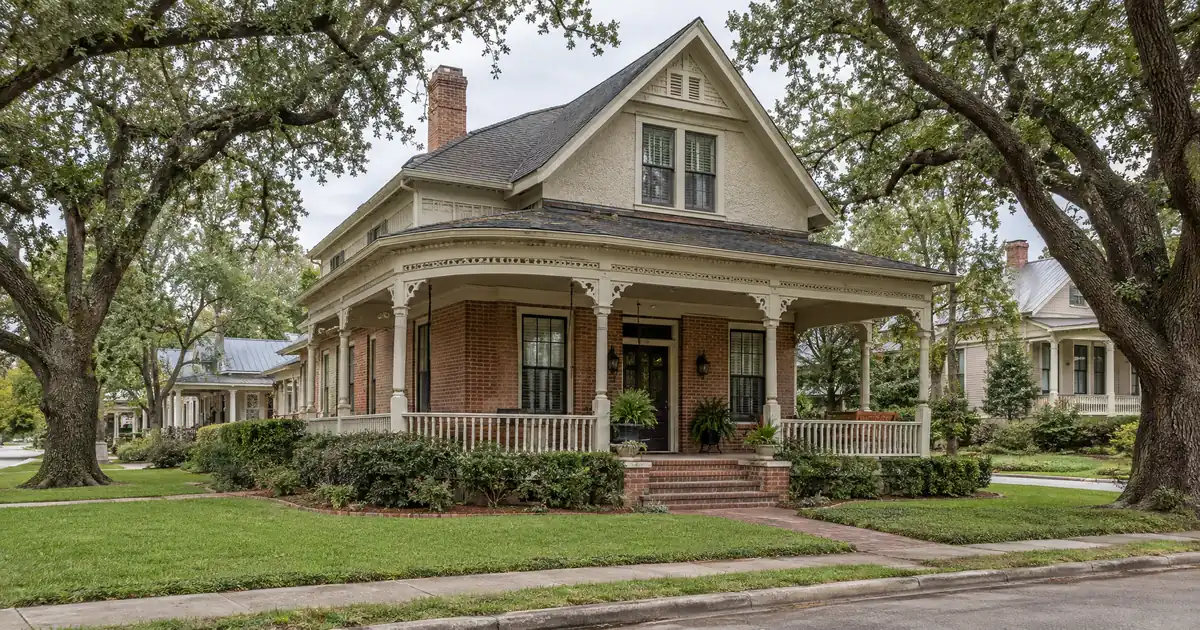
Picture an investor holding a three-bedroom rental in Old Townsite, bought when entry prices sat well under today’s. The tenant has renewed twice, the payoff balance is a modest slice of what the house would appraise for, and the investor wants that trapped equity working on the next purchase. The question is not whether equity exists. It is how much of it a DSCR lender will let out, and what the rent has to do to support it.
Pearland is a specific answer to that question. Prices have flattened, rents have stalled, and the spread between a $300,000 house and a $430,000 house matters more here than almost anywhere else in Greater Houston. This article walks through the mechanics step by step, shows where the coverage math holds, and flags where it doesn’t.
DSCR Cash-Out Calculator
Run the cash-out numbers in Pearland, TX
Rate source: Freddie Mac 30-yr average via FRED® — Federal Reserve Bank of St. Louis · effective Sep 24, 2026
Prefilled with starting assumptions — enter your property’s value, balance, taxes, and insurance for a more accurate picture.
Program parameters update from Lendmire’s centralized guideline source. Taxes and insurance are editable estimates.
As of Sep 24, 2026 · General Freddie Mac market benchmark, not a Lendmire loan offer. Property value, balance, taxes, and insurance are editable estimates. Maximum loan-to-value varies by lender, program, property type, and seasoning. Not a Loan Estimate, approval, or commitment to lend. Program availability and eligibility are subject to lender guidelines, credit approval, property review, and underwriting.
TL;DR: A DSCR cash-out refinance in Pearland, Texas runs from appraisal to payoff to proceeds, and it is underwritten primarily on the property’s rental income measured against its full monthly obligation, with the new loan capped at 75% of appraised value once roughly six months of ownership have passed.
- Zillow puts the typical Pearland home at $376,961, which strains coverage at 75% LTV.
- Old Town’s $297,500 median beats Shadow Creek Ranch’s $429,000 on rent-to-value, per Homes.com.
- Pearland apartment vacancy sits at 6.5% versus 11.1% for metro Houston, per Community Impact.
- Underwrite on current comps, because appraisals may not reach earlier peak prices. These specifics are subject to lender guidelines and a full review of property, leverage, and credit.
The Appraisal Is the Whole Game
Cash-out proceeds are not a function of what the house was worth at its peak. They are a function of what an appraiser says it is worth now, multiplied by the 75% LTV ceiling, minus the existing payoff and closing costs. Everything else in the file follows from that one number. Terms vary by lender guidelines, property type, leverage, credit profile, and full file review.
The step-by-step version looks like this. The appraiser sets a value. The lender applies a maximum of 75% of that value as the new loan. The new loan first retires the existing mortgage, then covers costs, and only the remainder reaches the investor. If the current payoff is already around 50% of value, roughly a quarter of value is the gross ceiling before costs. If the payoff is closer to 70%, there’s very little left. The proceeds are never a guaranteed figure, and reserves of about six months of PITIA come out of the investor’s liquidity picture too, subject to lender guidelines.
Seasoning is the other gate. Most programs in the network look for about six months of ownership measured from title recording. An investor who recently finished a rehab and is counting on the after-repair value should confirm that timing before ordering anything.
Pearland’s valuation picture is a mixed signal, and investors should read it as one. Zillow’s typical home value of $376,961 is up 1.3% over the past year, while Redfin reported a January median sale price of $372K, down 2.2% year over year, with homes averaging 45 days on market versus 33 a year earlier. The two measure different things, so this article uses the Zillow figure as the citywide reference point. An earlier Homes.com snapshot put the median sale price at $405,000, on yet another method, which suggests softening from a higher mark. The precise number matters less than the direction: flat to slightly negative.
That direction shapes the strategy. Pearland is not a market where you refinance on a hot appraisal that keeps climbing. The pitch is stable equity plus rental cash flow, and the appraisal should be underwritten on current rent and sale comps, not on what the property might have fetched at its highest. Equity built through years of paydown and an older, lower purchase basis is the reliable kind. Equity assumed from a peak comp is the kind that evaporates at the appraisal table.
How the Coverage Math Actually Runs
Here’s the part that surprises investors: at Pearland’s median price, a 75% LTV cash-out on long-term rent alone runs below 1.00. That’s the honest read. Exact terms depend on the lender’s guidelines, property type, leverage, and a full review of the borrower’s file.
The calculation is simple. Divide monthly rent used for lender review by the full monthly obligation: principal and interest, property taxes, and insurance (PITIA). The standard DSCR benchmark is 1.00x, meaning rent covers the obligation. Some lenders review lower-coverage files with compensating factors, but those typically bring lower leverage, stronger credit, or added reserves.
Rentometer’s all-property-type 3BR average is $2,202. For the modeled example below, assume $2,200 in rent, the same for every submarket. That assumption is mine, not a sourced fact, since no reliable neighborhood-level rent data exists for Pearland. Against Zillow’s $376,961 typical value, that’s a gross yield of roughly 7% annually before taxes and insurance (illustrative arithmetic, not a published figure). Once a full PITIA is loaded in, with taxes near 1.68% and insurance near 0.50% of price per year as Texas averages, and a 30-year amortization at a 7.03% note rate, the coverage falls off.
| Price point | Source | Modeled coverage at 75% LTV |
|---|---|---|
| Old Town median, $297,500 | Homes.com | About 1.0x |
| Citywide typical, $376,961 | Zillow | Mid-0.8s |
| Shadow Creek Ranch, $429,000 | Homes.com | Mid-0.7s |
| Mary’s Creek, $550,000 | Homes.com | Below 0.6x |
Modeled on $2,200 rent, full PITIA including taxes and insurance, rounded down. Homes.com figures come from an earlier snapshot.
Read that table for what it says. Rents don’t scale with price across Pearland submarkets, so the cheaper the basis, the better the coverage. The same $2,200 tenant supports very different loan sizes depending on where the house sits.
When a file lands under 1.00, there are structures a lender may review: lower leverage (the modeled citywide file only approaches 1.0x with leverage down near 60%), an interest-only option on select programs, or a sub-1.00 program that asks for stronger credit and more reserves. Whether any of those fits depends on lender guidelines, credit approval, and property review. It is not automatic, and an investor should assume less cash out, not more, when coverage is thin. The DSCR fundamentals page covers the base mechanics if the ratio itself is new.
Where the Equity Sits (and Where It Doesn’t)
Old Townsite and the downtown core are where the cash-out math is cleanest. Homes.com shows the Old Town District median at $297,500, the lowest of the submarkets it tracked. This is older, lower-basis stock in the historic core around SH 35 and FM 518, and it’s where an owner who bought years ago is most likely sitting on meaningful equity against a modest payoff. Rent-to-value beats every newer master-planned pocket in the city. Older homes also come with condition risk, so the appraisal can land soft if deferred maintenance shows.
Shadow Creek Ranch is the opposite trade. The median single-family price there is $429,000, and the modeled coverage on a $2,200 rent sits in the mid-0.7s at 75% LTV. Not ideal for maximum cash-out. The rental demand itself is real. Kelsey-Seybold Clinic is headquartered in the community, the Pearland EDC lists it at about 1,000 employees, and its clinic expansion added 27,000 square feet and capacity for 44 providers. Physician and clinical staff are a durable, higher-income renter pool, which supports rent levels. But the price-to-rent ratio is weaker, so investors here tend to use lower leverage or accept smaller proceeds. The stronger play might be a Shadow Creek owner who refinances for stability and modest cash-out, while a lower-basis Old Town owner pulls the larger check. This is a genuine toss-up for anyone holding both.
Silverlake ($439,000) and The Villages at Mary’s Creek ($550,000) get a shorter verdict. Skip them for cash-out purposes unless the payoff is tiny and the investor is happy with a small draw. At those prices, a $2,200 rent doesn’t come close to supporting a 75% loan.
Lower Kirby District deserves a mention for a different reason. It’s the employer-driven pocket, home to Lonza, the top employer on the Pearland EDC list, along with Millar. Demand tied to jobs there is a plus, but no verified rent or price data exists for this submarket, so it stays qualitative.
Why the Renter Base Holds
Pearland’s tenant demand rests on employment, not on a single industry. Data USA counts roughly 65.1 thousand jobs in the local economy, led by Health Care & Social Assistance (11,968), Manufacturing (7,182), and Educational Services (7,027). The Pearland EDC major employers list adds names with real headcounts: Lonza at 1,079, Kelsey-Seybold at 1,000, Memorial Hermann Pearland Hospital at 540, and Kemlon at 304. Many residents also commute to the Texas Medical Center. The mix of clinical work, cell and gene therapy manufacturing, and Houston-area commuting is more varied than most similarly sized suburbs, which lean on retail.
Population supports the story. The 2020 Census count was 125,828, up from 91,252 in 2010, per Wikipedia’s summary of Census data (the Census Bureau QuickFacts page is the primary source), and an aggregator estimate puts the current figure near 129,930.
Vacancy is where Pearland pulls away from the metro. Apartment vacancy stands at 6.5% versus 11.1% for Houston overall, per Cushman & Wakefield’s Houston MarketBeat, and Community Impact reports it has stayed under 7% since 2018. Metro Houston occupancy was 88.1% with an average asking rent of $1,368, according to Houston.org.
Now the catch. Deliveries are running ahead of absorption: 380 units arrived while 161 were absorbed. Pearland’s smaller apartment market makes vacancy sensitive to individual properties, as the C&W researcher noted. And rents are flat, roughly 0% to +0.4% year over year on RentCafe and down 1% on Zumper. Flat rents mean no rent-growth cushion to fix a thin coverage ratio later. Underwrite the rent you can document today. Every figure here varies by lender and program — guidelines, property type, leverage, and credit profile all apply.
Working DSCR brokers see a recurring pattern in suburban markets where prices have flattened: the borrower expects the cash-out to be sized off the last strong comp, and the appraisal comes in closer to the current median. The files that hold together tend to be the ones underwritten on the lower valuation from the start, with the rent supported by a lease or market rent schedule and reserves already lined up. Cash-out amounts drop, but the file stops moving.
Where Most Investors Get It Wrong in Pearland
They chase proceeds instead of coverage. An investor with a newer Shadow Creek Ranch rental sees $429,000 on a listing site, assumes a large draw, and discovers that the rent supports far less. The 75% LTV ceiling is a ceiling, not a target. The DSCR is the binding constraint, and at higher price points it binds first. Final terms depend on lender guidelines, property type, leverage, and the borrower’s complete credit picture.
The second mistake is leaning on citywide averages. Zillow’s $376,961 is a mixture of townhomes near $290,000 and larger single-family homes near $390,000, per the Homes.com snapshot. A subject property sitting at either end of that range has a different refinance profile than the mean suggests. Pull a rent schedule for the specific unit, not the zip code.
Duplexes: Better Math, Thinner Comps
The strongest cash-out coverage in Pearland, on paper, comes from two-to-four-unit product. The problem is that there isn’t much of it.
Homes.com listed just two multi-family homes and duplexes, priced between $370,000 and $599,900, and a Zillow search for duplexes and triplexes returned a single home. No sourced Pearland duplex rent data exists, so this is modeled. Take a $370,000 duplex and assume each side rents around $2,200, a benchmark that likely overstates smaller units. The gross monthly yield doubles versus a median single-family, and the modeled coverage at 75% LTV with full PITIA lands above 1.7x. Even if each side rents well below the 3BR benchmark, coverage stays above roughly 1.4x. Two rent streams against one price is the thing that can push a Pearland file well past 1.00 where a median single-family struggles.
The trade-off is appraisal risk. With so few comparable duplex sales, an appraiser has less to work with, and valuation can swing wider than on single-family. Expect the appraisal to be the hardest part of the file. An investor who already owns a small multi-unit property in Pearland is sitting on an unusual asset, and the refinance is worth pursuing with real per-unit rent comps in hand. An investor hunting for one to buy will find inventory is scarce. The bigger multifamily side is active: Marcus & Millichap commentary reported by CRE Daily noted small-property transactions under $10 million jumped 60% year over year in late 2025, naming Pearland among the low-vacancy submarkets.
What Happens to the Proceeds?
Cash-out proceeds become the down payment on the next deal, or reserves, or debt paydown. The right use depends on the math above.
DSCR vs. conventional financing
Two common ways to finance an investment property in Pearland, TX. They qualify you differently — here’s how investors weigh them.
Why investors choose it
- Qualifies on the property’s rental income — no personal tax returns, W-2s, or pay stubs needed to document income.
- No personal debt-to-income ceiling to clear, so existing mortgages and obligations don’t cap your borrowing the same way.
- Can be closed in an LLC, keeping the property inside a business entity.
- Built for scaling — not held to the limit on number of financed properties that conventional financing applies.
- Underwriting centers on the deal: generally qualifies when the rent covers the payment, a 1.00x coverage ratio being a common baseline (confirmed in underwriting).
- Designed specifically for investment property, including long-term and, where the program allows, short-term rentals.
Where it’s strong
- Often the lowest ongoing financing cost for a buyer who fully qualifies on personal income — a fit for a first property or a cost-first purchase.
Trade-offs for investors
- Requires full personal income documentation and must fit within a debt-to-income limit — salary, existing debts, and other mortgages all count.
- Typically held in your personal name rather than a business entity.
- Caps how many financed properties you can carry, which can become a ceiling as a portfolio grows.
- Evaluates you as a borrower as much as the property, which usually means more paperwork.
How investors usually choose: a first or single property often optimizes for the lowest financing cost; portfolio builders often optimize for leverage, vesting in an LLC, and scaling past conventional caps. The right answer depends on your goals, the property, and current guidelines — both paths run through select lenders in Lendmire’s wholesale network, with eligibility and terms confirmed in underwriting.
Suppose an Old Town owner draws equity and puts it toward a second property. The strongest use is a lower-basis purchase with better coverage than the property being refinanced, ideally in the sub-$300,000 range where Pearland rent-to-price ratios pencil best. Using proceeds to buy in Shadow Creek Ranch or Silverlake just recreates the thin-coverage problem one property later.
A few program parameters shape the plan, all subject to lender guidelines and varying by borrower, property, and loan scenario. Credit tiers typically run from a 620 floor upward through 660, 680, and 700, with better tiers generally improving eligibility. Reserves of about six months of PITIA are a common expectation. Standard programs cover loan amounts up to $3,000,000. Borrowers holding title in an LLC should confirm entity structure subject to lender program eligibility. Manufactured homes, log homes, and barndominiums fall outside these DSCR programs.
For the mechanics of pulling equity from a rental, Lendmire’s DSCR cash-out refinance page walks through the structure. Investors across the state can also look at Texas DSCR financing for the broader picture. Once you have a subject property in mind, you can ask Lendmire to review the file or call 828-256-2183.
One generic reminder applies: verify current local rental rules, property taxes, and insurance with qualified local professionals before committing, especially since Pearland spans multiple counties.
Frequently Asked Questions
How do you qualify for a DSCR cash-out refinance in Pearland?
Qualification centers on the property’s rent covering its full monthly obligation, typically at a 1.00x benchmark, along with about six months of seasoning, a credit score in the 620-and-up range, and roughly six months of PITIA in reserves. The new loan is capped at 75% of appraised value. Some lenders review sub-1.00 files with lower leverage or stronger credit, but that varies by lender guidelines and property review.
What are the requirements for an investment property cash-out refinance in Pearland, Texas?
Expect a 75% LTV ceiling, about six months of ownership measured from title recording, a minimum DSCR of 1.00 on most standard programs, and reserves of roughly six months of PITIA (about nine above $1,500,000). Loan amounts go up to $3,000,000 on standard programs. Eligibility depends on the borrower, property, and lender program.
Will a Pearland appraisal support a cash-out after the recent price softening?
It depends on the comps, and the safest assumption is that it may not reach earlier peak values. Zillow shows the typical value up 1.3%, while Redfin shows the January median sale price down 2.2%. Underwrite on recent comparables, size the request conservatively, and expect older, lower-basis properties to have more equity cushion than recently purchased ones.
Does a duplex cash out better than a single-family rental in Pearland?
On coverage, usually yes, because two rent streams sit against one price, so modeled coverage can clear 1.4x where a median single-family lands in the mid-0.8s. On valuation, the answer flips: Pearland has very few duplex listings, so appraisers have thin comps and the value can come in less predictably.
Two Roads From Here
Pearland investors holding seasoned equity face a real fork. One road is a cash-out now, against a flat-to-softening market, at modest leverage on a lower-basis property where the rent covers the payment and the appraisal is defensible. The tradeoff: a smaller draw than the equity seems to promise, and no assumption that values recover. The other road is holding, letting paydown and time build more cushion, and waiting for a stronger appraisal or a lower-priced acquisition to deploy into. The tradeoff: idle equity in a market where rents are flat and the next deal might not get cheaper. In a city where the same $2,200 rent supports very different loans depending on which side of Pearland the house sits, the choice is less about timing the market than about which basis you own.
For current guidelines and terms, see Lendmire’s DSCR loan programs page.
About Lendmire
Lendmire (NMLS# 2371349) is a DSCR-focused mortgage brokerage with investor programs available in 41 markets, including Washington, D.C. DSCR lenders typically look at whether a property’s rent covers its obligations rather than reviewing personal income paperwork, which suits LLC-owned and multi-property investors. Terms vary by lender, property, leverage, and program. Lendmire has been recognized by Scotsman Guide as a top-ranked workplace in 2025 and a top-ranked workplace in 2026.
Get Started
Ready to find the right loan for you?
In about 30 seconds you can review financing options available for your investment property. No commitment required.
Informational only. Not a Loan Estimate, approval, or commitment to lend. Program availability and eligibility are subject to lender guidelines, credit approval, property review, and underwriting.
References
1. Zillow, Pearland Home Values
2. Homes.com, Pearland Multi-Family
3. Community Impact, Pearland Multifamily
4. Redfin, Pearland Housing Market
5. Rentometer, Pearland Average Rent
6. kelsey-seybold.com — Kelsey Seybold Announces Major Expansion of Pearland Clinic
8. Pearland EDC, Major Employers
10. Census Bureau QuickFacts page
11. Cushman & Wakefield, Houston Multifamily MarketBeat
12. Houston.org
13. RentCafe
14. CRE Daily
15. Scotsman Guide — Top Workplaces 2025
16. Scotsman Guide — Top Workplaces 2026
This article is part of Lendmire’s investment property cash-out refinance program — full qualification details, guidelines, and scenarios live on the program page.
Related reading: Cash Out Refinance Investment Property Pearland Texas · DSCR Cash Out Refinance Friendswood Texas · DSCR Cash Out Refinance Bedford Texas
Guides: Investment Property Cash-Out Refinance in Pearland, TX · Investment Property Cash-Out Refinance in Texas
Brandon Miller
Founder & CEO, Mortgage Loan Originator, Lendmire LLC
- Mortgage Loan Originator · NMLS# 1129696 · Verify on NMLS Consumer Access
- North Carolina Real Estate Broker · License# 343312 · Verify on NCREC
- North Carolina Insurance Producer · License# 19053198 · Property, Casualty, Life, Health · Verify on NAIC SBS
- Lendmire LLC · Firm NMLS# 2371349 · Verify firm licensure
Compliance and disclosures. Lendmire (NMLS# 2371349) is a licensed mortgage broker and is not a direct lender, depository institution, financial advisor, or tax professional. Content in this article is general market analysis and educational information — not financial, legal, or tax advice for any specific situation. Lendmire does not guarantee loan approval; every transaction is subject to underwriting by the funding lender. Mortgage pricing and loan program guidelines are subject to change at any time without notice and vary by borrower characteristics, property type, and state regulations. Lendmire complies with Equal Housing Opportunity. Licensure verification: NMLS Consumer Access.