
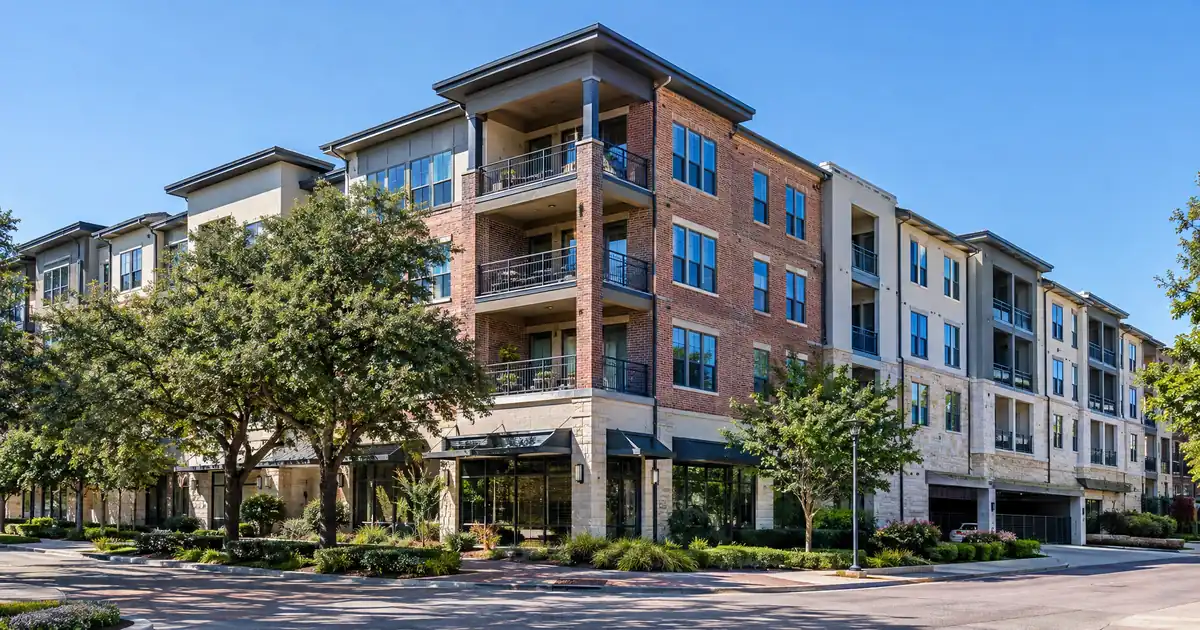
Legacy West is the highest-rent pocket in Plano, with apartments averaging $2,461 a month per RentCafe, against $1,512 in Old Shepard Place and $1,689 citywide. Corporate relocation households working at Toyota and a large national bank keep it full. It is also where the cash-out math is tightest, because prices rise faster than rents. An owner here who wants to pull equity out has to size the loan to the rent, not to the appraisal.
DSCR Cash-Out Calculator
Run the cash-out numbers in Plano, TX
Rate source: Freddie Mac 30-yr average via FRED® — Federal Reserve Bank of St. Louis · effective Sep 24, 2026
Prefilled with starting assumptions — enter your property’s value, balance, taxes, and insurance for a more accurate picture.
Program parameters update from Lendmire’s centralized guideline source. Taxes and insurance are editable estimates.
As of Sep 24, 2026 · General Freddie Mac market benchmark, not a Lendmire loan offer. Property value, balance, taxes, and insurance are editable estimates. Maximum loan-to-value varies by lender, program, property type, and seasoning. Not a Loan Estimate, approval, or commitment to lend. Program availability and eligibility are subject to lender guidelines, credit approval, property review, and underwriting.
Key Takeaways:
A cash-out refinance on a Plano, Texas rental is underwritten primarily on the property’s rental income measured against its full monthly obligation, with loan-to-value capped at 75 percent and about six months of ownership from title recording; with 3-bedroom houses renting near $2,498, coverage, not the LTV cap, usually sets the proceeds.
- Median sale price sits at $540,000, down 1.6 percent year over year per The Dunnica Team.
- Median rent is $1,903, down 5.0 percent.
- Modeled coverage on a 3-bed falls below 1.0x at the 75 percent cap.
- Duplex inventory is thin, so appraisers may reach into neighboring cities.
- Older 1990s stock in east and central Plano is the likelier cash-flow candidate (directional, unverified).
Plano Market Snapshot
A quick read on the Plano investor landscape — figures come from the cited sources below. Confirm current property-level numbers before underwriting.
| Metric | Detail |
|---|---|
| Home prices | 35-year median age (The Dunnica Team, Plano market) |
| Vacancy | 18.4% office (KiTalent, Plano corporate HQ) |
Why Appreciation Is Not the Plan Here
Plano equity comes from the long hold, not from this year’s market. The median sale price finished the most recent full year at $540,000, up 0.4 percent, and grew from $292,700 to $540,000 over ten years, an 84 percent increase, per Haistings Real Estate. The current direction is flat to slightly down. Zillow’s home value index puts the typical home at $518,080, down 2.4 percent over the past year. That is a different measure from the sale median, so don’t blend the two. This article uses the $540,000 sale median for the math.
The owners with room to refinance bought years ago. Those who bought near the peak have thin equity and a flat appraisal to work against.
One detail helps the case: Plano is a built-out, resale-dominated market. Per Haistings’ outlook piece, it recorded just 19 new-construction sales, under 1 percent of the market. Plano’s median rose $2,000 while Frisco fell $6,000, McKinney fell $35,000 and Celina fell $90,000. Competing new supply is not the problem in Plano. The problem is rent against price.
Inventory is not tight either. Active listings fell 19.7 percent to 686 homes, about 3.2 months of supply. The median home is 35 years old, so most of the stock is 1990s construction. An appraiser will see condition issues like HVAC, plumbing and roofing, and the investor should budget for them.
What the Rent Math Actually Does at 75 Percent
At the 75 percent ceiling, a typical Plano 3-bedroom rental does not reach 1.00 coverage. Rent runs near 0.46 percent of the sale median per month, and a full monthly obligation (principal, interest, taxes, insurance) eats more than that at high leverage. The fix is lower leverage.
Here is how that plays out. The figures below are modeled assumptions, not published statistics. They use the $540,000 sale median, the $2,498 single-family 3-bedroom rent from Doorstead, a 30-year amortization, and Texas-average taxes and insurance included in the monthly obligation. Rounded down:
| Cash-out LTV | Modeled coverage |
|---|---|
| 75 percent | about 0.65x |
| 60 percent | about 0.8x |
| 50 percent | about 0.9x |
| 40 percent | about 1.0x |
The 1.00x benchmark is common because rent covers the monthly obligation at that level. Some lenders review lower ratios, but those usually come with lower leverage, stronger reserves or different pricing, and eligibility depends on lender guidelines and the file.
The 3-bed rent is the one that matters. Doorstead’s median across all Plano rentals is $1,903, down 5.0 percent, and its 2-bedroom average is $1,879. RentEst’s modeled estimate for a 3-bedroom is $2,425, close enough to corroborate the Doorstead number. Its 4-bedroom estimate is $3,208. Rent climbs about 32 percent from a 3-bed to a 4-bed, and the likely read is that price climbs faster in west and north Plano. That makes the 3-bed the better coverage fit. Test it against sold comps before leaning on it.
Picture an owner with a 3-bed whose first lien sits around 30 percent of value. At the 40 percent loan level, the file lands near 1.0x and the cash-out is about ten points of value. Not a big number. At the 75 percent cap, the same property needs a rent far above what the market pays.
So the real question on most Plano single-family files is not “how much equity do I have?” It is “how much loan does the rent support?” Equity available depends on rent used for lender review, the full monthly obligation, reserves and the 75 percent ceiling. It is not a guaranteed figure. The cash-out qualification details cover the mechanics, and the guide “What Is a DSCR Loan” walks through rent divided by the full monthly obligation.
Legacy West and the Corporate Catchment
Legacy West is a single, well-defined rental catchment. Tenant demand here comes from corporate employers, not students or the military. KiTalent, a staffing-firm article, reports a large national bank with over 6,000 Plano employees, Toyota Motor North America with about 2,000 headquarters staff, and Frito-Lay with roughly 1,200. Per Data USA, the largest resident sector is professional, scientific and technical services at 27,081 people, followed by retail at 17,122 and finance and insurance at 16,281. City economic development points to banks and financial institutions moving operations to Plano, per Plano Economic Development.
That is a real long-term demand base. It is also concentrated. The same KiTalent piece reports Class A office vacancy at 18.4 percent, which is a risk signal for Legacy-area demand. If one employer trims headcount, the catchment feels it.
Median household income is $115,901 per Census Bureau QuickFacts, which also shows 292,615 people on 71.7 square miles. Population is stable, not booming. Renters are 43 percent of households, or 48,422. High entry prices keep would-be buyers renting, which supports occupancy even with flat rents.
For a cash-out refinance, the Legacy West story is a tenant-quality story. It does not lift the number. The rent premium is real, but the price premium is larger. Expect the lender to ask for a clean lease or a market rent schedule from the appraisal, and expect coverage to sit below 1.0x at high leverage.
Old Shepard Place, Parker Road and the Older-Stock Question
Lower-rent, older-stock pockets are the likelier candidates for better rent-to-price. That is a directional read, not a verified finding. No reliable neighborhood-level sale prices turned up, so a true rent-to-value ratio by neighborhood can’t be calculated.
What the data shows: RentCafe puts Old Shepard Place at $1,512, below the citywide $1,689. Zumper lists Willow Bend at $1,386, Dallas North Estates at $1,429 and Downtown Plano at $1,560 as the most affordable neighborhoods. Those are listing-based and apartment-heavy, not house rents.
Legacy West apartment rents run only about 1.6 times those of the lowest-rent neighborhoods. If purchase prices in the 75074 and 75075 belt (1990s stock) run well under west Plano levels, coverage improves. If they don’t, it doesn’t. Verify with MLS comps.
Parker Road is the northern terminus of DART’s Red and Orange lines, and a DART station sits in the historic downtown district. That supports commuter demand, but the research did not produce price data for either area. Downtown Plano also concentrates attached and condo product. Those files carry an HOA questionnaire and, on condos, a certification step. HOA dues come into the monthly obligation and pull coverage down. Incomplete questionnaires are a classic reason these files stall.
Willow Bend and the Stonebriar area are retail-anchored, drawn by The Shops at Willow Bend and The Shops at Legacy. Bent Tree, Canyon Creek, Craig Ranch and Twin Creeks report rents on Redfin, but that data is stale and volatile, so use those neighborhoods qualitatively. No price data was found for them.
The Duplex Angle (And Why Comps Get Hard)
Multi-unit math beats single-family on rent per loan, but Plano barely has any inventory. A marketplace search at Realmo showed two Plano duplexes for sale and had to widen to nearby cities such as Richardson and The Colony.
A listed duplex in the 75074 ZIP shows combined gross annual rent of $47,040, or about $3,920 a month (roughly $1,960 per side, by simple division), per Homes.com. A separate listing shows prior rents of $2,050 and $1,875. That is a single asset, not a market statistic. Still, two doors at $1,900 to $2,050 produce about 57 percent more income under one loan than a $2,498 single-family 3-bed.
Whether it clears 1.0x depends on price, which the listings did not give. Underwrite each duplex on its in-place rent roll and its actual price.
The cash-out risk is valuation. With so few duplex sales inside the city limits, appraisers may pull comps from neighboring cities, and an adjusted comp set can come in light. That is when an appraisal reconsideration request earns its keep: recent sales, condition adjustments, a clean rent schedule. For a duplex, plan on that step instead of hoping the first value holds.
Vacancy, Concessions and What Not to Underwrite
Underwrite flat rent. Don’t count on bumps to lift coverage.
The signals point soft. Doorstead shows Plano rent down 5.0 percent year over year and RentCafe shows apartments down 2.26 percent. Per Transwestern, West Plano occupancy is 93.9 percent, which implies roughly 6 percent vacancy (an inference), while Frisco and Allen/McKinney sit at 92.7 percent and metro rent declined 3.0 percent to $1,482. Matthews reports DFW vacancy elevated at 12.2 percent and rent growth negative 2.1 percent, with concessions widely used.
Those are broker-report definitions, so they differ. Read the range and name the source. Concessions at nearby apartment complexes cap what a single-family landlord can charge.
The pressure sits closest to Plano’s northern edge, where new Class A apartments compete for renters. Northmarq forecasts a pullback in new deliveries, which could help stabilize rents. That matters for timing a refinance appraisal. Plano’s 16-day median days on market beats Dallas at 29 and Fort Worth at 22, and its $1,903 median sits 8.4 percent under Dallas and 34.1 percent above Fort Worth. Properties lease. They just lease at a flat price.
Where Cash-Out Files Come Apart
In suburban markets with flat values and soft rent, the cleaner files on Lendmire’s deal desk tend to be the ones where the investor sized the loan to the rent before ordering the appraisal. The common friction point is a refinance priced on a prior valuation, then re-cut downward once the appraisal and market rent schedule arrive. Files that document entity papers, lease evidence, a full insurance quote and six months of title recording up front give the lender fewer gaps to review, though clean documentation does not guarantee approval.
A few habits to build in:
1. Seasoning from the settlement statement. Cash-out on a recent purchase typically requires about 6 months of ownership, measured from title recording. A file that assumes the clock started at contract gets kicked back.
2. Reserves documentation. Reserves typically run about 6 months of the full monthly obligation, and about 9 months above $1,500,000. Show seasoned funds in an account that is not the same pile you plan to pull equity from.
3. Lease evidence and market rent. Where a lease is in place, the lender reviews it against the appraisal’s rent schedule. Month-to-month tenants on a below-market lease can drag the coverage figure down.
4. Entity documents. For LLC-held rentals, operating agreement, EIN letter and the vesting match the title. Eligibility is subject to lender program eligibility.
DSCR vs. conventional financing
There are two common ways to finance an investment property in Plano, TX, and they qualify you differently — here’s how investors weigh them.
Why investors choose it
- Qualifies on the property’s rental income — no personal tax returns, W-2s, or pay stubs needed to document income.
- No personal debt-to-income ceiling to clear, so existing mortgages and obligations don’t cap your borrowing the same way.
- Can be closed in an LLC, keeping the property inside a business entity.
- Built for scaling — not held to the limit on number of financed properties that conventional financing applies.
- Underwriting centers on the deal: generally qualifies when the rent covers the payment, a 1.00x coverage ratio being a common baseline (confirmed in underwriting).
- Designed specifically for investment property, including long-term and, where the program allows, short-term rentals.
Where it’s strong
- Often the lowest ongoing financing cost for a buyer who fully qualifies on personal income — a fit for a first property or a cost-first purchase.
Trade-offs for investors
- Requires full personal income documentation and must fit within a debt-to-income limit — salary, existing debts, and other mortgages all count.
- Typically held in your personal name rather than a business entity.
- Caps how many financed properties you can carry, which can become a ceiling as a portfolio grows.
- Evaluates you as a borrower as much as the property, which usually means more paperwork.
How investors usually choose: a first or single property often optimizes for the lowest financing cost; portfolio builders often optimize for leverage, vesting in an LLC, and scaling past conventional caps. The right answer depends on your goals, the property, and current guidelines — both paths run through select lenders in Lendmire’s wholesale network, with eligibility and terms confirmed in underwriting.
5. Insurance quote complete. Coverage ratios pencil on last year’s quote and break when a new one lands mid-review. Get the fresh one in before the file goes in.
6. Condo and HOA paperwork. Downtown and near Parker Road, the HOA questionnaire has to be complete, and dues are part of the monthly obligation.
Typical program guidance, subject to lender guidelines and varying by borrower, property and loan scenario: credit tiers run 620, 660, 680 and 700, with 620 as the floor; loan amounts run up to $3,000,000 on standard programs; the minimum coverage benchmark is 1.00x. Manufactured homes, log homes and barndominiums fall outside the network’s DSCR programs. Verify current local rental rules, property taxes and insurance with qualified local professionals before underwriting.
Where the Proceeds Go
Thinking out loud: given flat values and softer rent, the better use of proceeds in Plano is probably not another Plano single-family. Putting the capital into a duplex (scarce here) or a property just outside the city limits may pencil better, though it adds the valuation and market-knowledge risk of leaving the zip codes you know. It is a genuine trade-off, and the answer depends on the next property’s rent per dollar of price.
Treat the refinance as capital for the next acquisition, not a payout. If the rent only supports a modest loan, the proceeds are modest too. Some investors take that smaller draw, keep the Plano rental as the cash-flow base and move on. Others would rather skip the refinance until rent firms up. Both are defensible. For a refinance that resets leverage without pulling cash, see refinancing options. The program-to-program comparison covers how this differs from conventional underwriting. Texas files route through Lendmire’s Texas DSCR platform.
An investor can share the scenario or call 828-256-2183 to see what a specific property’s rent supports.
Frequently Asked Questions
How do you qualify for a DSCR cash-out refinance in Plano?
The property’s rent used for lender review has to cover its full monthly obligation (principal, interest, taxes, insurance and any HOA dues), with 1.00x as the common benchmark. Loan-to-value is capped at 75 percent on cash-out, with about 6 months of ownership from title recording. In Plano, the rent often limits proceeds before the LTV cap does. Qualification is subject to lender guidelines, credit review and the property appraisal.
What are the requirements for an investment property loan in Plano, Texas?
Typical files need a credit score of at least 620, reserves of about 6 months of the full monthly obligation, a signed lease or appraiser rent schedule, and entity documents if an LLC holds title. Condos and townhomes add an HOA questionnaire. Loan amounts run up to $3,000,000 on standard programs, and exact eligibility varies by borrower, property and lender.
Will Plano’s flat values limit how much equity I can pull?
Yes, because an appraisal in a flat-to-down market is unlikely to include appreciation. The sale median is down 1.6 percent year over year. An owner who bought years ago, when the median was far lower, still has room. A recent buyer near the peak may not. Equity extraction here rests on purchase history and the rent, not on a rising market.
Do duplexes work better than single-family for cash-out in Plano?
On rent per loan, often yes. A duplex listing in 75074 shows about $3,920 a month in combined rent against $2,498 for a single-family 3-bed. The catch is inventory: a marketplace search showed two Plano duplexes, so appraisers may use comps from nearby cities. Underwrite each on its in-place rent roll and actual price.
The Question for Your Plano Hold
If the rent on your Plano rental covers the full monthly obligation at 50 percent leverage but not at 75 percent, is the cash you could pull today worth more than the coverage you would give up?
For current guidelines and terms, see Lendmire’s DSCR loan programs page.
About Lendmire
Lendmire is a DSCR-focused mortgage brokerage (NMLS# 2371349) that places investor loans across 41 markets, Washington, D.C. included. Lenders generally review DSCR eligibility around a property’s rental income rather than personal income documentation, which suits LLC-held rentals, self-employed investors and portfolios growing past conventional financed-property limits. Lendmire was recognized as a Scotsman Guide Top Mortgage Workplace, named a top-ranked workplace in 2026 and a top-ranked workplace in 2025.
Get Started
Ready to find the right loan for you?
In about 30 seconds you can review financing options available for your investment property. No commitment required.
Informational only. Not a Loan Estimate, approval, or commitment to lend. Program availability and eligibility are subject to lender guidelines, credit approval, property review, and underwriting.
References
1. RentCafe, Plano average rent
2. The Dunnica Team, Plano market update
3. KiTalent
4. Haistings Real Estate, Plano market data
8. Data USA
10. Census Reporter, Plano profile
11. Zumper
12. Realmo
13. Homes.com
14. listing
15. Transwestern, DFW multifamily factsheet
16. Matthews, DFW multifamily report
17. Northmarq
18. Scotsman Guide — Top Workplaces 2026
19. Scotsman Guide — Top Workplaces 2025
This article is part of Lendmire’s investment property cash-out refinance program — full qualification details, guidelines, and scenarios live on the program page.
Related reading: Cash Out Refinance Investment Property Plano Texas · Investment Property Loans in Plano, TX: East Side Cash Flow, West Side Equity · DSCR Cash Out Refinance in Brownsville, Texas: Equity From a Flat-Price Market
Guides: Investment Property Cash-Out Refinance in Plano, TX · Investment Property Cash-Out Refinance in Texas
Brandon Miller
Founder & CEO, Mortgage Loan Originator, Lendmire LLC
- Mortgage Loan Originator · NMLS# 1129696 · Verify on NMLS Consumer Access
- North Carolina Real Estate Broker · License# 343312 · Verify on NCREC
- North Carolina Insurance Producer · License# 19053198 · Property, Casualty, Life, Health · Verify on NAIC SBS
- Lendmire LLC · Firm NMLS# 2371349 · Verify firm licensure
Required disclosures. Lendmire (NMLS# 2371349) operates as a licensed mortgage broker, not a direct lender or depository. The discussion in this article is general in nature and should not be relied upon as financial, legal, or tax advice — every investment scenario is unique and should be reviewed by a qualified professional. Any loan inquiry is subject to lender underwriting, and this article is not a commitment to lend or a guarantee of approval. Mortgage rates, loan terms, and program guidelines vary by borrower, property, and state, and may change without notice. Equal Housing Opportunity. Verify licensure at NMLS Consumer Access.