
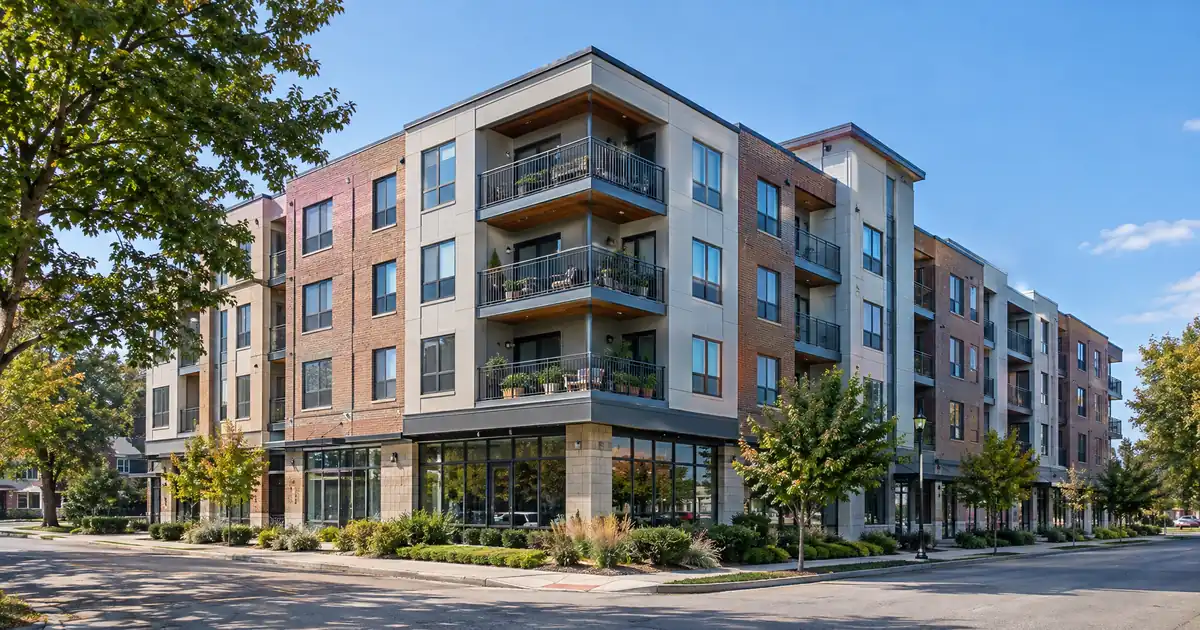
Six hundred twenty-five open jobs paying over $35,000 a year sat against roughly 120 homes for sale in Adams County during one GREDF housing push. Quincy has a real shortage of places to live, and it has a housing stock that doesn’t appraise like one. That mismatch is the whole story for an owner thinking about pulling equity out of a rental here.
The Short Version: A DSCR cash-out refinance in Quincy, Illinois is underwritten primarily on the property’s rental income measured against its full monthly obligation, so the file turns on appraised value in a market with a median sold price near $205,000 per Muddy River News and modest house rents, with leverage capped at 75% LTV. Every figure here varies by lender and program — guidelines, property type, leverage, and credit profile all apply.
DSCR Cash-Out Calculator
Run the cash-out numbers in Quincy, IL
Rate source: Freddie Mac 30-yr average via FRED® — Federal Reserve Bank of St. Louis · effective Sep 24, 2026
Prefilled with starting assumptions — enter your property’s value, balance, taxes, and insurance for a more accurate picture.
Program parameters update from Lendmire’s centralized guideline source. Taxes and insurance are editable estimates.
As of Sep 24, 2026 · General Freddie Mac market benchmark, not a Lendmire loan offer. Property value, balance, taxes, and insurance are editable estimates. Maximum loan-to-value varies by lender, program, property type, and seasoning. Not a Loan Estimate, approval, or commitment to lend. Program availability and eligibility are subject to lender guidelines, credit approval, property review, and underwriting.
- Cash-out leverage tops out at 75% LTV, and seasoning runs about 6 months from title recording.
- House rents near $1,075 against cheap acquisition prices leave single-family coverage thin at full leverage.
- Small multi-unit buildings stack rent onto one balance, which is where coverage improves.
- Comps are sparse and days on market are lengthening, so appraisal support is the main friction. Final terms depend on lender guidelines, property type, leverage, and the borrower’s complete credit picture.
Quincy Market Snapshot
A quick read on the Quincy investor landscape — figures come from the cited sources below. Confirm current property-level numbers before underwriting.
| Metric | Detail |
|---|---|
| Home prices | 167 vs 132 sales (Muddy River News) |
| Population | 45,000 population goal by 2030 (Whig, “Council receives formal report and recommendations from housing task force”) |
| Employment | 3,000+ employees (Blessing Health System careers) |
Why the Housing Shortage Doesn’t Equal Easy Equity
A housing shortfall supports occupancy. It does not raise appraisals. A 2023 GREDF-commissioned study, as reported by Muddy River News, found Adams County needs about 1,500 new housing units over the next decade, and the same reporting cites 300 jobs at a new Amazon last-mile facility. Blessing Health System says it has more than 3,000 employees and is the largest employer in the Quincy area. The demand side of a DSCR file is fine.
The value side is where owners get surprised. Quincy’s population is 39,109 with a median household income of $56,480, and the 2020 count was down from the 2010 count, per Wikipedia. This is a slow-decline city with a supply gap. Tenants exist. Price momentum is modest.
That distinction matters for an equity-extraction file. Muddy River News puts the median sold price near $205,000 with 167 sales in the month reported, up from 132 a year earlier. Redfin shows a lower $162,000 median from an earlier month, up 4.5%, a different method and window. Use one figure per file and name it. The same Redfin page shows median price per square foot at $100, down 2.4% year over year. A rising median with a falling per-foot number usually means mix shift, not broad appreciation. Don’t underwrite the cash-out on the idea that values are climbing.
The Single-Family Math
Single-family rentals at full cash-out leverage mostly land below 1.00 in Quincy. That’s the honest read.
Homes.com lists a median house rent of $1,075 and a price-to-rent ratio of 13.6. Run the numbers on a modeled house at $160,000 (an assumption, not a market quote) renting at that $1,075. Coverage is rent divided by full PITIA, meaning principal, interest, taxes, and insurance. At 75% LTV, using Illinois-average taxes and insurance, that file comes out around 0.9 including taxes and insurance. Bump the assumed value to $205,000 with a $1,200 rent and it slides lower, in the mid-0.8s. Illinois property taxes do most of that damage (most investors underestimate them, and lenders don’t). These specifics are subject to lender guidelines and a full review of property, leverage, and credit.
Below 1.00 on long-term rent isn’t a dead end, but it isn’t a green light either. The structures a lender may review include a lower LTV, a sub-1.00 program, or an interest-only structure. Cutting the same modeled house to 60% LTV moves coverage to roughly 1.1, and 50% LTV clears 1.2. Every one of those paths is subject to lender guidelines, credit approval, and property review. The trade is obvious: lower leverage means less cash out.
Most standard programs use a 1.00 benchmark because rent covers the obligation at that level. Some lenders will look below it, usually with lower leverage, different pricing, or a stronger reserves picture. Baseline, not guarantee. For the full mechanics, Lendmire’s DSCR walkthrough covers how the ratio is built.
Where Multi-Unit Changes the Answer
Small buildings are the natural fit. Per RentCafe’s Census-based breakdown, 54% of Quincy apartments sit in complexes under 50 units, 34% are single-family rentals, and 9% are in buildings of 50 or more. Renters are 36% of housing. Large-complex competition is thin, and the same page puts 2BR asking rents at $850 to $890.
Model a duplex at $200,000 (assumed) with two 2BR units at the low $850 ask. Rent stacks to $1,700, and at 75% LTV coverage runs around 1.2 including taxes and insurance. Same city, same leverage, better number. Two rent streams sit on one balance, one roof, one tax bill. Terms vary by lender guidelines, property type, leverage, credit profile, and full file review.
Here’s the catch. There’s no reliable Quincy source for duplex, triplex, or fourplex values, so that $200,000 is a placeholder. Multi-family also sells slowly. Homes.com shows multi-family homes averaging 62 days listed before sale, so sold comps are fewer and the appraiser reaches farther. Buildings with five or more units get financed commercially, not through standard 1-4 unit programs.
Submarkets: Qualitative Only
No source in the research gives neighborhood-level prices or rents for Quincy. So this is a description of housing type, not a rent table.
The South Side German Historic District, often called Calftown, sits just south of downtown and holds most of the city’s German architecture, per Wikipedia. The University of Illinois’ Mythic Mississippi Project describes sturdy brick cottages there. Small-building and workforce use is plausible, but unverified. Downtown, the Northwest, and East End districts round out four National Register districts and more than 3,500 historic structures, according to Only In Your State. Older brick and large-format homes are exactly where condition adjustments and thin comps collide.
Near Blessing Hospital, staff and service-area demand is plausible. Blessing’s recruiting profile lists Blessing Hospital at 349 beds and a 300,000-plus service population across three states. That’s an employer page, so read it as employer-reported.
Don’t sell Quincy as a college town. Quincy University and John Wood Community College are both small, and neither one drives the rental market. The demand base is health care, manufacturing, and regional employers: Knapheide, Niemann Foods, Titan International, and Quincy Medical Group are all headquartered in the city, and GREDF counts about 100 manufacturers.
Seasoning, Appraisals, and the Equity You Actually Get
Cash-out is built on appraised value, and that’s the soft spot. Seasoning is about 6 months of ownership measured from title recording, and it’s documented by the settlement statement. Files that assume it away get kicked back.
The rest of the equity math:
- Leverage caps at 75% LTV on cash-out, never the 80% purchase figure.
- Reserves run about 6 months of PITIA, more on larger balances.
- Minimum DSCR is 1.00, with credit tiers starting at a 620 floor.
- Usable cash is what’s left after the ratio, reserves, and the LTV ceiling all clear. It isn’t a fixed number. Exact terms depend on the lender’s guidelines, property type, leverage, and a full review of the borrower’s file.
Muddy River News reports homes taking about 43 days to sell versus 37 a year earlier, with about 218 active listings. Slower absorption means appraisers lean on older sales. An appraisal reconsideration request is a routine step on these files: recent in-neighborhood sales, condition adjustments, and documented renovation spend. A well-built packet can recover value. A thin one gets you the first number.
DSCR files in markets like this one typically look like a low-priced asset with a small rent base, where coverage on the full obligation, not the equity, sets the loan size. The brokerage sees the stronger cash-out files carry a signed lease, a current insurance quote, and an appraisal-ready comp set before submission, because Lendmire’s lender partners review the whole package once, not in pieces. Files built on last year’s tax bill or a stale quote are the ones that re-cut mid-review.
Vacancy needs explicit underwriting. There’s no reliable sourced vacancy rate for Quincy, so assume some rather than full occupancy. New supply looks thin, since a local developer told The Whig that homes here get built two or three at a time. That lowers glut risk, though it doesn’t remove vacancy risk.
Rental owners weighing the alternatives can review how DSCR and conventional financing differ, and read the DSCR cash-out refi mechanics or the details on rate-and-term and cash-out refinances. LLC-titled files are subject to lender program eligibility, and entity documents should be in the folder up front.
Where the Proceeds Go
The proceeds only work if the next deal clears its own ratio. Pulling cash out of a house that covers at 0.9 to buy another house that covers at 0.9 stacks two thin files. The cleaner play is redeploying into a small multi-unit building where combined rents carry the balance, or into workforce single-family purchased well below the median. Housing supply here is scarce, so the tenant side of a DSCR file is rarely the problem. Price and appraisal are.
Owners who want a second read on a specific Quincy scenario can review their scenario with me or call 828-256-2183. Statewide program context lives on the page for DSCR loans in Illinois. Program details change, so confirm current terms with a broker, and check local rental rules, taxes, and insurance with qualified local professionals.
What to Pull Before You Apply
The single most useful step is assembling your own sold-comp set before any lender orders an appraisal. Pull recent closed sales for your exact building type and street pattern in Quincy, note days on market, and build the case for value on paper. In a city where a $205,000 median coexists with a $100 price per square foot and slow multi-family sales, whoever brings the comps controls the number.
Frequently Asked Questions
How do you qualify for a DSCR cash-out refinance in Quincy?
Qualification centers on the property’s rent against its full PITIA, with a 1.00 minimum DSCR as the typical benchmark, subject to lender guidelines. Most borrowers need a credit score of at least 620, about 6 months of reserves, and about 6 months of ownership since title recording. Leverage caps at 75% LTV on cash-out.
DSCR vs. conventional financing
Two common ways to finance an investment property in Quincy, IL. They qualify you differently — here’s how investors weigh them.
Why investors choose it
- Qualifies on the property’s rental income — no personal tax returns, W-2s, or pay stubs needed to document income.
- No personal debt-to-income ceiling to clear, so existing mortgages and obligations don’t cap your borrowing the same way.
- Can be closed in an LLC, keeping the property inside a business entity.
- Built for scaling — not held to the limit on number of financed properties that conventional financing applies.
- Underwriting centers on the deal: generally qualifies when the rent covers the payment, a 1.00x coverage ratio being a common baseline (confirmed in underwriting).
- Designed specifically for investment property, including long-term and, where the program allows, short-term rentals.
Where it’s strong
- Often the lowest ongoing financing cost for a buyer who fully qualifies on personal income — a fit for a first property or a cost-first purchase.
Trade-offs for investors
- Requires full personal income documentation and must fit within a debt-to-income limit — salary, existing debts, and other mortgages all count.
- Typically held in your personal name rather than a business entity.
- Caps how many financed properties you can carry, which can become a ceiling as a portfolio grows.
- Evaluates you as a borrower as much as the property, which usually means more paperwork.
How investors usually choose: a first or single property often optimizes for the lowest financing cost; portfolio builders often optimize for leverage, vesting in an LLC, and scaling past conventional caps. The right answer depends on your goals, the property, and current guidelines — both paths run through select lenders in Lendmire’s wholesale network, with eligibility and terms confirmed in underwriting.
What are the requirements for a cash-out refinance on a Quincy investment property?
Expect a lease or rent evidence, entity documents if held in an LLC (subject to program terms), an insurance quote, and an appraisal. Seasoning of about 6 months from recording applies, and the loan must stay within the 75% LTV ceiling. Manufactured homes, log homes, and barndominiums fall outside these programs.
Why do single-family rentals in Quincy struggle to cover at full leverage?
House rents near $1,075 sit against cheap acquisition prices, and taxes and insurance take a large share of that rent. At 75% LTV the modeled coverage lands below 1.00 on many houses. Lower leverage, a sub-1.00 program, or an interest-only structure may apply, subject to lender review.
Does the Quincy housing shortage mean appraisals will come in high?
No. The shortage supports occupancy, but median price growth may reflect mix shift, since price per square foot is down while the median is up. Multi-family comps are also sparse. Bring your own sold comps to any appraisal reconsideration.
For current guidelines and terms, see Lendmire’s DSCR loan programs page.
About Lendmire
A DSCR-focused mortgage broker, Lendmire (NMLS# 2371349) places investor financing across 41 markets, meaning 40 states plus Washington, D.C. Lenders generally review eligibility on the property’s cash flow rather than traditional personal-income documentation, subject to lender guidelines. Scotsman Guide recognized the firm as a 2026 Scotsman Guide Top Mortgage Workplace and, recognized by Scotsman Guide in 2025, it earned the same distinction the year before. See Lendmire’s industry announcements for more.
Get Started
Ready to find the right loan for you?
In about 30 seconds you can review financing options available for your investment property. No commitment required.
Informational only. Not a Loan Estimate, approval, or commitment to lend. Program availability and eligibility are subject to lender guidelines, credit approval, property review, and underwriting.
References
3. Whig, “Council receives formal
4. blessinghealth.org — Experience Blessing Difference
6. 39,109
7. Wikipedia
8. Redfin
9. Homes.com
10. RentCafe’s Census-based breakdown
11. Homes.com
12. Wikipedia
13. Mythic Mississippi Project
15. employer.practicematch.com — Employer Blessing Health System
17. John Wood Community College
18. GREDF
19. The Whig
20. a 2026 Scotsman Guide Top Mortgage Workplace
21. recognized by Scotsman Guide in 2025
This article is part of Lendmire’s investment property cash-out refinance program — full qualification details, guidelines, and scenarios live on the program page.
Related reading: Cash Out Refinance Investment Property Quincy Illinois · Cash Out Refinance Investment Property in Naperville IL · Cash Out Refinance Investment Property in Mount Prospect
Guides: Investment Property Cash-Out Refinance in Illinois
Brandon Miller
Founder & CEO, Mortgage Loan Originator, Lendmire LLC
- Mortgage Loan Originator · NMLS# 1129696 · Verify on NMLS Consumer Access
- North Carolina Real Estate Broker · License# 343312 · Verify on NCREC
- North Carolina Insurance Producer · License# 19053198 · Property, Casualty, Life, Health · Verify on NAIC SBS
- Lendmire LLC · Firm NMLS# 2371349 · Verify firm licensure
Disclosure information. Lendmire is a state-licensed mortgage brokerage under NMLS# 2371349. Lendmire is not a depository institution, direct lender, or financial advisor — all loans referenced are placed through wholesale lender partners and are subject to each lender's underwriting standards. This article is provided for general informational purposes and is not a commitment to lend, nor does it constitute financial, legal, or tax advice. Loan programs, terms, rates, and qualification standards change without notice and depend on borrower profile, property type, and the state in which the subject property is located. Equal Housing Opportunity provider. NMLS Consumer Access: nmlsconsumeraccess.org.