
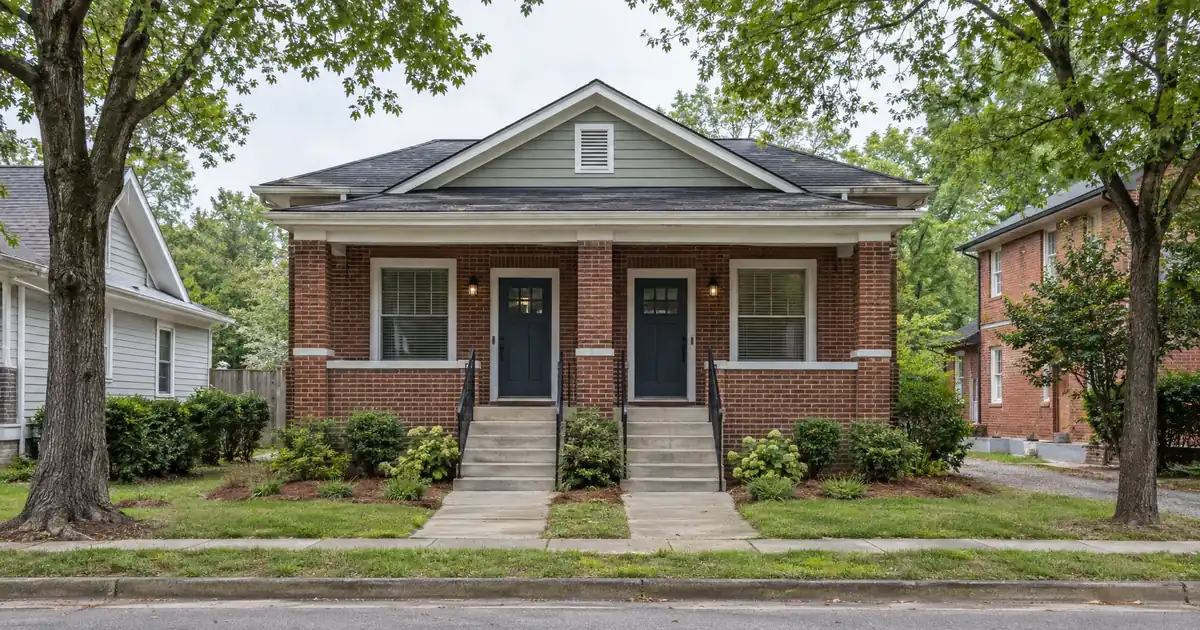
A rental in Boylan Heights hits the DSCR math like this. An older duplex has been owned for more than six months, both units are leased, and the owner wants to pull equity for the next purchase. The appraiser prices market rent below what the asking-rent sites show, and the lender sizes the loan off that lower number. That is the reality of a cash-out refinance investment property deal in Raleigh right now: the file is decided by in-place lease income, not by how much the neighbors’ houses are supposedly worth.
Lendmire (NMLS# 2371349), a DSCR-focused mortgage broker, arranges these files through wholesale investor channels, where the lender reviews eligibility and makes the approval decision. This article covers the equity-extraction side only, meaning what a Raleigh owner can realistically pull out and which property types support it.
DSCR Cash-Out Calculator
Run the cash-out numbers in Raleigh, NC
Rate source: Freddie Mac 30-yr average via FRED® — Federal Reserve Bank of St. Louis · effective Sep 24, 2026
Prefilled with starting assumptions — enter your property’s value, balance, taxes, and insurance for a more accurate picture.
Program parameters update from Lendmire’s centralized guideline source. Taxes and insurance are editable estimates.
As of Sep 24, 2026 · General Freddie Mac market benchmark, not a Lendmire loan offer. Property value, balance, taxes, and insurance are editable estimates. Maximum loan-to-value varies by lender, program, property type, and seasoning. Not a Loan Estimate, approval, or commitment to lend. Program availability and eligibility are subject to lender guidelines, credit approval, property review, and underwriting.
TL;DR: A Raleigh, North Carolina cash-out refinance is underwritten primarily on the property’s in-place rent measured against its full monthly obligation, so leases, seasoning, and appraised market rent drive the outcome more than price appreciation does.
- Metro asking rent was $1,539 per Yardi Matrix, up only 0.1 percent over three months.
- Older duplexes, triplexes, and fourplexes stack income better than new-build product.
- Cash-out LTV tops out at 75 percent, with about six months of seasoning.
- Modeled single-family coverage on a three-bedroom lands below 1.00 with full taxes and insurance.
Raleigh Market Snapshot
A quick read on the Raleigh investor landscape — figures come from the cited sources below. Confirm current property-level numbers before underwriting.
| Metric | Detail |
|---|---|
| Typical rents | $1,539 asking (Yardi Matrix Raleigh) |
| University enrollment | 40,503 enrollment (NC State University Catalog) |
| Employment | 10,291 employees (NC State University Catalog) |
| Vacancy | 7.5%–8.0% (Northmarq (Q3 2025)) |
Why Appreciation Won’t Fund This Refi
Raleigh equity is being built from purchase basis and paydown, not from price momentum. Zillow’s home value index puts the typical Raleigh home at $428,671, down 1.7 percent over the past year. Houzeo, using a different methodology, reports a median sale price of $460,000, down 0.54 percent. Different sources define “median” differently, but every one of them says flat to softening.
Rents tell the same story. Yardi Matrix shows Raleigh–Durham asking rent at $1,539, nearly unchanged over three months. Apartment List has the Raleigh median at $1,374, down 2.2 percent year over year, and Zillow’s rental manager tags the market temperature as cool.
For a cash-out, that means the lender is not giving you credit for projected growth. Underwrite on the leases in the file. Any upside is a bonus, not an assumption.
Seasoning, LTV, and the Paperwork That Stalls Files
The mechanics are simple, and the friction is almost always in the details. Cash-out on an investment property tops out at 75 percent LTV, and the 80 percent purchase figure does not carry over. Seasoning runs about six months of ownership, measured from title recording. The baseline DSCR is 1.00, meaning rent used for lender review covers the full PITIA. Most files also carry about six months of PITIA in reserves, closer to nine above $1,500,000. Credit tiers step up from a 620 floor through 660, 680, and 700, and standard programs run up to $3,000,000. All of this is subject to lender guidelines and varies by borrower, property, and loan scenario. The cash-out qualification details cover the full parameter set.
Here is where Raleigh files get stuck:
- Leases must exist. A DSCR refinance generally needs in-place tenants. A gutted 1920s Craftsman quadplex in the Glenwood-Brooklyn area is a renovation play, so the rehab has to be finished and leased before the cash-out makes sense.
- Rent conclusions differ from asking rents. With Zillow labeling the rental market cool, expect the appraiser’s rent schedule to land conservatively. Model the deal on that lower number.
- Accessory income is a lender call. ADU or accessory-unit rent may or may not count toward rent used for lender review, depending on the lender and the appraisal. Treat it as upside.
- Comps can be thin. Small multifamily inventory in the historic core is limited, and sparse comps can cap the appraised value that the 75 percent applies to.
One reminder, once: verify current local rental rules, taxes, and insurance with qualified local professionals before you commit to a structure.
Working DSCR brokers see a recurring pattern in soft-rent, high-basis markets like this one. The file that clears comfortably is usually a multi-unit property bought at a modest basis and stabilized for a year or more. The file that struggles is a high-priced single-family house whose rent covers only part of its full monthly obligation. Sorting the deal into one of those buckets before ordering the appraisal saves everyone time.
Fourplex Math vs. the Three-Bedroom House
Multi-unit stacking is the strongest DSCR angle in Raleigh, and the single-family workforce rental is the weakest, at least at current prices. The figures below are modeled assumptions, not sourced Raleigh comps. Each is rent divided by full PITIA, including taxes and insurance, at 75 percent LTV.
| Property | Modeled inputs | Coverage read |
|---|---|---|
| Older fourplex | $600,000 price, $1,400 per unit | Around 1.5 |
| 3BR single-family | $450,000 price, $2,026 rent | Around 0.75 |
| New-build duplex | Roughly $1,275,000 per building | Weak on rent-to-value |
The three-bedroom rent is real: Doorstead reports $2,026 as the metro median for three-bedroom rentals. The fourplex assumption of $1,400 per unit sits inside the range that Apartment List and RentCafe show for Raleigh one- and two-bedroom apartments. Yardi’s RentCafe puts two-bedrooms at $1,655. That is why the stacked-unit math works: four rents carry one loan, while a single house has to cover its full monthly obligation on its own.
Run the numbers on the house another way. A $450,000 rental at $2,026 in monthly rent is roughly 0.45 percent of value per month. That is thin, and it is why the single-family coverage lands well under 1.00. Investors in that spot typically look at lower leverage than the 75 percent cap, a stronger credit tier, more reserves, or a sub-1.00 program or interest-only structure. A lender may review any of these, and the outcome depends on lender guidelines, credit approval, and property review. It gets harder, not impossible, and none of it is a promise.
The new-build duplex is the other trap. Homes.com shows a new duplex pair on the market priced at $1,275,000 per building, in a category that also lists product from $245,000 to $3,450,000. Rent doesn’t scale with a seven-figure price. Skip the luxury duplex for cash-out purposes. The math needs premium rents to hold, and premium rents are exactly what a cool market withholds.
Where the Small-Unit Stock Sits
Boylan Heights, Southeast Raleigh, and the historic districts near downtown hold the older small-unit stock that pencils best. Garner and Knightdale carry the workforce single-family and small-unit product. Downtown and North Raleigh are strong markets for owners but poor ones for cash-out coverage.
Boylan Heights and the historic core. Renovated duplexes show up on Homes.com’s Boylan Heights rental listings, and century-old four-unit buildings exist around the near-downtown districts. Tenant demand here draws on downtown employment and NC State proximity. The catch is thin inventory. If you already own one of these, the appraisal comp problem is real, but so is the basis advantage over anything newly built.
Southeast Raleigh. Zillow’s neighborhood guide calls it one of the few areas within city limits with comparatively accessible pricing. That makes it the likeliest place for a workforce or small-multifamily rent-to-value fit. No sourced price or rent figures exist for the submarket, so pull a fresh rent schedule before you assume anything.
Garner and Knightdale. Garner’s median list price is $392,467, with Knightdale priced lower and tied to Raleigh by major roads. A local brokerage reports entry-level homes under $350,000 in Garner, Knightdale, and East Raleigh still drawing multiple offers. That is qualitative evidence of tenant and buyer depth at the low end. Those markets suit a workforce three-bedroom refinance where price is well under the citywide median.
Skip these for cash-out coverage. Redfin shows downtown at a $525,000 median sale price, up 4.4 percent, and North Raleigh at $500,000, up 4.1 percent. Both are good markets for owners and poor ones for DSCR coverage, because the rent has to carry a price that is high for what Raleigh rents produce. Five Points bungalows have the same issue, since bidding-war pricing means thin yield.
Is the Supply Wave Over?
Mostly, and the timing helps a cash-out today. Northmarq reports about 1,300 units delivered in the first quarter, after more than 26,000 completed across the prior two years. It expects deliveries to slow by more than 60 percent from the prior year’s level, and vacancy appears to have peaked at the start of the year. Absorption held up through the wave, with net move-ins of nearly 1,400 units in the quarter. Those figures cover the Raleigh–Durham region, not the city alone. Yardi puts stabilized metro occupancy at 93.1 percent.
The pressure is uneven. Marcus & Millichap expects the Apex-Cary area to face record completions that may pressure rents. It sees limited upcoming openings in Northeast Raleigh and East Durham. A separate operator interview calls Northwest Raleigh a standout because of high barriers to entry and limited new development. An owner near Apex-Cary competes with new lease-ups. An owner in Northeast or Northwest Raleigh has less new supply to fight. These are apartment-market findings, so read them as directional for small rentals.
The stronger cash-out play is probably the supply-constrained submarket, not the new-construction corridor. Investors chasing higher appraised value could argue otherwise, but the lender is sizing the loan on rent.
Who Pays the Rent
Raleigh’s tenant base leans on government, universities, health systems, and research employers. That is a steadier base than a single-industry market. The NC Office of State Budget and Management reports that Raleigh added 33,000 residents between April 2020 and July 2024 and passed 500,000. The RALtoday employer guide, citing chamber and Wake economic development data, lists the State of North Carolina at 24,083 employees, Duke University and Duke Health at 43,108, and WakeMed at 10,307. Wake County has more than 700,000 jobs.
NC State University reported fall enrollment of 40,503 and 10,291 employees, and Yardi says education and health services accounted for 8,000 of the region’s 16,500 net new jobs. Research Triangle Park, founded in 1959 among three Tier-1 research universities, spans 7,000 acres of employers. Renters make up 49 percent of households. That mix of long-tenure employers underpins lease renewals better than a boom-and-bust economy would, which is exactly what a lender wants to see in a refinance file.
What the Cash Does Next
Proceeds from a 75 percent cash-out become the down payment on the next property, so the cash-out and the next purchase should be structured together. An owner with a stabilized Boylan Heights duplex and a seasoned Garner rental has two refinance candidates, and the stronger coverage file should go first. Investor refinance options lay out the paths, and the coverage ratio is calculated from monthly rent and PITIA. Comparing this route to a bank loan matters most for owners hitting financed-property limits. LLC-owned properties are eligible subject to lender program eligibility.
Investors can find more on North Carolina DSCR financing, or request a scenario review or call 828-256-2183 to walk through a specific property.
Frequently Asked Questions
How much equity can I pull from a Raleigh duplex or fourplex?
It depends on rent used for program review, full PITIA, reserves, and the 75 percent LTV ceiling, so it isn’t a guaranteed figure. Multi-unit properties generally leave more coverage cushion than single-family houses at Raleigh prices. Appraised value and the appraiser’s rent conclusion both matter.
DSCR vs. conventional financing
Two common ways to finance an investment property in Raleigh, NC. They qualify you differently — here’s how investors weigh them.
Why investors choose it
- Qualifies on the property’s rental income — no personal tax returns, W-2s, or pay stubs needed to document income.
- No personal debt-to-income ceiling to clear, so existing mortgages and obligations don’t cap your borrowing the same way.
- Can be closed in an LLC, keeping the property inside a business entity.
- Built for scaling — not held to the limit on number of financed properties that conventional financing applies.
- Underwriting centers on the deal: generally qualifies when the rent covers the payment, a 1.00x coverage ratio being a common baseline (confirmed in underwriting).
- Designed specifically for investment property, including long-term and, where the program allows, short-term rentals.
Where it’s strong
- Often the lowest ongoing financing cost for a buyer who fully qualifies on personal income — a fit for a first property or a cost-first purchase.
Trade-offs for investors
- Requires full personal income documentation and must fit within a debt-to-income limit — salary, existing debts, and other mortgages all count.
- Typically held in your personal name rather than a business entity.
- Caps how many financed properties you can carry, which can become a ceiling as a portfolio grows.
- Evaluates you as a borrower as much as the property, which usually means more paperwork.
How investors usually choose: a first or single property often optimizes for the lowest financing cost; portfolio builders often optimize for leverage, vesting in an LLC, and scaling past conventional caps. The right answer depends on your goals, the property, and current guidelines — both paths run through select lenders in Lendmire’s wholesale network, with eligibility and terms confirmed in underwriting.
Do I need to hold a Raleigh rental for six months before a cash-out?
Seasoning is about six months of ownership, measured from title recording. Renovated properties also need leases in place, so the clock and the lease-up run separately. Lender guidelines vary on how they treat recent improvements.
Will asking rents or appraised market rents be used for a Raleigh property?
The lender relies on the appraisal’s rent conclusion and the leases in the file, and often takes the more conservative of the two. With Zillow tagging the Raleigh rental market as cool, model the deal below the asking rents you see online.
Why does a single-family rental in Raleigh struggle on coverage?
Rents in the $2,000 range against prices near $450,000 produce thin rent-to-value, so full PITIA outruns the rent at high leverage. Lower leverage, stronger reserves, or a sub-1.00 program may be reviewed, subject to lender guidelines.
Does a nearby new apartment project hurt my small rental’s refinance?
It can affect the rent conclusion, especially near Apex-Cary, where Marcus & Millichap expects heavy completions. Northeast and Northwest Raleigh face less new supply. The appraiser’s market rent estimate is where that pressure shows up.
Ask a local appraiser what wins in Raleigh and the answer is usually the same: an older, well-kept, fully leased fourplex bought at a sensible basis beats a shiny new building every time, because the rent schedule holds up under scrutiny and the price never had to be justified.
For current guidelines and terms, see Lendmire’s DSCR loan programs page.
About Lendmire
Lendmire, NMLS# 2371349, is a DSCR and non-QM mortgage brokerage with investor loan programs in 41 markets, including Washington, D.C. Lenders commonly review DSCR eligibility around property-level rent rather than personal income documentation, subject to lender guidelines, and the brokerage helps arrange financing for LLC-owned portfolios beyond conventional financed-property limits. Lendmire is recognized as a 2026 Scotsman Guide Top Workplace and was a top-ranked workplace in 2025.
Get Started
Ready to find the right loan for you?
In about 30 seconds you can review financing options available for your investment property. No commitment required.
Informational only. Not a Loan Estimate, approval, or commitment to lend. Program availability and eligibility are subject to lender guidelines, credit approval, property review, and underwriting.
References
1. Yardi Matrix, Raleigh Multifamily Report
2. NC State University Catalog
4. Zillow — Home Values Raleigh NC
6. Doorstead, Raleigh-Durham Rental Market Report
7. RentCafe
8. Homes.com
9. Homes.com’s Boylan Heights rental listings
10. Zillow’s neighborhood guide
11. Redfin
12. Redfin, North Raleigh
13. Northmarq, Raleigh-Durham Multifamily Construction Activity
14. Marcus & Millichap, Raleigh Multifamily Forecast
15. NC Office of State Budget and Management
18. a 2026 Scotsman Guide Top Workplace
19. Scotsman Guide — Top Workplaces 2025
This article is part of Lendmire’s investment property cash-out refinance program — full qualification details, guidelines, and scenarios live on the program page.
Related reading: Cash Out Refinance Investment Property in Raleigh NC · DSCR Loan Raleigh NC Rental Property Investors · DSCR Cash Out Refinance North Carolina
Guides: Investment Property Cash-Out Refinance in Raleigh, NC · Investment Property Cash-Out Refinance in North Carolina
Brandon Miller
Founder & CEO, Mortgage Loan Originator, Lendmire LLC
- Mortgage Loan Originator · NMLS# 1129696 · Verify on NMLS Consumer Access
- North Carolina Real Estate Broker · License# 343312 · Verify on NCREC
- North Carolina Insurance Producer · License# 19053198 · Property, Casualty, Life, Health · Verify on NAIC SBS
- Lendmire LLC · Firm NMLS# 2371349 · Verify firm licensure
Compliance and disclosures. Lendmire (NMLS# 2371349) is a licensed mortgage broker and is not a direct lender, depository institution, financial advisor, or tax professional. Content in this article is general market analysis and educational information — not financial, legal, or tax advice for any specific situation. Lendmire does not guarantee loan approval; every transaction is subject to underwriting by the funding lender. Mortgage pricing and loan program guidelines are subject to change at any time without notice and vary by borrower characteristics, property type, and state regulations. Lendmire complies with Equal Housing Opportunity. Licensure verification: NMLS Consumer Access.