
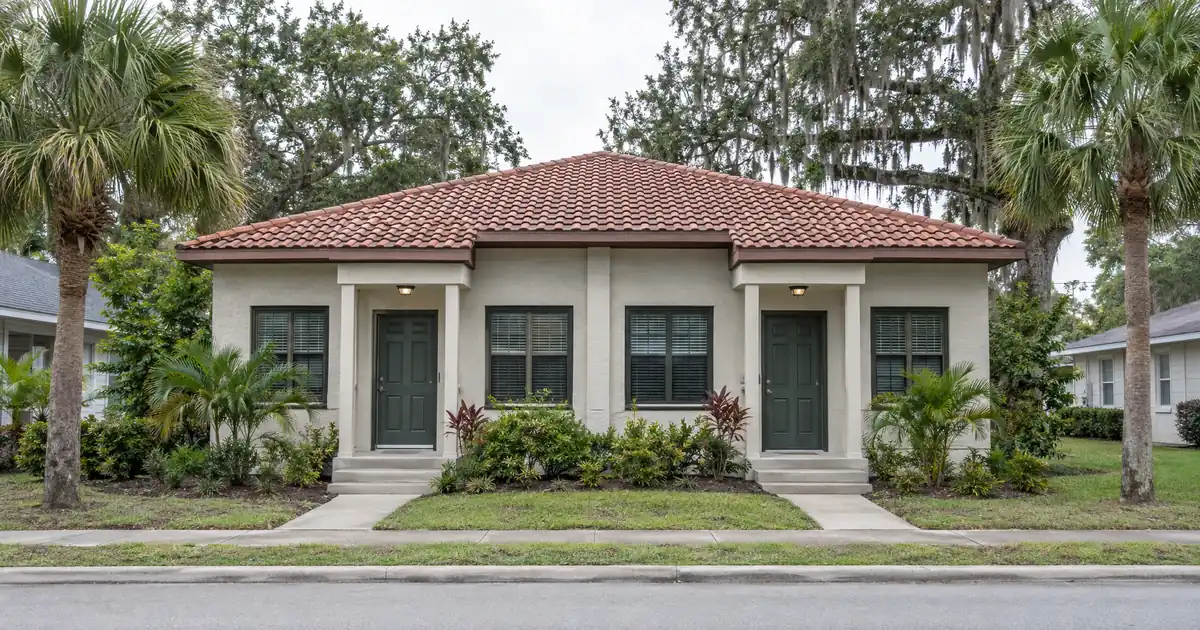
Most Ocala investors hunting for equity look west, toward the horse money. The cleaner coverage math is in Southeast Ocala, where Redfin puts the median sale price at $335K and a listed fourplex projects about $5,000 a month once all four units are leased. The same cash-out refinance on a single-family house at that median price runs into a wall. Property type decides the outcome here, more than neighborhood or appreciation.
TL;DR: A DSCR cash-out refinance in Ocala, Florida is underwritten primarily on the property’s rental income measured against its full monthly obligation, which favors owners of small multifamily over single-family holders who want the maximum borrowing level.
DSCR Cash-Out Calculator
Run the cash-out numbers in Ocala, FL
Rate source: Freddie Mac 30-yr average via FRED® — Federal Reserve Bank of St. Louis · effective Sep 24, 2026
Prefilled with starting assumptions — enter your property’s value, balance, taxes, and insurance for a more accurate picture.
Program parameters update from Lendmire’s centralized guideline source. Taxes and insurance are editable estimates.
As of Sep 24, 2026 · General Freddie Mac market benchmark, not a Lendmire loan offer. Property value, balance, taxes, and insurance are editable estimates. Maximum loan-to-value varies by lender, program, property type, and seasoning. Not a Loan Estimate, approval, or commitment to lend. Program availability and eligibility are subject to lender guidelines, credit approval, property review, and underwriting.
- Southeast Ocala fourplexes with four leased units are the strongest coverage fit in the research.
- Cash-out LTV is capped at 75 percent, with about 6 months of seasoning from title recording.
- Single-family at the Southeast median can land below 1.00x once taxes and insurance are counted.
- Downtown and equestrian-adjacent areas are appreciation plays, not coverage plays.
Ocala Market Snapshot
A quick read on the Ocala investor landscape — figures come from the cited sources below. Confirm current property-level numbers before underwriting.
| Metric | Detail |
|---|---|
| Home prices | $281,975 median sale price (Redfin – Ocala Housing Market) |
| University enrollment | 46,250 students (Marion County Public Schools) |
| Population | 70,245 population (Census Reporter – Ocala City) |
| Employment | 6,000 staff (Marion County Public Schools) |
Southeast Ocala: Where the Coverage Holds Up
Southeast Ocala is the best-supported cash-out submarket in the research, and the reason is multifamily. A fourplex there gives the lender four rent streams against one debt payment, and at 75 percent LTV that arrangement clears the 1.00x baseline with room to spare.
The listing evidence is specific. One occupied fourplex shows projected income near $5,000 monthly, and a separate quadplex lists four fully leased two-bedroom units at $1,400 each, or $5,600 combined. The research puts four-unit acquisitions in roughly the $400,000 to $550,000 range, though that range is an estimate, not a closed-sale median.
Run the numbers on a modeled case. Assume $5,000 in rent used for lender review on a $550,000 fourplex, the top of that range, at 75 percent LTV. Rent divided by full PITIA, with taxes and insurance included, comes out around 1.4x, and lower acquisition costs push it higher. Those are modeled assumptions, not a quote. Lender review, appraisal and the property’s actual lease file decide the final ratio.
Two caveats matter. First, “once all four units are leased” does a lot of work in that listing language, and a lender will size the loan on leases in place or market rent per the appraisal, not the projection. Second, Southeast Ocala’s median price per square foot sits at $185, up 5.1 percent year over year while the headline median is essentially flat. Equity growth here is modest. The cash-out case rests on income and a conservative LTV, not a price surge.
Rent.com’s neighborhood data shows Southeast Ocala one-bedroom rents averaging $1,369. That is apartment data, not single-family or fourplex data, so treat it as a directional read on the submarket’s rent tier.
What Happens When a $335,000 House Meets a 75 Percent Cap?
It falls short of 1.00x. Single-family homes at the Southeast Ocala median price struggle to cover full PITIA at the maximum cash-out LTV, and the shortfall is where most Ocala cash-out files get restructured. Every figure here varies by lender and program — guidelines, property type, leverage, and credit profile all apply.
Consider an investor holding a single-family rental at the $335K Southeast median. Assume $1,700 in monthly rent (a modeled figure, not a sourced market rent). Including taxes and insurance at Florida-average levels, coverage at 75 percent LTV lands around 0.8x. Drop the same house to a lower LTV and the number moves toward 1.00x, but the cash extracted shrinks with it.
A sub-1.00 result is not a dead end, but each path is a tradeoff a lender would review case by case:
- A sub-1.00 DSCR program, which typically carries reduced leverage and stronger credit requirements.
- An interest-only structure, which improves the coverage ratio but defers principal.
- A lower LTV, which trades proceeds for coverage.
Qualification on any of these depends on lender guidelines, credit, reserves and property review. The honest question is whether the sub-1.00 route is worth using. If the house has a real appreciation story, it can be defensible. If the investor is stretching because the numbers fail at every submarket they own in, the problem is the portfolio mix, not the loan.
Working DSCR brokers see a recurring pattern in inland Florida workforce markets like this one: single-family files that looked comfortable on gross rent drift to the edge of 1.00x once full taxes and insurance go into the denominator. The appraisal then lands closer to recent sold comps than to the owner’s expectation. Files that get through cleanly usually arrive with a fresh insurance quote, a lease on the unit and a borrowing level chosen from the coverage ratio rather than from the maximum LTV.
West Ocala and Northwest Ocala: Appreciation Without the Cushion
West Ocala has the strongest recent price momentum in the research, and Northwest Ocala has the weakest. For a cash-out borrower, that makes West the better appraisal story and Northwest the better rent-per-dollar story, and neither has the fourplex cushion.
| Submarket | Median Sale Price | Price/Sq Ft Trend | Cash-Out Read |
|---|---|---|---|
| Southeast Ocala | $335K | $185, up 5.1% | Multifamily-led coverage |
| West Ocala | $254K | $176, up 18.5% | Appraisal upside |
| Northwest Ocala | $261K | $163, down 6.9% | Rent-led, soft values |
Redfin reports West Ocala median at $254K, up 8.2 percent year over year with price per square foot up 18.5 percent. An investor who bought there and has held past the seasoning window may find the appraisal supports more value than the original purchase assumed. Rent.com shows West Ocala one-bedroom rents averaging $1,341.
Northwest Ocala runs the other way. Redfin shows a $261K median with price per square foot down 6.9 percent, yet Rent.com has Northwest one-bedroom rents at $1,514, the highest of the four submarkets it tracks. High rent against softening values makes Northwest Ocala a coverage-friendly submarket, though the College Road corridor’s appeal to renters without cars also means the tenant base turns over with local employment. A cash-out here is an income-driven decision. Don’t count on an appraisal lift.
Silver Springs Shores and Marion Oaks sit in a similar bracket: affordable entry, steady tenant demand and thin sourced data. Without verified sold comps for either, any coverage ratio quoted for those areas would be guesswork.
Downtown Ocala (Hold It, Don’t Harvest It)
Downtown Ocala is the weakest cash-out submarket on pure rental coverage. Walkability, the Reilly Arts Center and a historic core support long-term value, but the rent tier does not support aggressive borrowing.
Rent.com puts Downtown one-bedroom rents at $1,049, the lowest of the four submarkets despite the higher price per square foot. That gap between price and rent is why a Downtown property tends to need a lower LTV to clear 1.00x. Its case rests on appreciation and the owner’s patience.
The timing implication is straightforward. Someone who holds a Downtown property and wants capital should compare the cash from a refinance now against the value of waiting for appreciation to widen the equity cushion. If the borrower also owns coverage-friendly properties elsewhere in Ocala, the better move may be to refinance those and leave Downtown alone. (Harvesting equity from the weakest-coverage asset first is a common sequencing mistake.)
The Equestrian Premium Won’t Repeat
Land near the World Equestrian Center has already had its step-change. Cash-out borrowers there should underwrite moderating equity growth, not another surge.
A market analysis citing Stacker and Redfin figures reports that land within roughly three miles of the center has risen sharply since 2019, with forward estimates pointing to more modest annual gains. It is an aggregator source whose underlying data deserves independent checking, so weigh it accordingly. The center drew an estimated 1.2 million visitors in a year, a large share of them unique.
The more useful finding for a lender is who now lives there. WEC leadership has said the facility lets show-circuit workers base year-round in Ocala and settle down, which turns what looked like seasonal demand into long-term rental demand in the Golden Hills and Golden Ocala corridor. That supports 12-month lease underwriting, the basis a DSCR cash-out relies on.
One caution on property type. Acreage near the center sometimes includes barn apartments or barndominiums. Barndominiums, along with manufactured homes and log homes, fall outside these DSCR programs, so a rural property with that structure as its main dwelling is a different financing conversation.
Tenant Demand That Doesn’t Depend on Horses
Ocala’s rental demand has three legs that don’t depend on equestrian tourism: hospitals, logistics and manufacturing. That diversity is what lets a cash-out lender underwrite long-term occupancy with some confidence.
On the hospital side, AdventHealth Ocala operates a 425-bed acute care hospital, and HCA Florida Ocala Hospital serves as a trauma and stroke center. Shift-work tenants near those campuses create steady demand for workforce-priced single-family and small multifamily stock.
Logistics is the second leg. A local news tally from the Ocala Gazette counts about 2,400 workers at the Commerce Park near I-75 and US-27, where FedEx, Chewy, AutoZone and Amazon operate, and 4,500 distribution and warehouse jobs countywide. The tally dates from a few years back, so treat it as a floor. Manufacturing is the third: Lockheed Martin’s Ocala operations, established in 1970, employ roughly 950 people. Marion County Public Schools adds about 6,000 staff.
Underlying all of it, Census Reporter shows the city at 70,245 residents with a median household income of $61,814. The market is working-class and workforce-priced, which is why coverage depends so much on rent per dollar of price and not on luxury appreciation.
One honest risk: the brief notes Marion County’s rental vacancy ran above the Florida average and listings now point to a more balanced market. For an investor refinancing a single-family rental, that is a reason to carry a lease in place rather than a vacant unit into the appraisal.
How Much Equity Is Actually There?
Less than the median price headline implies. The equity available to a cash-out borrower is the lesser of what the 75 percent LTV cap allows and what coverage supports, minus the payoff and reserves.
Start with the appraisal problem. Zillow puts the typical Ocala home value at $271,737, down 0.5 percent over the past year. Redfin’s three-month figure is higher at $292K, up 12.2 percent, but the same Redfin page shows price per square foot down 4.9 percent. Zillow’s figure is a typical-value index and Redfin’s is a sold-price median, so the two measure different things. When price per square foot falls while the median price rises, bigger or newer homes are selling, not the same home appreciating. An investor’s older house will be appraised against comps matched on size and type, so the headline gain may not transfer.
A percentage example shows the mechanics without a payment figure. Say an investor bought with 25 percent down, so the original LTV was 75 percent. If the appraisal comes back 10 percent above the purchase price, 75 percent of the new value is about 7.5 percent of the original price above the old balance. Before costs and reserves, that is the extractable layer. If the appraisal comes back flat, there is essentially nothing to extract at the 75 percent cap. This is why the appraisal, not the market narrative, sets the cash-out amount.
Other parameters, as typical guidance and subject to lender guidelines:
- Seasoning: about 6 months of ownership, measured from title recording.
- Coverage floor: most standard programs are built around a 1.00x baseline, though some lenders review lower ratios with compensating factors such as stronger credit or lower leverage.
- Credit: tiers generally step through 620, 660, 680 and 700, with 620 as the floor.
- Reserves: about 6 months of PITIA, rising to about 9 months above $1,500,000.
- Loan size: up to $3,000,000 on standard programs, with smaller balances routed through select lenders in the network.
For LLC-held properties, eligibility is subject to lender program eligibility, and that includes title-seasoning and entity documentation.
DSCR vs. conventional financing
There are two common ways to finance an investment property in Ocala, FL, and they qualify you differently — here’s how investors weigh them.
Why investors choose it
- Qualifies on the property’s rental income — no personal tax returns, W-2s, or pay stubs needed to document income.
- No personal debt-to-income ceiling to clear, so existing mortgages and obligations don’t cap your borrowing the same way.
- Can be closed in an LLC, keeping the property inside a business entity.
- Built for scaling — not held to the limit on number of financed properties that conventional financing applies.
- Underwriting centers on the deal: generally qualifies when the rent covers the payment, a 1.00x coverage ratio being a common baseline (confirmed in underwriting).
- Designed specifically for investment property, including long-term and, where the program allows, short-term rentals.
Where it’s strong
- Often the lowest ongoing financing cost for a buyer who fully qualifies on personal income — a fit for a first property or a cost-first purchase.
Trade-offs for investors
- Requires full personal income documentation and must fit within a debt-to-income limit — salary, existing debts, and other mortgages all count.
- Typically held in your personal name rather than a business entity.
- Caps how many financed properties you can carry, which can become a ceiling as a portfolio grows.
- Evaluates you as a borrower as much as the property, which usually means more paperwork.
How investors usually choose: a first or single property often optimizes for the lowest financing cost; portfolio builders often optimize for leverage, vesting in an LLC, and scaling past conventional caps. The right answer depends on your goals, the property, and current guidelines — both paths run through select lenders in Lendmire’s wholesale network, with eligibility and terms confirmed in underwriting.
Where the Proceeds Go
The cash-out thesis depends on what the investor does with the proceeds. Pulling equity from a Southeast Ocala fourplex to buy another multi-unit in the same submarket, where the coverage math has been shown to work, is a straightforward use. Pulling equity to deploy into a market where the numbers don’t pencil is a different decision, and one worth stress-testing first.
The comparison to conventional financing is also situational. An investor with a strong W-2 file and only one or two financed properties may find a conventional cash-out carries lower cost and cleaner underwriting. The DSCR lane tends to win for LLC-held portfolios, self-employed borrowers and anyone near the conventional financed-property cap. DSCR versus conventional covers that break-even in more depth.
This one is a toss-up for borrowers holding both a Southeast Ocala fourplex and a Southeast Ocala single-family. The fourplex clears coverage with room, while the house falls short of the 1.00x coverage level that select programs look for. Refinancing the fourplex first and using part of the proceeds to pay down the house’s balance may do more for the portfolio than refinancing both at once. Run both before choosing.
Frequently Asked Questions
How do you qualify for a DSCR cash-out refinance in Ocala, Florida?
Qualification centers on the property’s rent measured against its full monthly obligation, with a typical baseline of 1.00x, a credit score generally at or above 620, about 6 months of seasoning and cash-out LTV capped at 75 percent. Reserves of about 6 months of PITIA are typical. Final eligibility depends on lender guidelines, the appraisal, the borrower’s credit and the property review.
What are the requirements for an investment property cash-out loan in Ocala, Florida?
The property must be an eligible type, such as a single-family home or a small multifamily, and must be owned about 6 months from title recording. Manufactured homes, log homes and barndominiums are not eligible through these programs, which matters on rural acreage near Ocala’s equestrian areas. Loan size, reserves and credit tiers vary by program and lender.
Does a World Equestrian Center location make cash-out proceeds bigger?
Not reliably. Land near the center has already seen large gains, and one local analysis projects 8 to 15 percent a year going forward, not a repeat of the run-up. The appraisal looks at comparable sales, so proceeds depend on those comps and on coverage, not on proximity to the venue.
Is a fourplex or a single-family rental better for a cash-out refinance in Southeast Ocala?
Typically the fourplex, because four rent streams against one payment produce a stronger coverage ratio at 75 percent LTV. A single-family home at the Southeast Ocala median can land below 1.00x once taxes and insurance are included. The flip point is a single-family with unusually high in-place rent or a lower target LTV.
What can limit DSCR cash-out proceeds in Ocala?
Lendmire arranges DSCR investor loans. The binding constraint is usually the combination of the 75 percent LTV cap and the coverage ratio: if rent doesn’t cover PITIA at the requested loan size, the loan amount shrinks. Reserves and the appraised value can also reduce the final figure.
For current guidelines and terms, see Lendmire’s DSCR loan programs page.
About Lendmire
Lendmire is a DSCR-focused mortgage brokerage, NMLS# 2371349, placing investor loans across 41 markets, including Washington, D.C. A lender generally reviews DSCR eligibility around a property’s rental income rather than personal income documentation, which fits LLC-held rentals, self-employed investors and portfolios scaling past conventional financed-property limits. The firm was named a top-ranked workplace in 2026 and recognized by Scotsman Guide in 2025.
Before ordering any appraisal, pull the last six months of sold comps for your exact property type and square footage in your Ocala submarket, then compare that price per square foot against what you paid.
For broader investor-financing rules and property-type coverage across the state, see Florida DSCR loans.
Investors weighing their equity options can start with cash-out refinance on an investment property.
Get Started
Ready to find the right loan for you?
In about 30 seconds you can review financing options available for your investment property. No commitment required.
Informational only. Not a Loan Estimate, approval, or commitment to lend. Program availability and eligibility are subject to lender guidelines, credit approval, property review, and underwriting.
References
1. Redfin — Southeast Ocala Housing Market
2. Redfin — Marion County Multi Family Homes for Sale
4. Marion County Public Schools
6. Homes.com — Ocala FL Multi Family Homes for Sale
7. Southeast Ocala one-bedroom rents averaging $1,369
8. West Ocala median at $254K, up 8.2 percent year over year
9. $261K median with price per square foot down 6.9 percent
10. 352today.com — World Equestrian Centers Growth Adds to Its Reputation as a Global Destination
11. 352today.com — World Equestrian Center Growing Adding Jobs and Helping Drive Area Economy
13. Ocala Gazette
14. Lockheed Martin’s Ocala operations
15. Zillow — Home Values Ocala FL
16. Scotsman Guide — Top Workplaces 2026
17. recognized by Scotsman Guide in 2025
This article is part of Lendmire’s investment property cash-out refinance program — full qualification details, guidelines, and scenarios live on the program page.
Related reading: Cash Out Refinance Investment Property Ocala Florida · DSCR Loans in Ocala, Florida: Investor Financing for the Horse Capital, Silver Springs, and SE Ocala — Affordable Cash Flow, Retiree Rental Demand, and Central Florida Growth · Cash Out Refinance Investment Property in Coconut Grove, Florida: Can Your Grove Rent Cover the New Loan?
Guides: Investment Property Cash-Out Refinance in Ocala, FL · Investment Property Cash-Out Refinance in Florida
Brandon Miller
Founder & CEO, Mortgage Loan Originator, Lendmire LLC
- Mortgage Loan Originator · NMLS# 1129696 · Verify on NMLS Consumer Access
- North Carolina Real Estate Broker · License# 343312 · Verify on NCREC
- North Carolina Insurance Producer · License# 19053198 · Property, Casualty, Life, Health · Verify on NAIC SBS
- Lendmire LLC · Firm NMLS# 2371349 · Verify firm licensure
Required disclosures. Lendmire (NMLS# 2371349) operates as a licensed mortgage broker, not a direct lender or depository. The discussion in this article is general in nature and should not be relied upon as financial, legal, or tax advice — every investment scenario is unique and should be reviewed by a qualified professional. Any loan inquiry is subject to lender underwriting, and this article is not a commitment to lend or a guarantee of approval. Mortgage rates, loan terms, and program guidelines vary by borrower, property, and state, and may change without notice. Equal Housing Opportunity. Verify licensure at NMLS Consumer Access.