
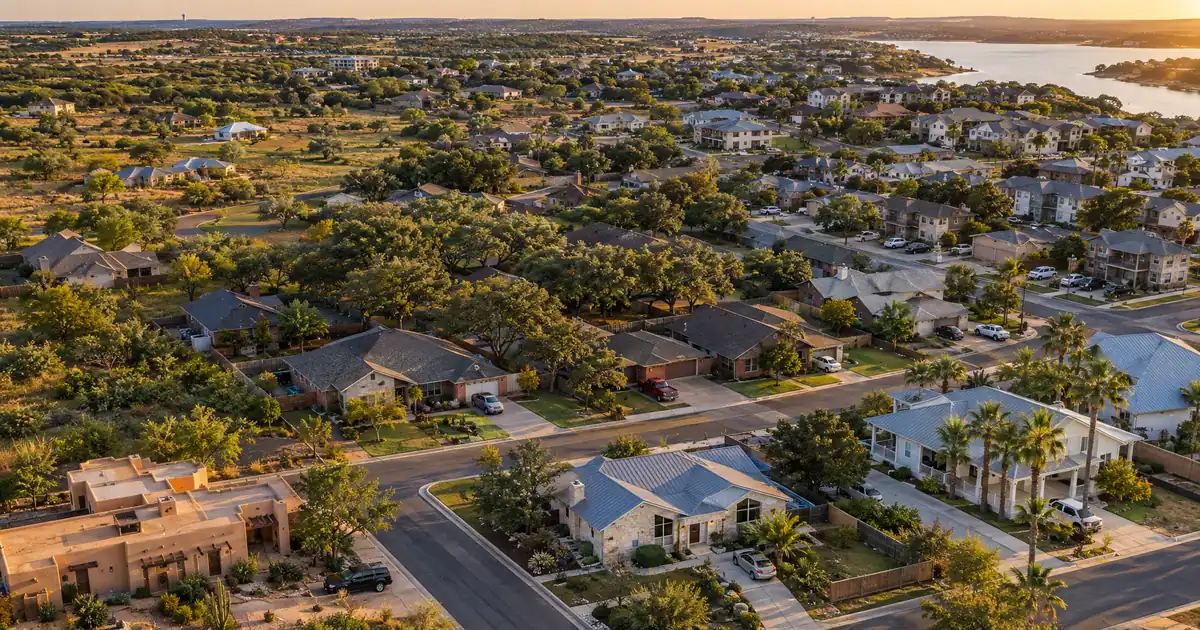
Most investors treat a Round Rock cash-out as an equity question, and it usually isn’t one. A DSCR cash out refinance in Round Rock is a coverage question first. Zillow’s city-level home value sits near $412,831 and is down 4.9 percent over the past year. The rent on a typical single-family home doesn’t carry a 75 percent loan once taxes and insurance are counted. The cash-out that works here depends less on how much equity a property has built and more on whether its rent can support the new balance.
TL;DR: A cash-out refinance on a Round Rock, Texas rental is underwritten primarily on the property’s rental income measured against its full monthly obligation. With prices drifting lower and rents softening, the property type matters more than the equity balance.
DSCR Cash-Out Calculator
Run the cash-out numbers in Round Rock, TX
Rate source: Freddie Mac 30-yr average via FRED® — Federal Reserve Bank of St. Louis · effective Oct 1, 2026
Prefilled with starting assumptions — enter your property’s value, balance, taxes, and insurance for a more accurate picture.
Program parameters update from Lendmire’s centralized guideline source. Taxes and insurance are editable estimates.
As of Oct 1, 2026 · General Freddie Mac market benchmark, not a Lendmire loan offer. Property value, balance, taxes, and insurance are editable estimates. Maximum loan-to-value varies by lender, program, property type, and seasoning. Not a Loan Estimate, approval, or commitment to lend. Program availability and eligibility are subject to lender guidelines, credit approval, property review, and underwriting.
- Zillow shows Round Rock values down 4.9 percent year over year, so appraisals deserve a stress test. Zillow
- Zumper’s median rent is $1,695 and fell 6 percent over the year. Zumper
- Cash-out is capped at 75 percent LTV, with about 6 months of seasoning from title recording.
- Single-family coverage models thin at full leverage. Older duplexes model meaningfully better.
Round Rock Market Snapshot
A quick read on the Round Rock investor landscape — figures come from the cited sources below. Confirm current property-level numbers before underwriting.
| Metric | Detail |
|---|---|
| Home prices | $439,999 median (Homes.com Round Rock multifamily) |
| Vacancy | Double-digit (Apartments.com High Vacancy Q2) |
Where the Cash-Out Math Holds: Older Duplex Pockets
Older duplexes in established subdivisions carry the strongest cash-out math in Round Rock. Highland Estates, Willowbend Estates, and Stony Point are where small multifamily product tends to show up. Two rent streams sit under one loan balance, and that is what moves the coverage number.
The evidence here is listing-based, so treat it as illustrative. Homes.com’s Round Rock multifamily page shows multifamily homes priced from $375,000 to $515,000. One duplex advertises two 3-bed, 2-bath units at $3,550 in gross monthly rent, with tenants covering utilities. Against that price band, the derived gross monthly rent-to-price lands between roughly 0.69 and 0.95 percent. The same arithmetic on single-family, using Zumper’s $1,695 median rent against Zillow’s $412,831 value, gives about 0.41 percent. Derived, not published, but the gap is the whole story.
Run the numbers on a duplex near $449,000, the low end of the Stony Point band (listed at $449,000 to $487,000, with units around 1,327 square feet each). Assume the $3,550 gross rent, a 75 percent LTV cash-out, and full PITIA including taxes and insurance at Texas-average loads. Modeled coverage comes out around 1.1. That is a modeled assumption, not a quote, and it clears the 1.00 benchmark that most standard programs are built around.
Now the catch. Listings in the older subdivisions often show in-place rents per side that sit below the single-family market range, and some are on long leases. Underwrite to the appraiser’s market rent, not the seller’s pro forma. If in-place income is what gets used, the same duplex models close to 1.0 instead of 1.1. Close to 1.0 is workable, but it leaves no cushion if the appraisal comes in light.
Thin comps are the other risk. Homes.com showed only five multifamily listings citywide, and just two in Round Rock West, where the median home price was $465,000. An appraiser building a value on that few sales has to reach, and reaching usually means conservative.
Why Does a Round Rock Three-Bedroom Struggle at Full Leverage?
A typical Round Rock three-bedroom models below 1.00 at 75 percent LTV because monthly rent is a small fraction of price, and the 75 percent loan carries the full weight of principal, interest, taxes, and insurance. The coverage number is rent divided by PITIA. Nothing about it is mysterious. The inputs just aren’t kind here.
Take the walkthrough step by step, using modeled inputs. Start with a $412,831 value (Zillow’s city-level figure). Use a 75 percent LTV cash-out. Count full taxes and insurance at Texas-average loads. For rent, RentCafe puts three-bedroom apartment rent at $1,967, though that data covers only buildings with 50 or more units. Modeled coverage lands around 0.7. Use Zumper’s $1,695 all-property median and it drops into the low 0.6s.
Cut leverage and the number improves, but not as much as most investors expect. Even near 50 percent LTV, the $1,967 rent models just under 1.0. This is why the cash-out proceeds on a single-family rental here can be modest, and why a borrower who assumed “lots of equity” can be surprised.
A sub-1.00 file isn’t automatically a dead end. A lender may review a sub-1.00 program, an interest-only structure, or a lower-leverage version of the same request. Each usually comes with trade-offs: more cash left in the property, stronger credit expected, different pricing. All of it is subject to lender guidelines, credit approval, and property review. The question worth asking first is whether the property should carry that structure at all. If a three-bedroom only works at a lender’s most flexible terms, the numbers may be telling the investor to hold it as is and pull equity from a different asset.
What Conventional Does Better
Conventional cash-out can beat DSCR in this market. For a W-2 borrower with one rental, strong personal income, and a single-family home that models at 0.7 or lower, a conventional product underwrites on the borrower’s income instead of the property’s rent. That sidesteps the coverage problem entirely. The flip point is portfolio size and income documentation. Past four financed properties, or when traditional personal-income documentation doesn’t cleanly show rental income, the conventional lane narrows and DSCR becomes the practical path. There’s a longer comparison at conventional vs DSCR on investor loans.
Six months. That is the seasoning clock, and it starts at title recording, not closing paperwork or the day the tenant moved in.
Seasoning, Valuation, and the 75 Percent Cap
The cash-out refinance caps at 75 percent LTV and generally requires about 6 months of ownership measured from title recording. The cap applies to appraised value, and that value is the least certain number in Round Rock right now. Pulling equity out works backward from the appraisal, so the valuation range deserves attention before anything is submitted.
Sources disagree on where Round Rock’s median sits. Zillow says $412,831, and Homes.com reports a $439,999 median with a $454,176 average for June. An aggregator citing Redfin put the June median closer to $372,787, and a local agent blog claims a higher band. That is a spread of well over $60,000 between credible-looking figures. An appraiser will land somewhere inside it, and a seller’s or agent’s number is not the benchmark.
Model the cash-out at the low end of the range, then stress a further 5 percent price decline. If the deal still works at that value, it works. If it only works at the high end, it doesn’t. Equity available also depends on rent used for lender review, PITIA, reserves of about 6 months PITIA (about 9 months above $1,500,000), and a credit tier that starts at a 620 floor. It is never a guaranteed cash figure. Loan amounts run up to $3,000,000 on standard programs, subject to lender guidelines.
DSCR files in markets like this one, with softening prices and mixed source data, tend to separate on documentation. Lendmire is a non-QM mortgage broker (NMLS# 2371349) arranging DSCR investor loans across 40 states plus Washington, D.C. Its deal desk tends to see the cleaner files when the borrower brings a current lease, a clear rent comparable set, and an insurance quote before the appraisal is ordered. The common friction point is a valuation that arrives below the investor’s expectation after the structure was already planned around the higher number. Building the file around the conservative value first avoids rework.
What the Proceeds Should Buy
Cash-out proceeds make the most sense when they go into another Round Rock asset that models better than the one being refinanced. The strongest case is moving equity from a thin-coverage single-family rental into a duplex in the older subdivisions, where coverage at 75 percent LTV can model near or above 1.0. That is a deliberate shift in property type, and it also diversifies tenant exposure.
The weaker case is pulling equity to buy somewhere the math doesn’t pencil. Out-of-state deployment into a market with similar coverage problems just moves the risk. Pulling equity to cover a shortfall on the property being refinanced is also a red flag.
Then there’s the appreciation question, which is a genuine toss-up. Every source the research found shows prices falling about 5 to 7 percent year over year, and builder incentives are in the market. An investor who believes prices are near a bottom could argue for refinancing now at full available leverage and buying into the dip. An investor who expects further softening could argue for waiting, because a later appraisal at a lower value shrinks the proceeds. Neither is wrong. What’s unwise is a cash-out that only works if prices recover. Details on structure sit under the refinance programs, and the broader state picture is covered in Texas DSCR financing.
For a self-employed investor holding rentals in an LLC, the DSCR route is usually the cleaner lane, subject to lender program eligibility on entity vesting. For a W-2 investor with a single rental and a strong income profile, conventional may still win on cost. Both statements can be true at once.
Demand Anchors Behind the Rent
Round Rock rental demand rests on employment and campus growth, not on commuters alone. The City of Round Rock reports a population above 130,000, about 15 miles north of Austin, ranking 29th largest in Texas. The city names Dell, Round Rock Premium Outlets, Kalahari Resorts and Conventions, Ascension Seton Williamson, Baylor Scott & White Healthcare, St. David’s Round Rock Medical Center, Emerson, Amazon, and UPS among its major employers. The Round Rock Chamber adds that the city hosts the global headquarters of Dell, Emerson Automation Solutions, and Toppan Photomasks.
Dell headcount figures conflict across sources, from roughly 12,000 to more than 13,000. Read it as a large single-employer base in the low five figures. That concentration is both a strength and a risk, since a single tech cycle moves a lot of households.
Hospital and clinical employment is the steadier layer. The Chamber says the city has three Level 2 trauma hospitals, and Texas A&M’s Round Rock medical campus lists more than 400 faculty and access to over ten hospitals. Nurses, residents, and clinical staff suit the 3BR-plus and duplex product, and their demand doesn’t track the tech cycle.
Then there’s the campus. Texas State University’s Round Rock campus reported more than 2,900 students in the most recent fall term, and spring exceeded 3,400. The university has set a stated goal of 10,000 students by the end of the decade, and the plan includes student housing and a first freshman class. The St. David’s School of Nursing is based on the campus. That growth is potential rental demand rarely seen in a suburb, though student housing could also absorb some of it. Renter households make up 44 percent of the city’s total, per RentCafe’s read of Census data.
DSCR vs. conventional financing
There are two common ways to finance an investment property in Round Rock, TX, and they qualify you differently — here’s how investors weigh them.
Why investors choose it
- Qualifies on the property’s rental income — no personal tax returns, W-2s, or pay stubs needed to document income.
- No personal debt-to-income ceiling to clear, so existing mortgages and obligations don’t cap your borrowing the same way.
- Can be closed in an LLC, keeping the property inside a business entity.
- Built for scaling — not held to the limit on number of financed properties that conventional financing applies.
- Underwriting centers on the deal: generally qualifies when the rent covers the payment, a 1.00x coverage ratio being a common baseline (confirmed in underwriting).
- Designed specifically for investment property, including long-term and, where the program allows, short-term rentals.
Where it’s strong
- Often the lowest ongoing financing cost for a buyer who fully qualifies on personal income — a fit for a first property or a cost-first purchase.
Trade-offs for investors
- Requires full personal income documentation and must fit within a debt-to-income limit — salary, existing debts, and other mortgages all count.
- Typically held in your personal name rather than a business entity.
- Caps how many financed properties you can carry, which can become a ceiling as a portfolio grows.
- Evaluates you as a borrower as much as the property, which usually means more paperwork.
How investors usually choose: a first or single property often optimizes for the lowest financing cost; portfolio builders often optimize for leverage, vesting in an LLC, and scaling past conventional caps. The right answer depends on your goals, the property, and current guidelines — both paths run through select lenders in Lendmire’s wholesale network, with eligibility and terms confirmed in underwriting.
The Softness Risk Nobody Should Skip
Rent is soft and the new supply is real. Zumper’s median rent of $1,695 fell 6 percent over the year, and RentCafe’s apartment average of $1,419 slipped 2.87 percent. Neither figure is single-family-specific, but the direction is consistent.
The pressure comes from Austin’s core. Apartments.com, using CoStar data, expects Austin to have added nearly 12,700 units, or 4 percent of inventory, in the past 12 months, with vacancy in double digits. That’s an Austin-metro figure, not a Round Rock one. Still, new Class A apartments compete with suburban single-family rentals for the same tenants, which caps rent growth.
The practical response: underwrite flat rents, not growth. A cash-out that models at 1.05 on today’s rent has little room if rents slip another few percent. Aim for a cushion built in at the start, not one hoped for later. Investors should verify current local rules, taxes, and insurance with qualified local professionals before committing to any structure.
Where the Asymmetry Sits
The underpriced piece of Round Rock, relative to its rent and demand fundamentals, is the older-subdivision duplex. Single-family rents sit near 0.41 to 0.49 percent of price monthly on a derived basis, while listed duplexes in Highland Estates, Willowbend Estates, and Stony Point model between roughly 0.69 and 0.95 percent gross. They also sit near the Dell, hospital, and Texas State demand anchors. Supply is scarce because the city’s housing is largely single-use subdivisions, per Round Rock 2030. That scarcity cuts both ways: the right duplex is hard to find and harder to appraise, but a buyer who finds one with market-rate rents is holding the one asset type here where full-leverage coverage can clear.
Frequently Asked Questions
How do you qualify for a DSCR cash-out refinance on a Round Rock rental?
Qualification centers on the property’s rent measured against its full PITIA, with 1.00 as the common baseline. The lender reviews the lease or market rent, the appraisal, the borrower’s credit, and reserves. A Round Rock three-bedroom often models below 1.00 at full leverage, so many borrowers need lower LTV or a different structure. Details on “What Is a DSCR Loan” are on the main program page.
What are the requirements for a cash-out refinance on an investment property in Round Rock, Texas?
Typical guidance includes about 6 months of ownership from title recording, a maximum 75 percent LTV, a credit floor of 620, and reserves of about 6 months PITIA. Loan amounts run up to $3,000,000 on standard programs. Manufactured homes, log homes, and barndominiums fall outside these programs. All of it is subject to lender guidelines and property review.
Will falling Round Rock prices shrink my cash-out?
Yes, potentially. The 75 percent cap applies to appraised value, and Zillow shows values down 4.9 percent year over year. A lower appraisal means a lower maximum balance. Modeling at the low end of the valuation range and stressing another 5 percent drop shows whether the deal survives.
Does a Round Rock duplex really cash out better than a three-bedroom?
Usually, on coverage. Two rent streams against one balance lift the rent-to-price ratio, so a duplex models near or above 1.0 where a single-family home models around 0.7. The tradeoffs are thinner appraisal comps and in-place rents that may sit below market. A single-family home in a stronger rent pocket can still work at lower leverage.
What credit score ranges may DSCR lenders review for a Round Rock rental property?
Credit tiers commonly reviewed run at 620, 660, 680, and 700, with a 620 floor, and leverage and pricing generally improve as scores climb. Lendmire arranges DSCR investor loans. Programs are underwritten primarily on property cash flow, subject to lender guidelines. To discuss a specific file, start your quote or call 828-256-2183.
For current guidelines and terms, see Lendmire’s DSCR loan programs page.
About Lendmire
A non-QM mortgage broker (NMLS# 2371349), Lendmire arranges DSCR financing for real estate investors in 41 markets, which means 40 states plus Washington, D.C. Because deals are underwritten primarily on property cash flow rather than personal income documentation, the structure suits self-employed buyers and entity-owned portfolios. Lendmire places loans through wholesale investor lenders and is not a direct lender. The brokerage is recognized as a 2026 Scotsman Guide Top Workplace and a 2025 Scotsman Guide Top Mortgage Workplace.
Get Started
Ready to find the right loan for you?
In about 30 seconds you can review financing options available for your investment property. No commitment required.
Informational only. Not a Loan Estimate, approval, or commitment to lend. Program availability and eligibility are subject to lender guidelines, credit approval, property review, and underwriting.
References
1. Zillow, Round Rock Home Values
2. Zumper, Round Rock Rent Research
3. Homes.com, Round Rock Multifamily
4. Apartments.com, High Vacancy Markets
5. RentCafe, Round Rock Rent Trends
6. City of Round Rock, About Round Rock
7. Round Rock Chamber, Major Employers
8. Texas A&M’s Round Rock medical campus
9. Texas State University, Round Rock Campus
10. Round Rock 2030
11. a 2026 Scotsman Guide Top Workplace
12. a 2025 Scotsman Guide Top Mortgage Workplace
This article is part of Lendmire’s investment property cash-out refinance program — full qualification details, guidelines, and scenarios live on the program page.
Related reading: Cash Out Refinance Investment Property Round Rock Texas · DSCR Loans in Round Rock / Georgetown, Texas: Investor Financing for Williamson County’s Tech Corridor, Sun City & Suburban Cash-Flow Markets · DSCR Cash Out Refinance in Rock Island, Illinois: Arsenal Paychecks and Duplex Equity
Guides: Investment Property Cash-Out Refinance in Round Rock, TX · Investment Property Cash-Out Refinance in Texas
Brandon Miller
Founder & CEO, Mortgage Loan Originator, Lendmire LLC
- Mortgage Loan Originator · NMLS# 1129696 · Verify on NMLS Consumer Access
- North Carolina Real Estate Broker · License# 343312 · Verify on NCREC
- North Carolina Insurance Producer · License# 19053198 · Property, Casualty, Life, Health · Verify on NAIC SBS
- Lendmire LLC · Firm NMLS# 2371349 · Verify firm licensure
Important disclosures. Lendmire (NMLS# 2371349) is a licensed mortgage brokerage. Lendmire is not a direct lender, depository institution, or financial advisor. All loan inquiries are subject to lender underwriting; this article does not constitute a commitment to lend. Rates, terms, and program guidelines are subject to change without notice and vary by borrower profile, property type, and state. Information in this article is general in nature and is not financial, legal, or tax advice. Equal Housing Opportunity. NMLS Consumer Access: nmlsconsumeraccess.org.