
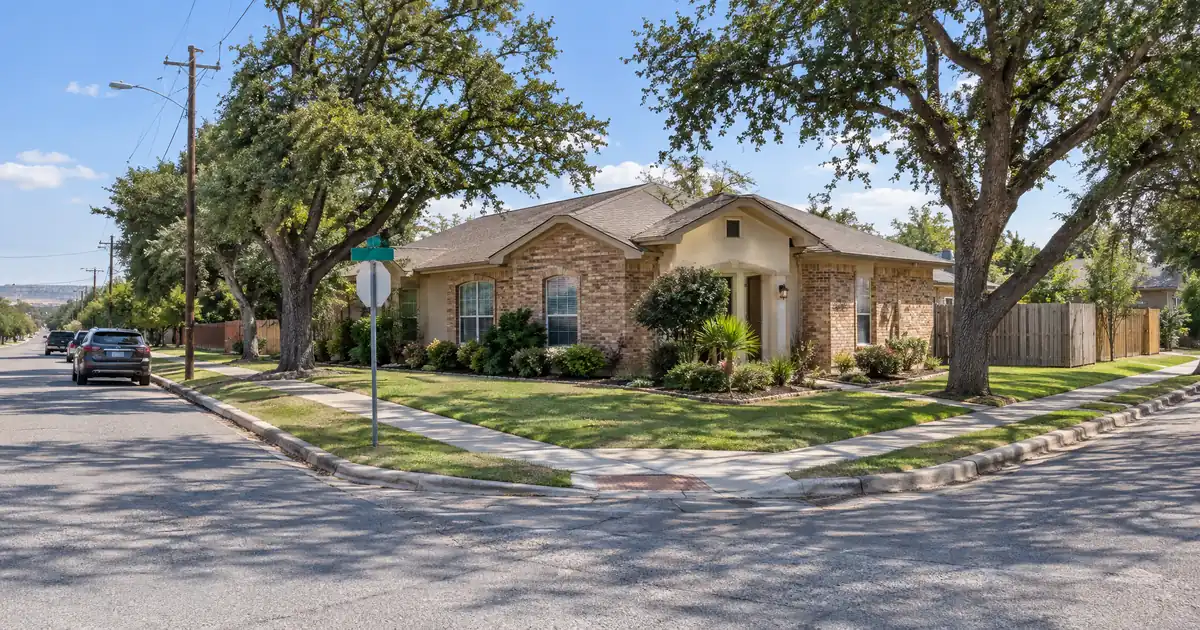
An out-of-state investor scanning San Angelo usually notices two things first. Prices look low next to the big Texas metros, and the tenant base looks steady: an Air Force training base, a regional hospital system, and a university posting record enrollment. What gets missed is how wide the price spread runs. Resideline tracked a citywide six-month median closing of $265,000, with the middle half of sales landing between $195,000 and $359,000.
For someone who already owns here, that spread is the whole cash-out conversation. Proceeds come from the appraisal. The appraisal comes from the comp set. The comp set depends on which side of town the house sits on. So the question to ask isn’t “what’s the median.” It’s “what sold near this house, and what does it rent for.”
DSCR Cash-Out Calculator
Run the cash-out numbers in San Angelo, TX
Rate source: Freddie Mac 30-yr average via FRED® — Federal Reserve Bank of St. Louis · effective Sep 24, 2026
Prefilled with starting assumptions — enter your property’s value, balance, taxes, and insurance for a more accurate picture.
Program parameters update from Lendmire’s centralized guideline source. Taxes and insurance are editable estimates.
As of Sep 24, 2026 · General Freddie Mac market benchmark, not a Lendmire loan offer. Property value, balance, taxes, and insurance are editable estimates. Maximum loan-to-value varies by lender, program, property type, and seasoning. Not a Loan Estimate, approval, or commitment to lend. Program availability and eligibility are subject to lender guidelines, credit approval, property review, and underwriting.
At a Glance: A DSCR cash-out refinance in San Angelo, Texas is underwritten primarily on the property’s rental income measured against its full monthly obligation, and in a flat-population market with a wide spread between side-of-town values, the appraisal comp set decides how much equity is actually reachable under the 75% LTV ceiling. Every figure here varies by lender and program — guidelines, property type, leverage, and credit profile all apply.
- The middle half of closings spans $195,000 to $359,000, so comps must come from the same side of town.
- Cash-out typically needs about 6 months of ownership, measured from title recording.
- Goodfellow AFB, Shannon Health, and Angelo State University anchor long-term rental demand.
- Small multifamily is only about 4.56% of housing units, per NeighborhoodScout, so duplex comps run thin.
- Proceeds depend on rent used for lender review, full PITIA, reserves near 6 months, and the 75% cap, subject to lender guidelines.
San Angelo Market Snapshot
A quick read on the San Angelo investor landscape — figures come from the cited sources below. Confirm current property-level numbers before underwriting.
| Metric | Detail |
|---|---|
| Home prices | $245K median (Redfin multifamily listings) |
| University enrollment | 12,003 students (Texas Comptroller) |
| Employment | 6,567 direct employees (Texas Comptroller) |
Central San Angelo: Where the Rent-to-Value Ratio Is Strongest
The older core around Santa Rita, Fort Concho, and the Westside gives the best rent-to-value ratio in the city for DSCR purposes. Redfin shows a central San Angelo median sale price of $175,000, and Rentometer puts two-bedroom houses in areas like Fort Concho and the Westside near $1,200. That works out to roughly 0.7% gross monthly rent against price, versus about 0.45% if the same rent sits against the $265,000 citywide median. Those ratios are simple arithmetic on aggregator figures, directional only.
One caution on the Redfin number. It shows central prices up 16.7% year over year, but on only 11 sales in the month. That’s a small sample. One good month of closings doesn’t make a trend, and nobody should underwrite a refinance to it.
The character of the stock matters for the file. ERA Newlin’s MLS area notes tie Santa Rita to the oil well it’s named for, with homes mostly from the early-to-mid twentieth century. Older houses mean condition adjustments. They also mean an appraiser who may price the house low on the first pass. A reconsideration packet with recent same-neighborhood sales, plus documented updates like roof, HVAC, and plumbing, is a routine step here, not an emergency move.
Demand in the core comes from proximity. Downtown, Shannon Health, and the Concho River Walk sit close by. The River Walk runs roughly four miles, and San Angelo voters funded riverfront improvements through a sales tax that generated $15 million. That kind of civic investment supports the long-term pull of the central blocks.
Apartments tell a different story. Rent.com’s one-bedroom averages run $625 in Angelo Heights and $737 downtown. Per-door rent is low in absolute dollars, so stacking small units only works when the price per door is low too. Skip the idea of buying expensive small units and hoping rent catches up.
Paulann and East Angelo: The Goodfellow Factor
The submarket near Goodfellow Air Force Base carries a demand feature few Texas cities this size have: constant turnover of trainees on top of a permanent workforce. The Texas Comptroller records 6,567 direct employees at Goodfellow, including 5,516 active-duty, and the base’s training group graduates nearly 14,000 students a year in fire protection and intelligence training. The same office’s earlier write-up calls the base’s fire academy the only military firefighting school in the country.
Overflow demand shows up in the paperwork too. The city has had an agreement with Goodfellow to house 100 unaccompanied base personnel at Angelo State. When the base needs outside beds, the nearby rental stock feels it.
What the research does not give is neighborhood-level price data for Paulann and East Angelo. No reliable sale-price or house-rent figures turned up, so this section stays qualitative. For a cash-out file, that matters: if an owner here is counting on a number, the appraiser’s comps will be the first real data point.
On the documentation side, mixed tenancy means the lease evidence has to be clean. A rent roll with short-term leases next to annual leases invites questions. Dated lease copies, tenant names, and term lengths ready before the file goes in keep the review from stalling on rent clarity.
Angelo State, Shannon, and the Employment Floor
Three institutions hold up the long-term renter pool: the university, the hospital system, and the base. Angelo State University reported 12,003 students in the latest fall term, up from 11,542 the year before, with about 1,900 graduate students. That was the third straight record.
Shannon Health is the largest locally based healthcare provider for the Concho Valley. A local employer ranking put it second in the city at about 4,149 employees, with San Angelo ISD at 1,934. Health Care and Social Assistance is the biggest industry group, at roughly 7,300 jobs in a Chamber of Commerce summary (the article is undated, so treat it as approximate).
The jobs picture is steady. Texas Workforce Commission data, reported by Yahoo News, put San Angelo’s unemployment at 3.6% in August, second-lowest among Texas metros, against 4.4% statewide. Population, by contrast, is flat. Census Reporter counts 99,661 residents, about the same as the last decade.
Flat population plus low unemployment means this is a stability market, not an appreciation market. That shapes how to think about cash-out. Equity here comes mostly from buying right, improving the property, and letting the last several years of price growth sit in the appraisal. It does not come from expecting next year’s bump.
Student-area rents are worth a look for context. Rent.com shows one-bedroom averages of $700 near ASU and College Hills and $1,050 in Vista del Arroyo. Those are apartment numbers, not house rents, so they don’t translate directly to a three-bedroom refinance.
What the Cash-Out Actually Depends On
A DSCR cash-out refinance here comes down to four inputs: the appraised value, the rent used for lender review, the full monthly obligation (principal, interest, taxes, insurance, and any HOA dues), and the program’s 75% LTV ceiling. Equity in a house isn’t cash in hand. The math has to clear all four at once, subject to lender guidelines. For a refresher on the ratio itself, see the guide “What Is a DSCR Loan”.
Most standard programs are built around a 1.00x benchmark, where rent covers the full obligation. Some lenders review lower ratios, but that usually means stronger compensating factors, lower leverage, or different terms. Credit tiers typically start at a 620 floor, with better positioning at 660, 680, and 700. Reserves typically run about six months of PITIA, documented on the file.
Seasoning is the quiet gate. Cash-out typically needs about six months of ownership, measured from the recording of title. Files that count from contract date, or assume the requirement away on a recent purchase, get kicked back. The settlement statement and recorded deed settle the question.
On appreciation, the readings are mixed. Zillow shows values up 4.9% over the past year. Homes.com shows the 12-month median sale price up 1% to $255,000. Gains over the longer stretch have been real but have cooled. For a new refinance, underwrite to today’s appraisal, not to trend.
Lendmire (NMLS# 2371349) structures DSCR scenarios for investors targeting San Angelo, Texas and places them with wholesale lenders across 41 markets, including D.C. On a file like this, the work starts with the rent and the comps, well before any loan amount is discussed.
Run the Numbers on Three Properties
These scenarios are modeled assumptions, not cited market facts. Coverage is rent divided by full PITIA (taxes and insurance included), on a 30-year amortization, at the 75% ceiling. Real files depend on the actual quote, tax bill, and insurance binder.
A three-bedroom at typical value. Say a house appraises near Zillow’s typical San Angelo value of $198,398 and rents at Rentometer’s three-bedroom average of $1,688. At 75% LTV, coverage lands around 1.2x including taxes and insurance. That clears the usual benchmark with some cushion. Final terms depend on lender guidelines, property type, leverage, and the borrower’s complete credit picture.
The same house, appraised high. Consider the identical rent on a house appraising near the $265,000 citywide median. Coverage slips to roughly 0.9x. Same rent, bigger obligation. The ratio flips below 1.00 on long-term rent alone.
A lender could review several structures for a file like that: a sub-1.00 program with compensating factors, an interest-only option, a lower LTV, or a principal paydown at closing. Whether any of those fits depends on lender guidelines, credit, reserves, and property review. None of it is a given.
A duplex near the median listing. Run the numbers on a duplex around the roughly $245,000 median listing price Redfin shows for multifamily, with two units at $1,100 to $1,250 each. Coverage comes out roughly 1.3x or better at 75%. The rent-to-price ratio is higher than the single-family cases, so a duplex at the median can clear coverage that a similarly priced house may miss.
That’s the tension worth sitting with. Thinking it through out loud: the duplex wins on the coverage math, but the same thing that makes it a better ratio makes it harder to appraise.
The Thin-Comp Problem on Small Multifamily
San Angelo’s housing stock is overwhelmingly houses. NeighborhoodScout reports single-family detached homes at 70.95% of units, duplexes, converted homes, and small apartment buildings at about 4.56%, and large complexes at 17.16%. Redfin’s live multifamily count was around 10 listings when checked.
Scarcity cuts both ways. A duplex or triplex is a differentiated asset, and the rent-to-price math favors it. But an appraiser pulling comps for a two-unit property may have to widen the search radius, reach back further in time, or lean on single-family sales with adjustments. Any of those can pull value down. Since Texas is a non-disclosure state, sale prices aren’t in the public record, so the comp set leans on MLS data and the appraiser’s own access.
Working DSCR brokers see a recurring pattern in small, flat-population markets like this one: the rent side of the file is easy and the valuation side is where it gets stuck. Coverage ratios pencil cleanly on leases, then the appraisal comes in light because the comp set is thin or drawn from the wrong part of town. The fix is usually built before the file goes in. That means a list of nearby closings, condition documentation, and an honest read on the side of town, so a reconsideration request has real support behind it.
Skip the Bluffs
The Bluffs, Bentwood, and the Lake Nasworthy area sit at the high end of the market and are generally owner-occupied. Homes.com-style neighborhood descriptions and realtor guides put them as premier neighborhoods, but the research found no reliable price or rent figures there. Low rental density means few rental comps. If you own a rental in that area, the appraiser may struggle to support the rent used for lender review at all.
The southwest side, the Southland corridor off Loop 306, is a closer call. It’s an established neighborhood with newer retail nearby and homes roughly 25 to 40 years old. Realtor blogs put prices around $200,000 to $300,000, but the figures are undated, so this stays qualitative. It might suit a workforce three-bedroom refinance, though the price band runs close enough to the median that the coverage math needs a close look before anyone assumes it works.
Rural and acreage properties around the city add one more check. Manufactured homes, log homes, and barndominiums fall outside these DSCR programs, however they are zoned or sold locally.
What Derails a San Angelo File
The friction points on cash-out files here are mostly documentation and valuation, not income.
1. Seasoning proof. The recorded deed and settlement statement have to show the ownership clock. A recent purchase with a rehab and a new lease doesn’t change the requirement.
2. Entity documents. If the property is held in an LLC, the operating agreement, formation documents, and good-standing evidence should be current and match the title, subject to lender program eligibility.
3. Lease evidence. Signed leases, rent roll, and, where needed, proof of rent received. Mixed tenancy near Goodfellow makes this matter more.
4. Reserves documentation. About six months of PITIA, showing the source. A statement that’s stale or shows a large recent transfer draws questions.
DSCR vs. conventional financing
There are two common ways to finance an investment property in San Angelo, TX, and they qualify you differently — here’s how investors weigh them.
Why investors choose it
- Qualifies on the property’s rental income — no personal tax returns, W-2s, or pay stubs needed to document income.
- No personal debt-to-income ceiling to clear, so existing mortgages and obligations don’t cap your borrowing the same way.
- Can be closed in an LLC, keeping the property inside a business entity.
- Built for scaling — not held to the limit on number of financed properties that conventional financing applies.
- Underwriting centers on the deal: generally qualifies when the rent covers the payment, a 1.00x coverage ratio being a common baseline (confirmed in underwriting).
- Designed specifically for investment property, including long-term and, where the program allows, short-term rentals.
Where it’s strong
- Often the lowest ongoing financing cost for a buyer who fully qualifies on personal income — a fit for a first property or a cost-first purchase.
Trade-offs for investors
- Requires full personal income documentation and must fit within a debt-to-income limit — salary, existing debts, and other mortgages all count.
- Typically held in your personal name rather than a business entity.
- Caps how many financed properties you can carry, which can become a ceiling as a portfolio grows.
- Evaluates you as a borrower as much as the property, which usually means more paperwork.
How investors usually choose: a first or single property often optimizes for the lowest financing cost; portfolio builders often optimize for leverage, vesting in an LLC, and scaling past conventional caps. The right answer depends on your goals, the property, and current guidelines — both paths run through select lenders in Lendmire’s wholesale network, with eligibility and terms confirmed in underwriting.
5. Insurance quote completeness. A partial binder or an old quote changes the PITIA line and so the ratio. Get current quotes in before review starts.
6. Appraisal comps. Same-side-of-town sales, recent, and adjusted for condition. The spread in this market makes this the single biggest swing factor.
Another check sits outside the loan: verify current local rental rules, property taxes, and insurance costs with qualified local professionals before underwriting.
When the file goes in clean, with leases, entity documents, title information, and property details ready for program review, the reviewer has fewer preventable gaps to chase. It doesn’t guarantee approval. It does mean the file doesn’t stall on paperwork that was always going to be asked for.
Investors with equity to recycle can see the equity recycle pathway for how proceeds move into the next acquisition, and the refinance side for the broader rate-and-term comparison. The difference from a conventional investor refinance is worth a look too: the guide “Where DSCR and Conventional Diverge”. Investors ready to see a scenario can get a rental-income loan quote or call 828-256-2183. The state-level picture sits under Lendmire’s Texas DSCR loan programs.
A Note on Vacancy
NeighborhoodScout classifies 11.50% of the housing stock as vacant, but that’s a citywide, all-tenure figure that includes seasonal and for-sale units. It is not a rental vacancy rate, and no reliable rental vacancy number turned up. Zillow’s rental page showed about 121 rentals available at one point, which suggests a shallow pool. Build a vacancy allowance into any stress test and check listing depth near the property rather than trusting a citywide statistic.
San Angelo appraises house by house. A three-bedroom on the central side and a three-bedroom on the southwest loop corridor can carry the same description and sit tens of thousands of dollars apart. Get the comps first, rent second, and treat any equity number as a range until the appraisal lands.
Frequently Asked Questions
How do you qualify for a DSCR cash-out refinance in San Angelo, Texas?
The property’s rent has to cover its full monthly obligation, with a 1.00x benchmark common on standard programs. Typical guidelines include a credit floor around 620, a 75% maximum LTV on cash-out, about six months of seasoning from title recording, and roughly six months of PITIA in reserves. Exact eligibility depends on the lender, credit profile, and property review.
What are the requirements for a cash-out refinance on a San Angelo duplex?
The same core requirements apply, but valuation is the pressure point. Duplexes are only about 4.56% of the city’s housing units, so appraisers may pull from wider areas or adjust single-family comps. Have current leases for both units, entity documents if an LLC holds title, and a list of nearby sales ready for an appraisal reconsideration if needed.
Why does the side of town matter so much for cash-out value in San Angelo?
The middle half of closings spans $195,000 to $359,000, so a citywide median says little about one house. Central and near-core homes can carry a stronger rent-to-value ratio than houses bought near the $265,000 median. Appraised value drives proceeds, so comps should come from the specific neighborhood.
Can Lendmire help structure DSCR financing for small multifamily investment properties in San Angelo?
Yes. Lendmire is a DSCR-focused mortgage broker that places investor loans with wholesale lenders. Qualification is based primarily on the property’s rental income, and cash-out is typically available up to a 75% LTV ceiling, subject to lender guidelines.
Does flat appreciation limit cash-out options in San Angelo?
It limits how much new equity appears, not whether a refinance can work. Zillow shows values up 4.9% over the past year, and earlier gains have cooled but remain in the appraisal. A refinance should be underwritten to today’s appraised value, not projected growth.
For current guidelines and terms, see Lendmire’s DSCR loan programs page.
About Lendmire
Lendmire (NMLS# 2371349) is a mortgage brokerage focused on DSCR investor lending, with programs available in 41 markets, including Washington, D.C. DSCR lenders commonly look at rental-income coverage rather than personal income paperwork, which suits LLC-owned and multi-property investors. The firm is a 2026 Scotsman Guide Top Mortgage Workplace and was recognized by Scotsman Guide in 2025. Terms vary by lender, property, leverage, and program.
Get Started
Ready to find the right loan for you?
In about 30 seconds you can review financing options available for your investment property. No commitment required.
Informational only. Not a Loan Estimate, approval, or commitment to lend. Program availability and eligibility are subject to lender guidelines, credit approval, property review, and underwriting.
References
1. Resideline: San Angelo housing market
2. NeighborhoodScout: San Angelo real estate
3. Redfin — San Angelo Multi Family Homes for Sale
4. Texas Comptroller: Goodfellow AFB
7. ERA Newlin’s MLS area notes
8. San Angelo voters funded riverfront improvements through a sales tax that generated $15 million
9. Rent.com’s one-bedroom averages
10. comptroller.texas.gov — September Military
11. an agreement with Goodfellow to house 100 unaccompanied base personnel at Angelo State
13. Angelo State University: record fall enrollment
14. Shannon Health
15. second in the city at about 4,149 employees, with San Angelo ISD at 1,934
17. Census Reporter: San Angelo
18. Zillow shows values up 4.9% over the past year
19.
20. Homes.com-style neighborhood descriptions
21. Zillow’s rental page showed about 121 rentals available
22. a 2026 Scotsman Guide Top Mortgage Workplace
23. recognized by Scotsman Guide in 2025
This article is part of Lendmire’s investment property cash-out refinance program — full qualification details, guidelines, and scenarios live on the program page.
Related reading: Cash Out Refinance Investment Property in San Angelo TX · DSCR Cash Out Refinance in Laredo, Texas: Can Your Rent Cover a Bigger Loan? · Cash Out Refinance Investment Property in Boerne, Texas: Can Your Equity Fund the Next Deal?
Guides: Investment Property Cash-Out Refinance in San Angelo, TX · Investment Property Cash-Out Refinance in Texas
Brandon Miller
Founder & CEO, Mortgage Loan Originator, Lendmire LLC
- Mortgage Loan Originator · NMLS# 1129696 · Verify on NMLS Consumer Access
- North Carolina Real Estate Broker · License# 343312 · Verify on NCREC
- North Carolina Insurance Producer · License# 19053198 · Property, Casualty, Life, Health · Verify on NAIC SBS
- Lendmire LLC · Firm NMLS# 2371349 · Verify firm licensure
Disclosure information. Lendmire is a state-licensed mortgage brokerage under NMLS# 2371349. Lendmire is not a depository institution, direct lender, or financial advisor — all loans referenced are placed through wholesale lender partners and are subject to each lender's underwriting standards. This article is provided for general informational purposes and is not a commitment to lend, nor does it constitute financial, legal, or tax advice. Loan programs, terms, rates, and qualification standards change without notice and depend on borrower profile, property type, and the state in which the subject property is located. Equal Housing Opportunity provider. NMLS Consumer Access: nmlsconsumeraccess.org.