
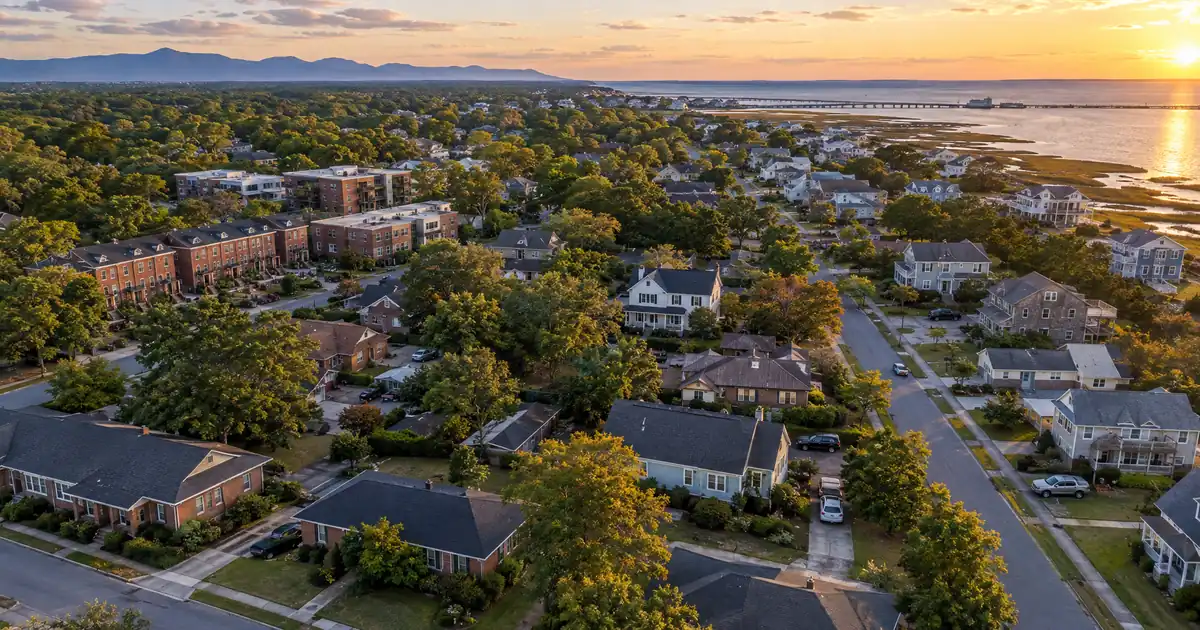
Median home value in Southport rose 56.3 percent, from $252,600 to $394,900, across the five-year window tracked by US Civic Data’s Census ACS profile. Rents did not keep pace with that climb. That gap explains this market’s DSCR cash-out profile: the equity is real, but the rent coverage decides how much of it an investor can actually pull out.
TL;DR: A DSCR cash-out refinance in Southport, North Carolina is underwritten primarily on the property’s rental income measured against its full monthly obligation, with appraised value capping proceeds at a maximum leverage ceiling set by program guidelines.
DSCR Cash-Out Calculator
Run the cash-out numbers in Southport, NC
Rate source: Freddie Mac 30-yr average via FRED® — Federal Reserve Bank of St. Louis · effective Sep 24, 2026
Prefilled with starting assumptions — enter your property’s value, balance, taxes, and insurance for a more accurate picture.
Program parameters update from Lendmire’s centralized guideline source. Taxes and insurance are editable estimates.
As of Sep 24, 2026 · General Freddie Mac market benchmark, not a Lendmire loan offer. Property value, balance, taxes, and insurance are editable estimates. Maximum loan-to-value varies by lender, program, property type, and seasoning. Not a Loan Estimate, approval, or commitment to lend. Program availability and eligibility are subject to lender guidelines, credit approval, property review, and underwriting.
- Zillow’s Southport rental data shows average rent of $2,395 and a WARM market rating.
- Cash-out typically caps at 75 percent LTV after about six months of ownership.
- Historic downtown holdings offer the best rent-to-value fit; St. James Plantation leans on appreciation.
- Closed-sale prices are softening, so model appraisals off recent closed comps, not asking prices.
Lendmire (NMLS# 2371349), a DSCR-focused mortgage broker, structures these files for owners who already hold Southport property and want to redeploy the equity. Through Lendmire’s DSCR program footprint (41 markets, including Washington, D.C.), lenders may review qualifying rental income subject to program guidelines for Southport, North Carolina investors.
Southport Market Snapshot
A quick read on the Southport investor landscape — figures come from the cited sources below. Confirm current property-level numbers before underwriting.
| Metric | Detail |
|---|---|
| Home prices | $437,700 median property value (Data USA) |
| Typical rents | $2,395 avg (Zillow Rental Manager Market) |
| Population | 4,205 population (Census Reporter (ACS 2024 5-yr)) |
| Employment | ~250 personnel (Grokipedia MOTSU Page) |
Historic Downtown: Where the Rent-to-Value Ratio Holds Up
Historic downtown Southport is the strongest candidate for cash-out coverage in this market. The housing stock is older and lower-basis than the resort communities, and the tenant pool draws on stable local employers. An owner who bought before the appreciation run has the most equity and the most flexibility on leverage.
Start with the demand side. Our NC Military, a state government resource, describes Military Ocean Terminal Sunny Point as the Department of Defense’s primary East Coast ammunition shipping point. It sits on an Army-owned 8,500-acre site on the Cape Fear River. Industry profiles put the workforce at roughly 250 to 350 civilians, contractors, and military personnel. Small, but federal payroll doesn’t swing with tourist season.
The larger anchor is the Brunswick Nuclear Plant. Local business reporting from WilmingtonBiz put its headcount at 800 to 900, and Duke Energy’s fleet factsheet confirms a two-unit, 1,870-megawatt facility in Southport. Shift-based utility jobs with long tenure tend to produce multi-year tenants, which is exactly what a DSCR lender wants to see behind a lease.
Then there’s the hospital. Dosher Memorial is the only independent critical access hospital in North Carolina, with 25 licensed acute beds and 64 skilled nursing beds, per its reference profile. Direct headcount is modest (about 85 employees), though it runs nine clinics across southern Brunswick County. That spreads healthcare-worker demand well beyond the hospital’s own payroll.
The Five-Unit Exception
Small multifamily is scarce inside city limits. Owner-occupancy runs about 80.2 percent, per Data USA, so true duplex and fourplex stock is thin. Denser rental inventory sits in Wilmington and Leland.
One listing shows what stacked income looks like when it does appear. A five-unit downtown property (four two-bedroom units plus a cottage) was projected at $150,000 in gross annual rent on leases, per Redfin’s Brunswick County multifamily listings. Units near the top of the market’s rent range give a lender several leases to underwrite instead of one. An owner of a multi-unit asset like that has a better cash-out setup than any single-family owner at comparable value. Finding one is the hard part.
What the Numbers Look Like at Cash-Out Leverage
At the maximum 75 percent LTV, most single-family rentals in Southport will not clear 1.0x on rent alone. That is the central fact for anyone planning a cash-out here.
Run the numbers on a modeled downtown three-bedroom. Assume it appraises near $500,000 and rents at the market average of $2,395. (Both inputs are modeling assumptions, not a specific property.) Coverage here means rent divided by full PITIA, meaning principal, interest, taxes, and insurance, using a 30-year term at an assumed high-6s financing cost and North Carolina average tax and insurance loads.
| Leverage | Modeled coverage (with taxes and insurance) |
|---|---|
| 75 percent LTV | Roughly 0.8x |
| Mid-50s percent LTV | Right around 1.0x |
| 50 percent LTV | About 1.1x |
Most standard DSCR programs are built around a 1.00x benchmark, but a lender may review lower-coverage files with compensating factors such as lower leverage, stronger reserves, or different pricing. Exact eligibility depends on lender guidelines, credit profile, and property review. Practically, an owner in this market often extracts less than the 75 percent cap implies, because the rent supports a smaller loan than the appraisal does.
A sub-1.00 file at full leverage isn’t a dead end. Options a lender may review include a sub-1.00 program, an interest-only structure, or dialing back the loan amount until coverage lands where the program wants it. None of that is automatic; it is subject to credit approval and property review. For the mechanics, see the guide “The Refi Options”, which covers the full sequence.
Working DSCR brokers see a recurring pattern in appreciation-heavy coastal markets: the appraisal arrives strong and the rent does not, so the cash-out amount gets set by coverage, not by equity. The owners who plan well decide their target leverage from the rent side first. They treat the LTV cap as an outer boundary they may never reach.
St. James Plantation: An Appreciation Play, Not a Cash-Flow One
St. James Plantation is the market’s premium address, and the math there looks different. Documented rentals in the community average $2,605 per month, per BEX Realty’s rental listings, with a broader range near $1,600 to $3,600 across roughly 15 rentals. Median listing prices run about $620,000 to $660,000 depending on the source, and one broker source pegs late-cycle medians near $800,000 to $1 million.
Rent against that price is a thin ratio. The coverage number will sit well below 1.0x at cash-out leverage, and HOA and amenity dues cut further into what the lender counts. Anyone holding here isn’t refinancing for cash flow. They hold for scarcity-driven equity, so any cash-out file leans on the appraisal, and the leverage that a low coverage ratio permits will be modest.
This is a genuine toss-up for a St. James owner. Pulling a smaller amount at lower leverage keeps the file clean and preserves the hold. Pushing for more proceeds means a sub-1.00 conversation with fewer lender options. Neither is wrong; it depends on what the capital is meant to do next.
Arbor Creek and the Newer Communities
Arbor Creek and Southport Meadows are the lower-basis workforce and newer-construction pockets. Current per-neighborhood prices and rents are thinly documented for these areas, so the honest read is qualitative: lower entry basis than the plantation communities generally means a better rent-to-value ratio, which is what makes coverage clear at higher leverage.
The catch is equity. Newer purchases have had less time to appreciate, and the six-month seasoning clock, measured from title recording, only gets an owner to eligibility. It does not create equity that isn’t there. Owners of recent purchases here should treat cash-out as a later-stage move once the appraisal and the rent both support it.
Skip the List Prices
Southport’s closed-sale data is softening. Redfin’s market page shows a median closed sale near $505,000, down 10.2 percent year over year. New listings are asking closer to $588,000 citywide and about $625,000 in the historic district. Zillow’s index tells a milder story: an average home value of $418,219, up 1.0 percent, with homes going pending in about 45 days. (The figures differ because they measure different things. Zillow’s index tracks typical values across all homes, while Redfin’s closed median reflects which homes actually sold.)
For cash-out, the practical read is that appraisers weight recent closed comps. Underwriting a refinance off asking prices invites a disappointing valuation. Model the low end.
Time on market backs this up. Redfin reports homes selling after about 60 days versus 129 the prior year in one measure, and historic-district listings averaging around 82 days with thin offer activity. This is not a bidding-war market. For an existing owner it is mixed news: appraisal risk rises, but the same softness gives buyers negotiating room when it’s time to redeploy proceeds into the next acquisition.
What Changes Over the Next 6 to 24 Months
Three indicators matter more than headlines.
Closed-sale trajectory. If the year-over-year decline in closed prices deepens, expect tighter appraisals and a smaller loan on the same rent. If it stabilizes near current levels, appraisals should hold.
Rent momentum. Zillow shows average rent up $395 over the past year, and Southport rents run about 20 percent above the national average. Rent growth is the only thing that improves coverage without touching the loan. A second year of gains would move several files from sub-1.00 into clean territory.
Anchor employment. Federal, utility, and hospital jobs are stable, but modest in headcount. The nuclear plant’s headcount figure comes from older local reporting, so treat it as a range, not a precise count. A shift in any of the three anchors matters more here than in a larger metro because the town’s tenant base is small. Population is roughly 4,205, up from 3,971 at the last decennial count.
The likeliest pattern: coverage improves gradually as rents climb, while values move sideways. That favors owners who wait to refinance until the rent side has caught up, not those who rush to extract at the peak of appraised value.
DSCR vs. conventional financing
Two common ways to finance an investment property in Southport, NC. They qualify you differently — here’s how investors weigh them.
Why investors choose it
- Qualifies on the property’s rental income — no personal tax returns, W-2s, or pay stubs needed to document income.
- No personal debt-to-income ceiling to clear, so existing mortgages and obligations don’t cap your borrowing the same way.
- Can be closed in an LLC, keeping the property inside a business entity.
- Built for scaling — not held to the limit on number of financed properties that conventional financing applies.
- Underwriting centers on the deal: generally qualifies when the rent covers the payment, a 1.00x coverage ratio being a common baseline (confirmed in underwriting).
- Designed specifically for investment property, including long-term and, where the program allows, short-term rentals.
Where it’s strong
- Often the lowest ongoing financing cost for a buyer who fully qualifies on personal income — a fit for a first property or a cost-first purchase.
Trade-offs for investors
- Requires full personal income documentation and must fit within a debt-to-income limit — salary, existing debts, and other mortgages all count.
- Typically held in your personal name rather than a business entity.
- Caps how many financed properties you can carry, which can become a ceiling as a portfolio grows.
- Evaluates you as a borrower as much as the property, which usually means more paperwork.
How investors usually choose: a first or single property often optimizes for the lowest financing cost; portfolio builders often optimize for leverage, vesting in an LLC, and scaling past conventional caps. The right answer depends on your goals, the property, and current guidelines — both paths run through select lenders in Lendmire’s wholesale network, with eligibility and terms confirmed in underwriting.
Where the Proceeds Go
Cash-out proceeds are only useful if the next deal pencils better than the one being refinanced. Since Southport itself has little small multifamily, many owners point the capital toward Wilmington or Leland, where denser stock offers stacked rent rolls and better coverage on purchase. That is a different article, but the sequencing matters here: line up the target before pulling the equity, because carrying idle proceeds costs money.
Typical guidelines for this product, subject to lender program requirements: a 75 percent LTV ceiling on cash-out, about six months of seasoning, credit tiers starting at a 620 floor, and reserves around six months of PITIA. Standard programs generally run up to $3,000,000. Investors holding property in an LLC should confirm entity treatment subject to lender program eligibility. For the broader investor-side picture, see the investor refinance breakdown and the DSCR versus conventional comparison. Program details change, so confirm current terms with a broker before planning around them.
Investors ready to test a specific file can see how the math pencils, or reach Lendmire at 828-256-2183.
Frequently Asked Questions
How do you qualify for a DSCR cash-out refinance in Southport, North Carolina?
The property has to show enough rent against its full monthly obligation, typically a 1.00x benchmark, though some lenders review lower ratios with compensating factors. Beyond coverage, the file usually needs about six months of ownership from title recording, a credit score at or above a 620 floor, and reserves near six months of PITIA. Cash-out is capped at 75 percent LTV. All of it is subject to lender guidelines and property review.
What are the requirements for an investment property loan in Southport, North Carolina?
Expect a property-level review of rent, value, and condition, plus credit and reserve checks. Manufactured homes, log homes, and barndominiums fall outside the network’s DSCR programs. Most Southport files are single-family or condo, and a lender will look at whether HOA dues are counted against the rent. Requirements vary by lender and loan scenario.
Why does a St. James Plantation refinance often produce less cash than expected?
Coverage, not equity, usually sets the limit. Rentals there average about $2,605 against prices that run well into the six figures, so the rent supports a smaller loan than the appraisal would. HOA dues reduce the income a lender counts. Owners often extract far less than the 75 percent cap implies.
How does rental income affect DSCR refinance eligibility in Southport?
Rental income is the primary qualifier: lenders compare documented or market rent to the property’s full PITIA. Lendmire arranges DSCR investor loans through wholesale channels, and qualification centers on the property’s rent rather than personal income, subject to lender guidelines.
Does Southport’s softer closed-sale data hurt cash-out appraisals?
Yes, it can. Appraisers weight recent closed comps, and Redfin’s closed median has slipped while asking prices remain higher. Modeling proceeds off closed sales, not list prices, keeps expectations realistic. Investors should also verify current local rental rules, taxes, and insurance with qualified local professionals.
The Next Step
Before any lender conversation, pull recent closed comps for the specific street-level pocket of Southport where the property sits (downtown, Arbor Creek, or the plantation communities), then divide realistic market rent by a conservative full-obligation estimate. The leverage level where that ratio crosses 1.0x is the real cash-out number for this town, and knowing it first tells you whether to refinance now or wait for another round of rent growth.
For current guidelines and terms, see Lendmire’s DSCR loan programs page.
About Lendmire
Lendmire is a non-QM mortgage brokerage (NMLS# 2371349) arranging DSCR investor loans in 41 markets, including Washington, D.C., through wholesale and investor-lending channels. Lenders evaluate DSCR loans on rental income rather than personal income, subject to lender guidelines, which suits LLC-owned portfolios, self-employed investors, and operators scaling beyond conventional loan caps. Lendmire was recognized by Scotsman Guide as a 2026 Top Workplace and named a 2025 Scotsman Guide Top Workplace.
Get Started
Ready to find the right loan for you?
In about 30 seconds you can review financing options available for your investment property. No commitment required.
Informational only. Not a Loan Estimate, approval, or commitment to lend. Program availability and eligibility are subject to lender guidelines, credit approval, property review, and underwriting.
References
1. Zillow Rental Manager, Southport market trends
2. Data USA
3. Census Reporter (ACS 2024 5-yr)
5. Our NC Military, Military Ocean Terminal Sunny Point
6. Duke Energy nuclear fleet factsheet
7. Wikipedia — Dosher Memorial Hospital
8. Redfin’s Brunswick County multifamily listings
9. BEX Realty’s rental listings
10. Redfin, Southport housing market
11. recognized by Scotsman Guide as a 2026 Top Workplace
12. a 2025 Scotsman Guide Top Workplace
This article is part of Lendmire’s investment property cash-out refinance program — full qualification details, guidelines, and scenarios live on the program page.
Related reading: Cash Out Refinance Investment Property in Southport, North Carolina · Cash Out Refinance Investment Property Duck North Carolina · Cash Out Refinance Investment Property in Chapel Hill NC
Guides: Investment Property Cash-Out Refinance in North Carolina
Brandon Miller
Founder & CEO, Mortgage Loan Originator, Lendmire LLC
- Mortgage Loan Originator · NMLS# 1129696 · Verify on NMLS Consumer Access
- North Carolina Real Estate Broker · License# 343312 · Verify on NCREC
- North Carolina Insurance Producer · License# 19053198 · Property, Casualty, Life, Health · Verify on NAIC SBS
- Lendmire LLC · Firm NMLS# 2371349 · Verify firm licensure
Disclosure information. Lendmire is a state-licensed mortgage brokerage under NMLS# 2371349. Lendmire is not a depository institution, direct lender, or financial advisor — all loans referenced are placed through wholesale lender partners and are subject to each lender's underwriting standards. This article is provided for general informational purposes and is not a commitment to lend, nor does it constitute financial, legal, or tax advice. Loan programs, terms, rates, and qualification standards change without notice and depend on borrower profile, property type, and the state in which the subject property is located. Equal Housing Opportunity provider. NMLS Consumer Access: nmlsconsumeraccess.org.