
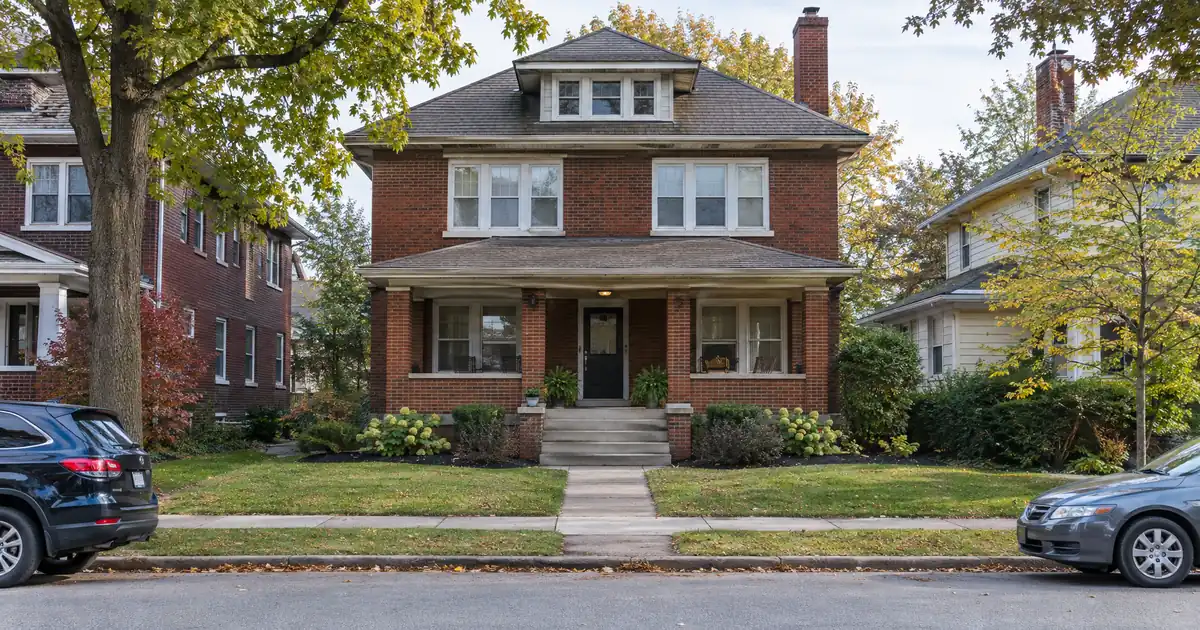
The South Fountain Avenue Historic District sits about 15 square blocks south of downtown. A local brokerage, The Haney Group, describes the South Side as home to some of the city’s most affordable entry points. That tells an investor where cheap, older rental stock sits. It does not say whether an appraiser will credit that stock at a value high enough to pull equity out. The gap between those two questions is where a Springfield cash-out refinance gets decided.
The Quick Read: A DSCR cash-out refinance in Springfield, Ohio is underwritten primarily on what the property’s rent covers against its full monthly obligation, which matters here because small, older duplexes can show strong coverage on paper while value support stays thin and local job data remains unsettled.
DSCR Cash-Out Calculator
Run the cash-out numbers in Springfield, OH
Rate source: Freddie Mac 30-yr average via FRED® — Federal Reserve Bank of St. Louis · effective Oct 1, 2026
Prefilled with starting assumptions — enter your property’s value, balance, taxes, and insurance for a more accurate picture.
Program parameters update from Lendmire’s centralized guideline source. Taxes and insurance are editable estimates.
As of Oct 1, 2026 · General Freddie Mac market benchmark, not a Lendmire loan offer. Property value, balance, taxes, and insurance are editable estimates. Maximum loan-to-value varies by lender, program, property type, and seasoning. Not a Loan Estimate, approval, or commitment to lend. Program availability and eligibility are subject to lender guidelines, credit approval, property review, and underwriting.
- Redfin’s city median sale price sits near $153K, down 4.2% year over year, so appraisal support matters more than appreciation.
- Cash-out is capped at 75% LTV after about 6 months of ownership, subject to lender guidelines.
- Modeled coverage runs near 1.7x on a two-unit rental and near 1.1x on a median single-family, taxes and insurance included.
- RentCafe shows 48% of households rent, which supports a deep tenant pool.
Springfield Market Snapshot
A quick read on the Springfield investor landscape — figures come from the cited sources below. Confirm current property-level numbers before underwriting.
| Metric | Detail |
|---|---|
| Home prices | Median list $150K (Redfin Clark County multifamily) |
| University enrollment | 1,285 total (Data USA) |
| Employment | ~8,000 jobs since ~2016 (official’s claim) (The Haitian Times) |
Where the Equity Actually Sits
Equity in Springfield is real but hard to measure, because published price levels disagree by tens of thousands of dollars. Redfin’s most recent city reading puts the median sale price near $153K, down 4.2% from a year earlier. Movoto reports a median of $226,900. Zillow’s modeled value for ZIP 45501 alone is $183,219. Each of these uses a different geography or method, from sold comps to modeled values to wider-area mixes. The spread is the first thing a cash-out borrower should understand.
This analysis uses Redfin’s sold-price median as the working figure. Sold comps are what an appraiser reads. Movoto and Zillow numbers are useful only to show how wide the range runs.
Redfin’s detail adds a wrinkle. Price per square foot rose 1.5% even as the median fell, and listing time shortened from the year before. A falling median alongside rising price per square foot usually signals a change in what’s selling, not a market in decline. Still, it argues against underwriting an equity pull on expected appreciation. Springfield is a cash-flow market. Treat any appreciation as a bonus, and size the refinance on in-place rent and conservative value.
Per Census Reporter’s ACS profile, the city has 58,190 residents and a median household income of $47,143, against $71,389 statewide. The population is also slightly shrinking: ohio-demographics.com shows a 1.6% decline from the prior five-year mark. Low incomes cap how far rents can stretch, and a flat population means demand growth isn’t automatic. The case for pulling equity rests on tenant depth and rent coverage, not on a rising tide.
What the six-month seasoning clock means here
Most DSCR cash-out programs look for about 6 months of ownership measured from title recording, subject to lender guidelines. In Springfield this matters for the buy-rehab-refinance investor. Older duplexes bought below replacement cost and rehabbed can show a big gap between basis and appraised value, but the appraiser will lean on sold comps in a thin market. A rehab that looks like a 30% value lift to the owner may read closer to 15% to an appraiser working from a limited set of nearby sales. The 75% LTV ceiling applies to the appraised value, not the owner’s hoped-for number.
Picture an investor whose payoff sits at 55% of appraised value. The 75% ceiling leaves about 20 points of value as gross proceeds before costs. If the appraisal comes in 10% lower than expected, that cushion shrinks sharply. Run the numbers on a conservative value before committing to a rehab budget. The equity-extraction mechanics page walks through how seasoning, LTV, and reserves interact.
The Coverage Math: Duplex Versus Single-Family
Small multifamily clears coverage far more comfortably than single-family in Springfield. That is the cleanest quantitative edge in the research. Redfin’s Clark County data shows 10 multifamily homes listed at a median of $150K. Springfield duplex listings advertise per-unit rents in the neighborhood of $900.
These are separate listings, not one deal, and a month-to-month seller-stated rent may not match an appraiser’s market-rent schedule. Still, they suggest a gross rent-to-price ratio near 1.2% per month for a typical duplex.
Here are two modeled cases. Inputs are assumptions, not sourced facts, and coverage is rent divided by full PITIA, meaning principal, interest, taxes, and insurance at Ohio-average levels.
- Two-unit rental: Assume a $150K appraised value, $900 per unit ($1,800 combined), and 75% LTV. Coverage lands near 1.7x including taxes and insurance, rounded down. Cut rents by 25% and the number still holds around 1.3x. The file has room to absorb vacancy and a soft appraisal.
- Median single-family: Assume a $153K value and rent at RentCafe’s $1,100 average. Coverage drops to about 1.1x at the same 75% LTV, taxes and insurance included. That clears a 1.00x benchmark, but the cushion is thin. Note that RentCafe’s figure comes from apartment buildings with 50 or more units, so it likely overstates what an older single-family house would rent for. At a more realistic rent, the single-family number could land at or below 1.00x.
- Final terms depend on lender guidelines, property type, leverage, and the borrower’s complete credit picture.
Most standard DSCR programs are built around a 1.00x benchmark, though some lenders review lower scenarios with compensating factors such as lower leverage or more cash down. A single-family that falls below 1.00x isn’t dead on arrival. It means the structure changes, whether through a different program, lower LTV, or a different property. It does not mean the file is automatically declined.
DSCR files in markets like this one typically look like a small-balance, older-stock book. Coverage on multi-unit properties tends to look strong on stated rents, and the friction shows up in the appraisal and the rent schedule instead. The stronger files arrive with a signed lease or documented rent history, a realistic market-rent estimate, and reserves already seasoned in the account. Files that depend on a seller-stated rent or an optimistic value tend to get repriced or restructured late. Running a conservative value case before ordering the appraisal prevents most of that.
Small balances also matter. Standard programs go up to $3,000,000, but many Springfield loans will be far smaller, and those typically route through select lenders in the network. Credit tiers generally run from a 620 floor up through 660, 680, and 700. Reserves are generally about 6 months of PITIA. The guide “What Is a DSCR Loan” covers the mechanics for readers new to the structure. Those program details are guideline ranges and vary by borrower, property, and lender.
Submarkets: Who Reads Well for an Equity Pull?
No reliable neighborhood-level rent or price source exists for Springfield, so what follows is qualitative. It leans on the brokerage characterizations noted above and on property-type logic, not on sourced rent bands.
South Side. The older multi-unit stock here is where the duplex math above is most plausible. Entry prices are low, which is exactly why coverage can look strong. The tradeoff is value support. Appraisers working in thinner pockets have fewer comparable sales to lean on, so a cash-out here depends heavily on the quality of the rehab and the comps available. This is the highest-coverage, highest-appraisal-risk submarket.
Warder Park and Snyder Park. The Haney Group calls these among the most desirable areas, with tree-lined streets and strong resale value. That is a brokerage marketing claim, not data. If it holds, these are the neighborhoods where an appraiser is most likely to support a refinance value, at the cost of thinner rent-to-price ratios. Fewer points of coverage, firmer value. For an owner who values a clean appraisal over maximum coverage, this is the stronger play.
Wittenberg area. The same brokerage describes walkability and a mix of owner-occupants and investment properties. Wittenberg University enrolled 1,285 students per Data USA, which is small, and the school has been placed on HLC probation over financial management. That is a modest demand risk to monitor, not a reason to avoid the area. Underwrite these properties as general rentals, not student housing.
North Side. The Haney Group says this part of the city has the most newer construction and move-in-ready homes. Newer stock usually means fewer repair surprises and cleaner appraisals, but also a higher basis. Coverage is probably the thinnest of the group, and equity depends on the purchase price relative to current appraised value.
East High Street and the Westcott House area. This district lies just east of downtown, per Ohio.org. The Westcott House is Frank Lloyd Wright’s only Prairie Style home in Ohio, according to Visit Greater Springfield. It makes the district distinctive, but heritage does not equal rent. Treat it as character, not a demand driver.
Downtown and the medical district. Mercy Health’s campus and the downtown core are the likely anchors, but no source describes them for investors, so no conclusion is offered here.
The stronger play for cash-out purposes might be the older multi-unit stock on the South Side over the quieter, pricier parks. Coverage and proceeds both run higher on the former. Investors who prize appraisal certainty over cash-on-cash could reasonably argue the other way. This one is a genuine toss-up, and it turns on how much appraisal risk a given file can carry.
The Demand Side: Anchors and Caveats
Springfield’s demand base is employment-led. The EXPAND Greater Springfield top-employers list runs, in order, from Mercy Health to Assurant, Navistar, Springfield City Schools, the Ohio Air National Guard’s 178th Wing, Cedarville University, Clark County, 7-Eleven/Speedway, AM-PM Employment, and Dole Fresh Vegetables. It then continues with Wright-Patterson AFB, Yamada, Topre America, Clark State, Kroger, and Honda. The list gives names in rank order but no headcounts.
Mercy Health’s Springfield Regional Medical Center is the city’s only full-service hospital and has been the top employer on the list nearly every year since 2008. Per Data USA’s Springfield profile, the top resident employment sectors are manufacturing (4,468 people), health care and social assistance (3,809), and retail trade (2,657). Manufacturing and healthcare give the tenant base two different income sources, which is a useful diversifier. The City of Springfield also publishes an overview of the PrimeOhio II Industrial Park, which targets logistics and advanced manufacturing.
Tenant depth looks solid. RentCafe shows an average rent of $1,100, up 6.04% from $1,037 a year earlier, with averages of $904 for a one-bedroom, $1,183 for a two-bedroom, and $1,485 for a three-bedroom. About 48% of households rent. All of this comes from larger professionally managed buildings, so it is a ceiling reference, not a prediction for a century-old duplex. A local official told the Springfield News-Sun that a “boom in population” pushed up rental demand and rents.
What’s the Catch on the Demand Side?
The main caveat is job data. Policy Matters Ohio, an advocacy organization, says preliminary BLS data show the Springfield metro led the state in year-over-year job losses. Attribute that accordingly. A local development official, speaking to the Haitian Times, put job creation at about 8,000 over roughly the past decade. The two claims don’t cancel out. They describe a labor market that expanded fast and now faces real uncertainty tied to federal workforce-status policy.
The housing-side worry is vacancy. Spectrum News reported that city leaders worry about another wave of empty houses if workers continue to leave. The exposure is likely greatest in older, lower-rent, multi-occupant housing, which is the same product the cash-out math above favors. That is the downside case for a three-to-five-year hold. A lender’s vacancy factor and the investor’s own reserves should be sized against it. A cash-out at 75% LTV with thin reserves on an older South Side duplex is the combination most exposed. These specifics are subject to lender guidelines and a full review of property, leverage, and credit.
Supply is the other risk. An Ohio Housing Finance Agency proposal, Clark View Estates, would build 200 modular duplexes with three- and four-bedroom units across more than 100 scattered sites in Springfield. It is a proposal, not an approved or funded project. If funded, it would add new affordable family-sized supply aimed at the same renters older three-bedroom duplexes serve, and it could cap rent growth on that unit type. Watch the funding outcome before underwriting rent growth.
Comps are thin as well. Multi-unit listing depth in Clark County is limited, and Redfin’s multifamily data shows a small sample. A cash-out appraisal on a duplex may have few truly comparable sales, which raises the odds of a lower-than-expected value. That is not a reason to skip the refinance. It is a reason to line up conservative assumptions before ordering one. Verify current local rental rules, property taxes, and insurance with qualified local professionals.
Where the Proceeds Go
Cash-out proceeds are only worth pulling if they have a use that beats the cost of holding the debt. In Springfield, the natural redeployment is another small multi-unit property, since the listed duplex-to-price ratios run well above what single-family offers. A $150K-range duplex at modeled coverage in the 1.7x neighborhood leaves room for a second refinance down the road without stretching the number.
DSCR vs. conventional financing
There are two common ways to finance an investment property in Springfield, OH, and they qualify you differently — here’s how investors weigh them.
Why investors choose it
- Qualifies on the property’s rental income — no personal tax returns, W-2s, or pay stubs needed to document income.
- No personal debt-to-income ceiling to clear, so existing mortgages and obligations don’t cap your borrowing the same way.
- Can be closed in an LLC, keeping the property inside a business entity.
- Built for scaling — not held to the limit on number of financed properties that conventional financing applies.
- Underwriting centers on the deal: generally qualifies when the rent covers the payment, a 1.00x coverage ratio being a common baseline (confirmed in underwriting).
- Designed specifically for investment property, including long-term and, where the program allows, short-term rentals.
Where it’s strong
- Often the lowest ongoing financing cost for a buyer who fully qualifies on personal income — a fit for a first property or a cost-first purchase.
Trade-offs for investors
- Requires full personal income documentation and must fit within a debt-to-income limit — salary, existing debts, and other mortgages all count.
- Typically held in your personal name rather than a business entity.
- Caps how many financed properties you can carry, which can become a ceiling as a portfolio grows.
- Evaluates you as a borrower as much as the property, which usually means more paperwork.
How investors usually choose: a first or single property often optimizes for the lowest financing cost; portfolio builders often optimize for leverage, vesting in an LLC, and scaling past conventional caps. The right answer depends on your goals, the property, and current guidelines — both paths run through select lenders in Lendmire’s wholesale network, with eligibility and terms confirmed in underwriting.
A rough decision flow looks like this:
- Confirm seasoning. About 6 months from title recording, subject to lender guidelines.
- Run coverage on a conservative rent and a haircut value.
- Check that reserves, generally about 6 months of PITIA, are available and seasoned.
- Compare against a conventional path to see when income-based underwriting beats documentation-heavy alternatives.
For investors holding several small balances, Lendmire’s refi programs outline the options across property types. Ohio DSCR financing covers the state-level program picture, and investors who want a worked estimate can run the numbers with Lendmire. Review details are subject to lender overlays and change over time.
Springfield rewards the investor who treats value as a range and coverage as the anchor. So: if the appraisal came back 15% light on your best-performing rental, would the refinance still be worth doing?
Frequently Asked Questions
How do you qualify for a DSCR loan in Springfield, Ohio?
Qualification centers on the property’s rent relative to its full monthly obligation, with 1.00x a common benchmark. Lenders generally also review credit (tiers typically start at a 620 floor), reserves of about 6 months of PITIA, and the property itself. In Springfield, expect the lender to weigh a documented rent schedule closely, especially on older duplexes with month-to-month leases. Exact eligibility depends on lender guidelines.
What are the requirements for an investment property loan in Springfield, Ohio?
For a cash-out refinance, the typical guideline is about 6 months of ownership measured from title recording, an LTV ceiling of 75%, and coverage at or above the program minimum. Reserves and credit tier factor in as well. Standard programs run up to $3,000,000, and smaller Springfield-sized balances route through select lenders in the network. Property type matters too, since manufactured homes, log homes, and barndominiums fall outside these programs.
Why do Springfield home values look so different from source to source?
Each source measures something different. Redfin reports a sold-price median, Zillow publishes a modeled value for ZIP 45501, and Movoto’s $226,900 reflects a different geography or home mix. For a refinance, the appraiser’s sold comps are what count, so Redfin’s sold-price trend is the closest proxy. Treat the higher figures as optimistic bounds and underwrite from the lower, sold-comp end.
Does the weak job-loss data change how a Springfield cash-out should be sized?
It argues for more conservative sizing, not for staying out of the market. Preliminary BLS data cited by Policy Matters Ohio point to job losses, and city leaders have voiced vacancy concerns. Investors can respond with higher reserves, a stressed rent assumption, and leverage below the 75% ceiling on older, lower-rent stock.
For current guidelines and terms, see Lendmire’s DSCR loan programs page.
About Lendmire
Lendmire (NMLS# 2371349) is a DSCR-focused mortgage broker that helps arrange investor financing across 41 markets, including Washington, D.C., through wholesale and investor-lending channels. DSCR eligibility is generally reviewed by the lender on the property’s rental income rather than personal income documentation, subject to lender guidelines. That structure suits self-employed investors, LLC operators, and portfolios above four financed properties. Scotsman Guide named Lendmire a Top Mortgage Workplace in both 2025 and 2026. Investors can reach the team at 828-256-2183.
Get Started
Ready to find the right loan for you?
In about 30 seconds you can review financing options available for your investment property. No commitment required.
Informational only. Not a Loan Estimate, approval, or commitment to lend. Program availability and eligibility are subject to lender guidelines, credit approval, property review, and underwriting.
References
2. Redfin, Springfield housing market
3. RentCafe, Springfield average rent
4. Redfin Clark County multifamily
5. Data USA
7. Movoto
8. Census Reporter, Springfield, OH profile
9. Ohio.org
11. Mercy Health’s Springfield Regional Medical Center
13. PrimeOhio II Industrial Park
15. Spectrum News
16. Ohio Housing Finance Agency, Clark View Estates proposal
17. 2025
18. 2026
This article is part of Lendmire’s investment property cash-out refinance program — full qualification details, guidelines, and scenarios live on the program page.
Related reading: Luxury Rental DSCR Loans In New Jersey · Jersey Shore Vacation Rental Loans: DSCR Financing In Ocean City, Cape May And Long Beach Island · DSCR Cash-out Refinance In New Jersey: Pulling Equity From A Rental
Guides: Investment Property Cash-Out Refinance in Springfield, OH · Investment Property Cash-Out Refinance in Ohio
Brandon Miller
Founder & CEO, Mortgage Loan Originator, Lendmire LLC
- Mortgage Loan Originator · NMLS# 1129696 · Verify on NMLS Consumer Access
- North Carolina Real Estate Broker · License# 343312 · Verify on NCREC
- North Carolina Insurance Producer · License# 19053198 · Property, Casualty, Life, Health · Verify on NAIC SBS
- Lendmire LLC · Firm NMLS# 2371349 · Verify firm licensure
Legal disclosures. Lendmire (NMLS# 2371349) is a state-licensed mortgage brokerage that arranges financing through wholesale lender relationships. Lendmire is not a direct lender, depository institution, or registered financial advisor. The discussion above is general informational content about real estate financing — it is not financial, legal, or tax advice, and readers should consult licensed professionals for guidance on their individual circumstances. Loan inquiries are subject to lender underwriting; this article does not represent a commitment to lend. Loan terms, rates, and qualification standards vary by borrower, property, and state, and are subject to change at any time. Equal Housing Opportunity. NMLS Consumer Access: nmlsconsumeraccess.org.