
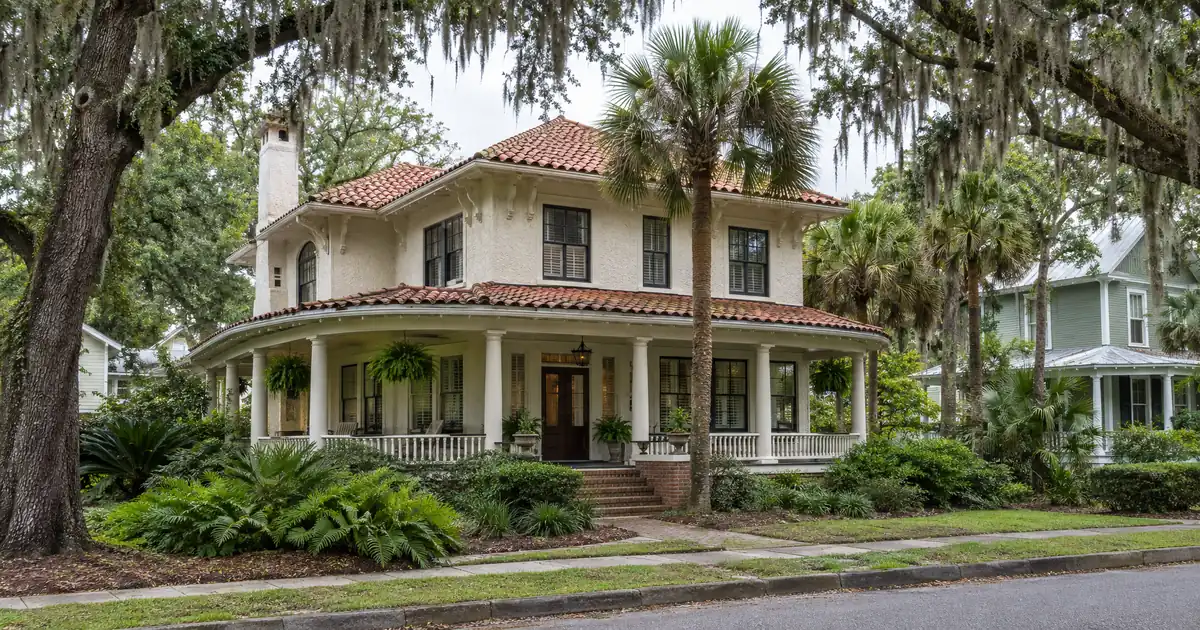
Southwood is where Tallahassee investor equity piles up and where rental coverage runs thinnest. Redfin’s rental data puts Southwood’s median rent at $1,750, against $2,895 downtown, $2,200 in Buck Lake, and $2,000 in Killearn Lakes. Resale and new-build homes in Southwood trade roughly between $300,000 and $480,000. An owner holding one of those houses has likely seen strong appreciation and has a rent that struggles to carry a fresh loan. That gap between equity and coverage is the central problem in cash-out refinancing across this market.
TL;DR: A cash-out refinance on a Tallahassee, Florida rental is underwritten primarily on the property’s rental income measured against its full monthly obligation, with the lender also capping leverage, requiring seasoning from title recording, and checking that reserves and valuation support the equity being pulled.
DSCR Cash-Out Calculator
Run the cash-out numbers in Tallahassee, FL
Rate source: Freddie Mac 30-yr average via FRED® — Federal Reserve Bank of St. Louis · effective Sep 24, 2026
Prefilled with starting assumptions — enter your property’s value, balance, taxes, and insurance for a more accurate picture.
Program parameters update from Lendmire’s centralized guideline source. Taxes and insurance are editable estimates.
As of Sep 24, 2026 · General Freddie Mac market benchmark, not a Lendmire loan offer. Property value, balance, taxes, and insurance are editable estimates. Maximum loan-to-value varies by lender, program, property type, and seasoning. Not a Loan Estimate, approval, or commitment to lend. Program availability and eligibility are subject to lender guidelines, credit approval, property review, and underwriting.
- Downtown median rent runs $2,895 against $1,750 in Southwood, per Redfin.
- Ten-year appreciation averages 6.68 percent annually, per NeighborhoodScout, which builds the equity side.
- Multi-unit rent rolls near FSU and FAMU can clear coverage where a single-family house at the same basis cannot.
- The cash-out ceiling is 75 percent LTV, after roughly six months of ownership seasoning.
The reader here already owns the asset. The question is how much equity can be extracted, what limits it, and where the proceeds go next. Lendmire (NMLS# 2371349), a DSCR-focused mortgage broker arranging investor loans across 40 states plus Washington, D.C., sees the same pattern in university-and-government markets. Appreciation is rarely the constraint. Coverage and reserves are. The cash-out qualification details cover the mechanics. This piece applies them to Tallahassee’s submarkets.
Tallahassee Market Snapshot
A quick read on the Tallahassee investor landscape — figures come from the cited sources below. Confirm current property-level numbers before underwriting.
| Metric | Detail |
|---|---|
| Home prices | $300K median (Redfin – Tallahassee Housing) |
| University enrollment | 44,275 students (FSU Office of Institutional) |
| Employment | 900+ jobs over 30 years (FSU News) |
| Vacancy | 6.2% (Ark7 Tallahassee Renting Guide) |
Equity Is Plentiful. Coverage Is the Constraint.
Tallahassee has produced steady, not speculative, appreciation. NeighborhoodScout reports a cumulative ten-year gain of 90.99 percent, equal to 6.68 percent a year on average. That is the profile a cash-out thesis wants: gradual equity growth that a six-month-seasoned property can plausibly show on a fresh valuation.
The current snapshot is stronger on price than on yield. Redfin shows a median sale price of $300,000, up 10.6 percent year over year, with homes averaging 58 days on market and 664 sales in the latest monthly count. Price per square foot, though, is $196, up only 2.3 percent. That gap suggests the headline median is partly a mix shift toward larger or newer homes, not uniform appreciation. Underwriting a refinance on the assumption that every house gained 10 percent would be a mistake.
Run the numbers on a modeled Southwood single-family rental. Assume a $400,000 appraised value, the $1,750 submarket median rent, the 75 percent LTV ceiling, and standard program terms. Full coverage including taxes and insurance lands below 0.75x. That is well short of the 1.00x benchmark most standard DSCR programs are built around, because at 1.00x rent just covers the payment. Not workable on those terms.
Sub-1.00 files are not automatically dead, though lender review applies in every case. Paths a lender may review include a sub-1.00 program, an interest-only structure, or a lower LTV that shrinks the loan against the same rent. Each trades something: lower proceeds, different pricing, or more reserves. Eligibility review depends on lender guidelines, credit, and property review.
The better question is whether the same equity should be pulled from a different asset.
What the Rent Roll Does That a Single House Can’t
Small multifamily near the campuses clears coverage with room to spare, and that is the core structural advantage for cash-out in this city. One reported fully leased fourplex near FSU and Tallahassee State College, with four 2BR/1.5BA townhome units, was generating $4,585 a month, or $55,020 annually, with room for increase. That is roughly $1,146 per unit.
Hold the basis at the same modeled $400,000 and the same 75 percent LTV. Against that fourplex rent roll, full coverage including taxes and insurance comes out comfortably above 1.5x. Same dollar basis, same leverage, and coverage more than double the single-family result. (The $400,000 is a modeled assumption, not the reported listing price. Actual fourplex pricing in this market starts well below that.)
Inventory depth supports the strategy. Realmo counts 72 multifamily properties for sale, with an estimated market value around $55.8 million. Homes.com shows asking prices running from $169,900 up to $5.75 million, with stock ranging from duplexes to an 8-unit building near the universities and a 16-unit southeast property. This is not a theoretical duplex-conversion market. Real comparable sales exist for 2-to-16-unit assets.
One caution: depth is thinner than single-family. Appraisers on a multifamily cash-out may lean on the income approach, valuing off the rent roll, more than on sales comps. That changes both the valuation methodology and what the owner should have ready. A clean rent roll with current leases matters more here than on a single-family refinance.
Three Submarkets, Three Refinance Profiles
The right cash-out strategy differs by submarket, and the data supports distinguishing three.
The student corridor near FSU and FAMU. This is the highest-coverage zone and the most management-intensive. Demand is anchored by Florida State University, with 44,275 students on the main campus, plus FAMU, whose projected fall enrollment is 9,980, and Tallahassee State College, with more than 24,500 students. Median age in the city is 28.2, well below Florida’s overall profile. FAMU has pursued roughly 2,000 new on-campus beds after a housing shortage pushed students off campus, so some off-campus pressure may ease. Still, a history of undersupplied campus housing plus rising enrollment suggests off-campus demand is resilient. Ark7 puts renter-occupied units at 60 percent of housing with a 6.2 percent rental vacancy rate. That is a citywide, balanced figure, not a near-campus one.
The FAMU corridor and Southside also show new-build activity, with affordable new construction in the $180,000-to-$220,000 band, and local reporting points to renovated multifamily near FAMU being absorbed steadily.
Suburban stability: Southwood, Killearn, Northeast, Midtown, and Betton Hills. Southwood runs $300,000 to $480,000, Killearn roughly $360,000 to $550,000, Northeast Tallahassee $320,000 to $500,000, and Midtown and Betton Hills $350,000 to $600,000. Tenants lean toward state employees, faculty, and downtown professionals. These are appreciation-oriented rentals, better for pulling equity than for maximizing yield. Killearn Lakes shows a $2,000 median rent against Southwood’s $1,750, so even within the suburban ring the coverage spread is real. The play is to refinance these holdings and redeploy.
Providence. Listing prices here are among the city’s lowest, with a median near $143,500. Low basis supports coverage at smaller loan amounts, and for smaller balances the file routes through select lenders in the network. The neighborhood demands tight property selection. Thin pricing cuts both ways: easy coverage, harder appraisals.
The student corridor is the stronger cash-flow market. Whether it is the stronger cash-out market is closer to a toss-up. A rent roll supports a higher valuation per dollar of income, but the appraisal depends on how many true income-comps exist.
The FSU Health Transfer and What It Means for Hold Periods
Tallahassee has a catalyst most mid-size Florida cities lack. FSU and Tallahassee Memorial HealthCare are transferring hospital assets, including a 75-acre property and a roughly 2-million-square-foot hospital building, to FSU, which would lease them back to TMH under a 40-year agreement, with the hospital transitioning to the FSU Health brand. A later FSU announcement cites a conservative projected economic impact above $3.64 billion and more than 900 new jobs over 30 years. Tallahassee Memorial HealthCare operates a 772-bed acute care hospital serving a 17-county region.
Keep that in proportion. Nine hundred jobs over three decades is roughly 30 a year, which will not move rents in a city of 204,902 residents, per the U.S. Census Bureau, within a metro of about 397,675. This is not a near-term rent catalyst. It is a durability signal. Data USA shows educational services employing 17,025 residents, public administration 13,692, and health care and social assistance 13,219. Those three sectors, all institutional, make up the bulk of employment. For an investor choosing between refinancing and selling, institutional anchors with multi-decade commitments argue for holding.
Honestly, this reads better as a reason to keep assets near the TMH, Midtown, and downtown corridor than as a reason to pay up for them.
How the Cash-Out Math Gets Built
Cash-out proceeds are the output of five constraints, and the binding one varies by property. Under the program parameters Lendmire’s network applies, the guidance looks like this:
- LTV ceiling: 75 percent on cash-out and refinance, a hard cap. The 80 percent figure applies to purchases only.
- Seasoning: about six months of ownership, measured from title recording.
- Coverage: a 1.00 minimum on rent used for lender review against full monthly obligation (principal, interest, taxes, insurance, and any HOA dues).
- Reserves: typically about six months of the monthly obligation, rising to about nine months above $1,500,000.
- Credit: tiers at 620, 660, 680, and 700, with 620 the floor.
Loan amounts run up to $3,000,000 on standard programs. All of this is guidance, subject to lender guidelines, credit approval, and property review.
The equity figure that results is a residual. Take 75 percent of the appraised value, subtract the existing payoff, and then subtract closing costs and the reserves the lender requires. That is a ceiling, not a promised cash figure. Two owners with identical values can net very different proceeds if one has a lower payoff balance, or one has a rent roll that clears coverage at full leverage while the other must step down to lower leverage to qualify.
The Tallahassee-specific twist is the valuation basis. An owner of a suburban single-family home gets a sales-comp appraisal, which in a market up 10.6 percent year over year can favor the borrower. An owner of a fourplex gets a valuation tied more closely to the rent roll. That cuts in the owner’s favor when rents have been raised recently, and against when leases are below market. Updating leases before seasoning ends, where the lease terms allow it, is the practical lever.
Documentation here is rental-focused. Leases, a rent roll, and proof of reserves carry more weight than traditional personal-income documentation. Where an LLC holds title, financing is available depending on program guidelines. For a broader comparison, Lendmire’s DSCR-versus-conventional breakdown explains why self-employed owners and larger portfolios often choose this route.
A pattern from similar markets: the deal desk typically sees files in university-and-government cities stall on documentation, not on coverage. Leases are expired or month-to-month, the rent roll does not match the lease file, and the reserves are sitting in an account the borrower has not seasoned. Cleaner files tend to show current leases and a matching rent roll before the application goes in. Fixing those items beforehand tends to protect proceeds better than anything done afterward.
For how DSCR qualification works, the pillar page walks through the full test. Investors ready to price a Tallahassee file can request a quote or call 828-256-2183.
Where Cash-Out Plans Go Wrong
Three failure modes show up repeatedly in markets shaped like this one.
First, assuming the median describes your asset. A $300,000 citywide median says nothing about a Providence house near $143,500 or a Betton Hills home at the top of its band. Appraisals come in on the individual property.
Second, running coverage on the wrong rent. A downtown unit at $2,895 and a Southwood house at $1,750 are different underwriting stories, and a single citywide rent average, such as the directional $1,752 cited by one neighborhood guide, can overstate suburban coverage or understate near-core coverage. The research brief found no authoritative neighborhood-level figures for 2-to-3-bedroom rents. Pull current comps for the specific property before modeling.
DSCR vs. conventional financing
There are two common ways to finance an investment property in Tallahassee, FL, and they qualify you differently — here’s how investors weigh them.
Why investors choose it
- Qualifies on the property’s rental income — no personal tax returns, W-2s, or pay stubs needed to document income.
- No personal debt-to-income ceiling to clear, so existing mortgages and obligations don’t cap your borrowing the same way.
- Can be closed in an LLC, keeping the property inside a business entity.
- Built for scaling — not held to the limit on number of financed properties that conventional financing applies.
- Underwriting centers on the deal: generally qualifies when the rent covers the payment, a 1.00x coverage ratio being a common baseline (confirmed in underwriting).
- Designed specifically for investment property, including long-term and, where the program allows, short-term rentals.
Where it’s strong
- Often the lowest ongoing financing cost for a buyer who fully qualifies on personal income — a fit for a first property or a cost-first purchase.
Trade-offs for investors
- Requires full personal income documentation and must fit within a debt-to-income limit — salary, existing debts, and other mortgages all count.
- Typically held in your personal name rather than a business entity.
- Caps how many financed properties you can carry, which can become a ceiling as a portfolio grows.
- Evaluates you as a borrower as much as the property, which usually means more paperwork.
How investors usually choose: a first or single property often optimizes for the lowest financing cost; portfolio builders often optimize for leverage, vesting in an LLC, and scaling past conventional caps. The right answer depends on your goals, the property, and current guidelines — both paths run through select lenders in Lendmire’s wholesale network, with eligibility and terms confirmed in underwriting.
Third, ignoring vacancy at the submarket level. Citywide rental vacancy sits near the national picture, but student-oriented stock has its own seasonal rhythm. A lease that rolls in the middle of the academic year faces different pressures than one that rolls in August, when demand tends to concentrate around the start of the fall term.
Local rental rules, taxes, and insurance vary by property, so verify the current requirements with qualified local professionals before committing.
Redeploying the Proceeds
Equity extraction is only useful if the capital gets a job. The cleanest sequence in Tallahassee is to refinance the lower-yielding, appreciation-heavy asset and acquire higher-coverage product with the proceeds.
Picture an investor holding a seasoned Southwood or Killearn house with strong appreciation and thin coverage. A cash-out at the 75 percent ceiling, to the extent the file supports it, can fund the equity for a small multifamily near the campuses, where listings start around $169,900 and rent rolls drive both coverage and valuation. The second asset then supports itself, and a future refinance of that property would draw on the rent-roll valuation approach described above. Over a few cycles, the portfolio shifts from appreciation-weighted to income-weighted without the investor selling anything.
The other path is to stack cash-out loans on assets near the TMH and FSU Health corridor, where institutional demand argues for long hold periods. Either way, the refinance side of the playbook should be mapped before the purchase side. Lendmire’s Florida DSCR loan programs outline how the broader state platform fits.
A local appraiser would likely put it this way: a stabilized fourplex near campus is valued off its rent roll, and a Southwood house is valued off the house next door. So pull the cash out of the second one and put it into the first.
Frequently Asked Questions
How do you qualify for a DSCR loan in Tallahassee?
Qualification centers on the property’s rent compared with its full monthly obligation, with 1.00x the common baseline, along with credit (620 floor), reserves of about six months, and LTV within program caps. Student-corridor multifamily tends to clear the test more easily than suburban single-family at the same price. Terms are subject to lender guidelines and property review.
What are the requirements for a cash-out refinance on an investment property in Tallahassee, Florida?
Expect about six months of ownership from title recording, an LTV no higher than 75 percent, rent used for lender review that covers the full monthly obligation, and reserves. Eligibility depends on lender guidelines, credit profile, and appraisal. Manufactured homes, log homes, and barndominiums fall outside these programs.
Does a fourplex near FSU appraise differently than a single-family rental?
Often yes. With 72 multifamily listings against a far deeper single-family comp pool, appraisers may weight the income approach, which values the property off its rent roll. Current leases and an accurate rent roll matter more than they would on a house. Pre-refinance lease updates, where terms allow, can influence the result.
Can a Southwood or Killearn rental still qualify if coverage falls below 1.00x?
Possibly, depending on the lender’s review. Structures a lender may consider include a sub-1.00 program, interest-only terms, or reduced leverage, each with trade-offs in proceeds, pricing, or reserves. Southwood’s $1,750 median rent against a roughly $300,000-to-$480,000 price band makes this the most common coverage gap in the city.
What can limit DSCR cash-out proceeds in Tallahassee?
The 75 percent LTV ceiling, the existing payoff, required reserves, and a valuation that comes in below the owner’s expectation are the usual limits. Lendmire arranges DSCR investor loans and its network’s cash-out guidance treats proceeds as a residual, not a guaranteed figure. Thin multifamily comps can also pull valuations down.
For current guidelines and terms, see Lendmire’s DSCR loan programs page.
About Lendmire
Lendmire (NMLS# 2371349) is a DSCR-focused mortgage broker that helps arrange investor financing across 41 markets, including Washington, D.C., through wholesale and investor-lending channels. DSCR eligibility is generally reviewed by the lender on the property’s rental income rather than personal income documentation, subject to lender guidelines, which works for self-employed investors, LLC operators, and portfolios above four financed properties. Scotsman Guide named Lendmire a Top Mortgage Workplace in both 2025 and 2026.
Get Started
Ready to find the right loan for you?
In about 30 seconds you can review financing options available for your investment property. No commitment required.
Informational only. Not a Loan Estimate, approval, or commitment to lend. Program availability and eligibility are subject to lender guidelines, credit approval, property review, and underwriting.
References
1. Redfin Tallahassee rental market
2. NeighborhoodScout Tallahassee real estate
3. Redfin Tallahassee housing market
4. Florida State University Institutional Research
5. FSU news release on hospital asset transfer terms
6. Ark7
7. wakullarealty.com — Tallahassee Homes for Sale Multi Family Homes
8. Realmo
9. Homes.com
10. 9,980
11. FSU and Tallahassee Memorial HealthCare academic health center announcement
12. U.S. Census Bureau QuickFacts, Tallahassee
13. Data USA Tallahassee profile
14. 2025
15. 2026
This article is part of Lendmire’s investment property cash-out refinance program — full qualification details, guidelines, and scenarios live on the program page.
Related reading: DSCR Loans Tallahassee: Investor Financing for FSU, FAMU, State Capitol, Southwood & Real Estate Investors · Cash Out Refinance Investment Property Tallahassee Florida · DSCR Cash Out Refinance Tallahassee: Qualify on Rent
Guides: Investment Property Cash-Out Refinance in Tallahassee, FL · Investment Property Cash-Out Refinance in Florida
Brandon Miller
Founder & CEO, Mortgage Loan Originator, Lendmire LLC
- Mortgage Loan Originator · NMLS# 1129696 · Verify on NMLS Consumer Access
- North Carolina Real Estate Broker · License# 343312 · Verify on NCREC
- North Carolina Insurance Producer · License# 19053198 · Property, Casualty, Life, Health · Verify on NAIC SBS
- Lendmire LLC · Firm NMLS# 2371349 · Verify firm licensure
Required disclosures. Lendmire (NMLS# 2371349) operates as a licensed mortgage broker, not a direct lender or depository. The discussion in this article is general in nature and should not be relied upon as financial, legal, or tax advice — every investment scenario is unique and should be reviewed by a qualified professional. Any loan inquiry is subject to lender underwriting, and this article is not a commitment to lend or a guarantee of approval. Mortgage rates, loan terms, and program guidelines vary by borrower, property, and state, and may change without notice. Equal Housing Opportunity. Verify licensure at NMLS Consumer Access.