
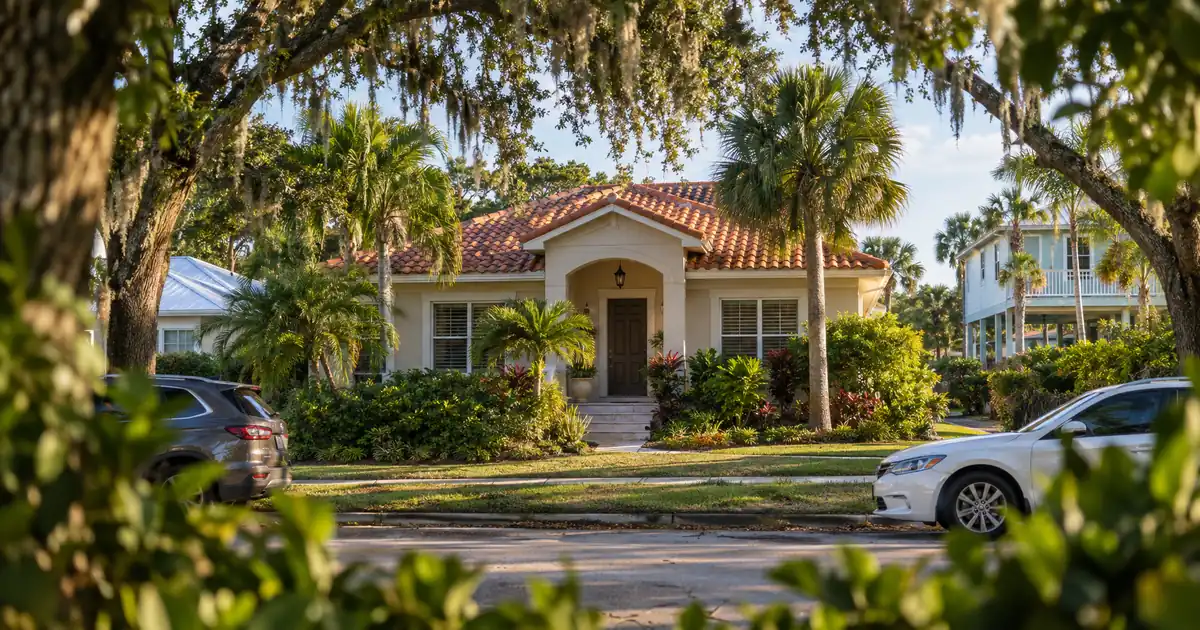
According to NeighborhoodScout, 38.0 percent of Tamiami’s residential real estate is row houses and attached homes, a share higher than nearly any neighborhood in America. For an investor sitting on equity, that building stock matters more than the headline median price. Attached product can carry two incomes on one parcel, and income stacking is what makes a cash-out refinance pencil in a market where detached homes are expensive relative to the rent they command.
This article covers only the equity-extraction side: owners who already hold a Tamiami property and want to turn appreciation into acquisition capital.
DSCR Cash-Out Calculator
Run the cash-out numbers in Tamiami, FL
Rate source: Freddie Mac 30-yr average via FRED® — Federal Reserve Bank of St. Louis · effective Oct 1, 2026
Prefilled with starting assumptions — enter your property’s value, balance, taxes, and insurance for a more accurate picture.
Program parameters update from Lendmire’s centralized guideline source. Taxes and insurance are editable estimates.
As of Oct 1, 2026 · General Freddie Mac market benchmark, not a Lendmire loan offer. Property value, balance, taxes, and insurance are editable estimates. Maximum loan-to-value varies by lender, program, property type, and seasoning. Not a Loan Estimate, approval, or commitment to lend. Program availability and eligibility are subject to lender guidelines, credit approval, property review, and underwriting.
At a Glance: A DSCR cash-out refinance in Tamiami, Florida is underwritten primarily on the property’s rental income measured against its full monthly obligation, so the work runs from seasoning and valuation, through a coverage test, to a capped loan-to-value that decides how much equity is actually accessible.
- Median sale price sits well above many South Florida inland submarkets, and values have continued to climb over the past year, per Redfin.
- Cash-out LTV tops out at 75 percent, with about six months of seasoning from title recording.
- Detached homes at median price run well under 1.00x coverage; attached two-unit stacks are the realistic path.
- Rental vacancy in Tamiami was 3.2 percent in the 2020 census, per Wikipedia’s census summary.
- Terms are subject to lender guidelines, credit review, and property review.
Tamiami Market Snapshot
A quick read on the Tamiami investor landscape — figures come from the cited sources below. Confirm current property-level numbers before underwriting.
| Metric | Detail |
|---|---|
| Home prices | $748,097 median price (NeighborhoodScout – Tamiami) |
| Typical rents | $3,174 avg (NeighborhoodScout – Tamiami) |
| University enrollment | Mdcps 40,000+ employees/350,000 students (Clearpoint HCO – Top Miami) |
| Population | 54,212 population (Wikipedia – Tamiami, Florida) |
| Employment | +10,608 private jobs Dec 2024-Dec 2025 (Miami Realtors – Miami-Dade) |
| Vacancy | 2.2% (Wikipedia – Tamiami, Florida) |
The Equity Case: Appreciation Is Outrunning Rent
Home values in Tamiami have climbed faster than rents, and that gap defines the whole strategy. Redfin reports that the median sale price has risen meaningfully from a year earlier, with homes selling after 59 days on the market versus 74 days the year before. NeighborhoodScout’s index-based value runs higher because it uses a different methodology, and this article relies on the Redfin sale-price figure throughout.
Rents tell a quieter story. NeighborhoodScout lists an average Tamiami rent of $3,174. Against a $660K median, that is a gross monthly rent-to-value ratio under 0.5 percent. Next door in Sweetwater, Foreclosure.com shows values up 12.66 percent year over year, while Zumper shows average rents down 5 percent.
Equity is building faster than cash flow. That favors a cash-out-and-hold approach over a thesis that depends on rent growth. It also means the coverage test, not the appraisal, is the binding constraint. An owner can have plenty of paper equity and still hit a wall at the 1.00x benchmark, because the 75 percent LTV ceiling and the coverage test both have to clear.
What the Math Actually Looks Like
Run the numbers on a detached home valued at the $660K median, renting at the $3,174 neighborhood average. At the 75 percent cash-out cap, and counting the full monthly obligation including taxes and insurance, coverage lands in low-0.7 territory. Not close.
Cutting leverage to 60 percent helps, but the ratio still sits under 1.00x. A typical detached Tamiami rental does not clear the standard benchmark on rent alone at these prices.
Now model something different. Assume (these are modeled inputs, not market data) an attached two-unit property valued near the same $660K, with two units renting for a combined $4,800. At 75 percent LTV and including taxes and insurance, coverage comes out around 1.1x. Same price, same leverage, different property type, and the number flips from a problem to a pass.
Some lenders review sub-1.00 files through specific programs, interest-only structures, or lower leverage. Those paths usually require stronger credit, more reserves, or more cash left in the deal, and approval remains subject to lender guidelines and property review. The question worth asking first is whether the shortfall means the loan type is wrong, or whether the asset is. For a detached home at median value, it often means the asset.
DSCR files in markets like this one typically look the same. The valuation is strong, the rent is solid but not proportionate to the value, and coverage depends on whether the property has one income stream or two. The files that go smoothly tend to have a lease in place, rent documented at or near market, and an insurance quote in hand before submission. The files that stall are usually single-family homes where the owner is counting on appraisal strength to carry a thin ratio.
For the mechanics of how the ratio is built, the guide “What Is a DSCR Loan” walks through the rent-to-obligation calculation.
Pockets Worth Knowing
The research does not support per-neighborhood price or rent breakdowns, so this section stays qualitative. The named pockets in active listing data are International Gardens, Tamiami Lakes, Sweetwater Groves, Southern Estates, and Sweetwater Estates.
Tamiami Lakes is the row-house-heavy pocket and matches the attached-home density that NeighborhoodScout flags. If an investor owns an attached or two-unit property anywhere in the CDP, this is the profile that stacks income best. It is also the likeliest to clear 1.00x at a 75 percent cap.
International Gardens reads as an established single-family and attached-home area and shows up often in resale listings. Detached homes here face the thin-coverage problem described above, so cash-out candidates should check the ratio before the appraisal.
Sweetwater Groves and Sweetwater Estates sit on the Sweetwater border, closer to the university. Demand there comes from the campus orbit rather than from general population growth, which matters when the lender looks at lease durability.
Southern Estates is workforce single-family housing. It is a fine hold, but cash-out proceeds from a detached rental will be limited by coverage more than by equity.
Housing stock age matters here too. NeighborhoodScout reports that 96.1 percent of residential real estate was built between 1970 and 1999. That is mature, stable stock. It rules out lease-up risk, but it can mean deferred maintenance and the need to present a clean property condition at review.
Why the FIU Base Holds Up
Tamiami’s rental demand anchors on a flagship university. Florida International University’s Modesto A. Maidique Campus covers 342 acres along Tamiami Trail, and Miami Today reported final fall enrollment of 55,673 students.
On-campus supply has not kept pace. FIU News describes a continued waitlist for university-owned housing and roughly 10,000 students living on campus or within walking distance. A new 820-bed off-campus facility is coming, yet a student-newspaper commentary in PantherNOW argues it barely dents total demand. WLRN also reports that four University Apartments buildings, which house up to 537 students, face demolition for a medical education complex. That is a net loss of existing beds.
Hospitals add a second layer. Baptist Health’s West Kendall Baptist Hospital has 203 private rooms and partners with FIU on a family medicine residency. HCA Florida Kendall adds a 417-bed acute care facility nearby. Shift workers, residents, and graduate students are renters whose employment does not follow a tourism calendar.
Zoom out and the county backdrop is supportive. Miami Realtors data shows Miami-Dade asking rents up 1.5 percent to $2,660, with stabilized occupancy of 95.4 percent. (That is down from 96.1 percent a year earlier, so the tightness is easing slightly.) The metro posted a 6.6 percent multifamily vacancy rate, the lowest among the largest South region metros, per Miami Realtors.
One caution on all of this: tenant demand supports the rent. It does not close the gap between rent and a $660K basis. Strong occupancy is why the two-unit math works. It does not rescue the detached-home math.
Seasoning, LTV, and What Proceeds Mean
Five program parameters shape most cash-out files. On most files, the cash-out ceiling is 75 percent LTV, measured against appraised value. Seasoning typically runs about six months of ownership from title recording. Reserves are typically about six months of the full monthly obligation, rising to about nine months on balances above $1,500,000. The credit floor is typically 620, with better tiers at 660, 680, and 700. Loan sizes can reach up to $3,000,000 on standard programs. All of this is subject to lender guidelines, and exact eligibility varies by borrower, property, and loan scenario.
The sequence matters. The new loan first retires the existing lien. Whatever remains, within the 75 percent ceiling and after reserves, is the accessible equity. It is not a guaranteed figure, and the coverage test can cut it below what the LTV math alone suggests. The cash-out qualification details cover how that interaction plays out, and the broader options for refinancing investor properties are outlined separately.
Think about what the proceeds are for. Pulling equity to acquire another attached two-unit property in the same corridor, where coverage clears, is a coherent chain: each new property supports the next draw. Pulling equity to chase a detached purchase at a similar basis repeats the thin-coverage problem at larger scale. And an owner with a single rental, a high traditional employment income, and a long hold horizon may find a comparison with conventional financing worth a hard look, since conventional can carry lower cost when personal income cleanly supports the file. DSCR becomes the practical lane for entity-held properties, self-employed owners, or portfolios beyond four financed properties. For LLC-titled borrowers, eligibility is subject to program terms.
Investors who own in Tamiami and elsewhere in the state can see how the broader program fits on the Florida DSCR investor loans page.
Where Cash-Out Plans Break
A few failure points show up repeatedly in markets with this shape.
- Appraisal over-reliance. Paper equity from a 6.8 percent annual gain means little if the ratio sits at 0.7x. Test coverage first.
- Condo and townhome files. The market has abundant attached inventory (53 condos and 24 townhouses on the market in the past month). Project-level review can add friction to those files, so budget extra preparation.
- Rent documentation. Tamiami-specific rent comps are thin in public data. Gather leases or market rent support before submission.
- Lease-term mismatch. Student-oriented leases that roll over at the same time each year can complicate rent documentation. Staggered terms read better.
Honestly, the call on a borderline file is a judgment. A 1.02x ratio with strong credit and full reserves is a different file than a 1.02x ratio with a thin cushion and rising operating costs. Stress-testing before committing makes sense. Verify current local rules, taxes, and insurance with qualified local professionals before underwriting.
DSCR vs. conventional financing
There are two common ways to finance an investment property in Tamiami, FL, and they qualify you differently — here’s how investors weigh them.
Why investors choose it
- Qualifies on the property’s rental income — no personal tax returns, W-2s, or pay stubs needed to document income.
- No personal debt-to-income ceiling to clear, so existing mortgages and obligations don’t cap your borrowing the same way.
- Can be closed in an LLC, keeping the property inside a business entity.
- Built for scaling — not held to the limit on number of financed properties that conventional financing applies.
- Underwriting centers on the deal: generally qualifies when the rent covers the payment, a 1.00x coverage ratio being a common baseline (confirmed in underwriting).
- Designed specifically for investment property, including long-term and, where the program allows, short-term rentals.
Where it’s strong
- Often the lowest ongoing financing cost for a buyer who fully qualifies on personal income — a fit for a first property or a cost-first purchase.
Trade-offs for investors
- Requires full personal income documentation and must fit within a debt-to-income limit — salary, existing debts, and other mortgages all count.
- Typically held in your personal name rather than a business entity.
- Caps how many financed properties you can carry, which can become a ceiling as a portfolio grows.
- Evaluates you as a borrower as much as the property, which usually means more paperwork.
How investors usually choose: a first or single property often optimizes for the lowest financing cost; portfolio builders often optimize for leverage, vesting in an LLC, and scaling past conventional caps. The right answer depends on your goals, the property, and current guidelines — both paths run through select lenders in Lendmire’s wholesale network, with eligibility and terms confirmed in underwriting.
Investors who want to see how a specific property scores can get a DSCR quote or call 828-256-2183.
Frequently Asked Questions
How do you qualify for a DSCR cash-out refinance in Tamiami?
Lenders typically look at four things: about six months of seasoning from title recording, a credit score of at least 620, reserves around six months of the full monthly obligation, and coverage of at least 1.00x. The ratio is monthly rent divided by principal, interest, taxes, insurance, and any HOA dues. Leverage tops out at 75 percent LTV, and approval is subject to lender guidelines and property review.
What are the requirements for an investment property loan in Tamiami, Florida?
Expect a property appraisal, documented rent from a lease or market rent analysis, proof of reserves, and entity paperwork if the property is LLC-held. Because the review centers on the property’s income, traditional personal-income documentation is not the primary focus on many programs. Details depend on the lender and the specific loan scenario.
Why does property type matter so much for cash-out in Tamiami?
Rents are modest relative to a $660K median price, so detached homes tend to produce coverage well under 1.00x at 75 percent leverage. Attached two-unit properties stack two incomes against one basis and can land around 1.1x on modeled assumptions. With 38.0 percent of local housing stock classified as row houses and attached homes, that product is more available here than in most places.
Does FIU’s growth make a cash-out refinance safer?
It supports rent durability but not the coverage ratio itself. Enrollment of 55,673 and a persistent on-campus bed shortfall keep the off-campus tenant pool deep. Even so, a lender tests rent against the loan, not against enrollment. A strong tenant base helps document rent and reduces vacancy concerns, but it cannot lift a thin ratio.
For current guidelines and terms, see Lendmire’s DSCR loan programs page.
About Lendmire
As a DSCR and non-QM mortgage broker, Lendmire (NMLS# 2371349) connects investors with wholesale lending channels across 41 markets, including Washington, D.C. The property’s rental income, rather than the borrower’s traditional personal-income documentation, is central to lender review, which suits self-employed operators and portfolios beyond four financed properties. The firm was recognized by Scotsman Guide as a 2026 Top Workplace and was a top-ranked workplace in 2025.
The choice facing a Tamiami owner is a binary one. Option one is to refinance now against 6.8 percent annual appreciation, accepting lower leverage or a structured sub-1.00 file to pull capital sooner, with less cushion if rents stay flat. Option two is to hold until an attached unit, a rent step-up, or a second income stream carries the ratio past 1.00x at the full 75 percent cap, and accept that the appraisal gains could slow while the owner waits.
Get Started
Ready to find the right loan for you?
In about 30 seconds you can review financing options available for your investment property. No commitment required.
Informational only. Not a Loan Estimate, approval, or commitment to lend. Program availability and eligibility are subject to lender guidelines, credit approval, property review, and underwriting.
References
2. Redfin
5. Wikipedia – Tamiami, Florida
6. Miami Realtors – Miami-Dade
8. Zumper
9. Florida International University’s Modesto A. Maidique Campus
10. Miami Today
11. FIU News
12. PantherNOW
13. WLRN
14. Baptist Health’s West Kendall Baptist Hospital
15. Miami Realtors
16. Miami Realtors
17. recognized by Scotsman Guide as a 2026 Top Workplace
18. Scotsman Guide — Top Workplaces 2025
This article is part of Lendmire’s investment property cash-out refinance program — full qualification details, guidelines, and scenarios live on the program page.
Related reading: Cash Out Refinance Investment Property in Tamiami, Florida: The 2026 DSCR Guide to Tamiami Trail · DSCR Cash Out Refinance in Kendall, Florida: Will the Rent Cover the New Loan After Cash Out? · DSCR Cash Out Refinance in Westchester, Florida: The 2026 DSCR Financing Guide to Coral Terrace
Guides: Investment Property Cash-Out Refinance in Florida
Brandon Miller
Founder & CEO, Mortgage Loan Originator, Lendmire LLC
- Mortgage Loan Originator · NMLS# 1129696 · Verify on NMLS Consumer Access
- North Carolina Real Estate Broker · License# 343312 · Verify on NCREC
- North Carolina Insurance Producer · License# 19053198 · Property, Casualty, Life, Health · Verify on NAIC SBS
- Lendmire LLC · Firm NMLS# 2371349 · Verify firm licensure
Legal disclosures. Lendmire (NMLS# 2371349) is a state-licensed mortgage brokerage that arranges financing through wholesale lender relationships. Lendmire is not a direct lender, depository institution, or registered financial advisor. The discussion above is general informational content about real estate financing — it is not financial, legal, or tax advice, and readers should consult licensed professionals for guidance on their individual circumstances. Loan inquiries are subject to lender underwriting; this article does not represent a commitment to lend. Loan terms, rates, and qualification standards vary by borrower, property, and state, and are subject to change at any time. Equal Housing Opportunity. NMLS Consumer Access: nmlsconsumeraccess.org.