
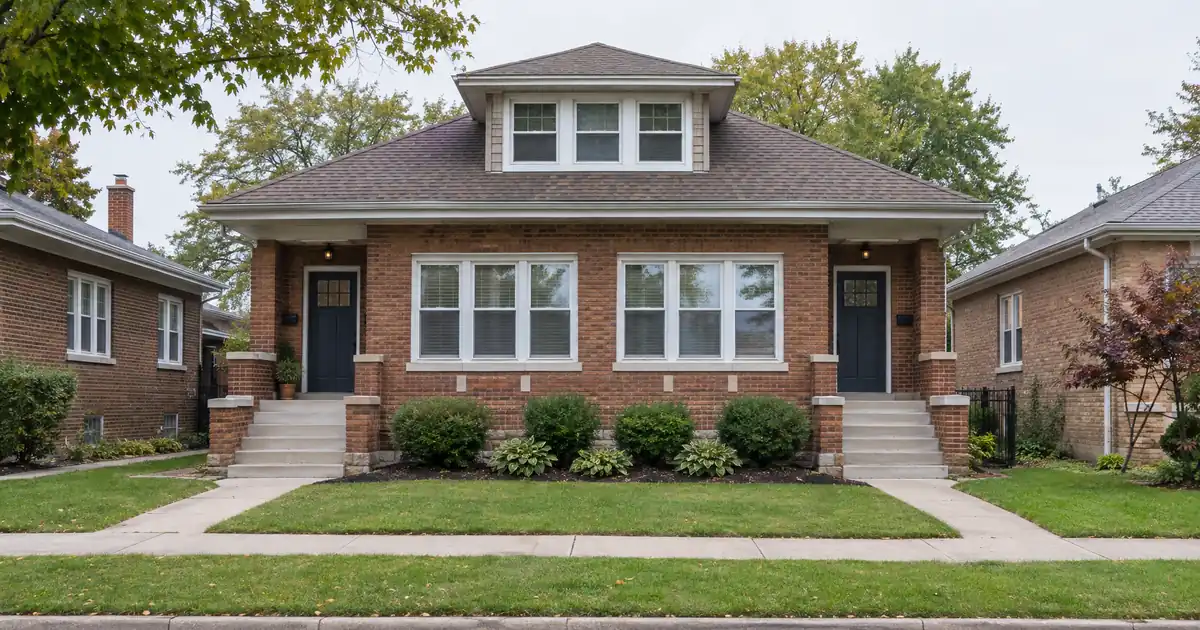
Pull three rent trackers for the same Tinley Park rental and you get three different stories. Apartments.com puts the average rent at $1,416 a month, while Zillow’s rental manager shows $2,388. That spread decides whether a cash-out refinance on an investment property clears 1.00 coverage or stalls in review. Lendmire (NMLS# 2371349), a non-QM mortgage broker, helps arrange DSCR financing for Tinley Park, Illinois investors as part of a broader non-QM footprint reaching 41 markets, including D.C. This article covers the equity-extraction side: what the six-month seasoning clock, the 75 percent ceiling, and thin rental comps mean for an owner who already holds the property.
The Quick Read: A DSCR cash-out refinance on a Tinley Park, Illinois rental is underwritten primarily on the property’s rental income measured against its full monthly obligation, with proceeds capped by a 75 percent loan-to-value ceiling and subject to about six months of seasoning, lender guidelines, and property review.
DSCR Cash-Out Calculator
Run the cash-out numbers in Tinley Park, IL
Rate source: Freddie Mac 30-yr average via FRED® — Federal Reserve Bank of St. Louis · effective Sep 24, 2026
Prefilled with starting assumptions — enter your property’s value, balance, taxes, and insurance for a more accurate picture.
Program parameters update from Lendmire’s centralized guideline source. Taxes and insurance are editable estimates.
As of Sep 24, 2026 · General Freddie Mac market benchmark, not a Lendmire loan offer. Property value, balance, taxes, and insurance are editable estimates. Maximum loan-to-value varies by lender, program, property type, and seasoning. Not a Loan Estimate, approval, or commitment to lend. Program availability and eligibility are subject to lender guidelines, credit approval, property review, and underwriting.
- Renters are only 13 percent of households, so rental comps run thin.
- The 80th Avenue Metra station averages 1,210 weekday boardings, the strongest commuter pocket.
- ZIP 60487 shows 1.08 percent vacancy; ZIP 60477 shows 5.07 percent, per zip-codes.com.
- Aggregator rents span $1,416 to $2,388, so signed leases matter more than any dashboard.
- Only 3 multifamily listings are active, so two-to-four-unit appraisals lean on few comps.
Tinley Park Market Snapshot
A quick read on the Tinley Park investor landscape — figures come from the cited sources below. Confirm current property-level numbers before underwriting.
| Metric | Detail |
|---|---|
| Home prices | $274,800 home value (ZIP Code 60477 Profile) |
| Typical rents | $1,489 (ZIP Code 60477 Profile) |
| Recent appreciation | +0.8% yoy (Zillow Home Values) |
| University enrollment | 10,578 students (main campus) (Wikipedia) |
| Employment | ~3,000 employees (Wikipedia) |
| Vacancy | 5.07% (ZIP Code 60477 Profile) |
The Metra Corridor Is the Strongest Pocket
The strongest rental-demand pocket in Tinley Park is the area around the two Metra Rock Island stations. The commuter tenant base there does not depend on local job growth. It depends on the train.
The 80th Avenue/Tinley Park station ranks 10th busiest among Metra’s 236 non-downtown stations, averaging 1,210 weekday boardings with 48 weekday trains. The Tinley Park station on South Street ranks 57th with 917 average weekday boardings. Those are real ridership numbers. A renter who works downtown can live here and commute on a schedule that exists.
Here’s the catch. No source in the research puts a verified rent premium on transit proximity. The corridor supports a demand story, but the appraiser still needs comparable leases, not a narrative. For a refinance file, the practical move is to document what the corridor property actually rents for, with the signed lease, the deposit, and payment history, rather than relying on the commuter logic to carry the rent figure.
Housing stock also matters on these files. Most of Tinley Park’s homes were built in the 1970s and 1960s, per Point2Homes. Older stock tends to show better rent-to-price ratios than new construction, but it also draws condition adjustments from appraisers. Roof, mechanicals, and updated kitchens move the value up or down. A file with dated photos and no capital-expenditure record gives the appraiser room to be conservative.
Two ZIP Codes, Two Different Refinance Problems
ZIP 60477 has the better rent-to-value math, and ZIP 60487 has the tighter tenant market. A cash-out refinance file looks different in each.
Per zip-codes.com, 60477 carries a median gross rent of $1,489 against a median home value of $274,800, a gross ratio near 0.54 percent a month. ZIP 60487 shows a median gross rent of $1,369, and City-Data lists a median asking price of $323,616 for vacant sale homes there. That puts the ratio near 0.42 percent. Vacancy runs opposite: 60487 sits at 1.08 percent, while 60477 sits at 5.07 percent. Both are far below the national figure on the same pages.
So 60487 is the place where finding a tenant is not the risk. Finding coverage is. A refinance there needs either a lower loan-to-value request or a property already at a rent level that beats the ZIP median.
Then there is the appreciation question. City-Data shows 60477’s population falling from 56,840 in 2000 to 38,161 in 2010 and an estimated 36,019 in 2024, while rents kept climbing. That is a built-out suburb, not a growth story. Equity here builds from debt paydown, improvements, and steady comps. It does not build from migration. Model the refinance on the value you can defend today, not on the value you hope a growth cycle delivers.
What 75 Percent Actually Produces Here
The 75 percent ceiling is a cap, not a target, and in Tinley Park it frequently runs into the coverage test before it runs into the appraisal. The equity available depends on rent used for lender review, full monthly obligation (principal, interest, taxes, insurance, and any HOA dues), reserves, and that ceiling. It is not a guaranteed cash figure.
Start with the price picture. Zillow puts the typical Tinley Park home value at $297,301, up 0.8 percent over the past year. Redfin reports a median sale price of $335,000, down 3.3 percent, and its median reflects what actually sold rather than a modeled value, which explains part of the gap. Houzeo splits the market by type: condos near $257,500, single-family homes near $391,000. Flat to slightly up, depending on the source. That is not a market where an owner can assume a value jump since purchase.
Now run the numbers on a modeled file. These inputs are assumptions, not sourced market data. Say you own a single-family rental an appraiser values near $300,000, close to the Zillow typical value. You request 75 percent of that value. The modeled rent is $2,000. Measured against full PITIA at standard 30-year terms, with taxes and insurance at Illinois averages, coverage lands in the 0.9s. Under the 1.00 baseline.
Change one input. At a modeled rent of $2,400, near the Zillow average, coverage comes out around 1.1 including taxes and insurance. Same house, same leverage. The rent input moved the file from short to clear.
A coverage number under 1.00 does not end the conversation, but it changes the structure. The options a lender may review include a sub-1.00 program, interest-only terms, a lower loan-to-value request, or extra reserves. Each comes with its own pricing and leverage, and any of them depends on lender guidelines, credit approval, and property review. (Honestly, a lower loan amount is often the cleanest fix. It costs the owner cash-out proceeds, but it keeps the file inside the standard box.)
Other parameters matter on the same file:
- Seasoning: about six months of ownership, measured from title recording and documented by the settlement statement.
- Credit: tiers at 620, 660, 680, and 700, with 620 as the floor. Higher tiers generally give the file more room.
- Reserves: about six months of PITIA, rising to about nine months above $1,500,000.
- Loan size: up to $3,000,000 on standard programs. Smaller balances route through select lenders in the network.
Program details shift with lender guidelines and state overlays, so confirm current terms before building a payoff plan around them. For the general mechanics, the guide “What Is a DSCR Loan” covers how coverage is calculated, and the refi options page walks through cash-out structure.
Which Rent Number Does the File Use?
The rent figure on a refinance file should come from signed leases and the appraiser’s rent schedule, not from an online average. Tinley Park’s aggregators disagree enough that any single one can mislead.
| Source | Reported average rent |
|---|---|
| Apartments.com | $1,416 |
| RentCafe | $2,006 |
| Zumper | $2,160 |
| Zillow rental manager | $2,388 |
Two-bedroom figures scatter the same way: $1,611 on Apartments.com, $1,750 on Zillow, $2,172 on RentCafe. Different listing samples, different methods. The gap between the low and high average is wide enough to swing a file from comfortable to marginal.
The friction point is predictable. An owner runs the refinance math on the high number, the appraiser’s market-rent estimate comes in lower, and coverage drops. Files that avoid this start with the lease in hand and a rent roll that matches it. Deposits and payment history back it up. If the property is a LLC-titled asset, the entity documents belong in the package from the start, subject to lender program eligibility.
Also consider the two-bedroom share. RentCafe and Point2Homes show that 2-bed units make up about half of Tinley Park’s rental market. A three-bedroom or a four-bedroom single-family house may have very few leased comps nearby. Thin comps are normal here. Plan for the appraisal reconsideration step, with recent nearby leases and condition adjustments ready, instead of treating it as a surprise.
Multifamily Is Scarce (and That Cuts Both Ways)
Small multifamily in Tinley Park is rare enough that the appraisal, not the coverage number, becomes the risk. Redfin’s multifamily page shows 3 multifamily homes for sale at a median listing price of $530,000, with 1 multifamily sale in the prior month against 58 single-family sales.
For an owner of a duplex or fourplex, that scarcity makes a cash-out refinance harder to value. An appraiser working with one recent sale and a handful of listings is making more judgment calls. Adjustments get larger, and the result can land above or below expectations. A value that comes in light cuts the 75 percent calculation directly.
There is a real example of how rarely this product trades. A Homes.com listing describes a fully occupied 10-unit brick building in the core, held by one owner for over 30 years, with a newer roof, windows, and boilers. Buildings like that rarely change hands. It also sits outside the small-residential box many programs use, so eligibility would depend on program terms.
In our experience as a non-QM DSCR mortgage broker, the cleaner files in thin-inventory suburbs like this one tend to arrive with the lease schedule, a trailing-twelve-month rent ledger, and a short appraisal-support packet already assembled. The common friction point in markets like this is the appraisal comp set, not the borrower’s credit. A packet of nearby sales and lease evidence, ready before the appraiser’s visit, gives a reconsideration request something to stand on.
The stronger play might be single-family for most owners, since comps exist and the paperwork is simpler. Multifamily owners could argue the income stacking is worth the appraisal risk. It’s a genuine toss-up, and it depends on how much cushion the coverage number has before value comes in.
Employment Anchors Behind the Rents
Tinley Park’s tenant base is spread across healthcare, retail, and education rather than concentrated in a single employer. That matters for a refinance because income stability is what keeps leases renewing through a hold.
Data USA shows the economy employing 27.8 thousand people, with Health Care and Social Assistance the largest sector at 3,547 workers, followed by Retail Trade at 3,458 and Educational Services at 2,867. The Census Bureau estimates the population at 54,856, down slightly from 55,971 at the 2020 count. The Village of Tinley Park reports more than 1,400 businesses and names Tinley Park and Joliet as the largest employment centers in the south and southwest suburbs. Panduit and UGN are both headquartered in town. No precise headcounts for them were verified, so treat them as named employers only.
Healthcare has the deepest local footprint. UChicago Medicine at Ingalls runs a Tinley Park campus with pediatric specialties and an urgent care center, and its parent hospital in Harvey is licensed for roughly 582 beds with about 3,000 employees. Loyola Medicine operates a multi-specialty center in town, and Northwestern Medicine runs primary care. Silver Cross Hospital in New Lenox employs over 4,500 employees, physicians, and volunteers, with physician and oncology offices inside Tinley Park. That is a durable long-term tenant base of nurses, technicians, and administrative staff, and it tends to renew leases.
Education is minor. Fox College has its main campus here, and Moraine Valley Community College runs a satellite center, but enrollment in Tinley Park itself is small. This is a workforce and commuter rental market, not a student market. Don’t underwrite the file like a college town.
Where the Proceeds Go
Cash-out proceeds only help if the next deal clears its own coverage test, and Tinley Park’s own math suggests how to think about that. The local market is ownership-dominant: about 87 percent of households own, and tenants compete for a small rental stock. That scarcity supports rent stability but does not create rent growth.
An owner with equity here has three realistic paths. Pay down other debt, which improves the portfolio’s overall position but does not add a property. Fund reserves, which the program requires anyway (about six months of PITIA on the new loan). Or put the money toward another acquisition, where the new property has to carry itself on rent without leaning on the old one.
A fourth path is weaker: pulling out the maximum amount on a property whose coverage is already close to 1.00. The proceeds look large on paper, but a file near the baseline has no cushion if the appraisal comes in light or a tenant turns over. The skeptical read is that the largest possible cash-out is rarely the best one in a flat market. A smaller draw that clears coverage with margin tends to hold up better through review.
For owners weighing this against a rate-and-term move, Lendmire’s guide to investor refinance options lays out the difference, and the comparison covers how DSCR underwriting differs from conventional. Owners ready to request terms can get a DSCR quote or call 828-256-2183. Investors can see Lendmire’s Illinois DSCR platform for program specifics. Verify current local rules, taxes, and insurance with qualified local professionals before building any payoff plan.
Frequently Asked Questions
How long do I have to own a Tinley Park rental before I can do a cash-out refinance?
Plan on about six months of ownership, measured from the date title was recorded, and documented with the settlement statement. A purchase made below market with light improvements is the case where seasoning produces equity. In a flat market with values up under 1 percent on Zillow, a recent market-price purchase often leaves little to extract.
DSCR vs. conventional financing
There are two common ways to finance an investment property in Tinley Park, IL, and they qualify you differently — here’s how investors weigh them.
Why investors choose it
- Qualifies on the property’s rental income — no personal tax returns, W-2s, or pay stubs needed to document income.
- No personal debt-to-income ceiling to clear, so existing mortgages and obligations don’t cap your borrowing the same way.
- Can be closed in an LLC, keeping the property inside a business entity.
- Built for scaling — not held to the limit on number of financed properties that conventional financing applies.
- Underwriting centers on the deal: generally qualifies when the rent covers the payment, a 1.00x coverage ratio being a common baseline (confirmed in underwriting).
- Designed specifically for investment property, including long-term and, where the program allows, short-term rentals.
Where it’s strong
- Often the lowest ongoing financing cost for a buyer who fully qualifies on personal income — a fit for a first property or a cost-first purchase.
Trade-offs for investors
- Requires full personal income documentation and must fit within a debt-to-income limit — salary, existing debts, and other mortgages all count.
- Typically held in your personal name rather than a business entity.
- Caps how many financed properties you can carry, which can become a ceiling as a portfolio grows.
- Evaluates you as a borrower as much as the property, which usually means more paperwork.
How investors usually choose: a first or single property often optimizes for the lowest financing cost; portfolio builders often optimize for leverage, vesting in an LLC, and scaling past conventional caps. The right answer depends on your goals, the property, and current guidelines — both paths run through select lenders in Lendmire’s wholesale network, with eligibility and terms confirmed in underwriting.
Does Tinley Park’s low renter share make a refinance harder?
It makes the appraisal rent schedule harder, not the loan itself. With only 13 percent of households renting, per RentCafe, comparable leases are sparse, especially for three- and four-bedroom houses. Bring the signed lease, rent ledger, and a short set of nearby leased comps so the appraiser has evidence beyond online averages.
Which Tinley Park ZIP code gives the better refinance math?
ZIP 60477 has the stronger gross rent-to-value ratio, about 0.54 percent a month against about 0.42 percent in 60487, per zip-codes.com and City-Data. The 60487 ZIP has far lower vacancy, at 1.08 percent, so lease-up risk is minimal but coverage is thinner. Each file still depends on the specific property’s lease and appraisal.
Can a duplex or fourplex in Tinley Park support a cash-out refinance?
It can be reviewed, but the comp set is the obstacle. Redfin shows 3 active multifamily listings and 1 sale in the prior month, so an appraiser has little to anchor on. Value can come in above or below expectations, which moves the 75 percent calculation. Eligibility depends on lender guidelines and program terms.
What happens if my coverage comes in under 1.00?
A 1.00 coverage baseline is common because rent covers the full monthly obligation at that level. Under it, a lender may review a sub-1.00 program, interest-only structuring, a lower loan-to-value request, or additional reserves. Each option comes with different pricing and leverage, and none is assured. Approval is subject to lender guidelines, credit review, and the property.
The Neighbor Comparison
Zillow data places Tinley Park above Oak Forest in average home value but below Orland Park, Mokena, and Frankfort. For a cash-out refinance, that mid-tier position is an advantage. Higher-priced neighbors ask more of the rent to hold a 75 percent request near 1.00, and Tinley Park’s lower entry values ask less. Between Tinley Park and those three, the math favors Tinley Park right now, provided the rent is documented and the appraisal holds.
For current guidelines and terms, see Lendmire’s DSCR loan programs page.
About Lendmire
As a non-QM mortgage broker (NMLS# 2371349), Lendmire facilitates DSCR investor loans across 41 markets, including Washington, D.C. DSCR eligibility is generally reviewed around a property’s rental income rather than personal income documentation, subject to lender guidelines. It serves LLC-structured portfolios and self-employed borrowers who don’t fit conventional boxes. Lendmire is a two-time Scotsman Guide Top Mortgage Workplace, recognized by Scotsman Guide as a 2026 Top Workplace and a top-ranked workplace in 2025.
Get Started
Ready to find the right loan for you?
In about 30 seconds you can review financing options available for your investment property. No commitment required.
Informational only. Not a Loan Estimate, approval, or commitment to lend. Program availability and eligibility are subject to lender guidelines, credit approval, property review, and underwriting.
References
3. RentCafe: Tinley Park rent trends
4. 80th Avenue/Tinley Park station
7. Zillow Home Values: Tinley Park
8. Wikipedia
9. Wikipedia
10. Tinley Park station on South Street
11. Point2Homes
12. Redfin Housing Market: Tinley Park
13. Houzeo
14. Zumper
18. U.S. Census Bureau QuickFacts: Tinley Park village
19. Village of Tinley Park business profile
20. UChicago Medicine at Ingalls
21. Loyola Medicine
23. Fox College
24. recognized by Scotsman Guide as a 2026 Top Workplace
25. Scotsman Guide — Top Workplaces 2025
This article is part of Lendmire’s investment property cash-out refinance program — full qualification details, guidelines, and scenarios live on the program page.
Related reading: Luxury Rental DSCR Loans In New Jersey · Jersey Shore Vacation Rental Loans: DSCR Financing In Ocean City, Cape May And Long Beach Island · DSCR Cash-out Refinance In New Jersey: Pulling Equity From A Rental
Guides: Investment Property Cash-Out Refinance in Tinley Park, IL · Investment Property Cash-Out Refinance in Illinois
Brandon Miller
Founder & CEO, Mortgage Loan Originator, Lendmire LLC
- Mortgage Loan Originator · NMLS# 1129696 · Verify on NMLS Consumer Access
- North Carolina Real Estate Broker · License# 343312 · Verify on NCREC
- North Carolina Insurance Producer · License# 19053198 · Property, Casualty, Life, Health · Verify on NAIC SBS
- Lendmire LLC · Firm NMLS# 2371349 · Verify firm licensure
Disclosure information. Lendmire is a state-licensed mortgage brokerage under NMLS# 2371349. Lendmire is not a depository institution, direct lender, or financial advisor — all loans referenced are placed through wholesale lender partners and are subject to each lender's underwriting standards. This article is provided for general informational purposes and is not a commitment to lend, nor does it constitute financial, legal, or tax advice. Loan programs, terms, rates, and qualification standards change without notice and depend on borrower profile, property type, and the state in which the subject property is located. Equal Housing Opportunity provider. NMLS Consumer Access: nmlsconsumeraccess.org.