
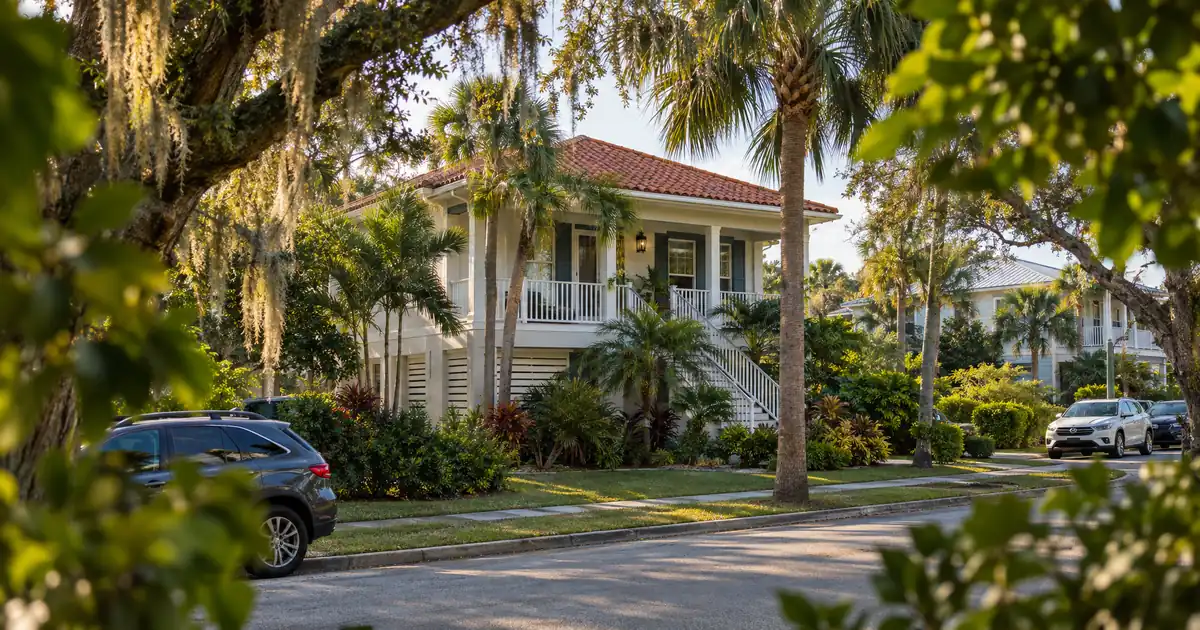
Scroll Vero Beach listings from an airport gate in another state and the barrier island grabs you first. Redfin shows a March median sale price of $950K in ZIP 32963, down 17.4 percent year over year. Then you find the mainland, where Zillow-derived data from Momentum Realty puts a typical ZIP 32960 home value near $281,160. Same city, two different loan conversations. Most out-of-state owners looking at a cash-out refinance on an investment property here miss that the equity is easier to turn into capital on the mainland than on the sand.
The Quick Read: A DSCR cash-out refinance in Vero Beach, Florida is underwritten primarily on the property’s rental income measured against its full monthly obligation, with the lender also reviewing seasoning, appraised value, reserves, and credit. The investor’s job is to assemble leases, entity documents, and title, then size the draw against the program’s loan-to-value ceiling.
DSCR Cash-Out Calculator
Run the cash-out numbers in Vero Beach, FL
Rate source: Freddie Mac 30-yr average via FRED® — Federal Reserve Bank of St. Louis · effective Sep 24, 2026
Prefilled with starting assumptions — enter your property’s value, balance, taxes, and insurance for a more accurate picture.
Program parameters update from Lendmire’s centralized guideline source. Taxes and insurance are editable estimates.
As of Sep 24, 2026 · General Freddie Mac market benchmark, not a Lendmire loan offer. Property value, balance, taxes, and insurance are editable estimates. Maximum loan-to-value varies by lender, program, property type, and seasoning. Not a Loan Estimate, approval, or commitment to lend. Program availability and eligibility are subject to lender guidelines, credit approval, property review, and underwriting.
- 32962’s typical value is about $260,956, the lowest of the four ZIPs reviewed (Momentum Realty). – Rentometer shows 2-3 bedroom houses in the 32962 area renting from $2,000 to $2,600.
- The 32963 barrier island is appreciation-led, not coverage-led, at a $950K median.
- Cleveland Clinic Indian River Hospital, in 32960, reports more than 2,500 caregivers.
- Rent sources disagree on direction, so underwrite on in-place leases.
Vero Beach Market Snapshot
A quick read on the Vero Beach investor landscape — figures come from the cited sources below. Confirm current property-level numbers before underwriting.
| Metric | Detail |
|---|---|
| Typical rents | $2,176 (Momentum Realty, Indian River) |
| Cap rates | ~7.2% cap rate (Momentum Realty, Indian River) |
| Employment | 20 new jobs (General Aviation News) |
South Vero and the In-Town Mainland: Where Coverage Holds
The mainland ZIPs are where the cash-out math works best in Vero Beach. ZIP 32962, south and west of US 1, carries the lowest typical value of the four ZIPs reviewed, about $260,956, with roughly 5.5 percent annual growth over five years, per Momentum Realty’s Zillow-derived scorecard. ZIP 32960, the in-town central mainland, sits near $281,160 with about 5.1 percent annual growth.
Rentometer’s Vero Beach South data puts two- and three-bedroom houses in that area at roughly $2,000 to $2,600. Against a $261K value, that is about 9 to 12 percent gross annually. That is Lendmire Research’s own arithmetic, not a sourced yield, and it runs above Momentum’s modeled 8.4 percent, so treat it as an upper-bound cross-check. The truth probably lands between the two.
In-town 32960 has a different feel. McAnsh Park and Royal Park have mature oak canopy and early-20th-century streets, and the area sits next to a large medical campus. That is the most plausible core for long-term tenant demand in the city. Which ZIP is better depends on the investor. Buyers who prize yield and can tolerate more price cuts (Momentum notes about 25.1 percent of 32962 listings had cuts) lean south. Investors who want a steadier tenant pool near the hospital lean in-town.
Both bands sit between the lagoon and US 1, at price points that let a 75 percent loan-to-value cash-out ceiling produce proceeds that matter for a next deal without pushing the coverage ratio into trouble.
The Hospital and the Hangar
Tenant demand in Vero Beach rests on a short list of employers, and most sit on or near the mainland bands. Cleveland Clinic Indian River Hospital says it employs more than 2,500 caregivers and calls itself the county’s largest employer, though other sources rank it second. Its campus is in ZIP 32960, so the in-town band sits next to a large concentration of nurses, technicians, and support staff. A travel-nurse review of the hospital describes hard-to-find housing. That is anecdotal, not data, but it fits the demand story.
The county’s community development report lists the School District of Indian River County at 2,039 employees, Indian River County government at 1,455, Publix at 1,380, and Walmart at 806. Its Piper Aircraft figure is 1,005. Those numbers come from an older report, so read them as scale, not precision.
Piper is the differentiator. The general-aviation manufacturer is headquartered here, calls itself the county’s largest private employer, and per its press release is planning a new service center on its 30-acre campus. General Aviation News reports at least 20 new jobs. Twenty jobs won’t move a rent roll. What matters is that healthcare, education, government, retail, and aircraft manufacturing give the mainland a diversified base rather than a single-employer bet.
Indian River State College’s Mueller Campus is in ZIP 32966, off College Lane. It adds some demand, though no four-year university is in Vero Beach, so don’t underwrite a student-housing thesis.
Skip the Island
The barrier island is a great place to own and a hard place to run a cash-out on a rental coverage ratio. ZIP 32963 shows a $950K median, roughly $500 per square foot, and 110 days on market on average, per Redfin. At that basis, rent-to-value is thin.
The central beach village is walkable and attractive to seasonal and high-income renters, but no sourced rent figure supports a long-term coverage case. The north-end club communities (John’s Island, Orchid Island, Sea Oaks, and Indian River Shores) are guard-gated, primarily owner-occupant and second-home markets, and club rules may limit leasing. Those files rarely pencil on rental income alone.
Here is where the flip point sits. An investor holding an island property with large embedded appreciation and a low balance may still pull equity through a cash-out, and the 75 percent cap is applied to appraised value, not rent. But the DSCR test still applies. If the rent can’t cover the full monthly obligation on the new, larger loan, the cash-out shrinks or fails. In that case a conventional or portfolio route may fit better, especially for an investor with strong traditional employment income and one or two properties. The comparison lays out where that tradeoff tips.
Unlike lenders whose condo warrantability requirements exclude most investor files, non-QM channels are generally more flexible on property type. Flexibility still doesn’t erase the math, though, and island prices leave little room for it.
West Vero and the 32967 Problem
West Vero runs along SR 60 toward I-95, with the newest subdivisions, Indian River Mall, Vero Beach Outlets, and the master-planned Pointe West. ZIP 32967 carries a typical value near $405,117 with about 6.0 percent annual growth and a modeled gross yield of about 7.06 percent, per Momentum Realty. That yield is directional, not exact.
The tension is easy to see. Growth is stronger than the mainland ZIPs, but the price is roughly 44 percent above the 32960 figure, and coverage compresses accordingly. Modeling a $405K value with an assumed $2,600 rent at 75 percent LTV, including taxes and insurance, lands near or a shade under 1.0x. The rent input there is an assumption, not a sourced market rent.
If a West Vero file lands below 1.00 on long-term rent, the structures a lender would review include a sub-1.00 program, interest-only restructuring, or a lower loan amount. Each comes with tradeoffs such as reduced leverage, stronger credit or reserve requirements, or different pricing, and qualification remains subject to lender guidelines and property review. The better question is whether the investor is buying appreciation. If yes, sub-1.00 is defensible. If the investor is reaching because nothing else works, that signals a submarket problem, not a loan-type problem.
What Does the Cash-Out Math Look Like on a Mainland Rental?
Picture an investor who bought a 32962 rental about a year ago and it has held value. Value is what gets appraised, and for a cash-out that value is capped at 75 percent loan-to-value, not the 80 percent that applies to purchases. Seasoning generally runs about six months from title recording. Reserves typically run about six months of PITIA (about nine months above $1,500,000 in loan size). Minimum credit is generally 620, with better pricing and leverage tiers at 660, 680, and 700. Loan amounts run up to $3,000,000 on standard programs, with smaller balances routed through select lenders. All of this is subject to lender guidelines, and the proceeds are never a guaranteed figure.
Run the numbers this way, as modeled assumptions and not market data. Take a $261K appraised value at 75 percent LTV with a $2,300 rent, roughly the middle of the Rentometer house range. Including taxes and insurance, coverage lands around 1.3x. At $2,000 rent it sits nearer 1.2x, and at $2,600 it clears 1.5x. On a $281K in-town value with the same $2,300 rent, coverage tightens to the mid-1.2s. The pattern to notice is that each additional $20K of value at the same rent eats meaningfully into the ratio, which is why the appraisal matters as much as the rent roll.
DSCR files in markets like this one typically look like this: a mainland single-family or small-multifamily property, a lease at or near market, an LLC or personal title, and a borrower asking how much equity can come out while keeping coverage above the baseline. The cleanest file from a documentation standpoint has complete leases, entity docs, title, and property details ready for lender review. Files get messy when the lease is month-to-month, when the appraisal comes in under the borrower’s own estimate, or when reserves sit in accounts the borrower can’t easily document. Investors who line up those items before the application tend to find the process is mostly a matter of math, not paperwork.
DSCR vs. conventional financing
Two common ways to finance an investment property in Vero Beach, FL. They qualify you differently — here’s how investors weigh them.
Why investors choose it
- Qualifies on the property’s rental income — no personal tax returns, W-2s, or pay stubs needed to document income.
- No personal debt-to-income ceiling to clear, so existing mortgages and obligations don’t cap your borrowing the same way.
- Can be closed in an LLC, keeping the property inside a business entity.
- Built for scaling — not held to the limit on number of financed properties that conventional financing applies.
- Underwriting centers on the deal: generally qualifies when the rent covers the payment, a 1.00x coverage ratio being a common baseline (confirmed in underwriting).
- Designed specifically for investment property, including long-term and, where the program allows, short-term rentals.
Where it’s strong
- Often the lowest ongoing financing cost for a buyer who fully qualifies on personal income — a fit for a first property or a cost-first purchase.
Trade-offs for investors
- Requires full personal income documentation and must fit within a debt-to-income limit — salary, existing debts, and other mortgages all count.
- Typically held in your personal name rather than a business entity.
- Caps how many financed properties you can carry, which can become a ceiling as a portfolio grows.
- Evaluates you as a borrower as much as the property, which usually means more paperwork.
How investors usually choose: a first or single property often optimizes for the lowest financing cost; portfolio builders often optimize for leverage, vesting in an LLC, and scaling past conventional caps. The right answer depends on your goals, the property, and current guidelines — both paths run through select lenders in Lendmire’s wholesale network, with eligibility and terms confirmed in underwriting.
This one is a genuine toss-up: take the maximum draw, or pull less and keep coverage comfortable. The maximum leaves less cushion if rents soften. A smaller draw costs less carry and leaves room to refinance again later. The stronger play might be the smaller draw on 32960 and the fuller draw on 32962, given the rent-to-value gap, though an investor with a specific next deal already priced could reasonably argue the other way.
The guide “What Is a DSCR Loan” covers the ratio mechanics in detail. The short version: monthly rent divided by principal, interest, taxes, insurance, and any HOA dues, with 1.00x the common baseline and exact eligibility depending on credit, reserves, property review, and state overlays.
Rent Sources Disagree: Underwrite Conservatively
Rent direction in Vero Beach is unclear, and that matters for any file underwritten on market rent. RentCafe reports an average city apartment rent of $2,101, up 11.08 percent year over year, but only for buildings with 50 or more units. Zumper reports an average of $2,500, down 9 percent from a year earlier. Same city, opposite direction.
Newly built local rentals quoted at $1,700 for a one-bedroom, $1,900 for a two-bedroom, and $2,300 for a three-bedroom, per WQCS, are new-construction figures from an affordable-housing advocate, not a market median. The same report says a three-person household needs about $76,000 a year to afford a two-bedroom at the 30 percent threshold. That points to demand for older, lower-priced stock, along with affordability limits on how high rents can climb.
The takeaway: underwrite on in-place leases or a conservative market rent. Skip the 11 percent growth assumption.
Another wrinkle is the thin renter pool. RentCafe’s city page shows only 36 percent of Vero Beach households (2,667) are renter-occupied, so city-limits comps are sparse. Use ZIP and county-level comps, and expect the appraiser to do the same.
Small multifamily is worth a look but not a bet. Homes.com showed only 16 multi-family listings in Vero Beach, priced from $250,000 to $1,600,000, averaging 103 days listed. That is a snapshot of active listings, not sold comps. The low end is close to single-family ZIP values, and duplex coverage typically has more cushion than a comparable single-family home. With inventory this thin, though, comps are scarce and list prices aren’t sale prices.
Where the Proceeds Go
The cash-out thesis depends on what the investor does with the capital. Pulling equity from a 32962 rental to buy another mainland rental, where coverage still works at current pricing, is straightforward. Pulling equity to deploy in out-of-state markets where the math doesn’t pencil is a different decision, and worth stress-testing before committing.
City-level values are flat to slightly down. Zillow shows an average home value of $362,300, down 1.9 percent year over year, even as the ZIPs reviewed have grown roughly 5 to 6 percent annually over five years. Investors who bought a few years back may hold real equity, but a cash-out built on last year’s appraisal expectations may disappoint.
The Biggest Blind Spot: Value and Rent Both Have to Cooperate
The single largest risk for DSCR-financed investors in Vero Beach is a cash-out that depends on two inputs neither of which is stable. City values are down 1.9 percent year over year, Movoto-style days-on-market figures have lengthened, and rent sources can’t agree on direction. An appraisal that comes in below expectations shrinks the 75 percent draw, and a rent that comes in below expectations shrinks the coverage ratio. Both can happen in the same file. The investors who do well here underwrite on in-place leases, treat the appraisal as an open question until it’s in hand, and keep enough reserves that a lower-than-hoped draw doesn’t strand the next purchase.
Frequently Asked Questions
How do you qualify for a DSCR cash-out refinance in Vero Beach?
Qualification centers on the property’s rent relative to its full monthly obligation, with 1.00x the common baseline, plus about six months of seasoning, reserves of about six months of PITIA, and a credit score generally at or above 620. The loan-to-value ceiling on a cash-out is 75 percent. Exact eligibility depends on the lender, credit profile, and property review.
What are the requirements for an investment property loan in Vero Beach, Florida?
Most files need a signed lease or market-rent appraisal, title and property documents, reserves, and credit at or above the program floor. Manufactured homes, log homes, and barndominiums fall outside these DSCR programs. Loan amounts run up to $3,000,000 on standard programs, and specifics vary by lender and scenario.
Can an LLC-owned Vero Beach rental be reviewed for DSCR financing?
Yes, subject to lender program eligibility, LLC-titled rentals are commonly reviewed. Lendmire arranges DSCR investor loans through wholesale lenders. A key program feature is that qualification is commonly evaluated around the property’s rental income rather than personal income paperwork.
Does a barrier island property work for a DSCR cash-out?
Usually not on coverage. With a $950K median in ZIP 32963, rent rarely covers the full monthly obligation on a large loan. Investors with big embedded equity may still run the numbers, but a smaller draw or a different loan type often fits better.
Which Vero Beach ZIP codes have the best rent-to-value for a cash-out?
The mainland ZIPs 32962 and 32960 carry the strongest modeled yields, about 8.4 and 8.46 percent gross per Momentum Realty’s Zillow-derived figures. ZIP 32967 is higher priced with a lower modeled yield of about 7.06 percent, so coverage is tighter there.
For current guidelines and terms, see Lendmire’s DSCR loan programs page.
Get Started
Ready to find the right loan for you?
In about 30 seconds you can review financing options available for your investment property. No commitment required.
Informational only. Not a Loan Estimate, approval, or commitment to lend. Program availability and eligibility are subject to lender guidelines, credit approval, property review, and underwriting.
About Lendmire
Lendmire (NMLS# 2371349), a non-QM mortgage broker serving investors in 41 markets including Washington, D.C., helps structure DSCR scenarios commonly evaluated around a property’s rental income rather than personal income paperwork, subject to lender guidelines. Recognized as a 2026 Scotsman Guide Top Mortgage Workplace and recognized by Scotsman Guide in 2025, Lendmire places loans through wholesale investor lenders and is not a direct lender.
This article is part of Lendmire’s investment property cash-out refinance program — full qualification details, guidelines, and scenarios live on the program page.
Related reading: DSCR Loans in Vero Beach, Florida: Investor Financing for the Barrier Island, South Beach & Gifford, Snowbird and Seasonal Rental Cash Flow & Real Estate Investors · Luxury Rental DSCR Loans In Vero Beach: A Complete Guide · Cash Out Refinance Investment Property in Fernandina Beach, Florida
Guides: Investment Property Cash-Out Refinance in Vero Beach, FL · Investment Property Cash-Out Refinance in Florida
References
1. Redfin
3. Freddie Mac 30-yr average via FRED® — Federal Reserve Bank of St. Louis
5. Rentometer
6. Momentum Realty, Indian River
8. Momentum Realty’s Zillow-derived scorecard
9. Cleveland Clinic Indian River Hospital
10. press release
11. Momentum Realty
12. RentCafe
Brandon Miller
Founder & CEO, Mortgage Loan Originator, Lendmire LLC
- Mortgage Loan Originator · NMLS# 1129696 · Verify on NMLS Consumer Access
- North Carolina Real Estate Broker · License# 343312 · Verify on NCREC
- North Carolina Insurance Producer · License# 19053198 · Property, Casualty, Life, Health · Verify on NAIC SBS
- Lendmire LLC · Firm NMLS# 2371349 · Verify firm licensure
Compliance and disclosures. Lendmire (NMLS# 2371349) is a licensed mortgage broker and is not a direct lender, depository institution, financial advisor, or tax professional. Content in this article is general market analysis and educational information — not financial, legal, or tax advice for any specific situation. Lendmire does not guarantee loan approval; every transaction is subject to underwriting by the funding lender. Mortgage pricing and loan program guidelines are subject to change at any time without notice and vary by borrower characteristics, property type, and state regulations. Lendmire complies with Equal Housing Opportunity. Licensure verification: NMLS Consumer Access.