
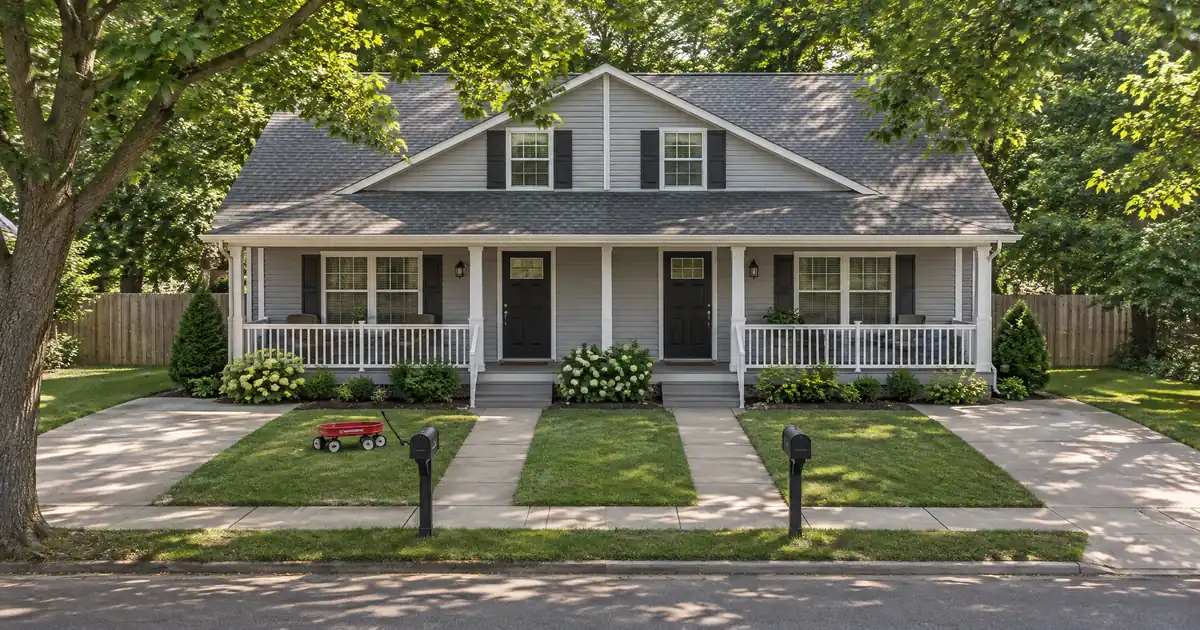
The Quick Read: A DSCR HELOC is a revolving line of credit secured by a duplex, triplex or fourplex you own, written as a standalone second lien behind the mortgage you keep or as a first lien on a building with no mortgage, and qualified primarily on property-level rental income covering the payment, subject to lender guidelines.
- Fit: The building must be a non-owner-occupied rental of two to four units with a lease in place and no more than one vacant unit.
- Leverage: Through select programs, a second lien reaches up to 70% combined loan-to-value (CLTV) at a 720 credit score or better. A first lien reaches up to 75% loan-to-value (LTV) at 740 or better. Both are subject to underwriting.
- Coverage: The rent must reach at least 1.10x a stress payment calculated on the entire credit limit.
- Choosing a lender: Which lenders fit depends on your building, credit, and leverage needs. Lendmire is a broker that compares wholesale DSCR HELOC lenders for you. Every figure here varies by lender and program — guidelines, property type, leverage, and credit profile all apply.
What Is a DSCR HELOC, and How Is It Different From a Bank HELOC?
A DSCR HELOC is a home equity line of credit on a rental, underwritten on the rent instead of your paycheck. DSCR stands for debt service coverage ratio. It measures whether the building’s rent covers the payment tied to the loan.
The name is a market label, not a formal product category. Underneath it sits an open-end line, which means you can borrow against it more than once. Some lenders also sell a closed-end DSCR second, which pays out a single lump sum. Those are different tools, so check which one a lender is actually offering.
A typical bank HELOC tests your personal income and your debt-to-income ratio. A DSCR HELOC tests the rental. Qualification runs primarily on the rental’s income covering the payment, with no W-2s or personal income calculation, subject to lender guidelines. Credit, title, and the property valuation are all still reviewed.
DSCR loans are designed for non-owner-occupied investment properties. Because they are business-purpose investor loans, they are reviewed differently from a standard owner-occupied mortgage.
One more point on lien position. This line is never closed together with a purchase. It is never a third lien. It is never placed on your own home or a second home. It sits on a rental you already hold.
Key Terms Defined
- DSCR: Gross monthly rent divided by the qualifying payment. A result above the program minimum means the rent covers the payment.
- CLTV: Combined loan-to-value. It adds the first mortgage balance and the new line, then divides by the property’s value.
- Second lien: A loan that sits behind your existing first mortgage and leaves that mortgage untouched.
- First lien: A loan in first position, available on a rental with no mortgage.
- Revolving line: A credit limit you can draw from, repay, and in some cases draw from again under the program’s draw rules.
- Stress payment: A fully amortizing payment on the whole credit limit at a rate set 2 percentage points above the line’s starting rate. The lender uses it only to test coverage.
- Guarantor: A member of your LLC who signs personally to back the loan.
Does Your 2-4 Unit Building Fit?
Most duplexes, triplexes and fourplexes fit. The tougher questions are about the building’s condition, location, and use.
Eligible: Two-to-four-unit properties, single-family homes, planned unit developments, townhomes, and warrantable and non-warrantable condominiums. Lots up to 10 acres also qualify. These are the program’s eligible property types, and the leverage tiers later here apply to every one of them.
Not eligible on this program:
- Rural-designated property
- Row homes
- Condotels
- Commercial or agricultural property
- Leaseholds and land trusts
- Age-restricted communities
- Hobby farms
- Modular and log homes
- Land-contract properties
- Mixed-use buildings
- Any property listed for sale in the prior 2 months
- Any property with a solar lien
If you are comparing a five-unit building, the answer is no, because the program stops at four units.
Occupancy and vacancy: The building must be a rental, with a lease in place. A two-to-four-unit property may have at most 1 vacant unit. If you live in one unit, this is not your product, because the line is never offered on an owner-occupied home.
Who can borrow: U.S. citizens, permanent residents, and non-permanent residents with a Social Security number. Foreign nationals and ITIN borrowers are not eligible.
Title: You can keep the building in your LLC, subject to program terms. The members sign as guarantors. A title holder who is not a borrower signs a non-borrowing owner acknowledgment along with the security instrument. The borrowers on the line do not have to be the borrowers on the first mortgage.
What DSCR HELOC Lenders Look For: Underwriting Step by Step
Wholesale DSCR HELOC lenders review a file in a fairly consistent order. The figures below come from the program Lendmire places files with, and every one is subject to underwriting.
Step 1: Lien position. If you have a mortgage, the line is a standalone second lien. If the building is free and clear, it is a standalone first lien. The first lender’s loan documents must also allow a second lien behind them. Check the first mortgage for a prepayment penalty as well, since that is a common source of delays on second-lien files.
Step 2: Leverage. The lender adds your first mortgage balance to the new line and divides by value. The line is sized by equity, not by rent alone. The next section lays out the tiers.
Step 3: Coverage. The lender divides gross monthly rent by the qualifying payment. That payment is principal and interest on the entire credit limit at the stress rate. Taxes and insurance are not part of it. The minimum is 1.10x.
On a second lien, confirm on the file how the lender treats the first-mortgage payment in that test. The lender’s own coverage calculation governs, and the arithmetic here is illustrative.
Step 4: Rent evidence. Rent is the lesser of the appraisal’s market rent and the lease, unless three months of receipts support a lease above market. The market rent comes from Form 1007, the appraiser’s rent schedule.
Step 5: Credit. The minimum score is 720 on a second lien and 700 on a first lien. The lender uses its own credit report to place you in a tier. The file also needs no 30-day mortgage late in the last 12 months. It needs 48 months since a bankruptcy, foreclosure, short sale or deed-in-lieu. No reserves and no cash to close are required, and exposure is capped at 5 loans or $2,500,000 per borrower with the program.
Step 6: Valuation and title. Lines up to $400,000 use an automated valuation with a confidence score of 85 or better plus a property inspection report, or a full interior appraisal. Larger lines need a full interior appraisal, which on a 2-4 unit building is the small-residential-income form, Form 1025. Appraisal waivers are not accepted. A full title policy applies on a first lien and on second liens above $400,000. Smaller second liens use an owner-and-encumbrance report. Hazard insurance must cover both liens, with flood coverage where required.
How Much Can You Borrow? Second Lien vs. First Lien
Leverage depends on whether a first mortgage is in place and on your score.
| Position | Credit score | Maximum | Line size |
|---|---|---|---|
| Second lien | 720 or better | 70% CLTV | $50,000 to $500,000 |
| First lien | 740 or better | 75% LTV | Up to $500,000 |
| First lien | 700 to 739 | 70% LTV | Up to $500,000 |
| First lien | 720 or better | 65% LTV | Above $500,000, to $1,000,000 |
Three details matter here. A rental with a mortgage can only take a second lien, and that product starts at a 720 score. A first lien exists only on a rental with no mortgage. A property in a market flagged as declining carries a ceiling 5 points lower. All figures are ceilings, not offers.
Lines start at $50,000. At least 80% of the line is drawn at closing, and the closing draw is never less than $50,000. On the smallest lines, that means the whole line is drawn at closing.
A Worked Example: Coverage on a 2-4 Unit Building
The stress payment is built on the entire credit limit, not on what you draw. A bigger line means a bigger qualifying payment. That is why a smaller line can pass when the maximum line fails.
| Scenario | What the lender tests | Likely read |
|---|---|---|
| Duplex, both units leased, coverage near 1.20x | Rent against stress payment | Clears the 1.10x minimum |
| Same duplex, largest line requested, coverage near 1.04x | Larger stress payment | Falls short of 1.10x |
| Same duplex, smaller line, coverage back above 1.10x | Smaller stress payment | Can clear, subject to underwriting |
| Fourplex, one unit vacant | One vacancy allowed | Within the limit, lender’s calculation governs |
| Fourplex, two units vacant | Two vacancies | Outside the program |
| Lease above market rent, three months of receipts support it | Lease may count | Receipts decide |
The second and third rows show the practical lever. If coverage falls short, the usual fix is a smaller line, not a different building. The fourth row shows the vacancy limit at work. The lender’s coverage calculation governs how the vacant unit’s rent is treated, so confirm that on the file before you count on it.
How the Draw and Repayment Work
This is the part that surprises investors who expect a credit card-style line.
The draw period is 5 years of interest-only payments on the drawn balance. Then a 25-year fully amortizing repayment period begins. The maturity is 30 years, and the rate is variable. After closing, each later draw is at least $5,000.
The Consumer Financial Protection Bureau describes a home equity line the same way in general: an open-end line you can borrow against repeatedly during a draw period, followed by a repayment period when borrowing stops. The Federal Trade Commission adds that you pay interest only on the amount you borrow, not on the full limit. Keep in mind that the qualifying payment is still calculated on the full limit.
The FTC also notes that a lender may reduce or freeze a line if the property’s value falls significantly below the appraised amount. Read the line agreement for how that applies to your file.
Because the line is secured by the building, the payment is due whether or not the building is cash flowing that month. Treat the drawn balance as a permanent expense, not a flexible one.
Seasoning: Can You Borrow on a Building You Just Bought?
Not right away. A rental bought or refinanced inside the last 6 months is not eligible (that clock runs from the last note date to the new note date), and the owner must have held title for 6 months (settlement date to note date).
That rule is why the line suits a rental you already own. It is also why it cannot fund its own purchase. The cash comes from the building you hold, and a separate loan does the buying on the next one.
Where the General Rule Breaks
Most 2-4 unit rentals follow the steps above. These situations do not.
A building mid-renovation. Equity is thin, and the valuation reflects the building as it stands. Investors usually borrow against a different, stabilized property.
A house-hack. If you live in one unit, the line is not available. The program is for non-owner-occupied rentals only.
Two or more vacant units. The limit is one. A lease also has to be in place.
A first mortgage that blocks a second lien. The first loan’s documents must allow it. A prepayment penalty on the first loan is worth checking before you apply.
Five-plus units, mixed-use, rural, row homes, condotels. All sit outside this program. A different loan type may fit instead.
Banks that decline rentals. Many large banks restrict equity lines to primary residences or second homes. One investor on BiggerPockets reports being told no unless the property was classified as a second home. That is one investor’s experience, not a rule. It does show why investors look at business-purpose lenders.
The income wall. Another investor on BiggerPockets says a HELOC stalled on debt-to-income.
Bank HELOC, DSCR HELOC or DSCR Cash-Out Refinance?
A DSCR HELOC is not the only way to reach equity. The right choice depends on the first mortgage you hold and how you plan to use the cash.
| Factor | Bank HELOC on a rental | DSCR HELOC | DSCR cash-out refinance |
|---|---|---|---|
| What gets tested | Personal income and debt | Rent against stress payment | Rent against the new payment |
| Your first mortgage | Stays in place | Stays in place | Replaced |
| How you receive funds | Revolving line | Revolving line | One lump sum |
| Best for | Owners with strong personal income | Keeping a first mortgage while tapping equity | Resetting the whole loan |
The bank column describes how a typical bank equity line is underwritten. Terms differ from lender to lender. A cash-out refinance replaces your first loan, so it makes more sense when you want the whole balance reset or need one lump sum. A line leaves your first loan alone. Among homeowners generally, Scotsman Guide reports that homeowners tapped equity at the fastest first-quarter pace since 2021, with second liens making up 54% of equity extraction. That is general homeowner data, not a DSCR statistic.
For a closer look at the qualification side, see Lendmire’s piece How to Qualify for an Investment Property HELOC on a 2-4 Unit Rental You Already Own. The complete DSCR loans guide covers the wider DSCR product family.
How to Find the Right Lender (the Broker Route)
Few lenders write this product, and their guidelines differ on property types, tiers, and overlays. A broker’s job is to place the file with the one whose guidelines fit your building.
Lendmire works with a network of wholesale DSCR HELOC lenders. It does not lend on these files. The program is offered in 15 of Lendmire’s 16 licensed states, every licensed state except Tennessee: Alabama, California, Colorado, Florida, Georgia, Indiana, Michigan, Montana, New Mexico, North Carolina, Ohio, Pennsylvania, Texas, Virginia, and Washington.
The best program for your situation depends on:
- The property type and its condition
- Your credit tier
- How much combined leverage you need
- Whether you hold a mortgage today
- How you hold title
What to gather before you apply:
- A current rent roll and the leases for every occupied unit
- Your most recent first-mortgage statement
- The deed or vesting documents, and LLC documents if the building is held in an entity
- Proof of hazard insurance
- Three months of rent receipts, if the lease is above market rent
Frequently Asked Questions
Can my LLC stay on title?
Yes, on investment property, subject to program terms. The LLC’s members sign as guarantors. If the title holder is not a borrower, that holder signs a non-borrowing owner acknowledgment and the security instrument.
How long do I have to own the building first?
Two six-month clocks apply: the line is not available on a rental bought or refinanced in the last 6 months (last note date to new note date), and title must have been held for 6 months (settlement date to note date).
Can I use the line to buy my next property?
You can use the cash as a down payment, but the line cannot close alongside the purchase. It is never closed together with one. A separate loan does the buying. The line is secured by the rental you already own, not the one you are buying.
What if one unit is vacant?
A two-to-four-unit property may have at most 1 vacant unit, and a lease must be in place. A lender’s coverage calculation governs how the empty unit’s rent is treated, so confirm that on the file.
Do I need tax returns or pay stubs?
No. The line qualifies primarily on property-level rental income covering the payment, subject to lender guidelines. There are no W-2s, pay stubs, tax returns or debt-to-income ratio. Credit, title, and the valuation are still reviewed.
What to Do Next
If you are considering a home equity line on a rental property and want to see how the numbers work, Lendmire can help you compare DSCR HELOC options based on the property, the rent, the equity available, credit profile, combined leverage, and your goals. Reach the team at 828-256-2183.
A two-to-four-unit building you have held for a while is often the simplest property to test. The lease is in place, the equity is built, and the only open question is how large a line the rent can support.
About Lendmire
As a mortgage broker (NMLS# 2371349), Lendmire helps landlords and real estate investors open DSCR home equity lines of credit on their rentals — lines qualified on the property’s rent, never on the owner’s own home — through wholesale lenders in 15 of Lendmire’s 16 licensed states (every licensed state except Tennessee). Lendmire is never the lender; line amounts, ceilings and terms are set by the lender under its guidelines. Scotsman Guide named Lendmire a Top Mortgage Workplace in both 2025 and 2026.
Get Started
Ready to find the right loan for you?
See your offer in seconds. No credit pull, no obligation.
Informational only. Not a Loan Estimate, approval, or commitment to lend. Program availability and eligibility are subject to lender guidelines, credit approval, property review, and underwriting.
References
1. Consumer Financial Protection Bureau
2. FTC – Home Equity Loans and Home Equity Lines of Credit
3. BiggerPockets – HELOC on investment property
4. BiggerPockets – HELOC vs cash-out refi
5. Scotsman Guide – Homeowners tap equity at fastest first-quarter pace
This article is part of Lendmire’s DSCR HELOC program — full qualification details, guidelines, and scenarios live on the program page.
Related reading: DSCR HELOC Lenders on a Property That Already Has a HELOC · Best DSCR HELOC Program When the Rental Already Has a HELOC · Best DSCR HELOC Program on a 2-4 Unit Rental · DSCR HELOC Requirements on a 2-4 Unit Rental You Already Own · How a DSCR HELOC Works on a 2-4 Unit Rental You Already Own
Brandon Miller
Founder & CEO, Mortgage Loan Originator, Lendmire LLC
- Mortgage Loan Originator · NMLS# 1129696 · Verify on NMLS Consumer Access
- North Carolina Real Estate Broker · License# 343312 · Verify on NCREC
- North Carolina Insurance Producer · License# 19053198 · Property, Casualty, Life, Health · Verify on NAIC SBS
- Lendmire LLC · Firm NMLS# 2371349 · Verify firm licensure
Disclosure information. Lendmire is a state-licensed mortgage brokerage under NMLS# 2371349. Lendmire is not a depository institution, direct lender, or financial advisor — all loans referenced are placed through wholesale lender partners and are subject to each lender's underwriting standards. This article is provided for general informational purposes and is not a commitment to lend, nor does it constitute financial, legal, or tax advice. Loan programs, terms, rates, and qualification standards change without notice and depend on borrower profile, property type, and the state in which the subject property is located. Equal Housing Opportunity provider. NMLS Consumer Access: nmlsconsumeraccess.org.