
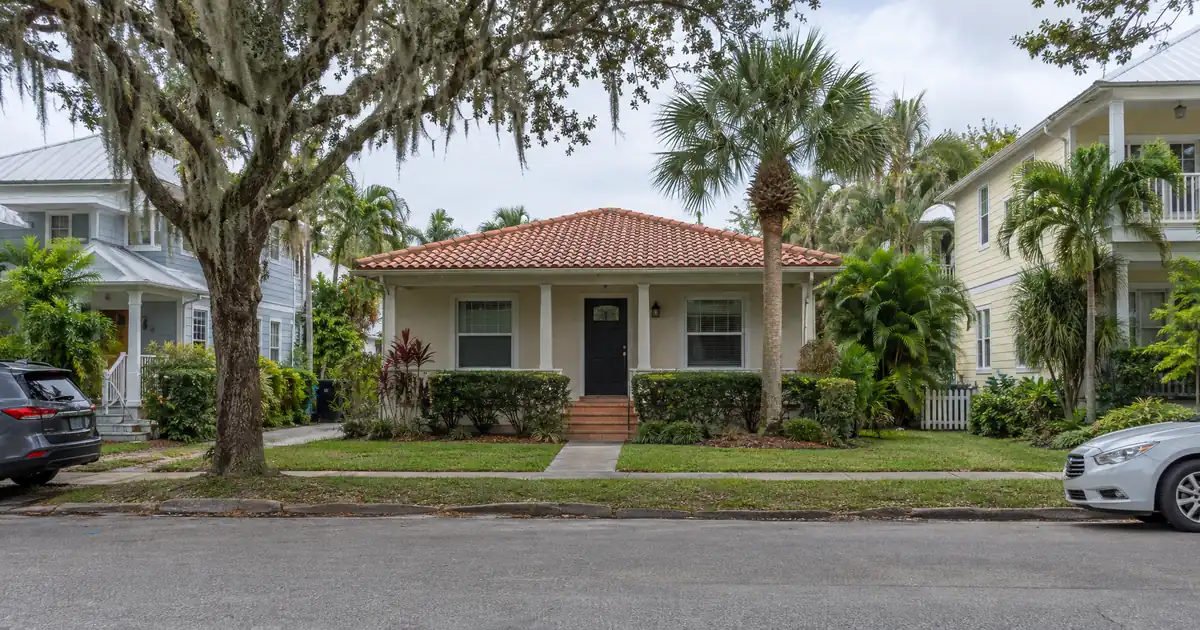
The Quick Read: A DSCR HELOC adds a rent-qualified line of credit behind the first mortgage you keep, while a DSCR cash-out refinance replaces that first mortgage with a new, larger loan and pays you the difference, so the choice mostly comes down to whether your current first mortgage is worth keeping. In brief:
- A DSCR HELOC (a home equity line of credit on a rental, qualified on the property’s rent) leaves your existing first mortgage untouched.
- A DSCR cash-out refinance resets the whole first lien and delivers one lump sum.
- The HELOC route through Lendmire’s wholesale network allows the rental to stay in an LLC, subject to underwriting.
- A HELOC suits staged or uncertain capital needs. A cash-out suits a single large need or a loan you want to restructure.
- The DSCR HELOC program is offered in 15 of Lendmire’s 16 licensed states, every licensed state except Tennessee, and that includes Florida, through select programs.
The Honest Answer First
Pick the DSCR HELOC if you like your current first mortgage and want flexible access to equity. Pick the cash-out refinance if the first mortgage is no bargain, or you need one big sum, or you want to reset the loan terms.
Neither is better in general. They solve different problems. A landlord in Santa Rosa County and a landlord in Miami face the same structural question: does the existing loan earn its place on the property?
One definition matters up front. “DSCR HELOC” is a loose label in the market. Some lenders use it for a second-lien line, some for a closed-end second loan, and some for a personal-income HELOC on a rental. Here it means a revolving line on a non-owner-occupied one-to-four-unit rental that qualifies primarily on property-level rental income covering the payment, subject to lender guidelines. DSCR stands for debt service coverage ratio, which is the rent divided by the monthly debt payment. The cash-out column below reflects published industry norms, since terms vary by lender.
Side-by-Side
| Factor | DSCR HELOC | DSCR Cash-Out Refinance |
|---|---|---|
| Lien effect | Second lien behind your first, or first lien if no mortgage | Replaces your existing first lien |
| Review basis | Rent coverage on a stress payment | Rent vs. the new loan payment |
| Personal income docs | Not calculated | Typically not calculated |
| Cash delivery | Revolving draws after an initial draw | One lump sum at closing |
| Entity vesting | LLC allowed, with guarantors | Often workable per program |
| Property types | One-to-four units, several exclusions | Broader, varies by lender |
| Reserves | None on the HELOC program | Commonly required |
| Valuation | Automated valuation or full appraisal | Full appraisal typical |
| Existing first mortgage | Stays in place | Paid off and replaced |
| Prepayment terms | Governed by the line’s terms | Often a step-down penalty |
Treat the cash-out column as industry norms rather than a promise. Programs differ, and every file is underwritten individually.
Key Terms Defined
Second lien: a loan recorded behind your first mortgage. If the property is ever sold or foreclosed, the first lender is paid first.
Combined loan-to-value (CLTV): your first mortgage balance plus the new line, divided by the property’s value.
Draw period: the stretch when you can borrow from the line and pay interest only on what you have drawn.
Seasoning: the waiting period after you buy or refinance before a lender will lend against the property.
Stress payment: a qualifying payment calculated on the full credit limit, set above the starting payment, to test whether the rent has a cushion.
How the DSCR HELOC Actually Works
Across Lendmire’s wholesale network, this line is a standalone second lien behind a first mortgage you keep. It can also be a standalone first lien on a rental with no mortgage. It is never closed together with a purchase, never a third lien, and never a line on your own home.
Qualification runs on the rent. Lenders do not calculate your personal income or debt-to-income ratio. The program asks for a minimum 1.10x DSCR, using the lesser of the appraiser’s market rent (Form 1007) or the lease. A lease in place is required. A two-to-four-unit property can have at most one vacant unit.
The payment used for the test is a stress payment. It is a fully amortizing payment on the entire credit limit, not just what you plan to draw. That is why a big line on a thin-rent property fails the test even if you would only borrow a little. Whether the first mortgage payment joins the calculation on a second lien depends on the lender’s coverage calculation, so the lender’s own math governs.
The leverage ceilings, subject to underwriting:
- Second lien, investment property: up to 70% CLTV at a 720 credit score or better, on lines from $50,000 to $500,000. Below 720 there is no second-lien option.
- First lien, investment property with no mortgage: up to 75% LTV at 740 or better, and 70% LTV from 700 to 739, on lines up to $500,000.
- First lien above $500,000: lines run up to $1,000,000 with a 65% LTV ceiling at 720 or better. These specifics are subject to lender guidelines and a full review of property, leverage, and credit.
The structure is a 5-year interest-only draw period, then a 25-year repayment period, with a 30-year maturity and a variable rate. At least 80% of the line (and never less than $50,000) is drawn at closing. Later draws are at least $5,000 each. The rate and the pricing terms come with the lender’s disclosures.
Other file facts matter:
- Valuation: lines to $400,000 use an automated valuation with a property inspection report, or a full interior appraisal. Larger lines need a full interior appraisal. Appraisal waivers are not accepted.
- Seasoning: a rental bought or refinanced in the last 6 months is not eligible.
- Credit history: no 30-day late on a mortgage in the last 12 months, and 48 months since a bankruptcy, foreclosure, short sale or deed-in-lieu.
- Reserves: none required.
- Exposure: at most 5 loans or $2,500,000 per borrower with the program.
- Exclusions: rural-designated property, condotels, row homes, leaseholds and mixed-use are outside the program.
- Borrowers: US citizens, permanent residents and non-permanent residents with a Social Security number. Foreign nationals and ITIN borrowers are not eligible.
For the full picture of how these loans fit together, see Lendmire’s complete DSCR loans guide.
How the DSCR Cash-Out Refinance Works
A DSCR cash-out refinance writes a new first mortgage that pays off the old one and any junior liens. You keep what is left after payoff and costs. Across most programs Lendmire sees, the lender sizes the loan to the lesser of a leverage cap on appraised value and the amount rent can still support.
The property qualifies primarily on rental income covering the new payment, subject to lender guidelines. The file usually includes a lease or an appraiser’s market-rent schedule (Form 1007 for a single-family, Form 1025 for two-to-four units), entity documents if the rental sits in an LLC, guarantor credit, and proof of reserves. Prepayment penalties are common and often step down over a few years, so ask about them before you choose.
Two details trip up first-time borrowers. First, a bigger loan means a bigger payment, so the coverage ratio falls as cash-out rises. Second, the cash you receive is not the loan increase, because payoff, costs and holdbacks come out first.
Select lenders in the network also offer programs below 1.00 coverage, but leverage and terms adjust when they do. Cash-out leverage is typically lower on short-term-rental collateral.
When the DSCR HELOC Is the Better Fit
The HELOC wins when the first mortgage is worth keeping. Many landlords hold an older first mortgage with a low monthly obligation. A cash-out refinance gives that up. A second-lien line leaves it alone.
It also wins when your capital need is uncertain or staged. Picture a landlord with a duplex that needs a roof now, kitchens next year, and maybe a down payment on another rental after that. A line lets you draw as invoices arrive. A lump sum would sit in an account while the loan carries a bigger balance.
Several situations point the same way:
- Your rental sits in an LLC. The line can be vested in the entity, with members signing as guarantors, subject to underwriting.
- Your personal income file is messy. Self-employed or heavily leveraged owners can see the rent evaluated instead of their debt-to-income ratio.
- You want no reserves. The HELOC program requires none.
- The cash need is modest. Refinancing the whole first lien to access a small amount of equity means re-papering a much larger loan.
- The rental is free and clear. A standalone first-lien line is possible, with leverage tiers by score.
A caution on sequencing. Before opening a second lien, read the documents on your existing first mortgage. Some first-lien lenders restrict junior liens, and a line that breaks that restriction is a bad surprise. Also remember that the 6-month seasoning rule and the program’s property exclusions apply, so check the property first. Lendmire’s piece HELOC vs Cash-Out Refinance for a Rental Down Payment: What Decides covers one common use of equity in more detail.
The HELOC’s weakness is limited headroom. Consumer-finance education sources such as Experian note that HELOCs on investment property involve a smaller pool of lenders and are harder to qualify for than owner-occupied lines. That description fits personal-income HELOCs. A rent-qualified line has its own limits: a 70% CLTV ceiling on a second lien, second-lien lines capped at $500,000, and the stress payment on the whole limit.
When the DSCR Cash-Out Refinance Is the Better Fit
The cash-out refinance wins when the first mortgage is not worth protecting. If your current loan has an unattractive structure, or is nearing a reset, replacing it costs you little. You get one clean loan instead of two.
It also wins on size. A single large need, such as paying off partners, funding a major renovation up front, or buying a property outright, fits a lump sum. The line’s ceilings are firm, but a refinance can be sized to the property’s value and rent.
Other situations favor the refinance:
- A second lien is not allowed. If your first mortgage prohibits junior liens, replacing it may be the only way to reach the equity.
- You need a property type the HELOC excludes. Rural property, row homes, condotels and leaseholds sit outside the HELOC program, though a cash-out lender may handle some of them differently.
- You hold a recent purchase and a lender with shorter seasoning. Seasoning on cash-out varies widely by lender, from shorter than the HELOC’s 6 months at some to longer at others.
- You want a fixed structure. The line carries a variable rate.
The tradeoffs are real. Closing costs apply to a much larger loan. A prepayment penalty can lock you in. Reserves are commonly required. And if you have an existing HELOC on the property, the refinance has to pay it off, which can eat into your net cash.
On a tight coverage ratio, a refinance can also be easier to shape. Select lenders offer sub-1.00 programs, with adjusted leverage and terms. The HELOC’s 1.10x test on a stress payment leaves no such room.
How the DSCR HELOC vs. DSCR Cash-Out Refinance Choice Plays Out
Three illustrative landlords show the split. All coverage figures here are modeled assumptions, and the lender’s own calculation governs.
The keeper. A landlord holds a fourplex in an LLC with a long-held first mortgage they like. Rent covers the stress payment on a mid-sized line at roughly 1.3x. The HELOC clears the 1.10x test, and the first mortgage stays put. The cash-out would give up that first mortgage for no gain.
The thin-coverage owner. A landlord with a single-family rental sees the full-limit stress payment push coverage to about 1.0x on the line they want. Under the HELOC test that falls short. They can shrink the line, which lifts the ratio, or look at a cash-out lender with a sub-1.00 program, accepting adjusted leverage and terms.
The big-sum owner. A landlord needs one large amount for a major renovation and wants to restructure the loan. Because the first mortgage is a candidate for replacement anyway, the cash-out refinance is the natural fit.
Clearing the coverage ratio is not the same as the property producing spendable cash. Taxes, insurance, repairs and vacancy all come from the same rent, and those costs vary by county in Florida. Run your own reserves before you borrow against equity.
Business-Purpose Context
DSCR loans are designed for non-owner-occupied investment properties. Because they are business-purpose investor loans, they are reviewed differently from a standard owner-occupied mortgage. The federal ability-to-repay rule, for example, does not apply to credit extended primarily for a business purpose, even when a dwelling secures it. Nolo’s explainer adds that HELOCs sit in an exempt category too. That is why lenders can set their own documentation standards, and why those standards differ.
Questions to Ask Before You Choose
A loose product label hides big differences. Before you commit, ask:
1. Is this a second lien, a first lien, or a closed-end loan?
2. Does coverage use the whole credit limit or only the drawn amount?
3. Can the rental stay in my LLC?
4. What seasoning is required, and does the clock run from the purchase or the last refinance?
5. Does my first mortgage allow a second lien?
6. What property types are excluded?
7. Is there a prepayment penalty, and how does it step down?
The Verdict
If you want flexibility and a first mortgage worth keeping, the DSCR HELOC is usually the cleaner tool. If you want one large sum or a reset, the DSCR cash-out refinance is. Between those poles sits a middle case: a modest cash need on a property where a refinance would not pay for itself, which usually favors the line.
Whatever you choose, the file is judged on the property. That means rent, lease, credit report and valuation, all documented and all subject to underwriting. Programs change, and a broker who sees several lenders’ guidelines can tell you which side your property falls on.
Frequently Asked Questions
Can I use a DSCR HELOC if my rental is in an LLC?
Yes, subject to program guidelines. The line can be vested in the owner’s LLC on an investment property, with the members signing as guarantors. A title holder who is not a borrower signs a non-borrowing owner acknowledgment. The borrowers on the line need not be the borrowers on the first mortgage.
Does a DSCR HELOC replace my first mortgage?
No. It sits behind the first mortgage as a second lien. The only exception is a rental with no mortgage, where the line is the first lien. A cash-out refinance, by contrast, pays off and replaces the existing first lien.
Is the DSCR HELOC available to Florida landlords?
Yes, through select programs. Florida is one of the 15 of Lendmire’s 16 licensed states where this program is placed under its consumer licensing, every licensed state except Tennessee. Program figures do not change by state, though taxes, insurance and rents do, and every file is underwritten individually.
How much can I borrow on a DSCR HELOC?
It depends on credit score, lien position, value and rent coverage. On a second lien, the ceiling is typically 70% CLTV at 720 or better, on lines from $50,000 to $500,000. On a rental with no mortgage, the first-lien ceiling reaches 75% LTV at 740 or better, subject to underwriting.
What if my rent does not clear 1.10x on the line I want?
Shrinking the line lifts coverage because the stress payment shrinks too. Otherwise a cash-out lender with a sub-1.00 program may fit, with leverage and terms adjusted. Qualification stays subject to lender guidelines, credit approval and property review.
Next Step
If you are considering a home equity line on a rental property and want to see how the numbers work, Lendmire can help you compare DSCR HELOC options based on the property, the rent, the equity available, credit profile, combined leverage, and your goals. You can reach the team at 828-256-2183.
For the mechanics of pulling equity out of a rental property, see Lendmire’s guide to cash-out refinance on an investment property.
Lendmire’s DSCR HELOC in Florida page presents the program for Florida landlords.
About Lendmire
Lendmire is a mortgage brokerage (NMLS# 2371349) arranging home equity lines of credit — primary-residence, second-home and investment-property lines — through a wholesale lending network in its 16 full-service states. Eligibility is determined by the lender on each file. Scotsman Guide named Lendmire a Top Mortgage Workplace in both 2025 and 2026.
Get Started
Ready to find the right loan for you?
See your offer in seconds. No credit pull, no obligation.
Informational only. Not a Loan Estimate, approval, or commitment to lend. Program availability and eligibility are subject to lender guidelines, credit approval, property review, and underwriting.
References
1. Experian – HELOC on an investment property
This article is part of Lendmire’s DSCR HELOC program — full qualification details, guidelines, and scenarios live on the program page.
Related reading: DSCR HELOC vs DSCR Cash-Out Refinance on a Rental Property for Landlords · DSCR HELOC vs DSCR Cash-Out Refinance for Landlords Borrowing Against a Rental · DSCR HELOC vs DSCR Cash-Out Refinance for Military Landlords Outgrowing a Credit Union
Guides: DSCR HELOC in Florida
Brandon Miller
Founder & CEO, Mortgage Loan Originator, Lendmire LLC
- Mortgage Loan Originator · NMLS# 1129696 · Verify on NMLS Consumer Access
- North Carolina Real Estate Broker · License# 343312 · Verify on NCREC
- North Carolina Insurance Producer · License# 19053198 · Property, Casualty, Life, Health · Verify on NAIC SBS
- Lendmire LLC · Firm NMLS# 2371349 · Verify firm licensure
Important disclosures. Lendmire (NMLS# 2371349) is a licensed mortgage brokerage. Lendmire is not a direct lender, depository institution, or financial advisor. All loan inquiries are subject to lender underwriting; this article does not constitute a commitment to lend. Rates, terms, and program guidelines are subject to change without notice and vary by borrower profile, property type, and state. Information in this article is general in nature and is not financial, legal, or tax advice. Equal Housing Opportunity. NMLS Consumer Access: nmlsconsumeraccess.org.