
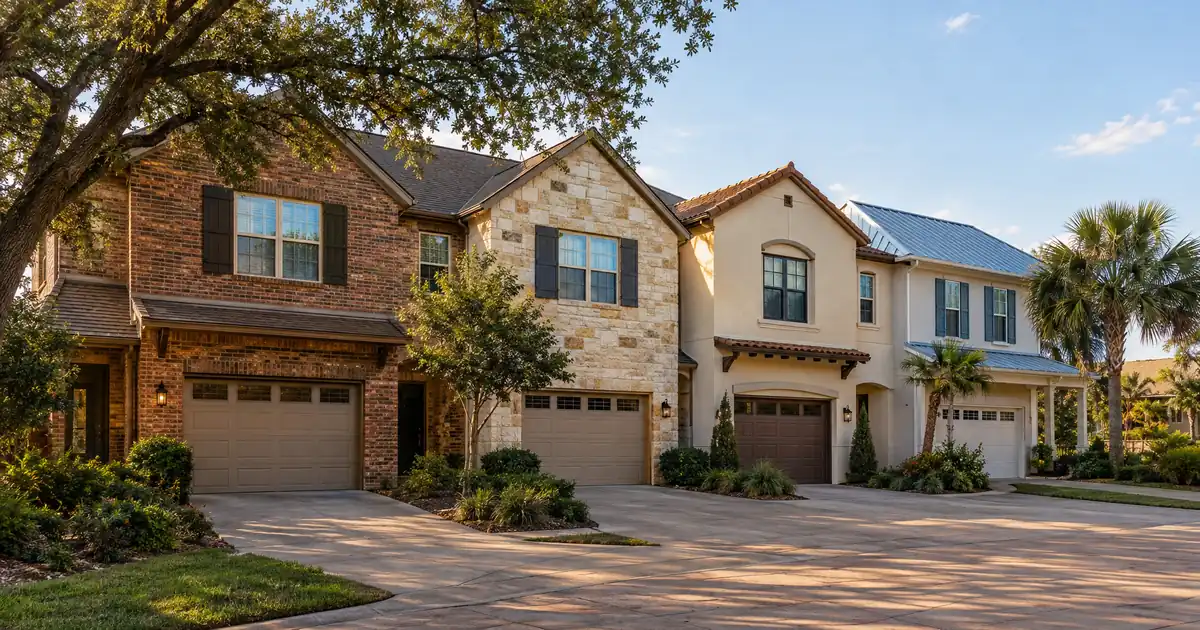
The Quick Read: Neither product is illegal on a true Texas rental, because the strict equity-loan limits people quote are homestead rules that attach to the home you live in, and both a rent-qualified home equity line and a rent-qualified cash-out refinance can be structured on a non-homestead rental, subject to lender guidelines and underwriting.
- A DSCR HELOC adds a line behind the first mortgage you keep. A DSCR cash-out refinance replaces that first mortgage with a bigger one.
- Both qualify primarily on the rental’s income covering the payment, not on your personal income.
- The homestead limits (80% combined debt, a 12-day wait, one equity lien at a time) do not follow your rental.
- Rentals that are really your residence stay under homestead rules.
- Through select programs, the HELOC reaches up to 70% combined loan-to-value on a second lien.
Here is the honest answer on who each option is for. A DSCR HELOC fits the landlord with a first mortgage worth keeping, who wants flexible access to equity without touching that loan. A DSCR cash-out refinance fits the landlord who wants one clean loan, one lump sum, and is fine giving up the old first mortgage to get it. Texas is the hook because that is where the “illegal” claim lives. The facts below apply well beyond Texas.
Is It Actually Illegal?
No. Here Is Where the Claim Comes From.
The claim comes from a real rule applied to the wrong property. Texas heavily regulates equity loans secured by a homestead. A true rental is not a homestead, so those limits do not govern it.
The Texas A&M Real Estate Research Center explains that the Texas home-equity provisions cover three kinds of loans: cash-out refinances, home equity loans, and HELOCs. It also says those loans may not be taken out on a secondary residence or on a rental or investment property. Read that carefully. The restriction describes loans secured by the homestead. It does not forbid lending against a rental.
The features landlords hear about all come from that homestead regime:
- Combined debt capped at 80% of the homestead’s fair market value
- One equity lien on the homestead at a time
- No securing the loan with any property other than the homestead
The State Bar of Texas adds more consumer protections on homestead equity loans: a 12-day waiting period after application and notice, no prepayment penalty, both spouses signing, and a 3-day right to cancel after closing.
Picture a landlord who hears that Texas won’t let you cash out more than 80%, one lien at a time, with a 12-day wait. That landlord is hearing homestead rules. Those rules do not attach to a non-homestead rental.
So when someone says it is illegal, they usually mean one of three different things:
1. A true legal limit on a homestead. Real, but not your rental.
2. A lender’s own program policy. A lender can choose not to offer a product on a given property type or in a given state. That is a business decision, not a statute.
3. A product that simply is not on that lender’s menu.
Only the first is law. The second and third are why a landlord can get told no at one shop and find a yes at another.
What Each Product Actually Is
A DSCR HELOC is a revolving line of credit secured by a rental you keep. It is written as a standalone second lien behind the first mortgage you keep, or as a standalone first lien on a rental with no mortgage. DSCR stands for debt service coverage ratio: the rent divided by the payment the lender tests. The rent qualifies the line, and your personal income is not calculated.
A DSCR cash-out refinance is different in structure. It replaces your existing first lien with a new, larger loan, and you receive the difference as a lump sum. It also qualifies primarily on property-level rental income covering the payment, subject to lender guidelines.
Add versus replace. That is the core structural decision, and everything else follows from it.
The DSCR HELOC is placed through a select wholesale lender in Lendmire’s network. It is offered in 15 of Lendmire’s 16 licensed states, every licensed state except Tennessee, Texas among them, under Lendmire’s consumer licensing. Lendmire is the broker. The lender reviews and approves every file individually.
Side-by-Side
The DSCR HELOC column below reflects the program figures Lendmire places through select lenders, subject to underwriting. The cash-out column shows published industry norms, which vary by program and lender.
| Factor | DSCR HELOC | DSCR Cash-Out Refinance |
|---|---|---|
| Structure | Standalone second or first lien | Replaces the existing first lien |
| Existing first mortgage | Stays untouched | Paid off by the new loan |
| Review basis | Rent coverage, minimum 1.10x | Rent coverage, floor varies by program |
| Personal income | Not calculated | Not the primary basis |
| Documentation | Lease, rent schedule, credit report, valuation | Lease or market rent, appraisal, entity papers |
| Entity vesting | LLC allowed; members guarantee | Commonly allowed; varies by program |
| Property types | 1-4 units, PUD, townhome, condo (limits apply) | Broader on many programs |
| Valuation | Automated valuation or appraisal by line size | Full appraisal is the norm |
| Reserves | None required | Commonly required |
| Funds | Revolving after the initial draw | Single lump sum at closing |
| Texas homestead limits | Not applicable on a true rental | Not applicable on a true rental |
Two rows deserve a closer look. Reserves are where the HELOC stands out, and the lump-sum-versus-revolving row is where the real planning happens.
How the Coverage Test Differs
Both products ask whether the rent covers the payment. They just define the payment differently.
On the DSCR HELOC, the lender tests a stress payment. That is a fully amortizing payment on the entire credit limit, not just the drawn balance, at the start rate plus 2 percentage points. Gross monthly rent divided by that payment must reach at least 1.10x, subject to underwriting. Rent counts at the lesser of the appraiser’s Form 1007 market rent or the lease. A lease in place is required. A two-to-four-unit property can have at most one vacant unit.
One caution. Whether the first-mortgage payment joins the qualifying payment on a second lien is the lender’s call, and the lender’s own calculation governs. Don’t assume it either way.
Because the test runs on the whole line, an unused line still counts against coverage. A landlord who wants a big line but expects to draw little should know that going in.
On a DSCR cash-out refinance, the test runs on the new, larger loan’s full monthly obligation: principal, interest, taxes, insurance, and any association dues. A bigger balance means a lower coverage ratio. Many programs set the coverage floor at 1.10x or above. Some select lenders in the network review coverage below that on a cash-out, though leverage and terms adjust to compensate.
Clearing the ratio is not the same as cash flowing. Coverage counts the payment only. Repairs, vacancy, and management sit outside it. Run the whole picture before pulling equity.
The Residence Trap
Using the equity in your own Texas home to buy or fix a rental is a different transaction. That loan is secured by the homestead, so the homestead rules apply in full. That means the 80% cap, the waiting period, the one-lien limit, and the closing requirements.
A DSCR HELOC is never a line on your own home or a second home. It is built for non-owner-occupied one-to-four-unit rentals. If you want to tap the home you live in, that is a separate, owner-occupied product.
The reverse problem also exists. A rental that is really your residence is a homestead problem. The Doss law firm notes that homestead protection cannot be waived and is not easily lost. Occupancy facts matter more than what the paperwork calls the property.
Deeding a homestead into an LLC does not clean this up. The same source points out that a deed carrying a condition of defeasance, such as a repurchase option or a lease, can be voided. An LLC does not make any property safe from homestead rules.
When a DSCR HELOC Is the Better Fit
Choose the HELOC when you want to keep what you have and add access beside it.
You have a first mortgage worth keeping. A cash-out gives up the existing first lien’s terms. The line leaves that loan alone. This is the single strongest reason to choose the HELOC.
You want equity on call, not in a lump. After the initial draw, later draws are at least $5,000 each. The draw period runs 5 years interest-only on the drawn balance. Then a 25-year fully amortizing repayment period follows, with a 30-year maturity. The rate is variable. At least 80% of the line, and never less than $50,000, is drawn at closing, so this is not a pure standby line.
You want to skip the reserves requirement. The program requires no reserves and no cash to close, subject to underwriting. Many cash-out programs ask for reserves.
You hold the rental in an LLC. The LLC can stay on title. Members sign as guarantors. A title holder who is not a borrower signs a non-borrowing owner acknowledgment and the security instrument.
Your leverage fits the box. On a second lien, combined loan-to-value (the first mortgage balance plus the new line, divided by value) reaches up to 70% at a 720 credit score or better, on lines of $50,000 to $500,000. Below 720 there is no second-lien option. On a paid-off rental, a first-lien line reaches 75% loan-to-value at 740 or better and 70% from 700 to 739, on lines up to $500,000. Lines above $500,000, up to $1,000,000, carry a 65% ceiling at 720 or better. All of these are ceilings through select programs, never offers. The exact numbers vary by lender and program and follow a full review of property, leverage, and credit.
The valuation path is lighter on smaller lines. Lines up to $400,000 can use an automated valuation (confidence score of 85 or better) with a property inspection report, or a full interior appraisal. Larger lines take a full interior appraisal. Appraisal waivers are not accepted.
Know the limits. The rental must be owned for at least 6 months, and a rental bought or refinanced inside the last 6 months is not eligible. Rural property, condotels, row homes, and leaseholds are outside the program. Exposure is capped at 5 loans or $2,500,000 per borrower. Foreign nationals and ITIN borrowers are not eligible. And because the rate is variable, the cost of carrying the line can move after closing.
When a DSCR Cash-Out Refinance Is the Better Fit
Choose the cash-out when one clean loan beats two moving parts.
Your first mortgage is not worth protecting. If the existing loan has no special advantage, replacing it costs you little. You end up with a single payment instead of two.
You need a large lump sum. Funding a purchase, a major rehab, or a payoff is often simpler with a single disbursement. Cash-out programs generally allow more total equity access than a line capped at 70% combined.
Your property falls outside the HELOC box. Property rules on cash-out programs are often broader. Rural-designated property, for example, is outside the HELOC lane, though a cash-out program may treat it differently. Eligibility depends on the program.
You want a fixed structure. Many cash-out programs offer fixed-rate choices. The HELOC does not.
You are comfortable with reserves and a full appraisal. Many cash-out programs ask for both. That is real friction, but it buys a bigger and more stable loan.
The costs are structural. You give up the old first lien. Your coverage ratio drops because the balance grows. And on a true Texas rental, none of the homestead timing rules slow you down, because they never applied. That absence of homestead timing rules is a practical advantage for both products.
Based on how these files typically come together across the wholesale network, the cash-out tends to win when the existing first mortgage is a poor loan to keep. The HELOC tends to win when the first mortgage is a good one. Landlords often reverse that logic and refinance a loan they should have left alone.
A Quick Picture: Same Rental, Two Paths
Say you own a Texas fourplex free and clear and want cash for the next deal. Your rent covers a full-line stress payment at roughly 1.2x. On the HELOC path, you open a first-lien line at up to 75% loan-to-value if your score is 740 or better, then draw at least 80% at closing. On the cash-out path, you take a new first lien and a single lump sum. The HELOC route clears the 1.10x test with a small cushion. The cash-out coverage depends on the new loan’s terms, so it could land higher or lower.
Now change one fact: you owe a first mortgage you like. The HELOC becomes a second lien capped at 70% combined, and the stress payment on the whole line has to clear 1.10x. The cash-out would erase that first loan. That one fact often decides the whole choice.
Going Back to the Lender Who Said No
If a lender told you this is illegal, ask three plain questions:
1. Is this a legal limit, or a policy of your program?
2. Do you offer any non-owner-occupied product in Texas, or only owner-occupied?
3. Would the same answer apply if the rental sat in an LLC?
An agency contrast helps here. The Fannie Mae Selling Guide says a Texas 50(a)(6) loan must be secured by a single-unit principal residence that is the borrower’s homestead, and investment properties are not eligible. That is a contrast, not a DSCR rule. It shows why the restriction sits with the homestead product and not with rentals. DSCR loans are not agency products.
Tax treatment varies; consult a qualified professional before relying on any deduction.
Where Landlords Get It Wrong
Reading a homestead rule as a rental rule. The 80% cap, the 12-day wait, and the one-lien limit belong to homestead equity loans.
Treating a lender’s no as the law. A no from one program is a business decision. Another program may say yes.
Refinancing a good first mortgage. Giving up a strong first lien for a lump sum is an avoidable mistake.
Forgetting the full-line stress test. A large line can fail coverage even when you plan to draw little.
Confusing coverage with profit. Clearing 1.10x does not mean the rental cash flows.
The Verdict
Neither option is illegal on a true Texas rental, and neither is the universal winner. If you keep a first mortgage you like and want flexible access to equity without opening your personal income file, the DSCR HELOC is usually the sharper tool. If you want one loan, one lump sum, and fewer property-type limits, the DSCR cash-out refinance usually fits better. The deciding facts are your existing first mortgage, the size of your cash need, your credit tier, and whether the rental truly is a rental.
The complete DSCR loans guide walks through how coverage works across all of these structures. Every file is underwritten individually, and nothing here is a commitment to lend.
Frequently Asked Questions
Is it illegal to get a HELOC on a rental in Texas?
No. The Texas home-equity limits apply to loans secured by a homestead, and the Texas A&M Real Estate Research Center says those loans may not be taken on a rental or investment property. That describes the homestead product, not a ban on lending against a rental. Availability then depends on the lender’s program and underwriting.
Why did my bank say no?
Usually because of policy, not law. Many depository lenders offer home equity lines only on the home you live in, or qualify them on personal income and debt ratios. A rent-qualified line through a select program is a different product. Ask whether the answer was a legal limit or a program limit.
Can my LLC take a DSCR HELOC?
Yes, subject to lender program eligibility. The LLC can stay on title for an investment property. Members sign as guarantors, and a title holder who is not a borrower signs a non-borrowing owner acknowledgment. The borrowers on the line need not match the borrowers on the first mortgage.
Can I use my own home’s equity to buy a rental in Texas?
You can, but that loan is secured by your homestead, so the homestead rules apply. That means the 80% combined cap, one equity lien at a time, and the waiting period. A DSCR HELOC is never written on your own home. It is secured by the rental.
If my rental clears 1.10x, does it cash flow?
Not necessarily. Coverage counts the payment only. Repairs, vacancy, and management sit outside the ratio. Treat clearing the test as a minimum, then check the full picture on the property.
Next Step
If you are considering a home equity line on a rental property and want to see how the numbers work, Lendmire can help you compare DSCR HELOC options based on the property, the rent, the equity available, credit profile, combined leverage, and your goals. Call 828-256-2183 to start the conversation.
A deeper walk-through of investment-property equity extraction lives in Lendmire’s guide to cash-out refinance on an investment property.
Lendmire’s DSCR HELOC in Texas page presents the program for Texas landlords.
About Lendmire
Lendmire (NMLS# 2371349) is a mortgage broker. Home equity lines of credit — on a primary residence, a second home or an investment property — are arranged through wholesale lenders in Lendmire’s 16 full-service states, and every line is underwritten by the lender under its program guidelines. Scotsman Guide named Lendmire a Top Mortgage Workplace in both 2025 and 2026.
Get Started
Ready to find the right loan for you?
See your offer in seconds. No credit pull, no obligation.
Informational only. Not a Loan Estimate, approval, or commitment to lend. Program availability and eligibility are subject to lender guidelines, credit approval, property review, and underwriting.
References
1. Texas A&M Real Estate Research Center
3. Doss Law Firm: Texas Homestead Protections
4. Fannie Mae Selling Guide B5-4.1-02
This article is part of Lendmire’s DSCR HELOC program — full qualification details, guidelines, and scenarios live on the program page.
Related reading: DSCR HELOC vs DSCR Cash-Out Refinance for North Carolina Landlords Using Rental Equity · How to Use a DSCR HELOC With FHA Cash-Out · DSCR HELOC vs DSCR Cash-Out Refinance for Qualifying Without a Paycheck From a Job
Guides: DSCR HELOC in Texas
Brandon Miller
Founder & CEO, Mortgage Loan Originator, Lendmire LLC
- Mortgage Loan Originator · NMLS# 1129696 · Verify on NMLS Consumer Access
- North Carolina Real Estate Broker · License# 343312 · Verify on NCREC
- North Carolina Insurance Producer · License# 19053198 · Property, Casualty, Life, Health · Verify on NAIC SBS
- Lendmire LLC · Firm NMLS# 2371349 · Verify firm licensure
Required disclosures. Lendmire (NMLS# 2371349) operates as a licensed mortgage broker, not a direct lender or depository. The discussion in this article is general in nature and should not be relied upon as financial, legal, or tax advice — every investment scenario is unique and should be reviewed by a qualified professional. Any loan inquiry is subject to lender underwriting, and this article is not a commitment to lend or a guarantee of approval. Mortgage rates, loan terms, and program guidelines vary by borrower, property, and state, and may change without notice. Equal Housing Opportunity. Verify licensure at NMLS Consumer Access.