
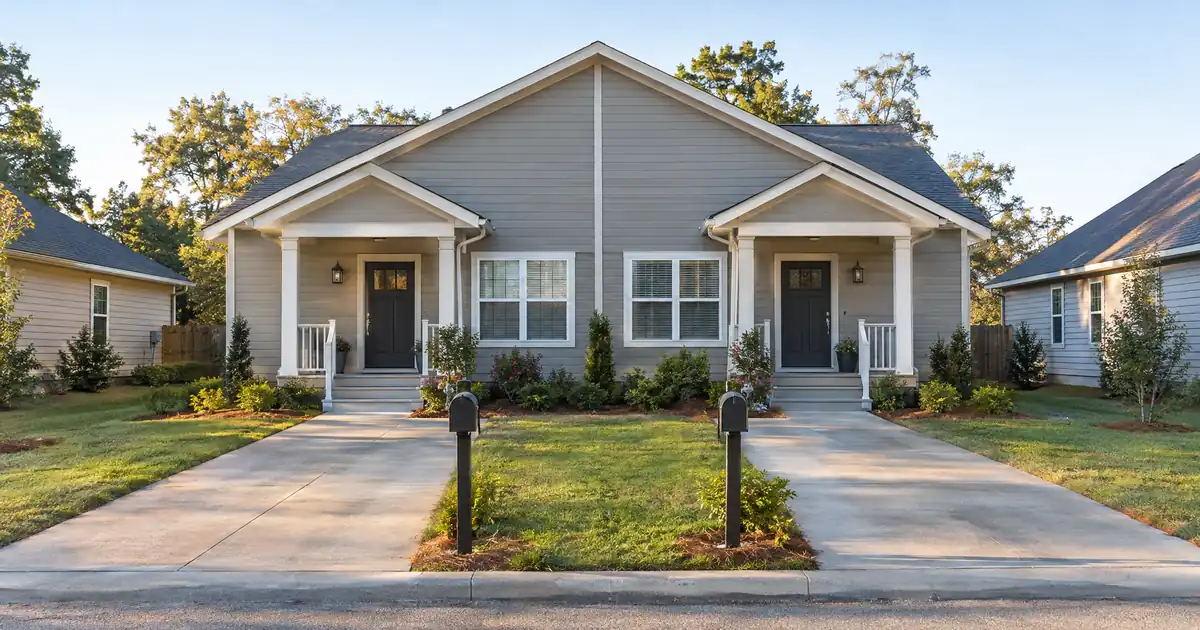
The Quick Read: While you live in one unit of a duplex, neither a DSCR HELOC nor a DSCR cash-out refinance is generally available, because both are built for non-owner-occupied rentals; the real choice starts once the duplex is a pure rental, where a HELOC keeps your first mortgage in place and a cash-out refinance replaces it. Both rely on the property’s rent rather than your personal income.
- Occupancy comes first. A duplex you live in is an owner-occupied property, and the DSCR versions of both products are written for rentals the owner does not live in.
- A DSCR HELOC adds a loan. It sits behind the first mortgage you keep, or stands alone as a first lien on a paid-off rental.
- A DSCR cash-out refinance swaps a loan. It pays off the existing first mortgage and replaces it with one new loan.
- Both look at rent coverage. Qualification centers on whether rent covers the payment, subject to lender guidelines.
- Moving out changes the picture. Once the duplex is a leased rental, both products become real options, subject to underwriting.
The honest answer has two parts. If you need equity now and you live in a unit, you are shopping in the owner-occupied world, and a DSCR product is not the tool. If you are about to move out, or already have, the HELOC suits the owner with a first mortgage worth keeping, and the cash-out refinance suits the owner who wants one clean loan and a larger lump sum.
Side-by-Side
The table below shows the structural differences. The HELOC column reflects the program Lendmire places through its wholesale network, subject to underwriting. The cash-out refinance column shows published industry norms, which vary by lender and program. Pricing is left out on purpose. Rate and pricing terms come with the lender’s disclosures.
| Factor | DSCR HELOC | DSCR Cash-Out Refinance (industry norms) |
|---|---|---|
| Lien position | Standalone second lien, or first lien if no mortgage | Replaces the existing first mortgage |
| Review basis | Rent coverage, 1.10x minimum on a stress payment | Rent vs. full housing payment; floor varies |
| Personal income docs | Owner’s income not calculated | Typically not calculated; rent is documented |
| Property types | 1-4 units, PUD, townhome, many condos | Commonly 1-4 units; varies by lender |
| Entity vesting | LLC allowed, investment property only | Entity closings common, per program terms |
| You live in a unit | Not eligible | Generally not eligible |
| Valuation | Automated valuation or appraisal; appraisal on larger lines | Full appraisal, usually on Form 1025 for 2-4 units |
| Reserves | None required | Commonly expected; amount varies |
| Seasoning | 6 months since the last note date and 6 months on title | Varies by program |
| Structure | Revolving line, variable rate | Closed-end, one lump sum |
The HELOC column carries a few details that surprise people. The line starts at $50,000, and at least 80% of it must be drawn at closing. Later draws are at least $5,000 each. That makes it behave more like a loan with a refill option than a flexible card you leave untouched.
Key Terms Defined
DSCR (debt service coverage ratio): monthly rent divided by the monthly payment the lender counts against the property. A result of 1.10x means rent is 110% of that payment.
DSCR HELOC: a home equity line of credit on a rental, qualified on the property’s rent instead of the owner’s personal income.
DSCR cash-out refinance: a new first mortgage on a rental that pays off the old one and returns the extra equity as cash, qualified primarily on the property’s rent.
Non-owner-occupied: a property the borrower does not live in. Living in even one unit of a duplex makes it owner-occupied.
CLTV (combined loan-to-value): the first mortgage balance plus the new line, divided by the property’s value.
Seasoning: the waiting period a lender requires after you buy or refinance before you can borrow against the property again.
Why Living in One Unit Changes the Answer
Both products are business-purpose loans on rentals. When you sleep in one unit, the lender sees a home, not a pure rental. Across our wholesale network, the DSCR HELOC program is never offered on the owner’s own home or on a second home. DSCR cash-out refinance programs are written the same way, and the application asks directly how the property is used.
The label on the title does not change this. Putting a duplex in an LLC does not turn your home into an investment property, because lenders look at how the property is actually used. Renting a room in a house you live in does not either. Misstating occupancy on a business-purpose certification creates serious legal and loan exposure, so the answer on the form has to match your life.
DSCR loans are designed for non-owner-occupied investment properties. Because they are business-purpose investor loans, they are reviewed differently from a standard owner-occupied mortgage. The federal business-purpose rule in Regulation Z, section 1026.3 treats a rental as non-owner-occupied only if the owner does not expect to use it for more than 14 days in the coming year. Moving back in later, even after closing, can undo that status.
What You Can Do Now While You Live There
If you need cash today, you are looking at owner-occupied products, which are consumer loans reviewed mostly on personal income. These include an owner-occupied home equity line and an owner-occupied cash-out refinance. A primary-residence HELOC is a different product from the rental line discussed here.
The tradeoff in those products mirrors the table above: keep your first mortgage and add a line, or replace the first mortgage and take a lump sum.
When a DSCR HELOC Is the Better Fit
A DSCR HELOC fits when the duplex is a leased rental and you want its equity without touching the first mortgage. You qualify on the rent, and your tax returns, pay stubs and debt-to-income ratio are not part of the file. Rent, the lease, the credit report and the valuation are all documented, and the lender’s coverage calculation governs.
The structure splits into two lanes, subject to underwriting, and they are set out below.
- Second lien behind your first mortgage: up to 70% CLTV on a non-owner-occupied rental, at a 720 credit score or better, on lines from $50,000 to $500,000.
- First lien on a rental with no mortgage: up to 75% LTV at 740 or better on lines up to $500,000. At 700 to 739 the ceiling is 70% LTV. Lines above $500,000, up to $1,000,000, carry a 65% LTV ceiling at 720 or better. Every figure here varies by lender and program, and guidelines, property type, leverage, and credit profile all apply.
Picture an investor whose duplex has a first mortgage near half its value. With a 720 or better score, a second lien could reach roughly 20% of value before hitting the 70% CLTV ceiling. A DSCR cash-out refinance on the same property would replace that first mortgage and could reach further, but the new loan would carry its own terms.
The line itself is a 5-year interest-only draw period, then a 25-year repayment period, with a 30-year maturity and a variable rate. The test is a minimum 1.10x coverage on a fully amortizing payment on the entire credit limit, figured at a stressed level. That means a large line can strain coverage even if you draw little. Keep the full limit in mind when sizing the request.
Other points that matter:
- A lease must be in place. A two-to-four-unit property may have at most one vacant unit.
- Rent is the lesser of the appraisal’s market rent and the lease, unless three months of receipts support a lease above market.
- Lines to $400,000 use an automated valuation with a property inspection report, or a full interior appraisal. Lines above $400,000 take a full interior appraisal. Appraisal waivers are not accepted.
- No reserves are required, subject to underwriting.
- A rental bought or refinanced in the last 6 months is not eligible (that clock runs from the last note date to the new note date), and the owner must have held title for 6 months (settlement date to note date).
- Each borrower is limited to 5 loans or $2,500,000 with the program.
- Credit minimums are 720 on a second lien and 700 on a first lien. The program also looks at mortgage history, with no 30-day late in the last 12 months.
- Rural property, condotels, row homes and leaseholds are outside the program.
The program is offered in 15 of Lendmire’s 16 licensed states: Alabama, California, Colorado, Florida, Georgia, Indiana, Michigan, Montana, New Mexico, North Carolina, Ohio, Pennsylvania, Texas, Virginia and Washington. The LLC can stay on title, and the members sign as guarantors.
When a DSCR Cash-Out Refinance Is the Better Fit
A DSCR cash-out refinance fits when you want one loan instead of two, or when the existing first mortgage is not worth keeping. It replaces the old first lien with a new closed-end loan. The lender compares rent against the full housing payment, meaning principal, interest, taxes, insurance and any HOA dues.
On a two-to-four-unit property, the appraisal is typically completed on Form 1025, which Fannie Mae’s Selling Guide lists as the small residential income property report. Form 1007 is a single-family rent schedule, so a duplex relies on the rent schedule built into the 1025. That form is named here only because it shapes how the appraiser documents your rent.
Reasons an owner picks the refinance over the line:
- Simplicity: one lien, one payment stream, no coordination with a first lender.
- No consent issue: replacing the first mortgage means no first lender has to allow a junior lien, which a second lien depends on.
- Larger lump sum: a closed-end loan can return more equity in a single payout than a line capped by the second-lien CLTV ceiling.
- Entity closings: many programs allow an LLC, depending on program guidelines.
The cost is giving up your existing first mortgage. If it carries terms you like, replacing it is a real sacrifice. Adding a second payment against the same rent also lowers coverage, which is plain arithmetic on any DSCR file. Reserve expectations on refinance programs vary, so ask for the specific program’s requirements before assuming none apply.
The Move-Out Path
The usual sequence runs in a set order. You live in one unit while owner-occupied financing is in place. You then move out, lease both units, and the duplex becomes a rental that may be reviewed as a DSCR property. Both the HELOC and the cash-out refinance become options after that, subject to lender guidelines.
Timing questions come down to seasoning and paperwork. You also need a lease on the unit you moved out of, with at most one vacant unit across a duplex. Lenders look hard at whether the move was genuine, so a clean break supports the file better than a hurried one.
Coverage can also drop after you move out. A vacant unit or a below-market lease lowers the number the lender counts. Coverage measures rent against the payment and says nothing about whether the property produces cash after repairs and vacancy.
Mistakes That Cost Files
- Calling the loan business-purpose while still living there. The certification must match the facts, and the risk of misstatement falls on the borrower.
- Sizing the HELOC on what you plan to draw. The stress test uses the full limit.
- Ignoring the first mortgage documents. A second lien depends on the first lender allowing it.
- Forgetting that the line is front-loaded. At least 80% is drawn at closing.
- Treating coverage as cash flow. Passing the ratio does not make a property profitable.
Tax treatment can depend on how the funds are used and how the property is held; borrowers should keep clear records and speak with a qualified tax professional before relying on any deduction.
A Balanced Verdict
This is a toss-up only after the duplex is a leased rental. Before that, neither DSCR product is on the table. Once it is a rental, the HELOC wins for owners who want to keep a first mortgage and tap equity in a measured way, with the LLC intact. The cash-out refinance wins for owners who prefer a single loan, want a larger lump sum, or are replacing a first mortgage they no longer want. Lendmire’s wholesale network places both, and the broader mechanics are in the complete DSCR loans guide.
Frequently Asked Questions
Can I get a DSCR HELOC on a duplex if I live in one unit?
No, not through this program. The rental line is offered only on non-owner-occupied rentals and never on the owner’s own home. If you live in a unit, an owner-occupied home equity product is the starting point, and the DSCR option opens up after you move out and lease both units.
What if I only rent out a room instead of a whole unit?
Living in the property still makes it owner-occupied, so the same occupancy rule applies. Renting a room does not turn a home into a rental for DSCR purposes. The rent from the other unit may help an owner-occupied file in some programs, but your own unit’s rent never counts.
Does putting the duplex in an LLC fix the occupancy problem?
No. Lenders look at actual use, not the name on title. An LLC can hold a true rental, subject to program terms, but it does not change the fact that a member lives in the building.
How long after I move out can I use a DSCR HELOC?
Two six-month clocks apply: the line is not available on a rental bought or refinanced in the last 6 months (last note date to new note date), and title must have been held for 6 months (settlement date to note date). A lease must also be in place, with no more than one vacant unit. Each file is underwritten individually, so confirm the details before planning around a date.
Which is better after I move out, the HELOC or the cash-out refinance?
It depends on your first mortgage and how much cash you need. The HELOC keeps the existing first loan and adds a second lien, with leverage up to 70% CLTV at 720 or better. The refinance replaces the first loan and returns a lump sum. Compare the combined leverage, the coverage on your rent, and whether your current first mortgage is worth keeping. Final terms depend on lender guidelines, property type, leverage, and the borrower’s complete credit picture.
If you are considering a home equity line on a rental property and want to see how the numbers work, Lendmire can help you compare DSCR HELOC options based on the property, the rent, the equity available, credit profile, combined leverage, and your goals.
About Lendmire
Lendmire, NMLS# 2371349, is a mortgage brokerage that arranges home equity lines of credit through wholesale lending partners in its 16 licensed consumer states. Each file is reviewed individually by the lender under the program’s occupancy, credit and combined-loan-to-value guidelines. Scotsman Guide named Lendmire a Top Mortgage Workplace in both 2025 and 2026.
A deeper walk-through of investment-property equity extraction lives in Lendmire’s guide to cash-out refinance on an investment property.
Get Started
Ready to find the right loan for you?
See your offer in seconds. No credit pull, no obligation.
Informational only. Not a Loan Estimate, approval, or commitment to lend. Program availability and eligibility are subject to lender guidelines, credit approval, property review, and underwriting.
References
1. CFPB — Regulation Z, Section 1026.3 Exempt Transactions
2. Fannie Mae Selling Guide B4-1.2-01
This article is part of Lendmire’s DSCR HELOC program — full qualification details, guidelines, and scenarios live on the program page.
Related reading: DSCR HELOC Requirements When Your Student Loans Are in Default · How Much Can You Borrow on a DSCR HELOC With Five or More Financed Rentals? · How Much Can You Borrow on a DSCR HELOC for a Warren MI Landlord With a Duplex?
Brandon Miller
Founder & CEO, Mortgage Loan Originator, Lendmire LLC
- Mortgage Loan Originator · NMLS# 1129696 · Verify on NMLS Consumer Access
- North Carolina Real Estate Broker · License# 343312 · Verify on NCREC
- North Carolina Insurance Producer · License# 19053198 · Property, Casualty, Life, Health · Verify on NAIC SBS
- Lendmire LLC · Firm NMLS# 2371349 · Verify firm licensure
Disclosures. The information presented in this article is general market commentary, not financial, legal, or tax advice. Lendmire is a mortgage brokerage (NMLS# 2371349) — not a direct lender or depository institution — and loan placement is subject to lender underwriting. Nothing in this content represents a commitment to lend. Loan terms, pricing, and program availability vary based on borrower qualifications, property characteristics, and state of subject property, and are subject to change at any time. Lendmire complies with Equal Housing Opportunity requirements. Consumer access: nmlsconsumeraccess.org.