
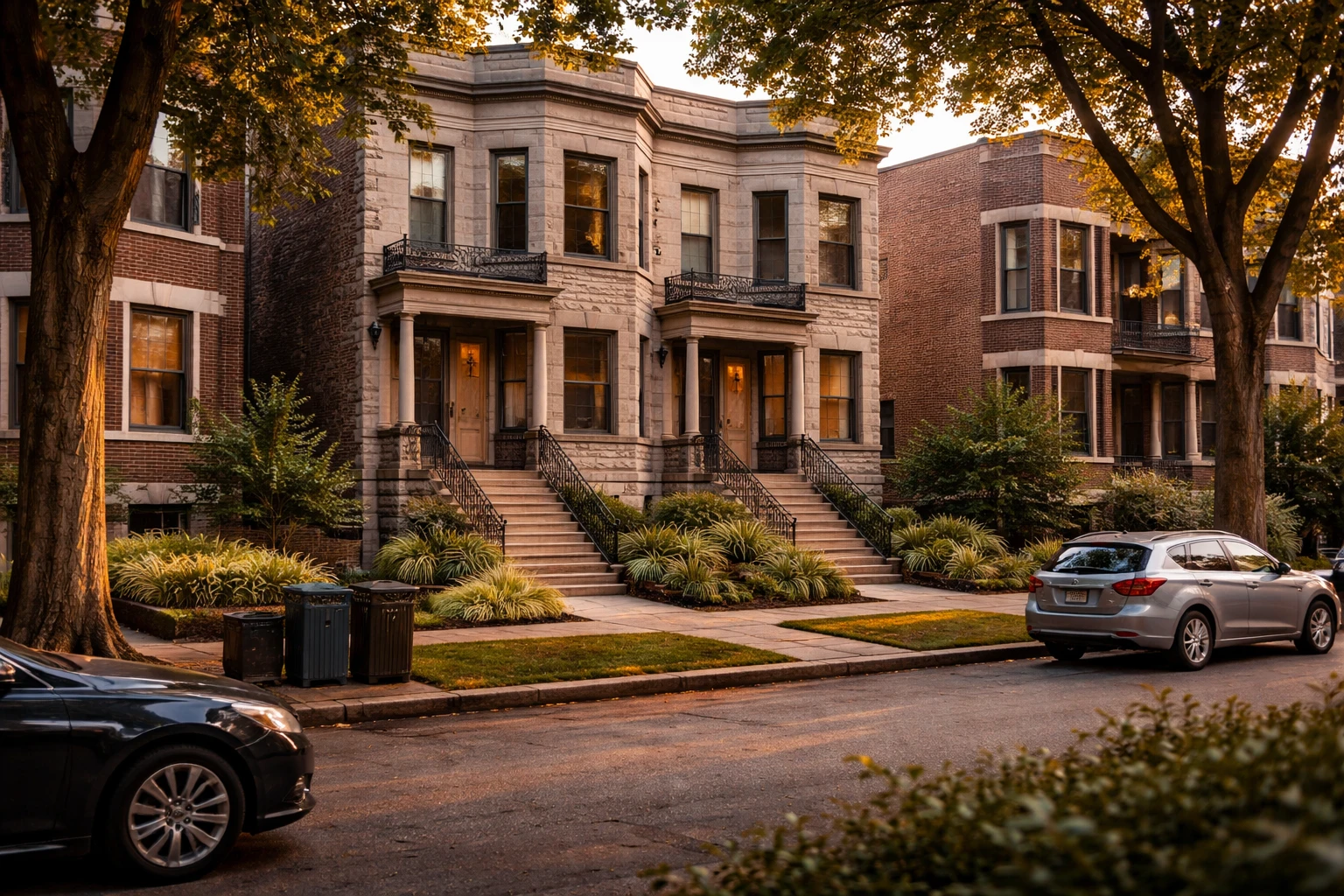
DSCR loans in Chicago make the Midwest’s largest rental market one of the most complex to finance.
Chicago is the third-largest city in the United States and the undisputed economic capital of the Midwest. Its investment property market spans an enormous range of strategies — from high-cash-flow two-flats and three-flats in working-class neighborhoods to premium Lincoln Park and Wicker Park multifamily to BRRRR execution in the South and West Side value corridors. Major employers include Boeing, United Airlines, Citadel, Morningstar, Hyatt Hotels, Aon, and the vast University of Chicago and Northwestern University systems — anchoring a diversified economy that supports rental demand across every price point and neighborhood type.
Median home prices in Chicago’s investable submarkets range from $130,000 for South Side SFRs and two-flats to over $700,000 for premium North Side and Lincoln Park multifamily. The city’s iconic two-flat and three-flat building type — a housing form unique to Chicago — creates a natural investor vehicle that combines owner-occupancy optionality with strong rental income. Three-bedroom rents average $1,200–$3,500 depending on submarket, with the North Side commanding the upper end and the South and West Sides offering the strongest DSCR ratios.
DSCR Calculator
Run the numbers in Illinois
Rate source: Freddie Mac 30-yr average via FRED® — Federal Reserve Bank of St. Louis · effective Jul 30, 2026
Prefilled with starting assumptions — enter your own rent or nightly figures, taxes, insurance, and HOA for a more accurate picture.
Program parameters update from Lendmire’s centralized guideline source. Taxes and insurance are editable estimates.
As of Jul 30, 2026 · General Freddie Mac market benchmark, not a Lendmire loan offer. Rent, nightly rate, occupancy, taxes, and insurance are editable estimates. Short-term rental figures are estimates only and vary significantly by season, property type, management approach, and local short-term-rental rules — confirm local regulations before relying on them. Qualifying income for short-term rentals varies by program — some use appraisal market rent, others use documented STR history or projections — and is confirmed in underwriting. Not a Loan Estimate, approval, or commitment to lend. Program availability and eligibility are subject to lender guidelines, credit approval, property review, and underwriting.
A DSCR loan qualifies on property rental income — not W-2s or tax returns. Lendmire is a broker licensed in Illinois with access to the top DSCR wholesale lenders. See our DSCR investor loan programs in 41 markets.
What Is a DSCR Loan?
A DSCR (Debt Service Coverage Ratio) loan qualifies an investment property based on rental income, not the borrower’s personal income. The formula: Gross Monthly Rent ÷ PITIA (Principal, Interest, Taxes, Insurance, and Association dues). A ratio of 1.0 means rent exactly covers the payment — breakeven. Above 1.0 is positive cash flow. In Chicago, DSCR ratios range widely by submarket — from 0.90–1.10 in premium North Side neighborhoods to 1.25–1.55 in South and West Side cash-flow corridors. Program selection depends on submarket and investor strategy.
Full overview: What Is a DSCR Loan — or compare structures at DSCR vs. Conventional Investment Loan.
Why Chicago, Illinois Is a Strong Market for DSCR Investors
Chicago’s investment case rests on scale and permanence. As the Midwest’s financial, logistics, and cultural capital, Chicago generates a rental demand base that is both enormous and structurally diverse. The city’s 2.7 million residents include a renter-majority population — over 55% of Chicagoans rent — creating a tenant pool across every income and lifestyle segment. No other Midwest market offers this combination of demand volume and diversity.
The city’s two-flat and three-flat building type is one of the most investor-friendly housing forms in America. These buildings — typically 2,500–4,500 square feet, owner-built in the early 20th century on standard 25-foot Chicago lots — allow investors to house-hack (live in one unit, rent the others), scale to pure rental with minimal transition, and rehab incrementally. The building form’s prevalence in gentrifying neighborhoods like Logan Square, Pilsen, and Bridgeport makes it the natural unit of DSCR investment at Chicago’s mid-market price point.
Chicago also offers one of the nation’s most geographically diverse investment landscapes within a single metro. Evanston and the North Side lakefront neighborhoods of Rogers Park and Edgewater offer university and lakefront demand. The West Side (Oak Park, Forest Park, Berwyn) offers suburban cash flow. The South Side and South Suburbs (South Shore, Pullman, Harvey) offer maximum yield. Investors can construct a portfolio strategy across multiple risk/return profiles without leaving the Chicago metro.
DSCR Loan Benefits for Chicago Investors
- No W-2s, tax returns, or personal income documentation required
- Finance in an LLC — essential for Chicago’s multi-unit and two-flat portfolio investors
- STR income accepted for River North, Wicker Park, and lakefront properties — see DSCR STR guide
- No limit on financed properties — scale across Chicago’s diverse submarkets
- Close in 15 business days from completed application — important in North Side acquisition markets
- Jumbo DSCR to $6M covers Lincoln Park and Gold Coast multifamily price points
DSCR Loan Requirements in Illinois
- Credit score: 620 minimum, 720+ for best rates, 640+ for no-ratio programs
- Down payment: 20–25% standard, select programs at 15%
- DSCR ratio: 1.0 standard, 0.75 on select programs, no-minimum available
- Property types: 1–4 unit residential, condos, townhomes, short-term rentals
- Loan amounts: $100K–$3M standard, up to $6M jumbo DSCR
- Loan terms: 30-year fixed, 40-year, ARM, and interest-only options
DSCR vs. Conventional Loans
Conventional investment loans require full income documentation, cap financed properties at 10, and rarely close in under 30 days. DSCR loans are purpose-built for investors. In Chicago’s complex investment market, DSCR’s no-income-verification and LLC vesting are essential tools for serious portfolio builders. Full comparison: DSCR vs. Conventional Investment Loan.
- No income verification — qualified on property cash flow only
- No limit on financed properties
- LLC vesting supported
- 15-day closings available
- STR and Airbnb income accepted
Chicago Investment Markets: Where the Opportunity Lives
Logan Square — Gentrification Inflection Point, Premium Two-Flat Demand
Logan Square is Chicago’s most active gentrification corridor — a tree-lined boulevard neighborhood where two-flats and greystones have been renovated at scale by investors who recognized the Blue Line proximity, walkable commercial strips, and demographic inflow from Wicker Park and Bucktown before prices fully reflected it. The neighborhood’s restaurant and nightlife scene now rivals Wicker Park, and long-term rental demand from creative professionals and tech workers has pushed vacancy below 3%.
Two-flats and three-flats in Logan Square range from $550,000 to $950,000. Combined gross monthly rents on a two-flat average $3,800–$5,200. DSCR ratios of 1.00–1.15 on appropriately priced acquisitions. This is Chicago’s best combination of appreciation trajectory and cash flow at the two-flat price point — investors here are capturing both.
Pilsen — Arts District Value with Strong Appreciation Upside
Pilsen on Chicago’s Lower West Side is one of the city’s most culturally distinct neighborhoods — a Mexican-American arts district that has attracted significant gallery, restaurant, and young professional investment over the past decade. Its proximity to the University of Illinois at Chicago (33,000 students) and the Illinois Medical District creates a diverse tenant base beyond the arts community. Pilsen’s National Museum of Mexican Art and its annual art walk create modest STR demand.
Two-flats and SFRs in Pilsen range from $350,000 to $650,000. Combined two-flat rents average $3,000–$4,200. DSCR ratios of 1.05–1.25 are achievable. Pilsen offers Logan Square-level appreciation upside at a lower acquisition price — making it Chicago’s current best risk-adjusted two-flat market for investors who can tolerate a slightly longer gentrification horizon.
South Shore / Woodlawn — Maximum Cash Flow, Obama Presidential Center Catalyst
South Shore and Woodlawn on Chicago’s South Side are the city’s maximum-yield DSCR submarkets, with acquisition prices that produce DSCR ratios unmatched anywhere on the North Side. The Obama Presidential Center, under construction in Jackson Park adjacent to Woodlawn, represents a once-in-a-generation neighborhood catalyst — comparable to major stadium and university expansions that have reset surrounding property values in other cities. Investors buying Woodlawn and South Shore today are positioned ahead of that repricing.
Two-flats in South Shore and Woodlawn range from $150,000 to $350,000. Combined rents average $2,400–$3,600. DSCR ratios of 1.25–1.55 are achievable — among the strongest in the metro. SFR acquisitions under $200,000 with rents above $1,500 produce ratios exceeding 1.40. Investors with a 5–10 year hold horizon and tolerance for transitional-market execution should study this corridor seriously.
Rogers Park / Edgewater — Lakefront Diversity with Loyola University Demand
Rogers Park and Edgewater anchor Chicago’s far North Side lakefront — a diverse, dense corridor anchored by Loyola University Chicago (17,000 students) and a long stretch of free public beaches. The neighborhood’s diversity, affordability relative to Lincoln Park and Andersonville, and proximity to the Red Line and Lake Michigan have made it a perennial favorite for investors who want lakefront access at non-lakefront prices.
Two-flats and small multifamily in Rogers Park range from $350,000 to $600,000. Combined rents average $3,200–$4,500. DSCR ratios of 1.05–1.20 are achievable. Loyola’s enrollment growth and the continuing gentrification of Howard Street and the Glenwood Arts District support steady rent appreciation. STR demand tied to beach access adds optionality in summer months.
Oak Park / Berwyn — Suburban Two-Flat Cash Flow
Oak Park and Berwyn, first-ring suburbs directly west of Chicago on the Green and Pink Lines, offer the metro’s best suburban two-flat and SFR cash flow. Both communities are architecturally celebrated — Oak Park for its Frank Lloyd Wright heritage, Berwyn for its bungalow-belt character — and attract tenants who want Chicago access with suburban stability. Oak Park’s school system and Berwyn’s affordability relative to Oak Park create a complementary two-market investment opportunity.
Two-flats in Oak Park range from $380,000 to $650,000; Berwyn offers $280,000–$450,000. Combined rents average $3,200–$4,600 in Oak Park, $2,800–$3,800 in Berwyn. DSCR ratios of 1.05–1.20 in Oak Park, 1.15–1.35 in Berwyn. These suburban markets offer Chicago’s best combination of school quality, transit access, and cash-flow ratio for investors building a suburban-anchored portfolio.
Pullman / Roseland — Deep Value South Side
Pullman on Chicago’s far South Side is a historic planned industrial community undergoing significant reinvestment driven by the Pullman National Monument designation and the adjacent Ford Motor Company assembly plant — one of Chicago’s largest manufacturing employers. Roseland, bordering Pullman, offers similar acquisition prices with strong workforce rental demand from Ford employees, healthcare workers from Roseland Community Hospital, and long-term South Side residents.
SFRs and two-flats in Pullman and Roseland range from $80,000 to $200,000. Three-bedroom rents average $1,200–$1,700. DSCR ratios of 1.35–1.65 are achievable on stabilized properties — among the strongest in the entire Chicago metro. This is the appropriate submarket for investors prioritizing maximum current yield with a longer-term appreciation thesis tied to the National Monument and Ford plant employment.
Using DSCR Loans for Short-Term Rentals in Chicago
Chicago’s STR market is driven by a year-round convention economy at McCormick Place (largest convention center in North America), lakefront tourism, music and food festivals, and sports events across six major professional teams. Lendmire accepts STR income for DSCR qualification on eligible properties. See our DSCR Airbnb and STR guide.
- River North / Streeterville: $180–$350/night, convention and lakefront tourist demand
- Wicker Park / Logan Square: $150–$260/night, arts and nightlife weekend leisure travelers
- Pilsen: $120–$200/night, cultural tourism and UIC family visit demand
- Rogers Park lakefront: $130–$220/night, summer beach season demand
- South Loop / Bronzeville: $120–$200/night, Obama Center and McCormick overflow
Example DSCR Loan Scenario in Chicago
A two-flat in Pilsen is acquired for $490,000. With 25% down ($122,500), the loan is $367,500. At 7.5% on a 30-year term, P&I is approximately $2,572. Adding $550 in taxes and $200 in insurance gives a PITIA of $3,322.
Two units rented at $1,800 and $1,950 respectively = $3,750 gross monthly rent. DSCR = $3,750 ÷ $3,322 = 1.13. The property qualifies with a positive ratio, closes in the investor’s LLC with no income documentation required, and delivers solid cash flow in one of Chicago’s strongest appreciation corridors.
DSCR Refinance Opportunities in Chicago
Chicago investors with appreciated equity in North Side and gentrifying South Side properties can access DSCR cash-out refinances. BRRRR investors in South Shore and Pullman can refinance from hard money into permanent DSCR. Full DSCR refinance guide here.
Why Chicago Investors Choose Lendmire
- Access to the top DSCR wholesale lenders — every lender competes for your loan
- Deep familiarity with Chicago market dynamics and submarket strategy
- No income docs required — close on property cash flow
- LLC vesting supported on all DSCR products
- 15-day closings on purchases and refinances
Lendmire is a great option for DSCR loans, offering flexible solutions for real estate investors in 41 markets.
Nearby Markets to Consider
- Milwaukee, WI — DSCR Loans in Milwaukee
- Rockford, IL — DSCR Loans in Rockford
- Springfield, IL — DSCR Loans in Springfield
Nearby states:
- DSCR Loans in Illinois
- DSCR Loans in Indiana
- DSCR Loans in Wisconsin
- DSCR Loans in Michigan
- DSCR Loans in Iowa
Frequently Asked Questions
What credit score do I need for a DSCR loan in Chicago?
620 is the floor. For South Side value-add and BRRRR programs, 700+ is recommended. 720+ for best rate tiers on North Side multifamily.
Can I use Airbnb income to qualify in Chicago?
Yes. STR income is accepted on eligible Chicago properties. See our DSCR STR guide.
Do I need tax returns?
No. DSCR loans qualify entirely on the property’s rental income.
What is a good DSCR ratio for Chicago?
1.0+ is the standard minimum. South Shore hits 1.25–1.55 and Pullman 1.35–1.65. Logan Square runs 1.00–1.15 and Pilsen 1.05–1.25. North Side two-flats often fall below 1.0 and require no-minimum programs.
Can I close in an LLC?
Yes. LLC vesting is fully supported on all DSCR products.
How fast can I close?
15 business days from completed application.
Explore More DSCR Guides
Core Resources:
- The guide “What Is a DSCR Loan”
- DSCR vs Conventional
- DSCR for Airbnb / STR
- DSCR Loans in 41 markets
- 15-Day Closing
- DSCR Refinance Guide
- Cash-Out Refi for Rentals
- Refinance Hard Money to DSCR
- BRRRR Strategy Refinance
- Pull Equity from Rental Property
State Guides:
For current guidelines and terms, see Lendmire’s DSCR loan programs page.
About Lendmire
Lendmire is a non-QM mortgage brokerage (NMLS# 2371349) arranging DSCR investor loans in 41 markets, including Washington, D.C. DSCR eligibility is generally reviewed around property-level rental income rather than personal income, subject to lender and program guidelines, making it a fit for self-employed investors and LLC-owned portfolios. Scotsman Guide named Lendmire a Top Mortgage Workplace in both 2025 and 2026.
Get Started
Ready to find the right loan for you?
In about 30 seconds you can review financing options available for your investment property. No commitment required.
Informational only. Not a Loan Estimate, approval, or commitment to lend. Program availability and eligibility are subject to lender guidelines, credit approval, property review, and underwriting.
This article is part of Lendmire’s DSCR loan program — full qualification details, guidelines, and scenarios live on the program page.
Related reading: DSCR Loans Illinois: Investor Financing for Chicago, Champaign-Urbana, the North Shore, and Illinois Real Estate Investors · DSCR Investment Property Loans in Chicago, IL: Do Two-Flats Really Beat Single-Family Math? · DSCR Loans in Springfield, Illinois: Investor Financing for Iles Park, Leland Grove, Downtown & Real Estate Investors
Guides: DSCR Loans in Chicago, IL · DSCR Loans in Illinois
Brandon Miller
Founder & CEO, Mortgage Loan Originator, Lendmire LLC
- Mortgage Loan Originator · NMLS# 1129696 · Verify on NMLS Consumer Access
- North Carolina Real Estate Broker · License# 343312 · Verify on NCREC
- North Carolina Insurance Producer · License# 19053198 · Property, Casualty, Life, Health · Verify on NAIC SBS
- Lendmire LLC · Firm NMLS# 2371349 · Verify firm licensure
Disclosures. The information presented in this article is general market commentary, not financial, legal, or tax advice. Lendmire is a mortgage brokerage (NMLS# 2371349) — not a direct lender or depository institution — and loan placement is subject to lender underwriting. Nothing in this content represents a commitment to lend. Loan terms, pricing, and program availability vary based on borrower qualifications, property characteristics, and state of subject property, and are subject to change at any time. Lendmire complies with Equal Housing Opportunity requirements. Consumer access: nmlsconsumeraccess.org.