
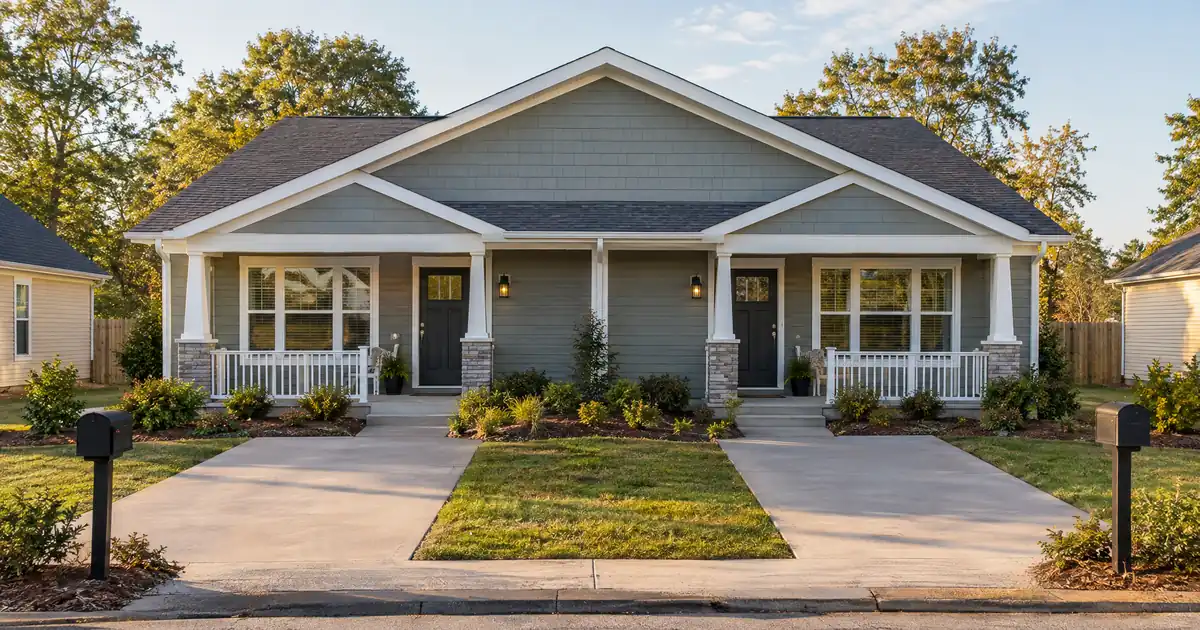
The Quick Read: A duplex does not change the FHA cash-out cap. The program reaches 80% of the home’s appraised value, the same as a single-family home, and every lien on the property counts toward that 80%. The cash you receive is what is left after the old loan, any second lien that stays, financed mortgage insurance and unpaid costs come out of that ceiling. Subject to lender guidelines and full file review.
What “Cash Released” Means on a Duplex
Cash released is the gap between the new loan and everything that loan has to pay off. It is not your equity, and it is not 80% of your value. It is whatever remains once the new loan has cleared your existing debts and costs.
Across the wholesale programs Lendmire places FHA files with, the cash-out refinance reaches 80% loan-to-value on a home you have owned and occupied for 12 months before the case number is assigned. A cash-out refinance, in HUD’s framing, is one where the proceeds are not limited to paying off the old mortgage and costs. A no-cash-out refinance is limited to exactly that.
HUD cut the cash-out ceiling from 85% to 80% of adjusted value in Mortgagee Letter 2019-11, citing risk to the FHA insurance fund. The change was folded into HUD Handbook 4000.1. If a friend mentions 85%, that figure is the ceiling HUD replaced with the 80% limit.
Lendmire’s FHA lane is a consumer one, so the home has to be your principal residence. On a duplex, that means you live in one unit. The other unit can be rented. The details of that rule are covered in the occupancy section below.
How Is the Cash Calculated, Step by Step?
The cash is plain subtraction from a ceiling. Start with 80% of the appraised value, then take away the payoff of your first mortgage, any second lien that stays, the financed upfront premium and any costs you do not pay out of pocket. What remains is your check.
Here is the order a lender works in:
1. Appraised value. Everything starts here. A higher appraisal lifts the ceiling dollar for dollar.
2. The 80% ceiling. Multiply the appraised value by 80%. This is the most the new loan can be.
3. Payoff of the existing first mortgage. The lender gets a payoff statement for every mortgage being paid.
4. Any subordinate lien that stays. A HELOC or second mortgage you keep counts toward the combined 80%. It uses up room. It does not add any.
5. Financed upfront premium. The FHA upfront mortgage insurance premium is 1.75% of the base loan and is usually financed. A financed premium lowers your net cash and raises your balance.
6. Costs and prepaids. Whatever is rolled into the loan rather than paid in cash comes off the check.
This formula is arithmetic derived from the HUD rules, not an HUD-published worksheet. The exact figures come from your Loan Estimate and appraisal.
You can also borrow less than the ceiling. The maximum is a limit, not a target. Many borrowers take only what a specific project or payoff needs.
Does a Duplex Release More or Less Than a Single-Family Home?
On the leverage cap alone, the answer is neither. The HUD material reviewed sets no separate loan-to-value for a duplex, so the same 80% applies to a one-unit and a two-unit home. Confirm that against the current Handbook, since it is the governing text.
What a duplex changes is the surrounding mechanics.
| Factor | Single-family | Duplex (2 units) |
|---|---|---|
| Cash-out LTV cap | 80% of value | 80% of value |
| Occupancy | Live in the home | Live in one unit |
| Appraisal form | Standard form | Small income property form |
| Rental income | Not counted | May count toward qualifying |
| County loan limit | One-unit limit | Higher two-unit limit |
Here is the practical effect. Two homes with the same appraised value and the same payoff leave the same room under the cap. A duplex tends to cost more, so its dollar amounts are often larger, but the percentage rule does not move. If you have seen a claim that duplexes get more cash than a single-family home on FHA, the research does not support that for the leverage cap. For a comparison from a different angle, Lendmire’s piece How Much Less Cash a Duplex Cash-Out Releases Than a Single-Family covers where the two diverge.
Which Limit Binds First: Leverage or the County Loan Limit?
For most owners, the 80% cap binds first. The county loan limit only becomes the binding factor on high-value duplexes in lower-cost counties. Both limits apply at once, and the lower of the two governs the loan.
FHA limits are set by county and unit count, and they change every year. County loan limits apply, so check yours before you assume anything. HUD publishes the annual figures in its 2026 limits announcement, and the two-unit limit sits above the one-unit limit in every county. That higher ceiling is one of the quiet advantages of owning a duplex.
Picture a duplex appraised well above the typical value in its county. Eighty percent of that value could exceed the county’s two-unit limit. In that case the loan limit caps the new loan, and the cash released shrinks even though you have plenty of equity. The reverse is more common: a duplex in a higher-cost county where the limit is far above 80% of value, so the cap governs.
The limit applies to the total of your first mortgage plus any subordinate liens. The base loan and the financed upfront premium are treated differently under the limit. Your lender will walk through that treatment with your actual numbers.
How the Second Unit’s Rent Figures In (and What It Doesn’t Change)
Rent helps you qualify, but it does not raise the loan-to-value cap. This is the most common misunderstanding about duplex cash-outs. The 80% ceiling is set by value. Rent only touches the debt-to-income side of the file.
Under HUD Mortgagee Letter 2023-17, rental income from a two- to four-unit subject property may be counted as effective income. Here is how it works in practice:
- The appraiser documents fair market rent on the small income property form for 2–4 unit homes.
- Where there is limited or no rental history, the lender uses 75% of the lesser of the appraiser’s market rent or the actual lease rent.
- The 75% factor is a built-in allowance for vacancy and upkeep. Landlords do not get credit for every dollar of rent.
- Income from commercial space in the building cannot be included.
Our base ratios across these programs are 31/43 (housing to total income) with no compensating factors. Documented compensating factors can reach 40/50 at the top tier, and the automated finding governs most files. Counted rent can ease those ratios, which matters for a borrower whose payment grows after a cash-out.
A tenant’s rent does not get you a bigger check. It may help the file clear. Those are different things.
What Comes Off Your Check?
Several items reduce the net cash, and the largest is usually the old mortgage. Here is the order of the walk-down, from ceiling to check.
| Step | What happens |
|---|---|
| Start | 80% of appraised value |
| Subtract | First mortgage payoff |
| Subtract | Second lien that stays |
| Subtract | Financed upfront premium (1.75% of base loan) |
| Subtract | Costs not paid in cash |
| Result | Cash to you |
The annual premium is separate. It is not subtracted from the check, but it lands in your monthly budget. The annual FHA premium runs between 0.15% and 0.75% of the balance depending on term, loan amount and LTV. On a thirty-year loan above 90% LTV, it lasts the full term. At or below 90% LTV, it ends after eleven years. A cash-out at 80% LTV falls in the second group. The exact numbers vary by lender and program and follow a full review of property, leverage, and credit.
A second lien can be the surprise. Suppose you have a HELOC that you want to keep. Because it counts toward the combined 80%, it shrinks the room for the new first loan. If you pay it off in the refinance instead, it comes out of the proceeds, and the check shrinks by that payoff but your total debt is simpler. Either way, the combined ceiling does not move.
Here is a practical read from placing these files: borrowers focus on the 80% number and forget that the payoff and the premium come out first. The check is almost always smaller than the headline math suggests. Ask for the Loan Estimate early and read the cash-to-borrower line, not the loan amount.
Who Qualifies?
Occupancy, Payment History and Credit
Five things decide the outcome: owner-occupancy for 12 months, clean payments, the appraised value, your credit and ratios, and, for a duplex, living in one of the units.
Occupancy and ownership. The property must have been your principal residence, owned and occupied by you, for the 12 months before the case number is assigned. HUD’s Handbook glossary defines a principal residence as your permanent place of abode, typically occupied for most of the calendar year, and you can have only one at a time.
Payment history. Lenders look for mortgage payments made on time over the prior 12 months, or since the loan began if that is shorter. Confirm the exact standard in the current Handbook, because lenders can apply it in slightly different ways.
Credit. Our wholesale programs start at a 580 decision score for FHA. HUD has a lower tier for scores of 500–579 that requires a 10% minimum investment, but the network does not reach below 580. Some lenders set a higher floor.
Co-borrowers. A non-occupant co-borrower is allowed on FHA purchase loans in this lane. Whether one fits a particular cash-out file depends on the lender, so ask.
Credit events. HUD’s waiting periods are two years from a Chapter 7 discharge and three years from a foreclosure. Those are HUD’s rules, not a promise from the network.
Duplex Versus a Three- or Four-Unit Home
The duplex has an easier road than a triplex or fourplex. HUD applies a self-sufficiency test to 3- and 4-unit properties, and sources point to duplexes being exempt. Verify that exemption in the Handbook for your file.
The test works from net rental income: the appraiser’s fair market rent from all units, less the greater of a vacancy and maintenance estimate or 25%. In plain terms, a 3- or 4-unit property has to carry itself on rent before it qualifies. A duplex does not face that hurdle.
The same 80% cap and the same occupancy rule apply across 1 to 4 units. The loan limit climbs with each additional unit, but extra tests tighten too. A duplex lands in a sweet spot: a higher limit than a single-family home, without the self-sufficiency test.
Where the General Rule Breaks
Most of these edge cases turn on occupancy or timing.
- Rented entirely to tenants. If you do not live in any unit, FHA cash-out is not available. Second homes and pure investment properties are not eligible. The lender reviews occupancy with employment records, utility bills and other documents.
- Inherited duplex. An inherited home can be exempt from the 12-month wait if you have not rented it. Renting it out after inheriting resets the clock. Because this rests on secondary sources, confirm it in the current Handbook.
- Previously rented, then you moved in. The 12-month clock runs from when you began occupying it, not from when you bought it.
- Moved out after the cash-out. The program is built on principal-residence occupancy. Misrepresenting your plans to occupy the home is a serious problem, and lenders take it seriously.
- Hawaiian Homelands. a 2019 HUD mortgagee letter does not apply to Section 247 mortgages.
- Older loans. A case number assigned before September 2019 may reflect the 85% era. That is history and does not govern a new loan.
- Streamline and rate-and-term. These are separate programs. The FHA Streamline refinances an existing FHA loan without an appraisal, with a limited credit review and a net tangible benefit. The rate-and-term with an appraisal reaches 97.75% on a principal residence occupied for the previous twelve months. Neither gives you cash.
FHA Cash-Out Versus Other Ways to Tap Duplex Equity
FHA cash-out is one of three common paths. Each fits a different goal.
| Option | Best fit | Tradeoff |
|---|---|---|
| FHA cash-out | Lower credit scores, large payoff | Mortgage insurance for the loan |
| Conventional cash-out | Strong credit, higher scores | Different leverage rules on 2-unit homes |
| Home equity loan or HELOC | Keeping a good first mortgage | Counts toward the 80% if you stay FHA |
Conventional programs may cap a two-unit cash-out at a different leverage than a one-unit. That leverage difference is worth comparing if your credit is strong. If you are replacing a conventional first mortgage, Lendmire’s piece How Much an FHA Cash-Out Releases Replacing a Conventional Loan walks through that swap.
If you are still deciding whether a refinance makes sense, the FHA cash-out refinance program page lays out how Lendmire arranges these loans.
Should You Take the Cash? Costs and Risk
A cash-out is a new, larger loan, not a bonus. The CFPB’s guide to using home equity notes that a cash-out refinance can raise your payment because a larger loan replaces the old one. It also resets your rate and terms, and the new loan often runs 30 years.
The CFPB also cautions that paying non-mortgage debts with mortgage debt can increase foreclosure risk. Paying off other bills was a common reason borrowers gave in the CFPB’s research.
Think through three questions:
1. Does the cash cost less than the debt it replaces? Compare the interest and fees on the new loan against what you pay on the debts being cleared.
2. Can the new payment fit comfortably? The loan is larger and may run longer.
3. Is the cash for something that holds value? A repair that protects the building is different from covering monthly spending.
No equity product converts 100% of your equity to cash. FHA leaves 20% in the home by design. Tax treatment can depend on your situation; borrowers should speak with a qualified tax professional before relying on any deduction or credit.
Key Terms Defined
Adjusted value: The appraised value used to set the loan ceiling, after HUD’s adjustments.
LTV and CLTV: Loan-to-value is the first mortgage divided by value. Combined loan-to-value adds any other liens.
UFMIP: The upfront mortgage insurance premium, 1.75% of the base loan, usually financed into the loan.
Principal residence: The one home you occupy as your permanent place of abode.
Self-sufficiency test: A rent-based test HUD applies to 3- and 4-unit homes, not duplexes.
Net cash to borrower: What remains after payoffs, premiums and costs are taken from the new loan.
Your Decision in Practice
Start with the appraisal and the payoff, since those two numbers decide most of the outcome. Then confirm your 12-month occupancy and payment history. Check your county’s two-unit limit. Finally, decide how much you actually need, since you can borrow less than the maximum.
If you are weighing a cash-out refinance against keeping the loan you have, Lendmire can help you compare the programs and the equity each one reaches.
Frequently Asked Questions
Can I take 100% of my duplex equity out with an FHA cash-out?
No. The ceiling is 80% of the adjusted value, and it counts every lien on the property. The 20% left in the home is built into the program. After the payoff, the financed premium and costs, your check is smaller than 80% of value.
Does the rent from my second unit increase the amount I can borrow?
No. Rent can help you qualify by counting toward income, but the loan-to-value cap is set by appraised value alone. Where rental history is limited, HUD counts 75% of the lesser of market rent or lease rent, and commercial space income cannot be included.
Can I do an FHA cash-out on a duplex I rent out entirely?
Not through this lane. FHA cash-out requires a principal residence you have owned and occupied for 12 months before the case number. A duplex that is fully tenant-occupied, a second home or a pure rental does not qualify.
If I keep my HELOC, does it affect how much I can get?
Yes. A subordinate lien that stays in place counts toward the combined 80% limit, so it takes room away from the new first loan. Paying it off in the refinance changes the math, but the combined ceiling is the same.
Is the duplex loan limit the same as for a single-family home?
No. County loan limits apply, and the two-unit limit is higher than the one-unit limit in every county. Those limits change every year, so check your county’s current figure.
For your own numbers, request a scenario review with Lendmire.
About Lendmire
Lendmire — NMLS# 2371349 — is a mortgage broker that arranges FHA, VA, conventional and jumbo home purchase and refinance financing in 16 states through wholesale lenders. Every option is subject to the lender’s guidelines and full underwriting. Scotsman Guide named Lendmire a Top Mortgage Workplace in both 2025 and 2026.
For the program’s current guidelines, see FHA loan programs.
Get Started
Ready to find the right loan for you?
In about 30 seconds you can review financing options available for your home or investment property. No commitment required.
Informational only. Not a Loan Estimate, approval, or commitment to lend. Program availability and eligibility are subject to lender guidelines, credit approval, property review, and underwriting.
References
1. HUD Mortgagee Letter 2019-11
2. HUD Handbook 4000.1 Update (transmittal)
3. HUD 2026 FHA loan limits announcement
4. HUD Mortgagee Letter 2023-17
6. CFPB, Using Home Equity guide
7. CFPB press release on cash-out refinance borrowers
This article is part of Lendmire’s FHA Loan series — every loan program’s qualification details, guidelines, and scenarios live on the loan options page.
Related reading: How Much Payment an FHA Cash-Out Frees on a Texas Homestead · How Much Cash an FHA Cash-Out Releases Over an Existing FHA Loan · Can You Get an FHA Cash-Out in a Divorce With Both Spouses on the Loan?
Brandon Miller
Founder & CEO, Mortgage Loan Originator, Lendmire LLC
- Mortgage Loan Originator · NMLS# 1129696 · Verify on NMLS Consumer Access
- North Carolina Real Estate Broker · License# 343312 · Verify on NCREC
- North Carolina Insurance Producer · License# 19053198 · Property, Casualty, Life, Health · Verify on NAIC SBS
- Lendmire LLC · Firm NMLS# 2371349 · Verify firm licensure
Required disclosures. Lendmire (NMLS# 2371349) operates as a licensed mortgage broker, not a direct lender or depository. The discussion in this article is general in nature and should not be relied upon as financial, legal, or tax advice — every investment scenario is unique and should be reviewed by a qualified professional. Any loan inquiry is subject to lender underwriting, and this article is not a commitment to lend or a guarantee of approval. Mortgage rates, loan terms, and program guidelines vary by borrower, property, and state, and may change without notice. Equal Housing Opportunity. Verify licensure at NMLS Consumer Access.