
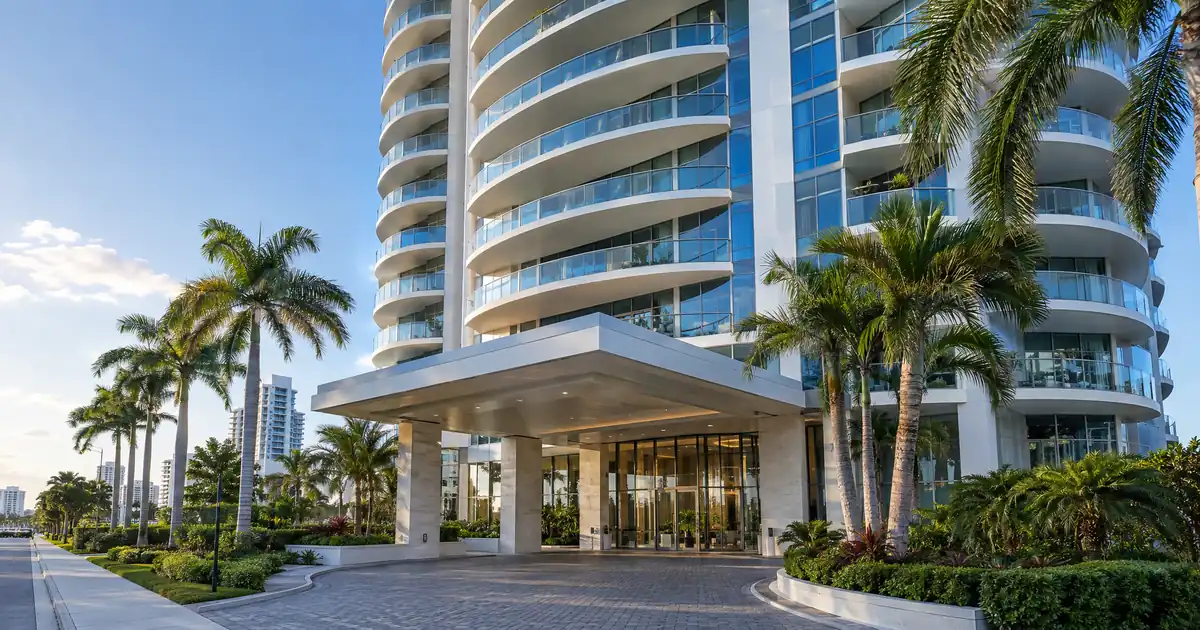
Finance A Luxury Condo On A Super Jumbo — The Quick Read: A self-employed buyer with a seven-figure condo purchase and a tax return that understates real cash flow can typically qualify using bank deposits instead of traditional personal-income documentation. Loan size and the property itself both drive the leverage: through select wholesale programs, sizing runs from $300,000 to $30,000,000 across two separate ladders, and every file above $4,000,000 gets reviewed case by case before submission. The condo building gets underwritten on its own, separate from the borrower — and a lot of luxury towers fail that review for reasons that have nothing to do with the buyer’s credit or income.
That last part is the piece most buyers don’t see coming. A borrower can have flawless deposits, strong credit, and plenty of reserves, and still watch a deal stall because the building itself doesn’t clear review.
Key Takeaways
- Bank statement loans replace traditional personal-income review with 12 or 24 months of deposit history — full underwriting still applies underneath it.
- Loan size changes leverage on a sliding scale; there is no single LTV number for “super jumbo.”
- The condo project is underwritten separately from the borrower — insurance gaps, litigation, or investor concentration in the building can stop a loan the borrower’s own file would otherwise clear.
- Above $4,000,000, every file moves to case-by-case review before it’s even submitted.
- Investment condos with real rental income sometimes qualify faster on property cash flow than on personal deposits — that’s a different loan entirely.
Why “Super Jumbo” Doesn’t Mean One Thing
There’s no regulator that defines a super jumbo loan. Deposits become the evidence of income instead. That distinction matters for a luxury buyer because most non-QM programs don’t inherit the leverage caps or condo rules that apply to agency-backed loans — they run their own.
Through select wholesale programs, sizing on this kind of file runs from $300,000 to $30,000,000, but it’s not one ladder. A portfolio non-QM program carries files to $6,000,000. A separate bank portfolio program carries twelve-month-statement files all the way to $30,000,000 on its own size bands — 65% loan-to-value to $5,000,000, 60% to $10,000,000, and 55% up to $30,000,000, with interest-only capped at 60% or the band’s own ceiling, whichever is lower. The bank program’s ladder actually starts above $4,000,000 and overlaps the portfolio program up to $6,000,000, then stands alone beyond that.
How the Income Math Actually Works
A bank statement file replaces the W-2 and the tax return with deposit history, then runs a full underwrite on top of it — credit, debt load, reserves, and the property all still get reviewed the normal way.
The lender typically pulls 12 or 24 consecutive months of personal or business statements. Business accounts need at least 25% ownership by the borrower. Qualifying income comes from eligible deposits divided by the number of statement months, after an expense ratio gets applied to strip out the cost of running the business. That ratio typically varies by business type and staffing level, running higher for businesses with more employees or product-based operations than for service businesses with no employees — or it can come from an accountant-provided figure, or a profit-and-loss method capped at 80%. Transfers the borrower moves from their own business account into a personal account count in full, at 100%.
Statements have to be consecutive. A transaction history print-out from the bank doesn’t substitute — lenders want the actual statements, month by month.
Some buyers have real income that doesn’t show up cleanly on a tax return. A business owner might run everything through an S-corp. A physician might have a practice that carries heavy depreciation. An entertainer might have lumpy 1099 income. For buyers like these, this is often the only realistic path to a condo priced well above what a conventional mortgage would support.
The Leverage Ladder: What Loan Size Buys
Leverage steps down as the loan gets bigger. There’s no flat percentage that applies at every size. Every figure below is a ceiling through select wholesale programs, subject to full underwriting. Bank statement loans sit in the non-QM category. This means they qualify a borrower outside the standard ability-to-repay documentation rules, which normally require traditional personal-income documentation or pay stubs.
On a primary residence, the ladder looks roughly like this at the price points where luxury condos usually land:
| Loan Size | Purchase LTV | Credit Floor |
|---|---|---|
| $2M–$2.5M | 80% | 720+ |
| $2.5M–$3M | 80% | 720+ |
| $3M–$3.5M | 75% | 720+ |
| $3.5M–$4M | 75% | 760+ |
| $4M–$5M | 65% (case by case) | 680+ |
| $5M–$6M | 60% (case by case) | 680+ |
Investment-property condos run a lower ladder at every step, since the property isn’t the borrower’s primary home:
| Loan Size | Purchase LTV | Credit Floor |
|---|---|---|
| $2M–$2.5M | 80% | 720+ |
| $2.5M–$3M | 75% | 720+ |
| $3M–$3.5M | 60% | 680+ |
| $3.5M–$4M | 60% | 680+ |
| $4M–$5M | 65% (case by case) | 760+ |
Second homes generally land somewhere between the two, five points or so under the primary-residence number at most sizes.
Above $3,500,000 on a primary home, or $3,000,000 on a second home or investment property, additional overlays kick in. These typically include a 700 credit floor, a clean 24-month housing payment history, 48 months of seasoning past any credit event, U.S. citizenship or permanent residency, no non-occupant co-borrowers, and cash-out proceeds that can’t be counted toward reserves. And above $4,000,000, every one of these files moves to case-by-case review before submission. The table above is a starting point for that conversation, not a guarantee.
Reserve requirements scale with loan size too: typically 3 months of payment reserves to $500,000, 6 months to $1,500,000, and 9 months above that, plus roughly 2 additional months for every other financed property the borrower carries, up to a 12-month maximum. A first-time investor buying a condo purely for rental income usually needs the full 12 months up front.
The Part That Trips Up Luxury Buyers: The Building Gets Its Own Underwrite
A condo loan reviews two things, not one — the borrower’s file and the building’s finances, litigation history, insurance, and ownership mix — and the second review can kill a deal the first review would have approved cleanly.
This is the mechanic most buyers don’t expect. On a detached single-family home, the lender is mostly looking at the borrower and the property itself. A condo adds a whole second layer, because every owner in the building shares financial exposure through the homeowners’ association. Fannie Mae’s own appraisal process for individual condo units, Form 1073, reflects exactly this split — the borrower’s finances and the unit’s value get appraised separately from the underlying project’s eligibility.
A lot of luxury towers simply don’t. Heavy investor concentration, a large short-term-rental pool, commercial space above roughly a third of the building, active litigation, or an HOA that’s behind on reserve funding can all knock a project out of warrantable status — and none of that has anything to do with whether the unit itself is a good asset.
Recent policy tightening from the agencies has widened this gap. Fannie Mae has retired the streamlined and limited condo review pathways. This means buildings that sailed through review a year or two ago can now land in non-warrantable territory on paperwork alone, according to condo-approval.com’s coverage of the change. That coverage also flags a scheduled increase in the minimum reserve-funding threshold lenders check for. A non-warrantable label doesn’t mean the building is poorly run — it means it doesn’t fit the box agency financing is built around.
That’s precisely the gap a super jumbo bank statement program is built to fill. Through select wholesale programs, warrantable condos can typically go to 80–85% depending on size, non-warrantable projects step down from there, and condotels — buildings with hotel-style rental programs or front-desk check-in — run lower still, generally 75% on a purchase and 65% on a cash-out through the portfolio program, or 50% through the bank program. If the tower in question runs a rental pool or requires guests to check in through an on-site desk, a program built specifically around that structure is worth understanding before assuming a standard bank statement approval will carry over — Lendmire’s guide to financing a condotel with a super jumbo walks through that distinction in more depth, and the leverage mechanics on warrantable versus non-warrantable buildings specifically are covered in Lendmire’s piece on warrantable condo leverage.
Insurance is worth flagging separately here. A condo association’s master policy and the owner’s own HO-6 “walls-in” policy work as a pair — the master handles the building shell and common areas, the HO-6 covers interior finishes, cabinetry, and fixtures. A high-end interior raises the dollar exposure if the master policy is a bare-walls form rather than an all-in one, and lenders will check that gap before closing regardless of how strong the borrower’s file looks.
What Can Go Wrong
The most common failure point on a luxury condo file isn’t the borrower’s income — it’s discovering the building’s HOA financials or litigation history late, after the buyer is already under contract with earnest money at risk.
A few patterns show up repeatedly across files like this. Business-account deposits with heavy month-to-month swings can shrink the qualifying income more than a borrower expects once the expense ratio gets applied — a product-based business at 50% loses half its gross deposits to that calculation before the math even starts. Buyers sometimes assume a strong stock portfolio can substitute for deposit history; it can, but only through a separate asset-based path — asset allowance divides liquid assets by 36, 60, or 84 months depending on the file, and an assets-only path needs liquidity equal to the full loan amount plus costs. Confusing that mechanism with bank statement qualification is a common and avoidable mistake.
On the building side, things can change fast. A condo with an active reserve study showing a funding shortfall, or an association passing a special assessment to cover deferred maintenance, can shift from warrantable to non-warrantable mid-transaction — sometimes after the loan file is already in underwriting. In market-rate luxury markets, financed buyers are often bidding against cash. In Manhattan, cash purchases represented 65.3% of all condo transactions in a recent quarter, and cash share climbs to roughly 90% on sales above $3 million, according to Manhattan Miami’s condo market analysis. This means a pre-underwritten, finance-ready file is a real negotiating edge, not just a formality.
Who This Fits — and Who It Doesn’t
This structure fits a self-employed or high-net-worth buyer whose real cash flow doesn’t show up on a tax return, buying a condo priced well above what conventional financing would support. It doesn’t fit a W-2 borrower who can already document income the standard way — that buyer is usually better served by a conventional jumbo loan with fewer overlays.
It also doesn’t fit a buyer who is purchasing a condo purely as a rental, where the property’s own income is stronger than the borrower’s personal deposits. That’s a different qualification path entirely. It’s built around the property’s rent covering the payment, rather than the borrower’s bank statements. Investment-purpose loans like that are business-purpose loans. Lenders review them differently from an owner-occupied mortgage, because they’re underwritten to the asset rather than the person. Lendmire’s complete DSCR loans guide covers how that qualification works in more detail. It’s worth comparing both paths before you assume bank statement is the right fit for a rental purchase specifically.
Retirees and asset-rich, income-light buyers are also a mismatch for straight bank statement underwriting — the asset-depletion path exists specifically for that profile, since deposit history won’t reflect meaningful monthly income even when the balance sheet is substantial.
Tax treatment can depend on how the funds are used and how the property is held; investors should keep clear records and speak with a qualified tax professional before relying on any deduction. Nothing here is legal or tax advice, and buyers should consult a qualified attorney or CPA about their own situation before making a financing decision on a specific property.
Frequently Asked Questions
Can I use bank statement income if I already have some traditional employment income too?
Yes — lenders will typically look at whichever documentation path produces the stronger, more usable qualifying income for the file. A borrower with mixed W-2 and self-employed income sometimes qualifies faster on a blended review than by picking one method exclusively; that’s a conversation worth having early with whoever is structuring the file.
Does a non-warrantable condo automatically mean a worse loan?
Not automatically — it means a narrower set of programs will consider it, and leverage typically runs a bit lower than on a warrantable building. A well-run, financially sound tower can still be non-warrantable purely because of its rental pool or ownership concentration, which has nothing to do with the quality of the asset itself.
What happens if the building fails project review after I’m already under contract?
The file usually pauses while the underwriter reviews the association’s financials, insurance, and litigation status in more depth, and in some cases the loan needs to shift to a program built around non-warrantable or condotel collateral. This is exactly why pulling HOA financials and a reserve study before going under contract saves time later.
Is there a minimum credit score for this kind of loan?
Typically 660 on the portfolio bank statement program and 680 on the bank portfolio program, stepping up to roughly 700 once the loan crosses into super-jumbo overlay territory above $3,000,000–$3,500,000, depending on occupancy. These are program floors, not guarantees — the exact requirement depends on the full file.
Can I do a cash-out refinance on a luxury condo I already own outright?
Cash-out is available through select programs, though proceeds are typically capped around $1,500,000 above 60% loan-to-value on the portfolio program, with different terms on the bank portfolio program at larger sizes. The exact structure depends heavily on loan size, occupancy, and the building’s warrantability status.
Are you weighing a luxury condo purchase between a bank statement file and a rental-income structure? Lendmire can help you compare both paths. It works with select lenders in its wholesale network. The comparison depends on the property, the borrower’s documentation, and the building’s own eligibility rules.
For current guidelines and terms, see Lendmire’s super jumbo bank statement loan programs page.
Self-employed borrowers can compare both super jumbo programs on Lendmire’s self-employed mortgages page.
About Lendmire
Lendmire (NMLS# 2371349), a non-QM mortgage broker serving investors in 40 markets including Washington, D.C., helps structure DSCR scenarios commonly evaluated around a property’s rental income rather than personal income paperwork, subject to lender guidelines. A Scotsman Guide Top Mortgage Workplace in 2025 and 2026, Lendmire places loans through wholesale investor lenders and is not a direct lender.
Lendmire’s Top Mortgage Workplace recognition is documented by Scotsman Guide 2025 Top Mortgage Workplace and Scotsman Guide 2026 Top Mortgage Workplace.
Get Started
Ready to find the right loan for you?
In about 30 seconds you can review financing options available for your home or investment property. No commitment required.
Informational only. Not a Loan Estimate, approval, or commitment to lend. Program availability and eligibility are subject to lender guidelines, credit approval, property review, and underwriting.
References
1. Fannie Mae – Individual Condominium Unit Appraisal Report (Form 1073)
2. condo-approval.com – What Is a Non-Warrantable Condo? 2026 Guidelines
3. Manhattan Miami – Manhattan Condo Market Report 2026
This article is part of Lendmire’s super jumbo bank statement loan program — full qualification details, guidelines, and scenarios live on the program page.
Related reading: Financing A Luxury Condo With Bank Statements: Complete Guide · How A Super Jumbo Bank Statement Loan Treats Condo Project Eligibility? · How Asset Qualifier Loans Handle Condo And Condotel Purchases?
Brandon Miller
Founder & CEO, Mortgage Loan Originator, Lendmire LLC
- Mortgage Loan Originator · NMLS# 1129696 · Verify on NMLS Consumer Access
- North Carolina Real Estate Broker · License# 343312 · Verify on NCREC
- North Carolina Insurance Producer · License# 19053198 · Property, Casualty, Life, Health · Verify on NAIC SBS
- Lendmire LLC · Firm NMLS# 2371349 · Verify firm licensure
Compliance and disclosures. Lendmire (NMLS# 2371349) is a licensed mortgage broker and is not a direct lender, depository institution, financial advisor, or tax professional. Content in this article is general market analysis and educational information — not financial, legal, or tax advice for any specific situation. Lendmire does not guarantee loan approval; every transaction is subject to underwriting by the funding lender. Mortgage pricing and loan program guidelines are subject to change at any time without notice and vary by borrower characteristics, property type, and state regulations. Lendmire complies with Equal Housing Opportunity. Licensure verification: NMLS Consumer Access.