
The Quick Read: Yes, a rental with no mortgage can carry a HELOC in first lien position, since nothing is recorded ahead of it, but few lenders write the product, they underwrite you rather than the rent, and an investment-property line in Lendmire’s network tops out at 70% CLTV and $500,000. A HELOC is a home equity line of credit, a revolving credit line secured by property.
- A line is a “second” only when something is already recorded ahead of it. On a paid-off rental, it is the first lien.
- Eligibility turns on your personal credit and debt load, not on how well the rental performs.
- Title must sit with you personally or in a revocable living trust. An LLC cannot hold title on this product.
- Within Lendmire’s network, an investment line requires a 700 minimum credit profile and typically relies on an automated valuation instead of a full appraisal.
- A DSCR cash-out refinance is the main alternative, and it reads the property instead of you.
All figures are typical guidance, subject to lender guidelines and full file review. This is not a commitment to lend.
How large a line the equity supports.
An equity line is sized by combined loan-to-value, occupancy, and credit — not by rental coverage. Switch the occupancy or the credit band and the ceiling moves with it.
Investment-property lines require a 700 minimum credit score; second-home lines start at a 640 minimum and primary-residence lines at 600, and the combined-LTV ceiling steps down as the credit band drops on primary-residence and second-home lines and holds on investment-property lines; the line cap steps down on primary-residence lines and holds at every tier on investment-property and second-home lines.
A debt-to-income ratio above 45% requires 680+ credit. Profiles under 640 are limited to single-family homes. At least 75% of the approved line is drawn at closing. Ceilings, floors, and caps update from Lendmire’s centralized guideline source.
Line estimate
Illustrative estimate only — not a quote, Loan Estimate, approval, or commitment to lend. The rate is an editable assumption; equity-line pricing is variable through both the draw and repayment periods and never converts to fixed. Occupancy and credit drive the ceiling together: an investment property tops out at 70% combined LTV (minimum credit 700, line cap $500,000); a second home tops out at 90% combined LTV (minimum credit 640, line cap $500,000), with the ceiling stepping down as the credit band drops (the cap holds at every tier); a primary residence tops out at 90% combined LTV (minimum credit 600), and its $750,000 maximum line is available only at 75% combined LTV or below with a 700-or-better credit profile (720 on the longer-runway program) and a full appraisal. Lines above $500,000 require a full appraisal. Credit, debt-to-income, property type, and full underwriting review all affect the final line.
What Does “First Position” Mean on a Rental?
First position means the line gets repaid first if the property is ever sold to satisfy debts. Lien priority follows the order in which liens are recorded against the property. The product name does not decide it.
People call a HELOC a second mortgage because most borrowers already have a first mortgage on the home. The line gets recorded behind it. Remove the first mortgage and the same line moves to the front of the queue. Nothing about the product changed. Only the recording order did.
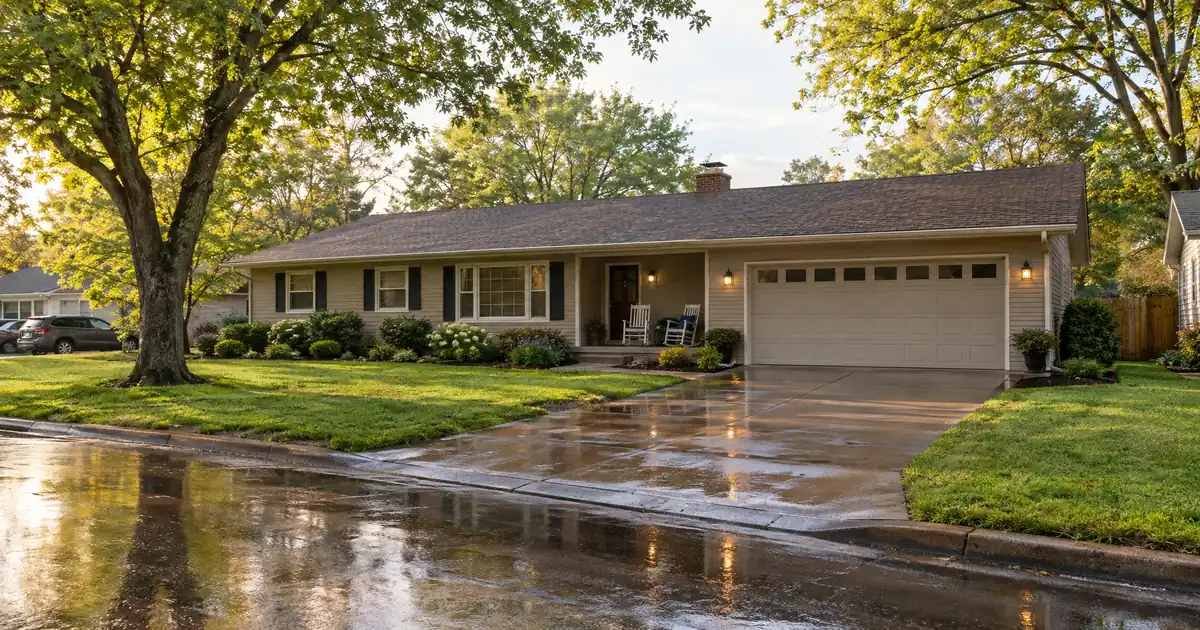
A rental you own outright is the cleanest case. The lender is not working around an existing balance or asking another lender for permission. Think of a duplex you paid off after years of ownership. A new line recorded against it would be the only lien on title, which makes it a first-position HELOC.
Does a Paid-Off Rental Automatically Qualify?
No. Being free and clear gives you collateral. It does not give you an approval. The lender still reviews your credit, your debt-to-income ratio, and the property’s value.
Availability is the real hurdle. NerdWallet says a HELOC on an investment property is possible, but the lender pool is smaller and you can borrow less than against a primary home. It adds that lenders see rentals as higher default risk, since borrowers tend to pay their own home’s bills first. The White Coat Investor reaches the same conclusion: yes, but harder, with fewer lenders.
Large retail lenders often do not offer a non-owner-occupied line at all. Many investors find the product through a broker who works with select wholesale partners, because those partners write business that a bank branch will not. That is how Lendmire approaches it. It brokers a standalone investment equity line, in first or second lien position, through its wholesale network. Lendmire is never the lender.
That product is available only in Lendmire’s 16 full-service states. This is narrower than the 41-market DSCR footprint, so check availability before building a plan around it.
How Do You Prove the Rental Is Actually Clear?
The lender orders a title search, and the title has to show no open liens. Do not assume it will. Check three things before you apply:
1. Recorded releases. A mortgage you paid off years ago can still appear open if the release was never formally recorded. Ask your title company to confirm that satisfactions are on record.
2. Forgotten lines. An old equity line that was never closed out can sit on title with a zero balance. It still counts as a lien.
3. Other claims. Judgments, mechanics’ liens, and unpaid assessments can attach to a property. Any of these can push your new line out of first position or stall the file.
A clean title report takes the most common surprise off the table. It costs far less to find a stale lien before you apply than after.
How Big a Line Can a No-Mortgage Rental Support?
Sizing starts with the property’s value, applied against a combined loan-to-value (CLTV) ceiling. CLTV counts every loan against the property, including the full credit line, divided by value. On a rental with an existing mortgage, you subtract that balance from the allowed percentage first. On a free-and-clear rental, you subtract nothing.
On an investment property in Lendmire’s network, the ceiling is 70% CLTV. Both the 720-plus and 700-plus credit tiers reach that same 70%, so a higher score buys eligibility rather than extra leverage. The minimum credit profile is 700, with no tier beneath it. The maximum investment line is $500,000.
Here is the comparison in percentages:
| Rental situation | CLTV room on an investment line |
|---|---|
| Free and clear | Up to the full 70% ceiling |
| Existing loan near half of value | Roughly 20 points of room left |
| Existing loan at or above 70% | None |
Two limits can bind, and the one that hits first depends on value. On a modestly priced rental, the 70% ceiling binds first. On a high-value rental, the $500,000 cap binds before the percentage does. In that case, extra equity sits idle. The line size runs from $25,000 up, and the full-appraisal threshold begins above $500,000. So an investment line is structurally in the automated-valuation lane and commonly closes without a traditional appraisal. A borrower can still request a full appraisal.
The lender also reviews your file on the interest-only payment calculated at the maximum draw. Debt-to-income tops out at 50%, and ratios above 45% need a 680 minimum credit profile. On an investment line the 700 floor already clears that.
Who Gets Underwritten: You or the Rent?
You do. A HELOC reads your personal file. The lender weighs credit, debt-to-income, and equity, and a rental’s income typically enters as part of your overall picture. It is not a test the property must pass on its own.
This is the sharpest contrast with a DSCR loan, which qualifies primarily on property-level rental income covering the payment, subject to lender guidelines. An investor with strong rents but heavy personal debt can fail the HELOC test and still pass the DSCR test. An investor with a thin rental and excellent personal numbers may find the opposite.
Exposure rules matter too. A borrower is limited to three lines, and an owner with more than 15 financed properties is not eligible. If you have scaled a portfolio, your debt-to-income ratio, not any single rental, may be the real limit.
Does Title or LLC Ownership Matter?
Yes, and it often decides the whole question. The equity line must be held by you individually or by an inter vivos revocable living trust. LLCs, corporations, partnerships, and irrevocable, blind, or land trusts cannot hold title on it.
If your rental sits in an LLC, you have two choices. You can move title into your own name or a revocable trust, which can cost you the liability separation the LLC gave you. That is a decision to make with your attorney, not a paperwork detail. Or you can choose a different product. A DSCR cash-out refinance can lend to an LLC borrower, subject to lender program eligibility, which is why many entity-owned portfolios go that route.
Property type matters as well. Single-family, 2-4 unit, PUD, townhome, and condominium properties are eligible, including non-warrantable condos. Manufactured homes, co-ops, condotels, log homes, commercial, mixed-use, and agricultural-zoned properties are not.
What Does the Line Look Like Once It Closes?
On an investment line, the structure is a 5-year interest-only draw period followed by a 25-year fully amortizing repayment. At least 75% of the line is drawn at closing. Pricing floats across both the draw and repayment periods and never converts to fixed.
NerdWallet reports a typical draw period of 10 years with interest-only payments, then up to 20 years of repayment. That is a market-wide description. The network figure for an investment property is the 5-year draw and 25-year repayment above.
The 75% drawn at closing changes what “revolving” means. You are not opening a large dormant reserve. Most of the line becomes real debt on day one. If you wanted a standby fund for staged renovations, expect to carry more debt, sooner, than the word “line of credit” suggests. Later draws have a $1,000 minimum, but lenders can reduce or freeze lines, so do not treat the undrawn portion as guaranteed capital.
Two points deserve a hard look before you sign:
- Variable pricing. Because pricing floats, your cost can change through the whole life of the line. Run the numbers on a worse case, not just today’s.
- Payoff on refinance. Once a first-position line is on the property, any later refinance has to pay it off. The line also complicates a sale if you want a quick clean exit.
First-Position Line or DSCR Cash-Out: Which Fits?
This is a genuine toss-up for some investors, and a clear call for others. Both pull equity out of a paid-off rental. They differ in what they read and what they leave behind.
| Factor | Investment equity line | DSCR cash-out refinance |
|---|---|---|
| Underwritten on | Your personal file | Property rent coverage |
| Leverage ceiling | 70% CLTV | Around 75% LTV on most files |
| Entity title | Individual or revocable trust only | LLC possible, subject to program terms |
| Structure | Revolving, floating pricing | New first-lien loan, 30-year fixed spine |
| Size | $25,000 to $500,000 | Up to $3,000,000 on standard programs |
On a free-and-clear rental, a cash-out refinance has no payoff step. It is a new first-lien loan, and most files in the network top out near 75% LTV on a standard rental, with about 6 months of seasoning as the common expectation. It typically asks for around 660 credit, though a 620 floor exists in parts of the network and 700-plus unlocks the strongest tiers. Reserves vary by lender, leverage, and loan size, commonly around 6 months of PITIA. That is principal, interest, taxes, insurance, and any association dues.
Coverage is where the DSCR route gets its test. Many select programs start at 1.00 coverage. A separate select-lender path takes coverage below 1.00, with leverage and terms adjusted. Stronger ratios open better pricing and leverage. Clearing 1.00 does not mean the rental has positive cash flow, because repairs, vacancy, management, and capex sit outside the calculation.
If you own the property in an LLC or have a heavy personal debt load, the DSCR route usually wins. If you own in your own name, have clean personal credit, and want a draw-as-needed structure for a project, the line can fit. For the full picture, see the complete DSCR loans guide.
Where Does This Go Wrong?
A few patterns come up repeatedly when investors try this structure.
Title surprises. A stale lien or an unreleased mortgage shows up in the title search. The file stalls until it is cleared.
The wrong owner on title. The investor applies in their own name for a property deeded to an LLC. The lender cannot close until title moves, which has legal consequences the investor should weigh first.
Counting on a bigger line than the caps allow. The investor sees a high property value and expects a large line. The $500,000 cap or the 70% ceiling cuts the number down.
Treating the line as free money. Heavy draws at closing, floating pricing, and a repayment period that begins after the interest-only draw can strain cash flow. Rent that covers a loan does not mean the loan is easy to carry.
Swapping the collateral. Some investors put the line on their primary home instead, to keep the rental clear. The collateral changes, and so does the risk. The CFPB’s HELOC booklet warns that renting out a home may be prohibited under the terms of your line, so read the occupancy terms before you move out. Lendmire’s piece Should You Tap a Home HELOC Instead of a Free-and-Clear Rental? walks through that tradeoff.
Tax treatment varies by how the funds are used and how the property is held, so consult a qualified professional before relying on any deduction.
Who Should Use It, and Who Should Skip It
This structure suits an investor who owns the rental personally or in a revocable trust, has a credit profile at or above 700, carries manageable personal debt, and wants a modest line at conservative leverage. It also suits someone who already knows how much they need, since most of the line is drawn at closing.
Skip it if your property is in an LLC and you want to keep it there. Skip it if your personal debt-to-income ratio is already stretched. Skip it if you need a bigger loan than $500,000 on an investment property, or if you want predictable payments across the term.
Some investors also consider the opposite sequence, opening a line on the rental first to keep a home clear. Lendmire’s explainer Should You Open a Rental HELOC First to Keep Your Home Clear? covers that order of operations.
Key Terms Defined
Lien: A legal claim against a property that secures a debt and must be paid before clean title passes to a buyer.
First position: The lien recorded ahead of all others. It gets repaid first if the property is sold to satisfy debts.
Free and clear: A property with no mortgage or other lien recorded against it.
CLTV (combined loan-to-value): The total of all loans against a property divided by its value, including the full credit line.
Vesting: How title is held, such as in your own name, a revocable trust, or an LLC.
DSCR (debt service coverage ratio): Monthly rent divided by the full monthly payment, including principal, interest, taxes, insurance, and dues.
How Do You Find a Lender That Writes It?
Start by asking the right questions. A loan officer who handles owner-occupied mortgages may not know whether a rental line exists. Ask each lender these directly:
- Do you write lines on non-owner-occupied one-to-four-unit properties?
- Do you lend in first position on a rental with no existing mortgage?
- Does the line require individual or trust title, and do you lend to LLCs?
- What are your CLTV ceiling and maximum line for an investment property?
- How much of the line must be drawn at closing?
- Is the pricing fixed or does it float?
A mortgage broker who works with several wholesale partners can compare these answers across lenders in one pass. That is the practical edge of brokering over calling one bank at a time.
Frequently Asked Questions
Is a HELOC on a paid-off rental really a first mortgage?
It is a first lien, though not a first mortgage in the traditional sense. Lien position depends on recording order, so a line recorded on a property with no other liens sits first. The product is still a revolving line, with a draw period and repayment period, not a standard closed-end mortgage.
Can I get one if my rental is in an LLC?
Not on this product. The line must be held by you individually or by a revocable living trust. If the property sits in an LLC, you would need to change vesting or use a DSCR cash-out refinance instead, subject to lender program eligibility.
How much can I borrow against a free-and-clear rental?
On an investment property in Lendmire’s network, the ceiling is 70% CLTV with a maximum line of $500,000. With no existing mortgage, the full 70% is available, up to the dollar cap. Your credit profile must be at least 700, and approval is subject to lender guidelines and full file review.
Will a lender count my rental income?
It typically becomes part of your overall debt-to-income picture instead of a standalone test. The lender qualifies you personally, with a 50% debt-to-income maximum. If you want a loan that reads the property’s rent coverage, a DSCR loan is built for that.
Is a DSCR cash-out refinance better for a paid-off rental?
It depends on how you hold title and how much personal debt you carry. A DSCR cash-out reads the property, allows higher leverage on most files, and can lend to an LLC. A line gives you a revolving structure but reads your personal file. If you are considering a home equity line and want to see how the numbers work, Lendmire can help you compare HELOC options based on the property, the equity available, credit profile, combined leverage, and your goals.
About Lendmire
Lendmire (NMLS# 2371349) is a mortgage brokerage serving homeowners and real estate investors in its 16 full-service states. Home equity lines of credit are arranged through wholesale lending channels; Lendmire brokers the line and the lender underwrites each application under its occupancy-based guidelines. Scotsman Guide named Lendmire a Top Mortgage Workplace in both 2025 and 2026.
Get Started
Ready to find the right loan for you?
In about 30 seconds you can review financing options available for your home or investment property. No commitment required.
Informational only. Not a Loan Estimate, approval, or commitment to lend. Program availability and eligibility are subject to lender guidelines, credit approval, property review, and underwriting.
References
1. NerdWallet – Can You Get a HELOC on an Investment Property
2. White Coat Investor – HELOC on Investment Property
This article is part of Lendmire’s investment property HELOC program — full qualification details, guidelines, and scenarios live on the program page.
Related reading: Can You Add a Rental HELOC Instead of a Blanket Refinance? · Rental HELOC vs Portfolio Loan Rules for LLC-Owned Rentals · How to Shop and Document Rental Insurance Before a DSCR Loan
Brandon Miller
Founder & CEO, Mortgage Loan Originator, Lendmire LLC
- Mortgage Loan Originator · NMLS# 1129696 · Verify on NMLS Consumer Access
- North Carolina Real Estate Broker · License# 343312 · Verify on NCREC
- North Carolina Insurance Producer · License# 19053198 · Property, Casualty, Life, Health · Verify on NAIC SBS
- Lendmire LLC · Firm NMLS# 2371349 · Verify firm licensure
Disclosures. The information presented in this article is general market commentary, not financial, legal, or tax advice. Lendmire is a mortgage brokerage (NMLS# 2371349) — not a direct lender or depository institution — and loan placement is subject to lender underwriting. Nothing in this content represents a commitment to lend. Loan terms, pricing, and program availability vary based on borrower qualifications, property characteristics, and state of subject property, and are subject to change at any time. Lendmire complies with Equal Housing Opportunity requirements. Consumer access: nmlsconsumeraccess.org.