
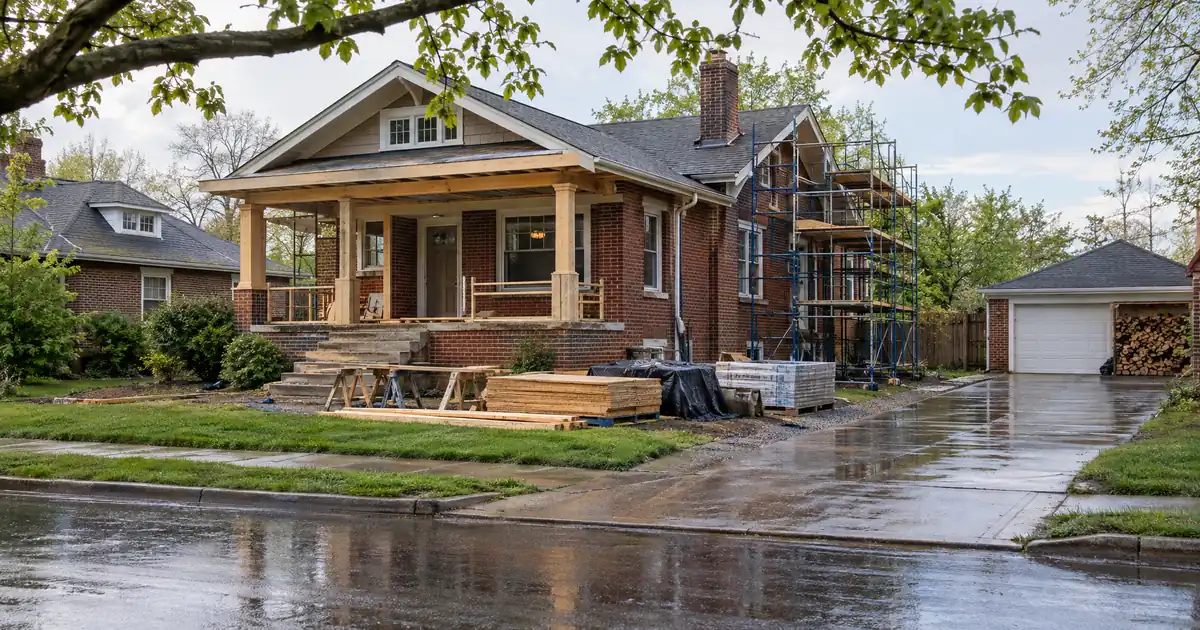
The Quick Read: Hard money is built for investors who need a loan sized on the deal itself (the property, the rehab plan, and the exit), while bank financing is built for borrowers whose income, credit, and a move-in-ready property carry the file. Most flips that need real renovation lean toward hard money, and most turnkey buy-and-hold purchases lean toward a bank. Across Lendmire’s wholesale network, that split shows up on file after file.
- Hard money underwrites the asset and the plan. Banks underwrite you first and the property second.
- Rehab money on a hard money loan is released in draws against completed work. A bank loan typically funds the purchase only.
- Hard money terms are short and interest-only. Bank loans are long and amortizing.
- Both need cash from you. Hard money needs it for the gap and the draw cycle, and a bank needs it for the down payment, the rehab, and reserves.
- Many investors refinance out of hard money into long-term rental financing once the property is stabilized.
Side-by-Side
This table compares Lendmire’s hard money network guidelines with published industry norms for bank financing. Both columns are typical ranges, not promises, and every file is reviewed individually.
What this loan actually costs to carry.
Hard money is sized against the project and priced by time. Enter the deal and see how much the program will lend, the cash required at closing, the carry while you hold it, and what is left at the exit.
Leverage tiers on the current program: 85% with fewer than 2, 90% with 2 or more, 93% with 5 or more completed projects — every tier capped at 75% of after-repair value. Loan amounts up to $5,000,000, larger by exception; terms of 6 to 18 months, interest-only, no prepayment penalty. The rehab portion funds in draws against completed work, not at closing.
Program parameters shown update from Lendmire’s centralized guideline source. Rate, points, and months are editable assumptions, not quoted terms.
Cost cap sets the loan · positive spread
Illustrative estimate only — not a quote, Loan Estimate, approval, or commitment to lend. Rate, points, and months are editable assumptions. Hard money is business-purpose financing for real estate investors, not a consumer mortgage. Leverage on the current program tops out at 93% of project cost for investors with a documented track record, capped at 75% of after-repair value, with rehab funding up to 100% of the documented budget released in draws; actual terms vary by lender, borrower experience, property, and exit. Lendmire is a mortgage broker, not a lender.
| Factor | Hard Money (network guidelines) | Bank Loan (industry norms) |
|---|---|---|
| Review basis | Property, rehab plan, exit | Borrower income, credit, debt |
| Documentation | Contract, scope, budget, entity papers | Traditional personal-income documentation, pay records, bank statements |
| Property condition | Distressed properties can be eligible | Usually needs a habitable property |
| Property types | Non-owner-occupied, 1-4 units | Wide range; condition-dependent |
| Entity vesting | LLC common; guarantor typical | Often favors individual borrowers |
| Rehab funds | Draws against completed work | Typically not included |
| Loan term | 6-18 months, interest-only | Long-term, amortizing |
| Cash expectation | Gap, draw float, reserves | Down payment, rehab, reserves |
Entity vesting on hard money is subject to lender program eligibility. A personal guarantee from the principal is common practice. The sections below explain each row in more detail.
How Each Lender Decides
Hard money lenders decide on the deal. A bank decides on the borrower. That one difference explains almost every other row in the table.
A bank mortgage channel starts with your credit, your income, your debts, and your reserves. The property then has to appraise as livable collateral. SmartAsset describes hard money as a non-conforming, short-term loan from private lenders secured by the property. Corporate Finance Institute adds that these loans usually come from private investors or non-bank financial companies.
On our side of the desk, a hard money file is built from the purchase contract, the scope of work and budget, a valuation, the entity documents, and proof you have the cash to close and carry the project. The lender also wants a clear exit by sale or refinance. “Asset-based” does not mean “no underwriting.” Valuation, budget, and exit all get reviewed, and the lender inspects work before it releases draw money.
A bank file for the same flip hits a wall earlier. A gutted kitchen, a failed roof, or a house with no working systems may not appraise as collateral at all. The bank may be happy with you and still unable to lend on the house.
When Hard Money Is the Better Fit
Hard money is the better fit when the property is the problem, the rehab is the plan, and the hold is short. It fits distressed purchases, heavy renovations, investors buying through an LLC, and borrowers whose income is real but hard to document.
Consider the situations where it tends to win:
- The house is not livable. Condition is the biggest dividing line. Hard money lenders can look past it. Bank collateral rules often cannot.
- The rehab needs funding, not just the purchase. Network programs fund up to 100% of the rehab budget in draws against completed work. That figure applies to the rehab budget, never to the purchase price.
- You are buying through an entity. Hard money lenders are used to LLC borrowers and a guarantor behind them, subject to lender program eligibility.
- Your traditional personal-income documentation does not tell the whole story. A self-employed investor with heavy write-offs can look weak on a bank’s income test and strong on a deal-based test.
Here is how leverage works, as a typical range that varies by lender, property, and experience. Fix-and-flip leverage is sized on project cost and tiered by completed projects:
- 93% of project cost at 5 or more completed projects.
- 90% of project cost at 2 or more completed projects.
- 85% of project cost with fewer than 2 completed projects.
- Every tier is capped at 75% of after-repair value (ARV, the property’s estimated value once renovation is done).
The lender uses whichever limit is lower. A flipper who buys cheap and renovates heavily may hit the 75% ARV cap before the cost percentage. Bridge purchases without a rehab run up to 80% of purchase price, and cash-out or rate-and-term refinances run up to 65% of value. There is no true 100% purchase program, and the top tier is reserved for experienced investors.
Other typical parameters: loan amounts up to $5,000,000 (larger by exception), terms of 6 to 18 months, interest-only, and no prepayment penalty. A 620 credit score is the common minimum, with additional conditions below 660. First-time investors qualify at the lower leverage tiers. Eligible collateral is non-owner-occupied residential property of 1 to 4 units, and ground-up construction can go to 10 units. Final terms depend on the lender’s guidelines, the property type, and the borrower’s complete credit picture.
The network figure for these programs is 6 to 18 months, so plan your schedule around the shorter number.
A first-time flipper picture shows the tradeoff. Say you have never completed a project and buy a dated rental house that needs a full renovation. A bank is unlikely to fund the purchase, so you land in the 85% of project cost tier at most, still capped at 75% of ARV. You bring the rest in cash. You also start each phase of work with your own money and get reimbursed after inspection, so the draw cycle is the part many first-timers underestimate.
The real cost of hard money is not just what the loan charges. It is the carry on a short clock and the cash tied up between draws. If the renovation slips past the term, you face an extension or a forced exit.
When Bank Financing Is the Better Fit
Bank financing is the better fit when the property is in good shape, your personal financials are strong, and you plan to hold for years. A clean purchase with little or no rehab is where a bank loan can make the most sense.
Here is where banks tend to win:
- Move-in-ready buy-and-hold. If the house rents as it stands, you do not need a draw schedule or a short-term loan. A long, amortizing loan gives you runway with no maturity date forcing a decision.
- Strong, documentable income. Borrowers with steady W-2 pay or clean traditional personal-income documentation can use those strengths. Hard money’s asset-based approach does not give them extra credit for that.
- No time pressure. A bank’s process is built around documents and verification. If you are not racing a seller or an auction deadline, that process costs you little.
- Light cosmetic work. Paint, flooring, and fixtures on a livable house do not scare a bank appraiser.
Some investors also pair the two. They use hard money for the heavy-lift purchase and renovation, then move into longer-term financing after the work is done. That is a plan, not a failure of the first loan.
Banks come with their own friction for flippers. Many bank programs have documentation and entity requirements that suit owner-occupants better than investors. They typically do not fund renovation draws, so your own cash carries the whole rehab. Those are published industry norms, and individual banks differ.
Why the Paperwork Looks Different
A flip loan is a business-purpose loan, and that shapes how it is documented. Because these loans are business-purpose investor loans, they are reviewed differently from a standard owner-occupied mortgage. Federal rules exempt credit extended primarily for a business purpose, and credit extended to someone other than a natural person, from the consumer-credit disclosure framework, per the CFPB’s Regulation Z text.
The label “investment property” does not settle the question by itself. The purpose of the loan controls, according to Compliance Alliance. That is why lenders ask for business-purpose documentation and why hard money lenders write their own draw and extension terms. No regulator sets those terms for private lending, so read them closely before you sign.
Key Terms Defined
ARV (after-repair value): The property’s estimated value after renovation is complete.
Loan-to-cost: The loan amount as a percentage of purchase price plus rehab budget.
Draw: A release of rehab money after you finish a phase of work and the lender confirms it.
Interest-only: A payment structure where you pay interest during the term and repay principal at maturity.
Asset-based underwriting: A review that centers on the property, the plan, and the exit more than on personal income.
DSCR (debt service coverage ratio): Monthly rent divided by the property’s monthly PITIA (principal, interest, taxes, insurance, and HOA dues if any).
Seasoning: The waiting period a lender wants between buying a property and refinancing it.
The Exit: Sale or Refinance
Hard money is a short loan, so every file needs an exit before it starts. The two exits are selling the renovated property or refinancing it into longer-term financing.
If you plan to keep the property as a rental, many investors refinance out of hard money into long-term DSCR financing once the property is stabilized, and Lendmire brokers that path. A DSCR loan qualifies primarily on property-level rental income covering the payment, subject to lender guidelines. Most programs want a credit score around 660, and 700 or higher unlocks the strongest leverage tiers. Cash-out refinances top out around 75% LTV on standard rentals across most of the network, and roughly 6 months of seasoning is a common expectation. Reserves vary by lender, leverage, and loan size.
Clearing 1.00 coverage is where many select programs start, and a separate select-lender path takes coverage below 1.00 with leverage and terms adjusted. Coverage is not the same as positive cash flow, because repairs, vacancy, management, utilities, and capital expenses sit outside the calculation. A bigger down payment can lift the ratio, but it does not erase leverage caps, credit floors, or property eligibility. Lendmire’s complete DSCR loans guide walks through those mechanics.
A flip that sells needs no refinance. A flip that turns into a rental needs one lined up before the hard money term ends.
The Balanced Verdict
Neither option is the “safe” one. Each is a tool, and the property decides which tool fits.
Choose hard money when the house needs work, the entity is an LLC, or the deal numbers are stronger than your paperwork. Expect a short term, a draw cycle, and a firm exit. Choose a bank when the property is livable, your personal profile is strong, and you want a long runway. Expect a documentation-heavy file and your own cash for any renovation.
Tax treatment can depend on how the funds are used and how the property is held; investors should keep clear records and speak with a qualified tax professional before relying on any deduction.
If you are buying, rehabbing, or refinancing an investment property on a short timeline and want to see how the numbers work, Lendmire can help you compare hard money options based on the project, the exit plan, leverage, and your goals. The brokerage arranges these loans through select lenders in its wholesale network across 41 markets, including Washington, D.C. Nothing here is a commitment to lend, and every file is underwritten individually.
Frequently Asked Questions
Does hard money skip underwriting?
No. The underwriting is asset-focused rather than income-focused. The lender reviews the valuation, the rehab budget, the exit plan, your liquidity, and the entity documents. Lenders also inspect completed work before releasing draw money.
Can I get 100% financing on a flip with hard money?
No true 100% purchase program exists. Network fix-and-flip leverage tops out at 93% of project cost for investors with 5 or more completed projects, and every tier is capped at 75% of ARV. Up to 100% of the rehab budget can be funded in draws, but that is a rehab-budget figure, not a purchase loan-to-value. Terms vary by lender, property, and experience.
Will a bank lend on a house that needs major work?
Sometimes, but published industry norms suggest banks often prefer habitable collateral. A house with serious condition problems may not appraise or underwrite as acceptable collateral. Light cosmetic work on a livable property is a different story.
What credit score do I need for hard money?
A 620 minimum is common in the network, with additional conditions below 660. First-time investors qualify at the lower leverage tiers, and stronger experience opens the higher tiers. Underwriting stays centered on the property, the plan, and the exit.
What happens if my flip runs past the loan term?
Hard money terms run 6 to 18 months, so a delayed rehab or slow sale creates pressure. Some lenders offer extensions, often with their own conditions, so read the extension terms in the loan agreement. Many investors with a rental-hold plan line up long-term refinancing before the term ends.
About Lendmire
Lendmire (NMLS# 2371349) is a mortgage brokerage built around DSCR investor lending, with programs available in 41 markets, including Washington, D.C. DSCR lenders commonly evaluate rental-income coverage instead of personal income paperwork — a practical fit for LLC-owned and multi-property investors. Terms vary by lender, property, leverage, and program. Scotsman Guide named Lendmire a Top Mortgage Workplace in both 2025 and 2026.
Get Started
Ready to find the right loan for you?
In about 30 seconds you can review financing options available for your investment property. No commitment required.
Informational only. Not a Loan Estimate, approval, or commitment to lend. Program availability and eligibility are subject to lender guidelines, credit approval, property review, and underwriting.
References
1. SmartAsset, Hard Money Loans
2. Corporate Finance Institute, Hard Money Loan
4. Compliance Alliance, Regulation Z and Investment Properties
This article is part of Lendmire’s hard money loan program — full qualification details, guidelines, and scenarios live on the program page.
Related reading: Can Hard Money Cover a Fix and Flip Purchase? · Can You Have More Than One Fix and Flip Hard Money Loan at Once? · Can a 1099 Contractor Get a Hard Money Loan to Flip a House?
Brandon Miller
Founder & CEO, Mortgage Loan Originator, Lendmire LLC
- Mortgage Loan Originator · NMLS# 1129696 · Verify on NMLS Consumer Access
- North Carolina Real Estate Broker · License# 343312 · Verify on NCREC
- North Carolina Insurance Producer · License# 19053198 · Property, Casualty, Life, Health · Verify on NAIC SBS
- Lendmire LLC · Firm NMLS# 2371349 · Verify firm licensure
Important disclosures. Lendmire (NMLS# 2371349) is a licensed mortgage brokerage. Lendmire is not a direct lender, depository institution, or financial advisor. All loan inquiries are subject to lender underwriting; this article does not constitute a commitment to lend. Rates, terms, and program guidelines are subject to change without notice and vary by borrower profile, property type, and state. Information in this article is general in nature and is not financial, legal, or tax advice. Equal Housing Opportunity. NMLS Consumer Access: nmlsconsumeraccess.org.